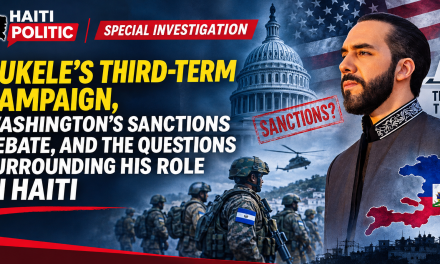
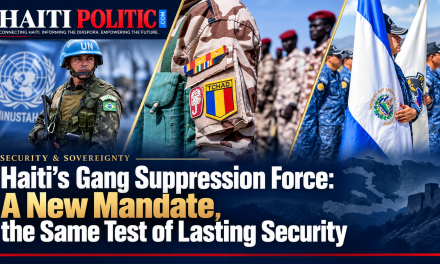
On November 2, 2026, the United Nations addressed two politically sensitive developments in Haiti: reports that most newly deployed Salvadoran military personnel operate outside the Gang Suppression Force framework, and a letter from Wilson Joseph, leader of the 400 Mawozo armed group, requesting international mediation. The UN’s response clarifies some boundaries of its mandate while leaving critical questions about military command, civilian protection, Haitian sovereignty and accountability unanswered.
HAITI POLITIC — November 3, 2026
A Statement That Raises More Questions Than It Answers
The United Nations issued a statement on November 2, 2026, addressing reports of additional Salvadoran military personnel operating in Haiti and a letter bearing the signature of Wilson Joseph, known as Lanmò San Jou, associated with the 400 Mawozo armed group.
The two issues are connected by a larger question: Who has the authority to determine how Haiti’s security crisis will be resolved?
According to the UN statement provided to Haiti Politic, the organization acknowledged reports of additional Salvadoran military deployments but said the vast majority of those personnel were not deployed under the Gang Suppression Force (GSF).
The statement reads:
“The vast majority of those are not deployed under the Gang Suppression Force (GSF) and, therefore, fall outside of the scope of the UN Support Office’s mandate and reporting.”
This is the most consequential passage in the UN’s response.
It establishes a distinction between Salvadoran personnel operating within the GSF framework and those reportedly deployed through other arrangements.
However, it does not establish that the personnel operating outside the GSF are acting unlawfully. Nor does it explain the legal basis for their deployment.
Those questions remain unanswered.
1. Salvadoran Troops Outside the GSF: Who Authorized Them?
The Gang Suppression Force was established as part of international efforts to support Haiti’s security institutions against heavily armed criminal organizations.
Yet the November 2 statement indicates that most additional Salvadoran personnel are not covered by the GSF framework.
That distinction matters because military deployments require identifiable legal authority, operational command arrangements and mechanisms for accountability.
The UN statement does not specify:
- Which Haitian authority approved the additional deployment.
- Whether Haiti and El Salvador signed a bilateral military agreement.
- Who exercises operational command over the personnel outside the GSF.
- Which rules govern their use of force.
- Who investigates allegations of civilian casualties or misconduct.
- Whether these operations receive financial or logistical support from third parties.
The UN’s statement that these personnel fall outside its support office’s mandate does not necessarily mean they operate without oversight. It means the UN support office is not the institution responsible for reporting on most of them under that mandate.
The next question is therefore straightforward: If the UN support office is not responsible for reporting on these soldiers, which institution is?
2. A Gang Leader Writes to António Guterres
The second development concerns a letter dated November 1, 2026, bearing the name and signature of Wilson Joseph.
The document identifies him as the leader of Gwoup Rebèl 400 Mawozo and requests international mediation.
In the letter, Joseph claims that he raised a white flag on August 20, 2026, and expressed willingness to participate in dialogue concerning Haiti’s security crisis.
He also alleges that recent military operations in the Plaine du Cul-de-Sac have endangered civilians, including women and children.
The letter specifically refers to operations involving Salvadoran personnel and describes an alleged incident in which a child narrowly escaped being struck by a bullet.
These are serious allegations, but the letter does not provide independently verified casualty records or evidence establishing responsibility for the incidents described.
Joseph asks the UN Secretary-General to send a delegation to facilitate dialogue and mediation among the parties concerned.
He also states that he is available to participate in meetings aimed at a peaceful settlement.
The significance of the letter lies not in whether its author should be granted political legitimacy, but in the fact that an armed-group leader is attempting to use an international diplomatic channel to influence the course of security operations.
3. What the United Nations Actually Said About Wilson Joseph
The UN’s response was carefully worded.
Spokesperson Stéphane Dujarric confirmed that the organization had received a letter bearing Wilson Joseph’s signature.
But the spokesperson explicitly distinguished receipt from recognition.
The UN stated that receiving the letter did not constitute endorsement of its contents, recognition of its author or adoption of a UN position.
This distinction is essential.
The United Nations acknowledged receiving the communication. It did not recognize 400 Mawozo as a legitimate negotiating authority.
Nor did the statement announce that mediation would begin.
Instead, the UN reiterated the importance of protecting civilians, respecting international law and pursuing peaceful solutions.
The wording leaves open whether the organization will take any further action.
4. Can the UN Mediate With an Armed Group?
The question of mediation is more complicated than simply accepting or rejecting a letter.
International organizations sometimes engage with non-state armed actors for limited humanitarian purposes, including securing civilian evacuations, facilitating hostage releases or obtaining access to populations in danger.
Such engagement does not necessarily constitute political recognition.
However, there is a fundamental difference between humanitarian contact and granting an armed organization a formal role in determining a country’s political future.
For Haiti, any mediation proposal would have to confront difficult questions.
Would the process require disarmament?
Would participants be required to release hostages and cease attacks against civilians?
How would victims obtain justice?
Could dialogue proceed without granting immunity for serious crimes?
Would Haitian authorities lead the process?
And would communities directly affected by armed violence have meaningful representation?
A peace process that excludes victims risks becoming a negotiation over power rather than a process for restoring justice.
5. The October 28 Warning From UNA-Haiti
The November 2 developments followed an October 28 open letter from the United Nations Association–Haiti (UNA-Haiti), signed by founder Harvey Dupiton.
The organization condemned reported Salvadoran military operations and called for an independent investigation into allegations of civilian deaths.
Its letter alleged that aerial bombardments, helicopter attacks and heavy-weapons operations had occurred in civilian neighborhoods, including Croix-des-Bouquets, Canaan and the Plaine du Cul-de-Sac.
UNA-Haiti called for an immediate halt to offensive bombing operations, an independent investigation and clarification from the Security Council regarding the legal authority for Salvadoran military action.
The organization also requested greater participation by Haitian civil society and diaspora organizations in discussions about Haiti’s future.
These allegations require independent verification. The supplied correspondence does not establish that the reported bombardments occurred as described, identify confirmed civilian casualties or prove that Salvadoran forces violated international humanitarian law.
Nevertheless, the letter raises legitimate questions about civilian protection and the legal basis of foreign military operations.
UNA-Haiti’s document also explicitly acknowledges that it does not hold a UN mandate or speak for every Haitian.
That clarification matters: UNA-Haiti is a civil-society organization, not the United Nations itself.
6. Two Letters, Two Very Different Appeals
Although UNA-Haiti and Wilson Joseph both requested international attention, their letters must not be treated as equivalent.
UNA-Haiti’s appeal came from a civil-society organization seeking investigation, accountability and participation.
Joseph’s appeal came from an individual identifying himself as the leader of an armed organization.
Both documents raise questions about civilian protection, but their authors occupy fundamentally different positions in Haiti’s security crisis.
The UN’s responsibility is not to treat every correspondent as an equally legitimate political representative.
Its responsibility is to apply consistent legal and humanitarian standards while recognizing the difference between civilian advocacy and the interests of armed actors.
7. The UN’s Human Rights Warning
The November 2 statement also emphasized that security operations in Haiti must comply with applicable international law, including human rights law and international humanitarian law.
This is significant because it extends the principle of accountability beyond the GSF.
The UN’s position, as presented in the supplied statement, is that operations conducted by Haitian authorities and their partners must respect applicable legal obligations regardless of whether they operate within the GSF framework.
That principle is important.
But the UN did not identify which institution would investigate alleged violations involving Salvadoran personnel outside its support office’s reporting mandate.
Nor did it describe a complaint mechanism accessible to Haitian civilians.
For families living in areas affected by military operations, those omissions are consequential.
A statement about human rights has limited practical value unless civilians know where to report violations, who will investigate them and what remedies are available.
8. The Missing Chain of Command
The most important unresolved issue may be the command structure governing the additional Salvadoran deployment.
If the personnel are outside the GSF, several possibilities exist.
They could be operating under a separate bilateral arrangement with Haitian authorities.
They could be supporting Haitian security institutions through a different operational structure.
Or they could be deployed under arrangements not explained in the UN statement.
The documents supplied do not establish which explanation is correct.
That uncertainty should not be filled with speculation.
Instead, Haiti’s authorities and El Salvador should publicly identify the applicable legal framework, command relationships and accountability procedures, subject to legitimate operational-security restrictions.
The distinction between operational secrecy and institutional secrecy is important.
Military authorities may reasonably withhold tactical information that could endanger personnel or civilians.
But the basic legal authority for a foreign military deployment is a matter of public accountability.
9. Who Controls Territory After Military Operations?
The military campaign also raises a longer-term governance question.
Removing an armed group from a neighborhood does not automatically restore functioning public institutions.
Communities need police protection, courts, property-rights safeguards, public services and the ability of displaced residents to return safely.
This is especially important in areas where armed groups have controlled roads, neighborhoods and economic activity.
Once territory is recovered, who administers it?
Who protects displaced homeowners?
Who verifies competing land claims?
Who prevents new armed groups from occupying the same areas?
And what role will Haitian civilian authorities play in rebuilding local governance?
The supplied UN statements do not answer these questions.
Nor do they establish that Salvadoran operations are intended to benefit particular landowners or private commercial interests.
Such allegations would require property records, deployment information, financial documentation and other independent evidence.
Nevertheless, transparent administration of recovered territory is essential to preventing renewed violence and displacement.
10. What the UN Statement Does — and Does Not — Establish
The November 2 statement provides three important clarifications.
First, the UN acknowledges reports that most additional Salvadoran personnel are operating outside the GSF framework.
Second, it distinguishes those personnel from forces covered by the UN Support Office’s mandate and reporting.
Third, it confirms receipt of Wilson Joseph’s letter without endorsing its contents or recognizing its author.
The statement does not establish that Salvadoran troops entered Haiti illegally.
It does not independently verify allegations of indiscriminate bombardment.
It does not announce negotiations with 400 Mawozo.
And it does not explain the full legal and operational arrangements governing Salvadoran personnel outside the GSF.
Those distinctions are essential to an accurate assessment of the UN’s response.
11. Ten Questions Haiti Deserves Answered
The developments warrant direct questions to the Haitian government, El Salvador and the United Nations.
1. What legal agreement authorizes the additional Salvadoran military personnel operating outside the GSF?
2. Which Haitian authority approved their deployment, and when?
3. Who exercises operational command over these personnel?
4. What rules govern the use of force, detention, searches and interactions with civilians?
5. Which institution investigates allegations of civilian casualties involving Salvadoran forces?
6. Are the additional Salvadoran operations funded by El Salvador, Haiti or other international partners?
7. What procedures exist for journalists and civilians to report interference, intimidation or misconduct?
8. Will the UN independently assess the allegations raised in UNA-Haiti’s October 28 letter?
9. Does the UN intend to respond further to Wilson Joseph’s mediation request, and what conditions would govern any humanitarian contact?
10. What is the plan for transferring recovered territory to accountable Haitian civilian institutions and enabling displaced residents to return safely?
Conclusion: Acknowledgment Is Not Accountability
The November 2 UN statement is notable because it publicly distinguishes most additional Salvadoran personnel from the GSF framework.
That distinction creates a clear need for further explanation.
It does not, by itself, establish misconduct or illegality.
But it raises questions that cannot be resolved simply by invoking international cooperation.
Haitian citizens deserve to know who authorizes foreign military operations, who commands participating forces, how civilians are protected and who is accountable when something goes wrong.
The letter from Wilson Joseph adds another challenge: whether humanitarian dialogue can protect civilians without legitimizing armed violence or undermining justice for victims.
Meanwhile, UNA-Haiti’s appeal underscores the demand for independent investigation and greater Haitian participation in decisions about national security.
The central issue is not whether Haiti needs help confronting armed violence. It is whether that assistance operates within a transparent legal framework that protects civilians, respects Haitian sovereignty and strengthens accountable Haitian institutions.
The United Nations has clarified where its support office’s mandate ends.
Haiti still needs to know where responsibility begins.
HAITI POLITIC | Investigative Analysis
Source note: This analysis is based on the November 2, 2026 UN statements reproduced in the supplied screenshots; the November 1 letter bearing Wilson Joseph’s signature; and UNA-Haiti’s October 28 open letter. The underlying allegations concerning civilian casualties and military operations have not been independently verified in this analysis. The UN statements should be checked against their original publication before the article is released as a fully verified news report.