
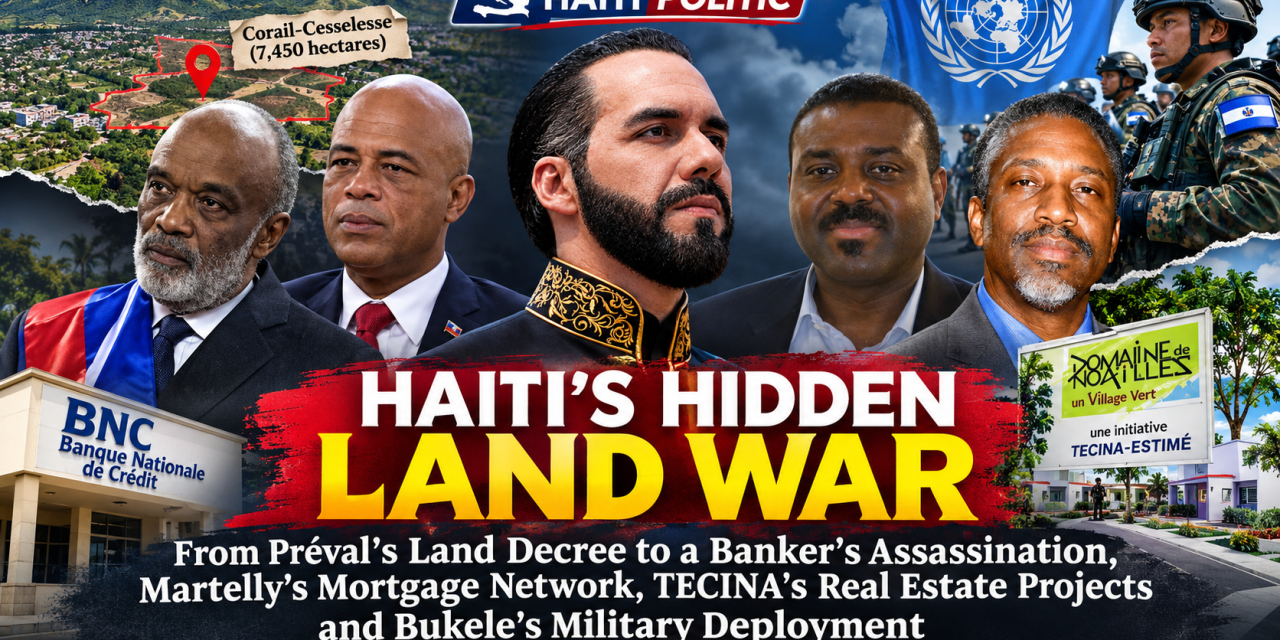
From Préval’s Land Decree to a Banker’s Assassination, Martelly’s Mortgage Network, TECINA’s Real Estate Projects and Bukele’s Military Deployment
HAITI POLITIC | SPECIAL INVESTIGATION
Who owns the land, who finances the property, who controls the territory—and who benefits when foreign soldiers restore security?
November 2, 2026
INTRODUCTION: THE QUESTION BEHIND HAITI’S SECURITY CRISIS
Haiti’s security crisis is generally described as a confrontation between armed gangs, the Haitian National Police, a weakened government and foreign security forces.
But there is another dimension that deserves investigation: land ownership.
In Haiti, control over territory can determine who collects revenue, who occupies valuable property, who develops housing and who exercises political authority.
This raises a question that cannot be answered by military operations alone:
When armed groups lose control of territory, who receives that territory back?
The Haitian state? Displaced homeowners? Private developers? Or individuals whose property claims have remained unresolved for decades?
Our investigation examines several historical developments that intersect geographically, institutionally or economically: the Corail-Cesselesse land dispute, NABATEC’s proposed development, TECINA-associated housing projects, the Banque Nationale de Crédit’s mortgage program, the Kenya-led international security mission and President Nayib Bukele’s subsequent deployment of Salvadoran soldiers.
These connections deserve scrutiny. They do not, by themselves, establish a coordinated conspiracy.
PART I — PRÉVAL’S LAND DECREE AND THE BATTLE FOR CORAIL-CESSELESSE
The 2010 earthquake changed Haiti’s real estate landscape
Following the devastating January 12, 2010 earthquake, President René Préval’s government confronted an urgent humanitarian challenge: hundreds of thousands of displaced residents needed shelter.
On March 19, 2010, the government declared approximately 7,450 hectares of land in the area between Bon Repos and Cabaret to be of public utility.
The designated area included territory associated with Corail-Cesselesse and the expanding settlements around Canaan.
The decision was intended to facilitate reconstruction and resettlement.
However, it also created significant questions concerning land titles, compensation, government authority and the rights of private owners.
The area’s property disputes had deeper historical roots, including an earlier public-utility declaration dating to the Duvalier era.
NABATEC and the proposed Habitat Haïti 2020 development
Before the earthquake, NABATEC S.A., associated with businessman Gérald-Émile Brun, had promoted an ambitious development concept known as Habitat Haïti 2020.
The proposal envisioned an integrated economic zone combining residential neighborhoods, commercial facilities, industry, infrastructure and public services.
The proposed development was reportedly valued at approximately $2 billion over a multiyear implementation period.
That figure represented a proposed development value, not verified investment expenditure.
After the 2010 declaration, NABATEC’s claimed property interests became entangled with government reconstruction policies and the occupation of land by displaced residents.
A subsequent economic-zone assessment identified unresolved ownership and compensation questions involving NABATEC and other landholders.
The reported $64 million compensation claim
By 2013, NABATEC was reportedly seeking approximately $64 million in compensation related to land affected by government actions and occupation.
The amount was reported as a claim by the developer.
Our investigation has not established that the Haitian government paid NABATEC $64 million.
Nor have we established the final judicial or administrative disposition of the claim.
These distinctions matter.
A compensation demand is not evidence of a government payment. A proposed development is not proof that financing was secured.
Nevertheless, the historical record establishes that the Haitian state and private development interests had conflicting claims involving strategically located land.
PART II — GÉRALD-ÉMILE BRUN, NABATEC AND TECINA
Gérald-Émile Brun’s professional associations provide an important link between the earlier Corail-Cesselesse development proposals and the broader Haitian real estate industry.
Brun has been identified with NABATEC and with TECINA S.A., a company involved in architecture, engineering and urban planning.
This establishes a professional relationship across the companies.
It does not establish that NABATEC and TECINA are legally the same business, share every asset or jointly own the disputed Corail land.
That distinction becomes especially important when examining a later TECINA-associated development.
PART III — THE 2019 DISCOVERY: DOMAINE DE NOAILLES, TECINA–ESTIMÉ AND KAYXPERT
A residential project in Croix-des-Bouquets
New promotional materials obtained by Haiti Politic identify a residential project called Le Domaine de Noailles, advertised in Croix-des-Bouquets.
A Facebook post dated April 22, 2019, described the project as an initiative promoted by the TECINA/ESTIMÉ team.
According to the advertisement, the development proposed:
-
75 single-family homes.
-
Approximately 8.6 acres of land.
-
Green spaces and children’s recreational facilities.
-
Housing intended for middle-class buyers.
-
A location within Village Noailles, known for its artistic and metalworking heritage.
The advertisement described the project as being approximately 15 minutes from the airport in Tabarre.
These were promotional representations. We have not independently established how many houses were constructed, sold or delivered.
The October 2019 Miami presentation
A second promotional document advertised a presentation on October 4, 2019, at the Citadel in Little Haiti, Miami.
Its message encouraged prospective buyers to own a home in Haiti and eventually retire there.
The flyer explicitly identified the development as:
“Une initiative TECINA-ESTIMÉ.”
It also listed the contact address:
This establishes a documented marketing connection between the Domaine de Noailles project and KayXpert.
It does not establish that KayXpert owned the land or financed the construction.
The USAID Haiti logo
The same promotional flyer included the statement:
“An event supported by USAID | HAITI.”
That detail introduces a new investigative question.
What was USAID’s actual involvement?
Did the agency support the event itself, a diaspora investment initiative, a housing-sector program or some other activity?
The promotional flyer does not establish that USAID financed Domaine de Noailles, purchased land, guaranteed mortgages or invested in TECINA.
The underlying agreement would be necessary to determine the scope of support.
Why Croix-des-Bouquets matters
Domaine de Noailles was marketed in Croix-des-Bouquets, an area subsequently affected by extensive armed-group activity.
The earlier NABATEC development interests were associated with the broader Corail-Cesselesse region.
The geographic proximity makes it reasonable to examine both projects within a larger investigation of land ownership and development.
But proximity is not proof that the properties share an owner, lender or legal history.
The next decisive evidence would be the registered title and cadastral identification for Domaine de Noailles’s advertised 8.6-acre parcel.
Those records could help determine whether its ownership intersects with NABATEC, TECINA or other development companies.
PART IV — THE BANKER WHO WAS KILLED BEFORE THE MORTGAGE PROGRAM LAUNCHED
Guiteau Toussaint and the Banque Nationale de Crédit
The history of Haiti’s housing finance sector introduces another important figure: Guiteau Toussaint.
Toussaint served as president of the Banque Nationale de Crédit, commonly known as BNC.
He was associated with the bank’s modernization and its efforts to expand access to financial services.
One of the institution’s initiatives was Kay Pa’m, a mortgage program intended to help eligible Haitians purchase or construct homes.
June 12, 2011: Toussaint is assassinated
On June 12, 2011, Toussaint was killed during a reported armed intrusion at his residence.
The mortgage initiative had been scheduled for launch shortly afterward.
Its official launch ultimately took place on July 19, 2011, during Michel Martelly’s presidency.
The timing raises understandable questions about the investigation into Toussaint’s killing.
However, there is no verified evidence in the materials examined that his assassination was connected to Kay Pa’m, NABATEC, TECINA or a real estate dispute.
The murder must not be presented as evidence of a property-financing conspiracy without supporting investigative records.
The relevant questions are whether the criminal investigation identified the perpetrators, established a motive and resulted in prosecutions.
PART V — MARTELLY, JEAN-PHILIPPE VIXAMAR AND THE MORTGAGE NETWORK
Following Toussaint’s death, Jean-Philippe Vixamar succeeded him as president of BNC’s board.
Vixamar had previously served on the bank’s board and was appointed to the leadership position during President Michel Martelly’s administration.
BNC’s Kay Pa’m program was publicly associated with an initially announced lending envelope of approximately $100 million.
That figure should not be confused with the amount of mortgages actually approved or disbursed.
The missing financial link
Three separate financial matters appear in this investigation:
NABATEC’s proposed $2 billion development.
NABATEC’s reported $64 million compensation claim.
BNC’s announced $100 million mortgage initiative.
They are not evidence of a single financing arrangement.
We have not established that BNC financed NABATEC or TECINA, that Vixamar personally invested in their developments, or that Kay Pa’m funds were used to acquire disputed Corail land.
The appropriate investigative approach is to examine corporate filings, recorded mortgages, bank disclosures and legally obtainable transaction records.
PART VI — THE KENYA-LED SECURITY MISSION: WHY DID IT FAIL TO REVERSE GANG EXPANSION?
From international support to operational frustration
In June 2024, Kenya began deploying personnel to Haiti as part of the Multinational Security Support mission.
The mission was designed to assist the Haitian National Police in confronting armed groups and restoring security.
However, the mission faced major operational limitations.
Its personnel strength remained below its authorized ceiling.
Funding and equipment were insufficient.
Logistical support, mobility and operational capabilities were constrained.
Meanwhile, armed groups continued to control or contest substantial areas.
The Kenyan contingent conducted operations and supported Haitian police, so it would be inaccurate to claim that it accomplished absolutely nothing.
But its deployment did not produce the sustained nationwide security improvements that Haitians urgently needed.
The deeper problem
Even successful security operations cannot produce lasting stability if recovered neighborhoods remain without functioning police stations, courts, public administration and basic services.
This is particularly relevant in areas where property records are disputed or residents have been forcibly displaced.
A security operation may remove an armed group.
It does not automatically establish who legally owns the land.
PART VII — THE GANG SUPPRESSION FORCE: A NEW MANDATE, AN OLD ACCOUNTABILITY PROBLEM
The Gang Suppression Force was designed to replace the limitations of the earlier Kenya-led mission.
Its mandate provided for a larger and more operationally capable international force.
The GSF was intended to conduct coordinated operations against armed groups while supporting the Haitian authorities.
It also introduced formal command and oversight arrangements.
This creates an important distinction between the GSF and an individual country deploying troops under its own national military leadership.
If a foreign contingent operates within the GSF, its relationship to the force commander and established operational rules should be identifiable.
If it operates separately, the legal basis for that separate operation becomes a critical question.
PART VIII — BUKELE’S DEPLOYMENT: WHO COMMANDS THE SALVADORAN SOLDIERS?
The October 2026 ambush
Following an October 18, 2026 incident involving four missing Salvadoran personnel in the Croix-des-Bouquets area, President Nayib Bukele announced additional military operations in Haiti.
Contemporary reporting described a rapid increase in Salvadoran troop deployments.
The publicly stated immediate objective was the recovery of missing personnel.
However, the reported size of the deployment raised questions about whether the operation would remain limited to that objective.
Why deploy additional soldiers when the GSF already exists?
Several possible explanations require examination.
One is that Salvadoran authorities wanted direct operational control over efforts to recover their missing personnel.
Another is that a nationally directed operation could allow faster military decision-making.
A third possibility is that Salvadoran commanders intended to employ tactics different from those used by the multinational force.
A fourth is that the deployment could develop into a longer-term Salvadoran security commitment.
These are possible explanations, not established findings about Bukele’s motives.
The unresolved chain-of-command question
The most important question is whether the additional Salvadoran troops were formally integrated into the GSF’s command structure.
If they were, the public should be able to identify the commander exercising operational control.
If they were not, Haitian authorities should explain the separate legal authorization and command arrangements.
An independent Salvadoran operation cannot be inferred solely from the nationality or number of soldiers deployed.
A national military contingent can retain administrative responsibilities while operating under multinational operational command.
The distinction must be established through actual command orders and agreements.
Ten questions for the Haitian government, GSF and Salvadoran authorities
-
Who exercises operational control over the additional Salvadoran soldiers?
-
Did Haiti authorize their deployment through a separate bilateral agreement?
-
Did the GSF leadership formally request the reinforcements?
-
Are Salvadoran units subject to GSF operational orders?
-
Who approved their rules of engagement?
-
What geographic limits apply to their operations?
-
What conditions would trigger their withdrawal?
-
Who investigates allegations of civilian casualties?
-
What is the division of responsibility between Salvadoran troops and the Haitian National Police?
-
Who administers territory after armed groups are removed?
Until these questions are answered, the public cannot fully evaluate the operation’s accountability arrangements.
PART IX — IS THE UN PROTECTING HAITI’S GOVERNMENT OR HAITI’S PEOPLE?
The United Nations’ role in Haiti includes supporting state institutions, security, political stability, human rights and civilian protection.
That mandate is not equivalent to protecting a particular administration from criticism or guaranteeing the commercial interests of private developers.
The distinction matters because Haiti’s government has historically been involved in land disputes with private parties.
International security support should not become an informal mechanism for deciding those disputes.
The Corail-Cesselesse test
Suppose foreign-supported security operations recover an area containing disputed property.
What happens next?
Does the Haitian state regain control?
Are displaced families allowed to return?
Do private developers resume projects?
Are compensation claims resolved?
Are property titles examined by independent courts?
The answers depend on Haitian law, the relevant ownership records and the actions of public authorities—not simply on which military force controls the area.
Security operations must not substitute for lawful property adjudication.
PART X — IS BUKELE FIGHTING FOR NABATEC OR TECINA?
This is the most consequential hypothesis raised by the geographic overlap between historical real estate projects and current security operations.
The available evidence establishes several separate facts.
NABATEC pursued development interests in the Corail-Cesselesse area.
Gérald-Émile Brun was professionally associated with NABATEC and TECINA.
TECINA/ESTIMÉ promoted Domaine de Noailles in Croix-des-Bouquets in 2019.
The development’s Miami promotional event listed KayXpert as a contact and advertised USAID Haiti support.
Salvadoran military operations have been reported in the broader Croix-des-Bouquets region.
What the evidence does not establish is that NABATEC or TECINA requested, financed, directed or influenced Bukele’s deployment.
Nor does it establish that the Salvadoran military is attempting to transfer land to either company.
Three competing explanations
Hypothesis One: Public-security operations.
Salvadoran troops are operating to confront armed groups, recover missing personnel and assist in restoring security.
Under this explanation, private property owners may benefit indirectly, but they are not the mission’s sponsors.
Hypothesis Two: Incidental economic benefits.
Military operations restore access to commercially valuable territory.
Existing landowners, developers and businesses may consequently regain the ability to use their properties.
This would establish an economic consequence, not necessarily an improper motive.
Hypothesis Three: Private influence over security priorities.
Specific private interests influence the selection of operational areas or the disposition of recovered property.
This would require evidence such as communications, agreements, payments, documented requests or operational decisions connecting those interests to the mission.
The third hypothesis remains unsubstantiated by the evidence currently available.
PART XI — THE USAID QUESTION
The Domaine de Noailles flyer introduces USAID into the investigation, but only within a clearly defined evidentiary limit.
The document advertised USAID Haiti support for a 2019 presentation.
It did not disclose the relevant grant, contract, budget or partnership terms.
USAID has historically operated across multiple Haitian development sectors.
That broad presence is not, by itself, evidence of involvement in the Corail-Cesselesse property dispute or Salvadoran military decisions.
The next investigative step should be to identify the program under which the 2019 event received support, if any, and establish precisely what the support covered.
Questions include whether the support was financial or nonfinancial, who received it, and whether it extended beyond the presentation.
PART XII — FOLLOW THE LAND, THE MONEY AND THE COMMAND ORDERS
The investigation now has three distinct documentary tracks.
Follow the land
Identify the registered owners and precise locations of the parcels associated with NABATEC, Habitat Haïti 2020 and Domaine de Noailles.
Determine whether any parcels overlap with land affected by the 2010 public-utility declaration.
Establish whether residents were displaced and whether compensation or ownership disputes remain unresolved.
Follow the money
Examine the disposition of NABATEC’s reported $64 million claim.
Identify the actual financing arrangements for TECINA-associated developments.
Determine the documented scope of USAID’s advertised support for the 2019 presentation.
Investigate whether any publicly available mortgage records identify BNC financing for the relevant parcels.
Follow the military command
Obtain the legal authorization for the Salvadoran deployment.
Identify the operational command arrangements.
Determine the authorized geographic scope of the operations.
Examine the safeguards for civilians and displaced property owners.
Establish who is responsible for administering recovered neighborhoods.
These three documentary trails must be investigated independently before any causal connection can be established.
CONCLUSION — THE QUESTION THAT WILL REMAIN AFTER THE SOLDIERS LEAVE
Haiti’s security crisis cannot be understood solely through the number of gangs, police officers or foreign soldiers operating on its territory.
Land ownership, forced displacement, economic opportunity, weak institutions and unresolved property disputes also shape the country’s future.
The Corail-Cesselesse dispute demonstrates how reconstruction policy can collide with private ownership claims.
The NABATEC and TECINA histories show that private development interests existed in areas subsequently affected by insecurity.
The Domaine de Noailles materials document a TECINA/ESTIMÉ housing initiative marketed to the Haitian diaspora, with KayXpert serving as a promotional contact and a flyer advertising USAID Haiti support.
The BNC story raises separate questions about housing finance and institutional continuity following Guiteau Toussaint’s assassination.
The Kenya-led mission illustrates the limitations of international security support without adequate resources and functioning Haitian institutions.
And Bukele’s deployment raises urgent questions about command authority, legal authorization and civilian accountability.
These are connected subjects for investigation, but they are not proof of a single coordinated operation.
The decisive issue is what happens when foreign forces recover territory.
Will displaced families regain their homes?
Will disputed ownership claims be resolved lawfully?
Will private developers be subject to the same rules as ordinary citizens?
Will Haiti’s institutions exercise meaningful authority over security operations conducted on Haitian soil?
And will the public be allowed to examine the agreements governing those operations?
HAITI POLITIC’S CENTRAL QUESTION:
WHO CONTROLS HAITI’S LAND AFTER THE GANGS ARE GONE—AND WHO HAS THE AUTHORITY TO DECIDE?
Until the property records, financial arrangements and military command agreements are made available, that question remains unanswered.
Haiti Politic — Investigative Analysis
Editorial evidence note: This article distinguishes historical reporting, the 2019 promotional materials supplied to Haiti Politic, reported October 2026 developments and investigative hypotheses. Promotional claims are not treated as proof of completed construction, financing or property ownership. Allegations of connections between private developers, armed groups and foreign military operations remain unverified.
Principal documentary references: Haiti Grassroots Watch’s 2013 Corail-Cesselesse investigation; Integrated Economic Zones in Haiti: Site Assessment; BNC annual reports and Kay Pa’m program materials; the April 22 and October 1, 2019 Domaine de Noailles Facebook posts; the October 4, 2019 TECINA–ESTIMÉ promotional flyer; UN Security Council Resolution 2793 (2025); and contemporary reporting on the Kenya-led mission and Salvadoran deployment.