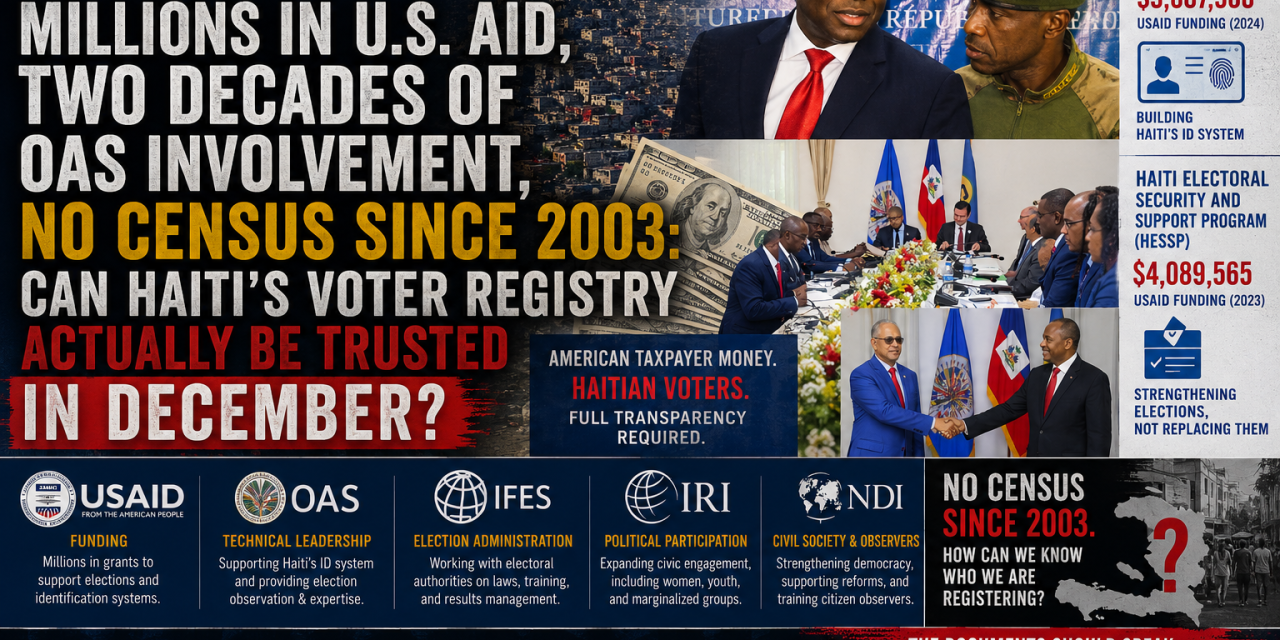
USAID, OAS, IFES, IRI, NDI. Four acronyms, tens of millions of dollars, and one basic unanswered question: does anyone actually know how many Haitians there are to register?
📌 THE HEADLINE
Haiti is racing toward its first national elections in a decade — a first-round vote, legislative races, and a constitutional referendum all set for December 13, 2026. Behind that date sits a dense, multi-decade infrastructure of American and international support: USAID funding, an Organization of American States (OAS) identification program running since 2005, and a U.S.-backed democracy consortium — CEPPS — that has trained Haiti’s electoral council for years. Millions of dollars have flowed through this system. The question this piece digs into: does any of it add up to an electoral system Haitians can actually trust?
🔍 THE MONEY AND THE PLAYERS
USAID and the OAS National ID Program. U.S. government foreign assistance data shows USAID obligated $3,087,500 in Fiscal Year 2024 to the “OAS/PADF – Haiti National ID Card Program,” implemented by the Organization of American States, with an activity end date of June 4, 2026. That funding sits inside a much larger, longer-running effort: the OAS has supported Haiti’s national identification system since 2005, helping establish the National Identification Office (ONI) and its 141 registration offices, managing its database, and updating the electoral roll across five previous elections.
Separately — and importantly, not the same funding stream as USAID’s — the Government of Japan has been the OAS’s largest identification-program donor: an $8 million grant launched in 2023 that the OAS says registered more than 1.07 million new citizens, bringing Haiti’s total ID database to roughly 6.55 million people, with 1.22 million physical ID cards delivered and about 5.8 million Haitians now holding a valid biometric card. On August 18, 2026, Japan and the OAS signed a new $3 million agreement — announced during a visit by OAS Secretary General Albert Ramdin to meet Prime Minister Alix Didier Fils-Aimé — specifically to fund 350,000 additional blank biometric ID cards, prioritizing mobile units for remote areas and the estimated 1.4 million internally displaced Haitians who lost their identity documents fleeing gang violence.
USAID and CEPPS. Separately from the ID program, USAID has funded Haiti’s broader electoral institution-building through the Consortium for Elections and Political Process Strengthening (CEPPS) — a joint venture of three Washington-based democracy organizations: the International Foundation for Electoral Systems (IFES), the International Republican Institute (IRI), and the National Democratic Institute (NDI). Federal procurement records show a $16.6 million cooperative agreement (No. 72052123LA00001) awarded to CEPPS by the U.S. Mission to Haiti in May 2023 for the Haiti Electoral Security and Support Program (HESSP) — funding activities the OAS/PADF summary confirms fall under “Political Competition and Consensus-Building.” IFES has separately run its own Haiti Elections Program (HEP), providing direct technical assistance to Haiti’s Provisional Electoral Council (CEP), while NDI has historically supported Haitian domestic election observation efforts.
Both programs — the ID system and CEPPS’s electoral support work — report up through USAID and are tied to the same underlying goal: a credible December 2026 vote.
🏛️ WHAT THE OAS ACTUALLY DOES DURING HAITIAN ELECTIONS
The OAS’s role in Haiti isn’t limited to identification cards. Since the 1990s, the organization has combined technical electoral assistance — training poll workers, supporting the CEP’s institutional capacity, and helping manage the voter database — with election observation missions that deploy internationally during the vote itself to assess whether balloting meets democratic standards. The OAS frames this work as capacity-building and neutral technical support; critics both inside and outside Haiti have long argued that repeated foreign stewardship of the same electoral infrastructure, across two decades and numerous failed or delayed election cycles, raises a harder question — whether technical assistance has become a substitute for durable Haitian institutional ownership, rather than a bridge toward it.
📊 WHY CENSUS DATA IS THE ELEPHANT IN THE ROOM
Here is the fact that underlies almost every other question in this piece: Haiti’s last full national census was conducted in 2003. A fifth General Census of Population and Housing was formally launched in December 2017 with UNFPA technical support and World Bank and Inter-American Development Bank financing — but as of the most recent public reporting, it remains at a pilot phase, not a completed national count. Population figures used for planning purposes today — Haiti’s population is commonly estimated at roughly 11.8 to 11.9 million — are statistical projections built on a 23-year-old baseline, not a current count.
This matters enormously for elections. A voter registry’s credibility depends on knowing, with real confidence, how many eligible citizens exist, where they live, and how that population has shifted — and Haiti’s population has been reshaped dramatically since 2003 by the 2010 earthquake, mass rural-to-urban migration, diaspora growth, and, most recently, the displacement of an estimated 1.4 million people by gang violence since 2021. Without a current census, the electoral roll being built through ONI’s biometric ID system is, in effect, the closest thing Haiti has to a national demographic count — which means the voter registry isn’t just supporting the census function, it’s substituting for it. That’s a structurally different, and more fragile, foundation than most democracies build elections on.
⚠️ SO WHY DOESN’T MONEY EQUAL INTEGRITY?
This is the hardest question raised by the numbers above, and it deserves a direct answer: millions of dollars in sustained investment have clearly produced real infrastructure — expanded ID coverage, trained ONI staff, a functioning (if imperfect) biometric database, and a CEP that, as of August 2026, has managed to publish a credible party-registration process and a public election calendar despite enormous security constraints. That’s not nothing.
But infrastructure isn’t the same thing as integrity, and several structural problems persist regardless of funding levels:
- A registry built without a current census is inherently working from incomplete ground truth about who should be on it.
- 1.4 million internally displaced people — a population larger than several Haitian departments — represent a moving target for any registry trying to track where voters actually live and can safely cast a ballot.
- Security, not funding, has been the dominant constraint. The CEP itself has publicly stated that meeting its own December 13 deadline depends on “an acceptable level of security” as much as on financial resources — an implicit admission that money alone cannot fix Haiti’s electoral problem.
- Two decades of the same external actors managing the same core electoral functions — OAS on identification, CEPPS on institutional support — is either a sign of valuable continuity or a sign that the underlying Haitian institutions have never been positioned to fully take over. Reasonable people read that pattern differently.
🤔 SO — CAN THIS SYSTEM ACTUALLY DELIVER A CREDIBLE ELECTION?
The skeptical take:
Two decades of OAS involvement, tens of millions in USAID-backed programming, and Haiti still doesn’t have a current census, still has 1.4 million displaced citizens with uncertain registration status, and still faces a security environment its own electoral council says could derail the whole calendar. If this level of sustained international investment hasn’t produced a self-sustaining, trusted Haitian electoral institution by now, it’s fair to ask whether it ever will.
The other take:
Building durable electoral infrastructure in a country without a functioning census, under active gang control of significant territory, was never going to be quick or clean — and the alternative to this level of international support is likely no functioning registry at all. Real, measurable progress — millions more Haitians with valid biometric IDs, an actual published election calendar, a CEP still standing and operating — represents genuine capacity that didn’t exist before, even if it remains incomplete and externally dependent.
Both arguments are grounded in the same documented facts. Which one a reader finds more persuasive likely depends on how much weight they put on the money and infrastructure delivered versus the two decades it’s taken to get only this far.
🗳️ THE BOTTOM LINE
By December 13, 2026, Haiti is set to hold its first national elections in ten years, backed by a voter identification and electoral-support infrastructure built substantially with American and international money, and substantially run by the same handful of international institutions — OAS, USAID, CEPPS, IFES, IRI, NDI — that have been present in Haitian elections for two decades or more. Real progress is documented: millions of new biometric IDs, an operating national election calendar, a functioning (if contested) party registration process. Real gaps are equally documented: no current census underlying any of it, 1.4 million displaced people whose registration status is genuinely uncertain, and a security situation that could still derail the whole timeline regardless of how much funding arrives.
Whether that adds up to a Haitian electoral system with real integrity, or an externally propped-up process papering over Haiti’s deeper institutional failures, is not a question money can settle. It’s a question only the actual conduct of the December vote — and the judgment of Haitian voters themselves — can answer.
Sources: USAID Foreign Aid Explorer / OAS-PADF Haiti National ID Card Program activity summary, USAID HESSP activity summary, Haitian Times, Nation News, Biometric Update, Caribbean National Weekly, OAS official press releases (oas.org), HigherGov federal procurement records, IFES.org, NDI.org, Reuters/KFGO, France24, UNFPA Haiti, World Bank, Wikipedia (Demographics of Haiti, 2026 Haitian general election) — reporting current as of August 2026.