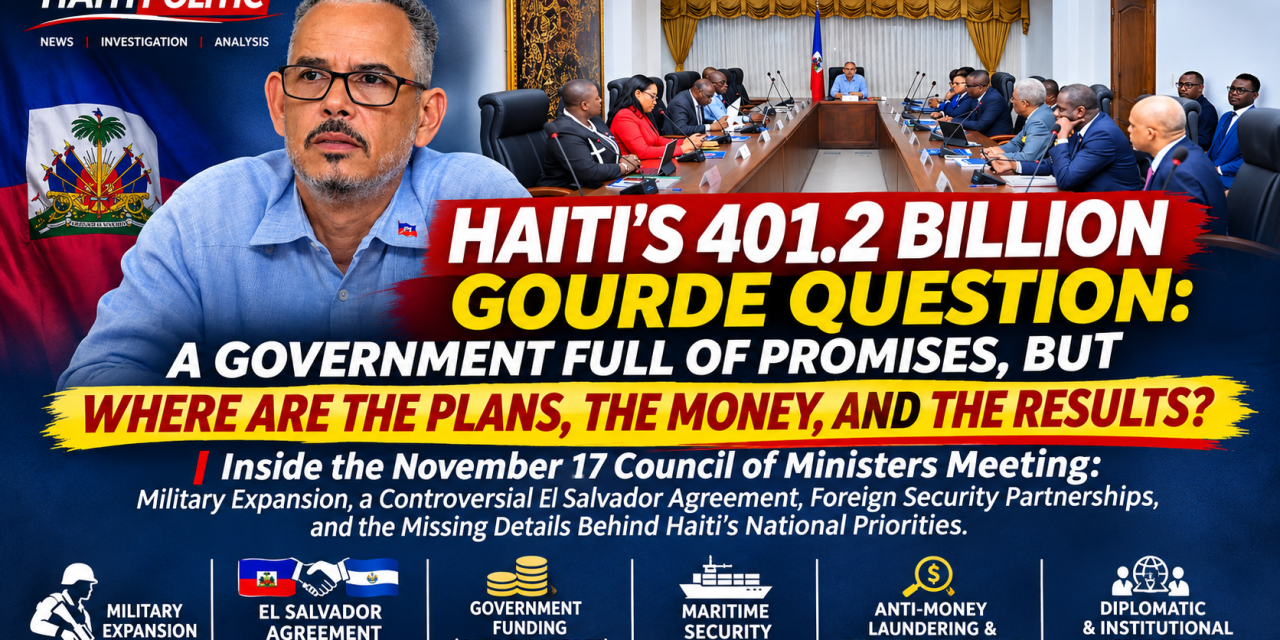
Inside the November 17 Council of Ministers Meeting: Military Expansion, a Controversial El Salvador Agreement, Foreign Security Partnerships, and the Missing Details Behind Haiti’s National Priorities
HAITI POLITIC | SPECIAL INVESTIGATION | NOVEMBER 17, 2026
Haiti’s government has outlined an ambitious agenda involving national security, military modernization, financial oversight, maritime security, and international cooperation. But the Council of Ministers’ latest communiqué leaves fundamental questions unanswered: What exactly was approved? Which projects have dedicated financing? Who controls the spending? And when will Haitians see measurable results?
A Government Meeting That Raises More Questions Than Answers
On Tuesday, November 17, 2026, Haiti’s Council of Ministers convened at the Villa d’Accueil in Port-au-Prince under the leadership of Prime Minister Alix Didier Fils-Aimé.
According to the official communiqué issued by the Prime Minister’s Office, the meeting addressed several strategic priorities concerning the country’s security, institutional development, and international relationships.
Among the principal subjects were:
-
Modernization of the Armed Forces of Haiti (FAd’H).
-
Strengthening measures against money laundering and terrorism financing.
-
Examination of a cooperation agreement between Haiti and El Salvador.
-
Haiti’s international commitments concerning maritime affairs.
-
Territorial development and recognition of social and religious institutions.
-
Strengthening Haiti’s diplomatic representation abroad.
These are consequential matters for a country confronting armed violence, institutional weakness, economic instability, and a prolonged crisis of democratic legitimacy.
Yet the communiqué contains a striking omission.
It does not identify the specific resolutions adopted, the amounts authorized, the implementation schedules, or the officials responsible for delivering results.
The government announced what it discussed.
It did not provide the public with a detailed account of what it decided.
That distinction matters.
A Council of Ministers meeting should be more than an opportunity to announce political priorities. It should produce decisions that can be examined, financed, implemented, and audited.
For Haitians who have endured years of promises without adequate results, the central question is no longer whether the government recognizes the country’s problems.
The question is whether the government has a credible, financed plan to solve them.
1. The 401.2 Billion Gourde Budget: Where Is the Money Going?
Haiti’s approved national budget for fiscal year 2026–2027 totals approximately 401.2 billion gourdes, according to figures published by the Ministry of Economy and Finance.
The budget identifies several financing sources, including:
| Financing category | Reported amount |
|---|---|
| Current domestic revenues | 262.9 billion gourdes |
| Grants and loans | 91.75 billion gourdes |
| Treasury bills | 35.18 billion gourdes |
| Total national budget | 401.2 billion gourdes |
These financing categories do not, by themselves, constitute a complete reconciliation of the budget. Their reported amounts total approximately 389.83 billion gourdes, leaving other financing or accounting items to be identified in the detailed budget documents.
The figures nevertheless demonstrate that Haiti has substantial public resources allocated to government operations and national priorities.
They also illustrate the continuing importance of external financing.
But an approved budget is not the same as money already collected or spent.
Government appropriations must be distinguished from actual disbursements, procurement contracts, completed projects, and verified outcomes.
A budget tells citizens what the government intends to finance. Expenditure reports and independent audits reveal what actually happened to the money.
That distinction is especially important when discussing Haiti’s security institutions.
2. Approximately 73 Billion Gourdes for Justice and Defense: What Will Haitians Receive?
According to the published budget summary, approximately 73 billion gourdes are allocated jointly to the Ministry of Justice and Public Security and the Ministry of Defense.
These institutions oversee major components of Haiti’s security architecture, including the Haitian National Police and the Armed Forces.
The government’s broader security priorities include police recruitment, equipment, military expansion, and infrastructure.
Among the publicly identified objectives are continued implementation of the P4000 police recruitment program and expansion of the Armed Forces toward a proposed strength of 15,000 personnel over three years.
However, the combined 73-billion-gourde figure must not be confused with a dedicated military modernization budget.
It includes responsibilities across two ministries.
The November 17 communiqué does not establish precisely how much money will be allocated to each new initiative discussed at the meeting.
Several questions therefore deserve immediate answers.
How much is specifically allocated to the PNH?
How much is assigned to the Armed Forces?
What portion will finance salaries, training, weapons, vehicles, fuel, maintenance, and infrastructure?
Which procurement contracts have been approved?
How many additional police officers and soldiers will become operational during the fiscal year?
And what measurable security improvements are expected?
These questions are not arguments against investing in national security.
They are necessary conditions for ensuring that security expenditures produce meaningful results.
Haiti does not simply need a larger security budget. It needs a security budget that can be traced from appropriation to implementation and independently evaluated.
3. The El Salvador Agreement: A Foreign Military Partnership Without Public Financial Details
Perhaps the most politically sensitive issue addressed during Tuesday’s meeting was the cooperation agreement between Haiti and El Salvador.
The November 17 communiqué states that the Council of Ministers examined the agreement as part of the government’s efforts to strengthen international partnerships in response to Haiti’s security challenges.
However, the communiqué does not disclose the agreement itself.
It does not establish whether the Council formally approved the agreement, authorized its signature, or adopted additional measures governing its implementation.
This uncertainty has become particularly significant following public statements attributed to Salvadoran Vice President Félix Ulloa concerning military cooperation with Haiti.
Salvadoran personnel have reportedly been involved in operations connected to Haiti’s international security deployment, and reports concerning four missing Salvadoran personnel have intensified scrutiny of the mission.
The public deserves clarity about the relationship between those operations and the bilateral agreement discussed by Haiti’s government.
The Financial Questions
The available communiqué does not disclose:
The total cost of the agreement.
The amount Haiti is obligated to contribute.
The financial obligations of El Salvador.
Whether international donors will provide additional funding.
The duration of the financial commitments.
The institutions responsible for monitoring expenditures.
The conditions governing withdrawal or termination.
Nor does the communiqué establish a clear operational command structure or publish the human rights safeguards applicable to the proposed cooperation.
These omissions do not prove that the agreement is unlawful or that its terms are improper.
They establish something more immediate: the public has not been given enough information to evaluate it.
If the agreement creates financial obligations for Haiti, those obligations should be reflected in the government’s financial planning and disclosed through the appropriate legal and budgetary mechanisms.
If it authorizes foreign military activities, the legal basis, scope, command arrangements, and accountability procedures should be explained.
And if the mission involves significant risks to Haitian civilians or Salvadoran personnel, both populations deserve to understand the safeguards and objectives.
National sovereignty cannot be reduced to a declaration in a government communiqué while the practical terms of foreign military cooperation remain unavailable for public examination.
4. Modernizing Haiti’s Armed Forces: What Is the Actual Strategy?
The Council also discussed modernization of the Armed Forces of Haiti.
In principle, developing a professional, accountable national defense institution is a legitimate objective of a sovereign state.
However, military modernization requires more than recruitment announcements and equipment purchases.
It requires a coherent national defense strategy.
That strategy should explain the military’s constitutional responsibilities, its relationship with the PNH, the threats it is expected to address, and the resources needed to perform its duties.
Haiti’s government must also explain how it intends to prevent overlapping responsibilities, fragmented command structures, and wasteful spending.
A military expansion program should be accompanied by a realistic personnel plan, training standards, infrastructure requirements, equipment-maintenance provisions, and long-term financial projections.
For example, increasing the number of soldiers creates recurring costs.
Personnel must be paid, housed, trained, equipped, supplied, and supervised.
Those costs continue long after an initial recruitment announcement.
Where is the three-year financing plan for the proposed military expansion?
What are the annual recruitment targets?
Which facilities will accommodate additional personnel?
Who will provide training?
How will the government measure readiness?
The November 17 communiqué does not answer these questions.
Without such information, it is difficult to determine whether the proposed modernization effort represents a sustainable national strategy or another ambitious objective awaiting implementation.
5. Money Laundering and Terrorism Financing: New Measures or Another Announcement?
The Council discussed strengthening Haiti’s mechanisms for combating money laundering and terrorism financing.
This is an important area of public policy.
Financial crime can undermine government revenues, facilitate corruption, weaken legitimate businesses, and complicate efforts to investigate organized criminal networks.
However, Haiti already has institutions and legal responsibilities related to financial intelligence, law enforcement, banking supervision, and criminal prosecution.
The central question is therefore not simply whether the government recognizes the problem.
What additional measures will it implement?
Will the government strengthen financial intelligence capabilities?
Will it improve cooperation among investigative and prosecutorial institutions?
Will it establish new reporting requirements?
Will it increase resources for financial investigations?
Will it publish measurable enforcement objectives?
The November 17 communiqué does not identify a newly funded program, a dedicated appropriation, or a timetable for implementing specific reforms.
That does not mean existing anti-money-laundering programs are unfunded.
It means the communiqué does not demonstrate what new measures, if any, emerged from Tuesday’s discussion.
A commitment to fighting financial crime should ultimately be judged by institutional performance, lawful investigations, successful prosecutions, and measurable improvements in financial transparency—not by the number of meetings devoted to the subject.
6. Haiti’s Ports: Another International Security Framework, but Who Controls the Implementation?
The Council also discussed Haiti’s international commitments concerning maritime affairs.
This subject deserves particular attention because the Organization of American States recently publicized recommendations for strengthening Haiti’s maritime and port security.
The OAS report addresses security concerns involving maritime infrastructure and commercial routes.
Haiti’s ports are economically strategic.
They facilitate international trade, customs collection, the movement of essential goods, and the operation of national supply chains.
Effective port security can help combat illicit trafficking while protecting legitimate commerce.
But the involvement of international organizations raises important questions about institutional responsibility and national ownership.
Who designs Haiti’s maritime-security strategy?
Who selects the equipment?
Who controls operational information?
Who manages surveillance systems?
Who owns the infrastructure?
Who pays for maintenance?
And who determines when foreign technical assistance is no longer necessary?
These questions are particularly relevant when foreign governments and international organizations help finance or implement security projects.
There is an important distinction between international technical assistance and foreign control of national infrastructure.
The existence of an OAS proposal does not, by itself, establish that foreign governments intend to take ownership of Haitian ports.
Nor does Tuesday’s communiqué establish that Haiti adopted the OAS recommendations.
Nevertheless, the government should make clear whether it intends to develop its own maritime-security framework, use an externally proposed model, or combine elements of both.
Haiti should be capable of receiving international assistance without surrendering responsibility for its own national security priorities.
That requires transparent agreements, Haitian institutional leadership, and a credible plan for developing domestic expertise.
7. Territorial Development and Diplomatic Representation: Where Are the Projects?
The Council also addressed territorial development, recognition of social and religious institutions, and strengthening Haiti’s diplomatic representation.
These subjects may have important implications for public administration and international relations.
But the communiqué provides little operational detail.
It does not identify the territorial-development projects under consideration.
It does not specify the institutions proposed for recognition.
It does not announce particular diplomatic appointments or embassy reforms.
And it does not disclose dedicated funding for new initiatives in these areas.
The national budget may contain existing appropriations relevant to these responsibilities.
However, without a direct connection between specific budget lines and the matters discussed on November 17, the public cannot determine what additional actions the government intends to undertake.
The difference between a policy priority and an executable government project is a documented plan with responsible officials, financing, deadlines, and expected results.
8. The Foreign-Funding Question: How Sustainable Is Haiti’s Government Agenda?
The reported budget figures identify approximately 91.75 billion gourdes in grants and loans.
This represents a substantial financing category within Haiti’s fiscal framework.
External assistance can support legitimate development and security priorities.
But dependence on external resources creates additional planning challenges.
Grants may be restricted to particular activities.
Loans create repayment obligations.
Some pledged financing may be subject to conditions or disbursement schedules.
And international partners may have priorities that do not perfectly match those of Haitian institutions.
These realities make transparent financial planning essential.
For every major project involving external financing, the government should identify the source, amount, conditions, implementation responsibilities, and long-term operating costs.
Haiti’s government must also demonstrate that the institutions receiving assistance can eventually maintain the resulting infrastructure and services.
Otherwise, a project may function while foreign financing is available and deteriorate when that financing ends.
This is especially relevant to police recruitment, military modernization, maritime security, and international technical assistance.
A sustainable national strategy cannot depend indefinitely on outside institutions designing, financing, and operating functions that Haitian authorities must ultimately manage themselves.
9. The Missing Element: A Public Implementation and Accountability Framework
The most revealing feature of the November 17 communiqué is not the number of issues discussed.
It is the absence of a publicly identified implementation framework connecting those issues to measurable government action.
A credible framework should include:
-
Formal authorization: The legal instrument approving each initiative.
-
Dedicated financing: The budget allocation and any external financial commitments.
-
Responsible institutions: The ministries and officials accountable for implementation.
-
Timelines: The dates by which specific milestones must be completed.
-
Procurement transparency: The contracts, suppliers, and purchasing procedures involved.
-
Performance indicators: The measurable results expected from each initiative.
-
Public reporting: Regular financial and operational progress reports.
-
Independent oversight: Mechanisms for auditing expenditures and investigating irregularities.
Without these elements, the public is left evaluating political declarations rather than government performance.
A budget may authorize spending.
A ministerial meeting may establish priorities.
An international agreement may create opportunities for cooperation.
But none of these automatically produces security, institutional reform, or economic development.
Implementation is what transforms public commitments into public results.
10. What Should Prime Minister Fils-Aimé Publish?
The Prime Minister’s Office could resolve much of the uncertainty surrounding Tuesday’s meeting by releasing the formal decisions and supporting documents.
The most important records would include the Council’s adopted resolutions, any resulting arrêtés, the relevant budget allocations, and the full text or legally disclosable provisions of the Haiti–El Salvador agreement.
For military modernization, the government should publish a costed implementation strategy identifying recruitment, training, equipment, infrastructure, and operational objectives.
For maritime security, it should clarify which international proposals have been accepted and who will control the resulting systems.
For financial-crime enforcement, it should identify the new measures approved and the resources assigned to them.
For territorial development and diplomatic reform, it should identify the specific projects or institutional changes authorized.
These disclosures would not require the government to reveal sensitive operational intelligence.
They would require it to explain how public authority and public resources are being used.
Transparency is not an obstacle to national security. Properly implemented, it is one of the foundations of legitimate and accountable government.
CONCLUSION: HAITI DOES NOT NEED ANOTHER LIST OF PRIORITIES. IT NEEDS A GOVERNMENT THAT CAN SHOW ITS WORK.
Haiti’s November 17 Council of Ministers meeting addressed important national challenges.
The government discussed military modernization, financial crime, maritime security, diplomatic representation, and cooperation with El Salvador.
Meanwhile, the country’s approved 2026–2027 budget provides a substantial financial framework for government operations.
But the available communiqué does not establish that each initiative discussed has a dedicated implementation plan, newly authorized financing, or measurable performance targets.
That is the central accountability gap.
The existence of 401.2 billion gourdes in an approved national budget does not mean that every government promise is adequately financed.
Nor does discussing an international agreement establish that its financial obligations, legal conditions, and operational safeguards have been publicly explained.
Haitians have every reason to demand more than declarations of national sovereignty and institutional modernization.
They deserve to know which projects have been approved, how much each will cost, who will finance them, which officials are responsible, and when the promised results should become visible.
The government must also explain how international assistance will strengthen Haitian institutions rather than perpetuate dependence on foreign-designed programs.
The objective should not be permanent international supervision of Haiti’s security and public administration.
It should be the development of effective Haitian institutions capable of exercising their responsibilities independently and transparently.
THE QUESTIONS THAT MUST BE ANSWERED
Where is the implementation plan?
Where is the financing agreement?
Where are the procurement records?
Where are the deadlines?
Who is accountable for the results?
And, perhaps most importantly:
How much longer will Haitians be asked to judge their government by its announcements instead of its accomplishments?
🇭🇹 HAITI NEEDS MORE THAN PROMISES. IT NEEDS PLANS, FUNDING, TRANSPARENCY, AND RESULTS.
HAITI POLITIC — SPECIAL INVESTIGATION
Government Accountability | Public Finance | National Security | Sovereignty
DOCUMENTARY BASIS AND REPORTING LIMITATIONS
This analysis draws on the November 17, 2026, communiqué from Haiti’s Prime Minister’s Office, previously reported figures from the Ministry of Economy and Finance’s 2026–2027 budget announcement, and the publicly described OAS maritime-security initiative.
The communiqué establishes the subjects discussed but does not provide the complete Council minutes or a list of formal resolutions. The budget figures are reported allocations and financing projections, not verified expenditure totals. The article does not establish that the Haiti–El Salvador agreement has been formally approved or that any undisclosed financial obligation has been incurred.
Primary references for further verification:
-
Haiti’s Ministry of Economy and Finance: https://mef.gouv.ht
-
Haiti’s official budget portal: https://budget.gouv.ht
-
Organization of American States: https://www.oas.org
-
Haiti’s Prime Minister’s Office: Official communiqué dated November 17, 2026.
Editorial note: Before publication, the detailed 2026–2027 budget tables, any formal resolutions from November 17, and the text of the Haiti–El Salvador agreement should be obtained to verify the precise appropriations, legal authorizations, and financial commitments.