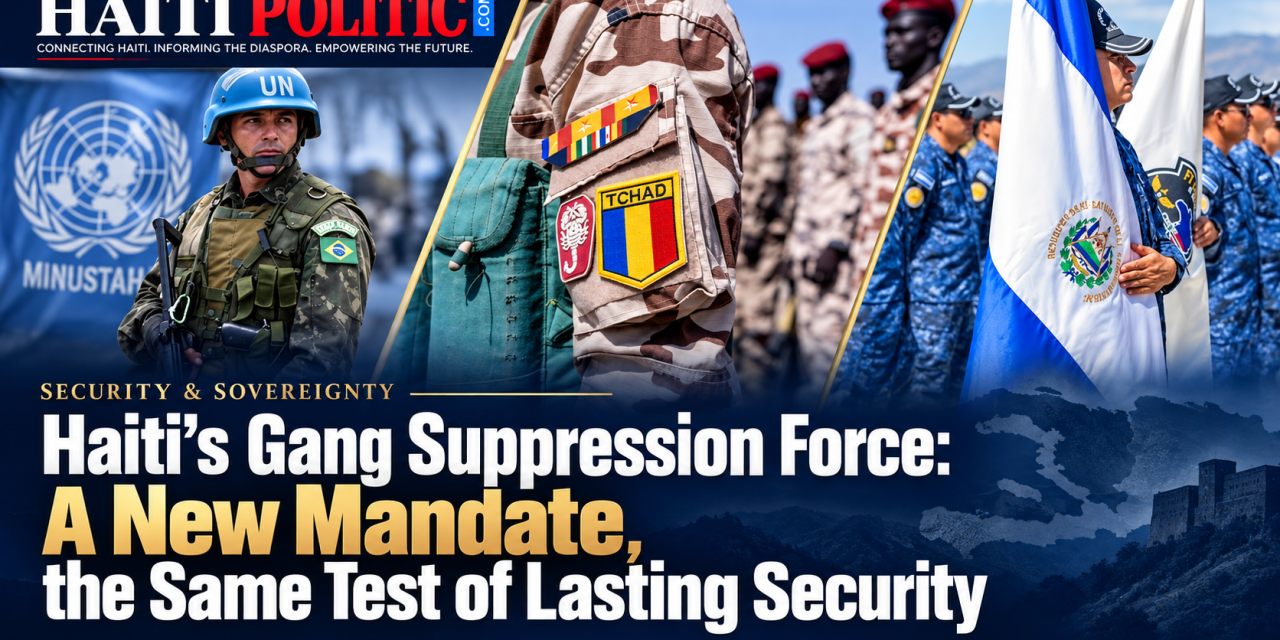
Chad’s troop commitment and El Salvador’s rescue deployment mark a new phase of foreign security assistance. Whether that phase strengthens Haitian institutions will matter more than its military firepower.
For Haitians living under gang rule, the value of another international deployment comes down to ordinary freedoms: returning home, opening a business, traveling safely and sending children to school.
The Gang Suppression Force (GSF) promises to help restore those freedoms through a more explicit campaign against armed groups. But a stronger mandate cannot, by itself, resolve the question that has outlasted previous missions: who will maintain security when foreign forces leave?
To assess this intervention, Haiti needs a clear account of what has changed—and what military force alone cannot deliver.
MINUSTAH was more than a defensive mission
The UN Stabilization Mission in Haiti, known as MINUSTAH, operated from 2004 until October 2017. Its responsibilities extended beyond security to political support, institution building and human rights. It also had a Chapter VII security mandate; describing it as merely defensive understates its authority.
Its departure did not end the international presence. A smaller UN mission, MINUJUSTH, followed, focusing on policing, justice and human rights. The subsequent deterioration in security therefore requires a broader explanation than the withdrawal of blue helmets alone.
The relevant comparison is whether today’s intervention can turn temporary security gains into durable Haitian capacity. That requires examining command, resources, accountability and the institutions expected to take over.
From the Kenyan-led mission to a stronger enforcement mandate
The GSF emerged from the Kenyan-led Multinational Security Support mission (MSS). In Resolution 2793, adopted in 2025, the Security Council authorized that transition and established a UN support office. The resolution acknowledged that the MSS mission’s resources and capabilities had not kept pace with the expanding gang threat.
The new framework provides for targeted operations against gangs alongside Haitian security forces, protection of critical infrastructure and support for humanitarian access. It also establishes more structured logistical support. The GSF is a UN-authorized multinational force, rather than a conventional UN peacekeeping operation.
These changes address practical weaknesses. Their effectiveness still depends on funding, equipment, intelligence and coordination reaching units in the field.
Chad’s contribution is not a transfer of command
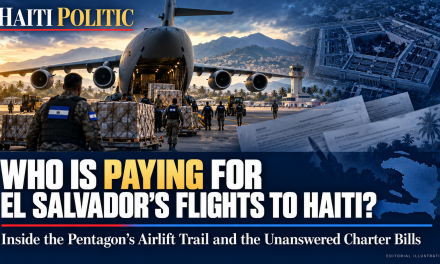
Chad’s deployment adds an important military component. On April 20, 2026, President Mahamat Idriss Déby announced a planned contribution of 1,500 personnel, organized into two battalions of 750. At that point, 400 Chadian personnel were reported already deployed.
Those figures describe a commitment and an initial deployment, rather than confirmation that the entire contingent had arrived. Likewise, Chad’s contribution should not be confused with command of the multinational mission. The GSF identifies Mongolian Major General Erdenebat Batsuuri as its force commander.
Additional infantry may expand operational capacity. Whether it produces lasting control will depend on what follows an operation: a continuing police presence, functioning courts, essential services and protection against gang retaliation.
El Salvador: a support role becomes a rescue emergency
The disappearance of four Salvadoran aviation technicians after an October 18 ambush in Croix-des-Bouquets exposed the risks facing support personnel. El Salvador’s contribution had centered on aviation assistance, including medical evacuation.
On October 22, the Associated Press reported that 100 Salvadoran special forces soldiers had arrived to help recover the missing personnel, citing two officials.
That rescue deployment represents an operational escalation. It does not, on its own, establish a permanent change in El Salvador’s mandate. The immediate questions concern command, coordination with Haitian authorities and safeguards for residents caught near the search operations.
The political test beyond the battlefield
Reporting this month on another election postponement underscores the connection between security and Haiti’s unresolved political transition. Citizens cannot participate freely while armed groups control access to their communities. Yet indefinite transitional government cannot become the accepted alternative to elections.
The mission therefore needs public benchmarks beyond arrests and territory entered. Can displaced families return safely? Do roads remain open after troops withdraw? Can police investigate crimes and courts process cases? Are allegations of misconduct independently examined?
A credible strategy must also address the supply of weapons, financing and political protection that allows armed groups to regenerate. Reclaiming a neighborhood means little if those networks remain intact.
International assistance can give Haitian institutions room to recover. Its lasting value will depend on whether those institutions become capable, accountable and trusted enough to protect the population themselves. Haiti’s sovereignty should be measured in that capacity—and in its citizens’ ability to choose their government.