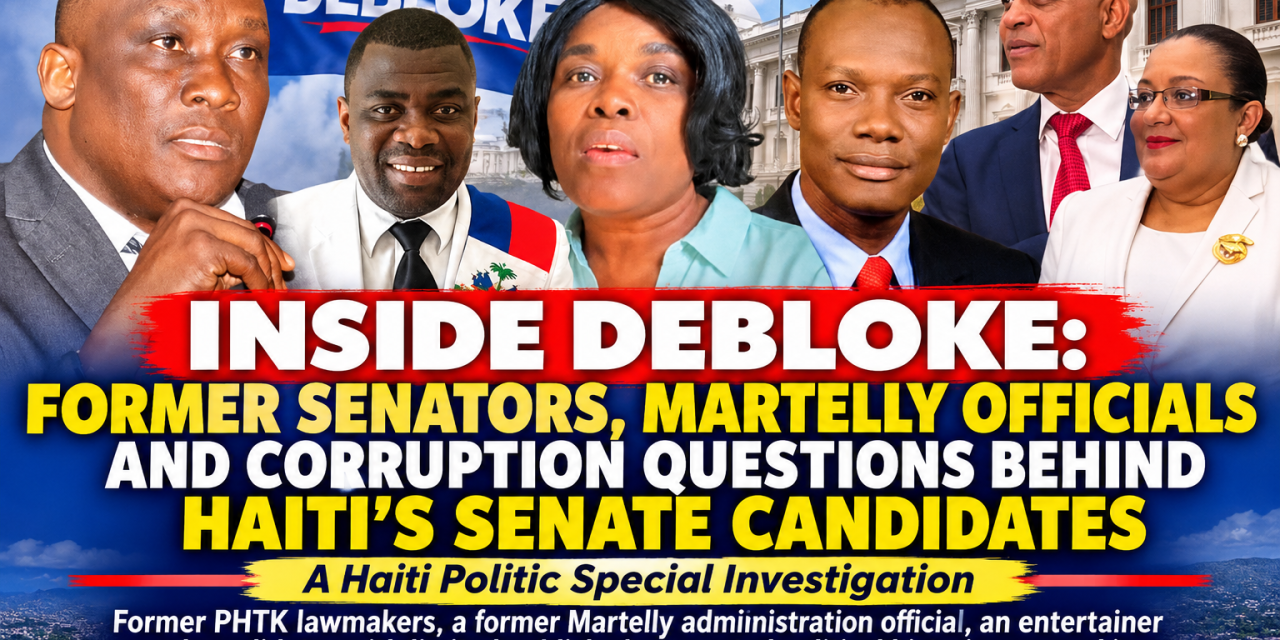
A Haiti Politic Special Investigation
Former PHTK lawmakers, a former Martelly administration official, an entertainer and candidates with limited publicly documented political histories are seeking Senate seats under DEBLOKE. Two former senators face particularly important questions arising from anti-corruption investigations and judicial proceedings.
HAITI POLITIC | SPECIAL INVESTIGATION | NOVEMBER 16, 2026
A NEW POLITICAL NAME, BUT HOW MANY OLD POLITICAL FACES?
As Haiti prepares for another attempt to restore elected government, the political organization DEBLOKE is assembling a national slate of Senate candidates.
The movement is associated with former President Michel Joseph Martelly, whose political career remains closely connected to the Parti Haïtien Tèt Kale (PHTK) and the administration of his successor, Jovenel Moïse.
A review of 24 prospective DEBLOKE Senate candidates appearing in an earlier November 2026 electoral registry snapshot reveals a mixture of former parliamentarians, previous government officials, entertainers and political newcomers whose professional backgrounds remain insufficiently documented.
Among the names are former senators Willot Joseph and Wanique Pierre, former deputies Marie Jossie Étienne and Clauvy Robas, and former Secretary of State Gérald Junior Oriol.
Their backgrounds raise an important question:
Is DEBLOKE introducing a new generation of political leadership, or bringing together experienced political figures from previous administrations under a new organizational banner?
The available evidence shows elements of both. Several candidates have identifiable histories in Parliament or government, while the backgrounds of many others require further investigation.
The most consequential findings concern two former senators whose names appear in separate corruption-related proceedings.
But before examining those cases, another issue requires attention: the changing electoral registry itself.
1. THE ELECTORAL REGISTRY: 24 NAMES BECOME 26
The original November 2026 snapshot examined by Haiti Politic contains 24 prospective Senate candidates distributed across nine departments.
However, a newer registry compilation dated November 16 identifies 26 DEBLOKE Senate registrations.
The differences are significant.
In the Ouest, Edwine Blaise appeared under DEBLOKE in the earlier list. A subsequent registry compilation places her under the Mouvement Travailliste Haïtien (MTH), while Jean-Fritz Jean-Louis appears under DEBLOKE.
In the Nord-Ouest, the earlier list includes Emmanuel Remy. The updated DEBLOKE registry instead lists Kechner B. Civil and Dhawens Lafrance alongside Jusclaire Dorgil.
In the Sud, Pierre Michel Lubin appears in addition to Clauvy Robas.
The Artibonite registry also records the fuller name Greatz Marie Lydie S. Charles Gracia, rather than the shorter form in the earlier list.
These differences may reflect changes in registration, corrections or evolving database records. They should not automatically be interpreted as withdrawals or party defections without confirmation from the CEP.
Most importantly, registration does not mean that the CEP has approved a candidacy.
The following investigation examines the 24 names originally supplied while separately identifying the additional names appearing in the November 16 registry.
PART I — THE FORMER PARLIAMENTARIANS
2. WILLOT JOSEPH: THE FORMER PHTK SENATOR AND THE ASSET-DECLARATION CONTROVERSY
Department: Centre
Previous office: Senator
Previous political affiliation: PHTK
2026 registration: DEBLOKE
Willot Joseph is not a newcomer to Haitian politics.
He previously served as a senator representing the Centre department and was elected under the PHTK banner.
His political history therefore provides a direct connection between DEBLOKE’s current Senate registrations and the parliamentary network associated with the Martelly-era political movement.
But his previous public office is only part of the story.
The 2023 ULCC investigation
In March 2023, Haiti’s Unité de Lutte Contre la Corruption (ULCC) identified Willot Joseph among seven former senators accused of failing to comply with mandatory asset-declaration requirements.
The institution called for legal proceedings concerning the alleged failure to declare assets.
A subsequent investigation examined a certificate that Joseph had presented as evidence of compliance.
According to reporting on the ULCC’s November 2023 findings, investigators concluded that the certificate was not authentic and recommended proceedings concerning its alleged use.
These are serious institutional findings.
However, an ULCC recommendation is not a criminal conviction.
Haiti Politic has not verified a final judicial decision establishing Joseph’s criminal liability.
Why his candidacy matters
Joseph’s prospective return to the Senate raises several questions:
Did prosecutors act on the ULCC recommendations?
Was a criminal case formally opened?
Has any court issued a judgment?
Did the proceedings result in any restriction on his political rights?
And what documentation has Joseph submitted to establish his eligibility for the 2026–2027 elections?
The CEP should determine eligibility according to applicable law and verified judicial records—not allegations alone.
Haiti Politic finding: Former PHTK senator with a documented ULCC asset-declaration controversy. Final judicial outcome not established.
3. WANIQUE PIERRE: A FORMER PHTK SENATOR REFERRED FOR CRIMINAL TRIAL
Department: Nord-Est
Previous office: Senator
Previous political affiliation: PHTK
2026 registration: DEBLOKE
Wanique Pierre represents another direct link between DEBLOKE and the former PHTK parliamentary establishment.
He previously served as senator for the Nord-Est department after being elected under PHTK.
His name has also appeared in one of the most consequential investigations involving the management of Senate property.
The Senate vehicle investigation
Following the expiration of the mandates of Haiti’s remaining senators, questions emerged concerning vehicles and other public assets that had been assigned to parliamentarians.
The ULCC investigated the circumstances surrounding vehicles that had allegedly not been returned to the Senate.
The investigation eventually entered the judicial system.
According to a November 10, 2026 report by Satellite509, investigating judge Mathieu Chanlatte issued an order dated October 9, 2026, referring former Senator Wanique Pierre and former Senate chief accountant Alexandre Joseph to criminal trial.
The allegations concern the suspected misappropriation of public property, particularly Senate vehicles.
The same report states that the judge ordered their arrest and detention.
Importantly, the investigating judge reportedly reached different conclusions concerning several other former senators, issuing decisions not to prosecute them because the evidence was considered insufficient.
That distinction demonstrates why individual judicial records matter.
What the court order means
A judicial order referring someone for trial is not equivalent to a conviction.
Pierre remains entitled to the presumption of innocence and the opportunity to challenge the allegations through the judicial process.
Nevertheless, the reported order is directly relevant to public scrutiny of his prospective Senate candidacy.
Questions for DEBLOKE and the CEP
Has Pierre appealed or otherwise challenged the investigating judge’s order?
What is the current status of the proceedings?
Has the court issued any subsequent ruling?
Does the pending case have any legal consequences for electoral eligibility?
Has DEBLOKE publicly addressed the matter?
Haiti Politic finding: Former PHTK senator reportedly referred for criminal trial in October 2026 over alleged misappropriation of Senate property. No conviction established.
4. MARIE JOSSIE ÉTIENNE: THE FORMER DEPUTY RETURNING UNDER DEBLOKE
Department: Nord
Previous office: Deputy
Previous political affiliations: RASANBLE; later PHTK electoral association
2026 registration: DEBLOKE
Marie Jossie Étienne previously represented the Plaine-du-Nord/Milot constituency in Haiti’s Chamber of Deputies.
Her parliamentary career predates the current electoral cycle.
She served during the period of Haiti’s 49th Legislature and was associated with RASANBLE.
She later appeared in the electoral record as a PHTK candidate.
Her political history therefore illustrates the movement of established parliamentary figures across party organizations.
Previous parliamentary responsibilities
During her parliamentary career, Étienne was associated with work concerning women’s rights and women’s participation in public institutions.
In 2013, she received public recognition for her advocacy in this area.
Her record deserves examination on its own terms, including legislative initiatives, constituency representation and public-policy results.
Corruption and legal controversies
The research reviewed for this article did not establish a specific corruption prosecution or judicial finding against Marie Jossie Étienne.
That does not establish that no complaints or investigations exist.
It means that no sufficiently substantiated individual allegation was identified for publication in this review.
Haiti Politic finding: Former deputy with documented parliamentary experience and previous PHTK electoral ties. No verified individual corruption case identified in the reviewed material.
5. CLAUVY ROBAS: THE FORMER OPL DEPUTY SEEKING A SENATE SEAT
Department: Sud
Previous office: Deputy
Previous political affiliation: OPL
2026 registration: DEBLOKE
Clauvy Robas previously represented the Les Cayes/Île-à-Vache constituency.
Official electoral results identify him as an OPL candidate who was elected to the Chamber of Deputies during the 2015 electoral cycle.
His record includes 16,675 votes, representing 55.38% in the reported result.
Robas subsequently participated in public activities involving the administration of President Jovenel Moïse.
A July 2017 government communication identifies him among officials accompanying the president during activities in Les Cayes connected with local development and the Caravane du Changement.
That association is documented.
It does not, by itself, prove that Robas formally became a PHTK member.
Questions concerning his legislative record
What legislation did Robas sponsor or support?
What was his position on parliamentary oversight of public spending?
What constituency-development projects were implemented during his mandate?
Did he submit all legally required financial disclosures?
The reviewed material did not establish a specific corruption conviction or prosecution involving Robas.
Haiti Politic finding: Former OPL deputy with documented participation in activities involving the Jovenel Moïse administration. No verified individual corruption case identified in the reviewed material.
PART II — THE FORMER GOVERNMENT OFFICIAL
6. GÉRALD JUNIOR ORIOL: FROM MARTELLY’S CABINET TO DEBLOKE
Department: Ouest
Previous office: Secretary of State for the Integration of Persons with Disabilities
Previous administrations: Michel Martelly and Jovenel Moïse
2026 registration: DEBLOKE
Gérald Junior Oriol is among the clearest examples of continuity between previous Haitian administrations and DEBLOKE.
Unlike candidates whose earlier government careers remain uncertain, Oriol’s appointments are documented in official government records.
First appointment: Michel Martelly
On October 29, 2011, the administration of President Michel Martelly and Prime Minister Garry Conille announced Oriol’s appointment as secretary of state responsible for the integration of persons with disabilities.
His responsibilities involved expanding access to education, employment and public services for people with disabilities.
Second appointment: Jovenel Moïse
On April 4, 2017, Oriol returned to the same position during the Jovenel Moïse administration.
The government’s official announcement of his installation described this as his second period of service.
Consequently, Oriol’s political connection to both administrations is not merely an inference based on party membership.
He held senior government office under both presidents.
The accountability question
Oriol’s previous government service should be evaluated through measurable results.
What budget did his office receive?
How much was spent?
What programs were implemented?
How many people benefited?
Were public contracts and expenditures independently audited?
The available research did not establish a specific corruption prosecution against Oriol.
It would therefore be inappropriate to suggest that his association with either administration constitutes evidence of personal wrongdoing.
Haiti Politic finding: Former secretary of state appointed under both Martelly and Moïse. Directly documented executive-government experience; no verified individual corruption case identified in the reviewed material.
PART III — THE ENTERTAINER ENTERING THE SENATE RACE
7. DANIEL FILS-AIMÉ, KNOWN AS TONTON BICHA
Department: Nord
Profession: Actor, comedian and entertainer
2026 registration: DEBLOKE
Daniel Fils-Aimé, popularly known as Tonton Bicha, is one of the most recognizable personalities appearing on DEBLOKE’s Senate slate.
His public reputation comes primarily from entertainment rather than elected office.
He became known through Haitian comedy, film and popular culture, including the I Love You Anne productions.
His candidacy illustrates how public recognition outside politics can become part of an electoral campaign.
The questions facing Tonton Bicha
Entertainment experience does not disqualify someone from public service.
But the Senate requires knowledge of legislation, constitutional responsibilities, government oversight and national policy.
What is Fils-Aimé’s legislative program?
What is his position on public spending and corruption?
What proposals does he offer for security, education and economic development in the Nord?
How would he exercise oversight over an administration led by his own political organization?
The reviewed material did not establish previous parliamentary service or a substantiated corruption proceeding against him.
Haiti Politic finding: Established entertainment figure entering electoral politics. No previous elected office or verified corruption case established in the reviewed material.
PART IV — THE REMAINING CANDIDATES: WHAT THE PUBLIC RECORD DOES AND DOES NOT SHOW
The remainder of the original 24-person list presents a different investigative challenge.
Their registrations can be identified, but available biographical and institutional records do not yet establish whether each previously held public office.
In several cases, publicly accessible electoral profiles contain no linked government documents, institutional histories or judicial records.
That absence must not be interpreted as proof of a clean record—or evidence of wrongdoing.
It is a documentation gap.
8. ARTIBONITE
Greatz Marie Lydie Sironel Charles
The updated registry uses the fuller name Greatz Marie Lydie S. Charles Gracia.
Her DEBLOKE Senate registration is documented.
The reviewed records did not establish previous service as a senator, deputy, minister or senior government official.
No specific, substantiated corruption case was identified.
Further investigation should establish whether the name variations refer to the same person and identify her professional and political history.
Enock-Gene Genelus
Genelus appears in the Artibonite Senate registrations under DEBLOKE.
The reviewed material did not establish a previous parliamentary mandate or senior executive appointment.
No verified individual corruption case was identified.
His previous electoral candidacies, professional activities and possible public appointments remain subjects for additional research.
Altes Toussaint
Toussaint is listed as another DEBLOKE Senate registrant for Artibonite.
Previous parliamentary or ministerial service was not established.
No substantiated individual corruption allegation was identified in the reviewed records.
Artibonite finding: Three registrations confirmed; previous public-office histories remain insufficiently documented.
9. CENTRE
Elione St Fleur
Elione St Fleur appears alongside former Senator Willot Joseph in DEBLOKE’s Centre slate.
The reviewed material did not establish previous service as a senator, deputy, minister or other senior government official.
No verified corruption proceeding was identified.
Marie Andrée Ruth Thélus
Marie Andrée Ruth Thélus is the third prospective DEBLOKE Senate candidate listed for Centre.
Her previous public-office history remains unverified.
No sufficiently documented corruption case was identified.
Centre finding: Willot Joseph has an established parliamentary history and a documented ULCC controversy. The previous government careers of the other two registrants remain unverified.
10. GRAND’ANSE
Marie Kethlene B. Elize Charité
Charité appears in the Grand’Anse Senate registry under DEBLOKE.
Previous elected or senior appointed office was not established in the reviewed material.
No substantiated individual corruption case was identified.
Kivins Charles
Charles is registered as a prospective DEBLOKE Senate candidate for Grand’Anse.
His earlier parliamentary, administrative and professional history requires additional verification.
No documented individual corruption proceeding was established.
Michel Guy Clérie
Clérie appears as the third DEBLOKE Senate registrant in Grand’Anse.
The available research did not establish previous parliamentary service or a senior government appointment.
No verified corruption case was identified.
Grand’Anse finding: All three registrations are documented, but the candidates’ previous public-service histories remain insufficiently established.
11. NIPPES
Rolnor Chalite
Chalite is registered under DEBLOKE for the Nippes department.
The reviewed records did not establish previous service as a senator, deputy or senior executive official.
No substantiated individual corruption case was identified.
Esther Pierre
Esther Pierre appears as another DEBLOKE Senate registrant in Nippes.
Her previous political affiliations and government-service history remain unverified.
No specific corruption prosecution or judicial finding was established.
Wilfrid Tropnas
Tropnas completes the three-person DEBLOKE registration list for Nippes.
Previous parliamentary or ministerial service was not established.
No verified individual corruption case was identified.
Nippes finding: Three registrations confirmed; previous public-office histories require further documentation.
12. NORD
Gaby Silencieux
Gaby Silencieux appears alongside Marie Jossie Étienne and Daniel Fils-Aimé in DEBLOKE’s Nord Senate registrations.
The reviewed material did not establish a previous parliamentary mandate or senior government appointment.
No substantiated individual corruption case was identified.
Nord finding: The slate includes a former deputy, a nationally known entertainer and a third candidate whose public-service background remains insufficiently documented.
13. NORD-EST
Jacques Philomé Félix
Félix appears in DEBLOKE’s Nord-Est Senate registrations.
Previous service in Parliament or a senior government position was not established.
No verified individual corruption proceeding was identified.
Jacques Jean
Jacques Jean is another prospective DEBLOKE Senate candidate in Nord-Est.
The reviewed records did not establish previous elected or senior appointed office.
No substantiated individual corruption case was identified.
Because the name is relatively common, reliable identification requires additional biographical information before attributing any historical records to this candidate.
Nord-Est finding: Wanique Pierre’s former Senate service and reported criminal-trial referral are documented. The backgrounds of the other two registrants require further verification.
14. NORD-OUEST
Jusclaire Dorgil
Dorgil appears in both the earlier list and the updated DEBLOKE Senate registry.
The reviewed material did not establish previous parliamentary or senior government service.
No verified individual corruption case was identified.
Emmanuel Remy
Emmanuel Remy appears in the earlier 24-person list supplied for this investigation.
However, he does not appear among the three DEBLOKE Nord-Ouest Senate registrants in the November 16 compilation reviewed for this article.
His earlier registration and any subsequent change require confirmation from the CEP.
Previous parliamentary service and individual corruption allegations were not established.
Nord-Ouest finding: The original and updated lists differ. The newer registry identifies Kechner B. Civil, Jusclaire Dorgil and Dhawens Lafrance.
15. OUEST
Edwine Blaise
Edwine Blaise is an attorney whose prospective Senate candidacy has been reported in connection with DEBLOKE.
She has publicly discussed priorities involving education, healthcare, women’s rights and child protection.
However, a newer electoral registry compilation identifies her under MTH rather than DEBLOKE.
The reason for this discrepancy has not been established.
Previous parliamentary or senior government service was not verified.
No substantiated individual corruption case was identified.
Almetis Junior Saint-Fleur
Almetis Junior Saint-Fleur appears in DEBLOKE’s Ouest Senate registrations.
The reviewed material did not establish previous service as a senator, deputy or senior government official.
No verified individual corruption case was identified.
Ouest finding: Gérald Junior Oriol has documented service under both Martelly and Moïse. Edwine Blaise’s current party registration requires clarification, while Almetis Junior Saint-Fleur’s earlier government history remains unverified.
PART V — FOUR ADDITIONAL NAMES IN THE UPDATED REGISTRY
The November 16 registry includes several names not present in the original 24-person list.
These should be examined before any final article presents DEBLOKE’s complete Senate slate.
Jean-Fritz Jean-Louis — Ouest
The updated registry lists Jean-Fritz Jean-Louis as a DEBLOKE Senate registrant.
Historical government records identify a Jean Fritz Jean-Louis as secretary of state for territorial collectivities in the Martelly–Conille administration.
This is a potentially important connection, but the identity match has not yet been independently established.
Until that match is confirmed, the Senate registrant should not automatically be described as the former secretary of state.
Kechner B. Civil — Nord-Ouest
Listed in the updated registry.
Previous parliamentary or senior government service and individual corruption proceedings were not established in the reviewed material.
Dhawens Lafrance — Nord-Ouest
Listed in the updated registry.
Previous parliamentary or senior government service and individual corruption proceedings were not established in the reviewed material.
Pierre Michel Lubin — Sud
Listed in the updated registry alongside Clauvy Robas.
Previous parliamentary or senior government service and individual corruption proceedings were not established in the reviewed material.
These additional names illustrate why an electoral investigation must be updated as registration data changes.
PART VI — THE MARTELLY CONNECTION AND THE QUESTION OF POLITICAL CONTINUITY
The strongest documented connection between DEBLOKE and the former PHTK political establishment is not simply that Michel Martelly is associated with the movement.
It is that several prospective candidates previously held office within the same political environment.
Consider the established records:
Willot Joseph previously served as a PHTK senator.
Wanique Pierre previously served as a PHTK senator.
Marie Jossie Étienne previously served in the Chamber of Deputies and subsequently appeared as a PHTK electoral candidate.
Gérald Junior Oriol served as secretary of state under both Michel Martelly and Jovenel Moïse.
Clauvy Robas was elected under OPL and later participated in documented government activities involving President Moïse.
These are different forms of political connection.
Some establish formal party affiliation.
Others establish government appointments or participation in official activities.
They should not be treated as interchangeable.
Nevertheless, together they demonstrate that DEBLOKE’s prospective Senate slate includes figures with substantial experience in Haiti’s previous political institutions.
That continuity is relevant to voters examining the organization’s proposed approach to governance, security, public finance and institutional reform.
PART VII — MARTELLY’S OWN SANCTIONS RECORD
Any examination of DEBLOKE’s political leadership must also consider the documented international sanctions imposed on Michel Martelly.
On August 20, 2024, the United States Department of the Treasury announced sanctions against the former Haitian president under Executive Order 14059, concerning international illicit drug trafficking.
Treasury alleged that Martelly had abused his influence to facilitate drug trafficking, engaged in laundering illicit drug proceeds, worked with traffickers and sponsored gangs.
The Treasury announcement also noted that Canada had previously sanctioned Martelly in November 2022.
These are official government sanctions and allegations, not findings from a criminal trial establishing guilt beyond a reasonable doubt.
The U.S. measures imposed specified financial and investment restrictions.
They did not, by themselves, establish that every person associated with Martelly or DEBLOKE participated in wrongdoing.
The relevance to DEBLOKE
The sanctions create legitimate questions about political leadership, financial transparency and compliance with applicable law.
How is DEBLOKE financed?
Who are its principal donors?
What procedures govern campaign contributions?
What financial relationships, if any, exist between sanctioned individuals and party operations?
How does the organization ensure that campaign financing complies with Haitian law and applicable international restrictions?
These questions require documentary answers rather than assumptions about individual candidates.
PART VIII — WHAT THE CORRUPTION INVESTIGATIONS ACTUALLY ESTABLISH
The investigation identifies two distinct cases requiring particular attention.
Willot Joseph
The ULCC reportedly recommended proceedings concerning failures to comply with asset-declaration requirements and the alleged use of a false certificate.
Established: An anti-corruption investigation and recommendations for prosecution were publicly reported.
Not established: A final criminal conviction or a current judicial restriction on candidacy.
Wanique Pierre
An investigating judge reportedly ordered his referral to criminal trial in October 2026 in connection with alleged misappropriation of Senate property.
Established: A reported judicial referral for trial.
Not established: A conviction, final appellate outcome or definitive electoral disqualification.
These distinctions are essential.
The public has a right to examine corruption investigations involving candidates seeking legislative authority.
Candidates also have a right to due process and to be judged on verified evidence.
For the other individuals reviewed, the research did not identify sufficiently substantiated corruption allegations that could responsibly be attributed to them.
That is a limitation of the available evidence, not a declaration that every possible background check has been completed.
PART IX — THE QUESTIONS DEBLOKE SHOULD ANSWER
A political organization presenting candidates for the Senate should be prepared to explain its selection procedures and standards of accountability.
For DEBLOKE, the following questions deserve public answers.
1. What criteria were used to select the Senate candidates?
Were candidates evaluated for professional qualifications, previous public service, legal compliance and financial transparency?
2. How many candidates previously served under PHTK or in the Martelly and Moïse administrations?
Will DEBLOKE publish a complete list of previous government positions held by its candidates?
3. What is the status of the legal proceedings involving Willot Joseph and Wanique Pierre?
Have the candidates or their representatives supplied updated judicial documentation?
4. Will every former public official publish the required asset declarations and discharge-related documentation?
Which legal requirements apply to each individual candidacy?
5. How will DEBLOKE finance its electoral campaign?
Will the organization disclose major donors and financial reporting procedures?
6. What is the party’s position on parliamentary oversight?
Will DEBLOKE senators independently investigate government spending, including spending by an administration led by their own political allies?
7. What specific legislative proposals will the candidates advance?
What reforms do they propose concerning public procurement, anti-corruption enforcement, security and judicial independence?
8. Why do the electoral registry snapshots contain different names?
Has DEBLOKE submitted amendments, replacements or corrections?
9. What explains the apparent change involving Edwine Blaise?
Does she currently seek office under DEBLOKE or MTH?
10. Will the party publish a complete, verified candidate roster before the CEP issues its final decisions?
A transparent roster would allow voters to evaluate each candidate’s background independently.
PART X — A SENATE THAT MUST BE ACCOUNTABLE TO THE PUBLIC
Haiti has been without elected senators since January 2023.
The restoration of the Senate would therefore be more than another electoral contest.
It would mark the return of a legislative institution responsible for lawmaking, government oversight and constitutional checks on executive power.
That responsibility makes candidate vetting especially important.
The public needs to know not only who is seeking office, but also what those individuals did when they previously exercised public authority.
For former lawmakers, that means examining voting records, public expenditures, legislative initiatives and financial disclosures.
For former government officials, it means examining budgets, administrative decisions, program outcomes and procurement records.
For political newcomers, it means understanding their professional qualifications, financial interests and policy commitments.
And for candidates named in judicial proceedings, it means distinguishing allegations from established facts while determining whether any legal restrictions affect their eligibility.
CONCLUSION: A NEW POLITICAL BANNER DOES NOT ERASE AN OLD PUBLIC RECORD
DEBLOKE’s Senate registrations reveal an organization that includes both established political figures and individuals whose previous public-service histories are not yet well documented.
The presence of former PHTK senators Willot Joseph and Wanique Pierre demonstrates direct continuity with the previous parliamentary establishment.
The participation of Gérald Junior Oriol establishes an additional connection to the executive administrations of Michel Martelly and Jovenel Moïse.
Marie Jossie Étienne and Clauvy Robas bring previous parliamentary experience from different political backgrounds.
Daniel Fils-Aimé introduces a well-known entertainment figure into the Senate contest.
For the remaining registrants, important questions about previous public offices, professional backgrounds and financial disclosures remain unanswered.
The corruption-related proceedings involving Joseph and Pierre warrant careful scrutiny, but neither should be described as convicted on the evidence reviewed here.
Meanwhile, the changing electoral registry demonstrates why the public must distinguish preliminary registration from final CEP approval.
The central issue is not whether DEBLOKE’s candidates are familiar political figures or newcomers. It is whether each can demonstrate the qualifications, legal eligibility, transparency and commitment to institutional accountability required of someone seeking a seat in Haiti’s Senate.
A political party can change its name, its alliances and its candidates.
Its members’ documented public records remain relevant.
And in a country seeking to rebuild its democratic institutions, those records deserve examination before—not after—political power is restored.
HAITI POLITIC — SPECIAL INVESTIGATION
Editorial research cutoff: November 16, 2026.
Methodology: This investigation reviews the 24 names in an earlier November 2026 electoral registry snapshot and compares them with subsequently published registration compilations, historical electoral records, government appointment announcements, sanctions notices and reporting on judicial proceedings. The original CEP candidate files, complete ULCC investigative reports and full judicial case records were not independently obtained for every person. Registration is not final candidacy approval. Absence of a verified allegation does not establish that a comprehensive judicial or financial background check has been completed.