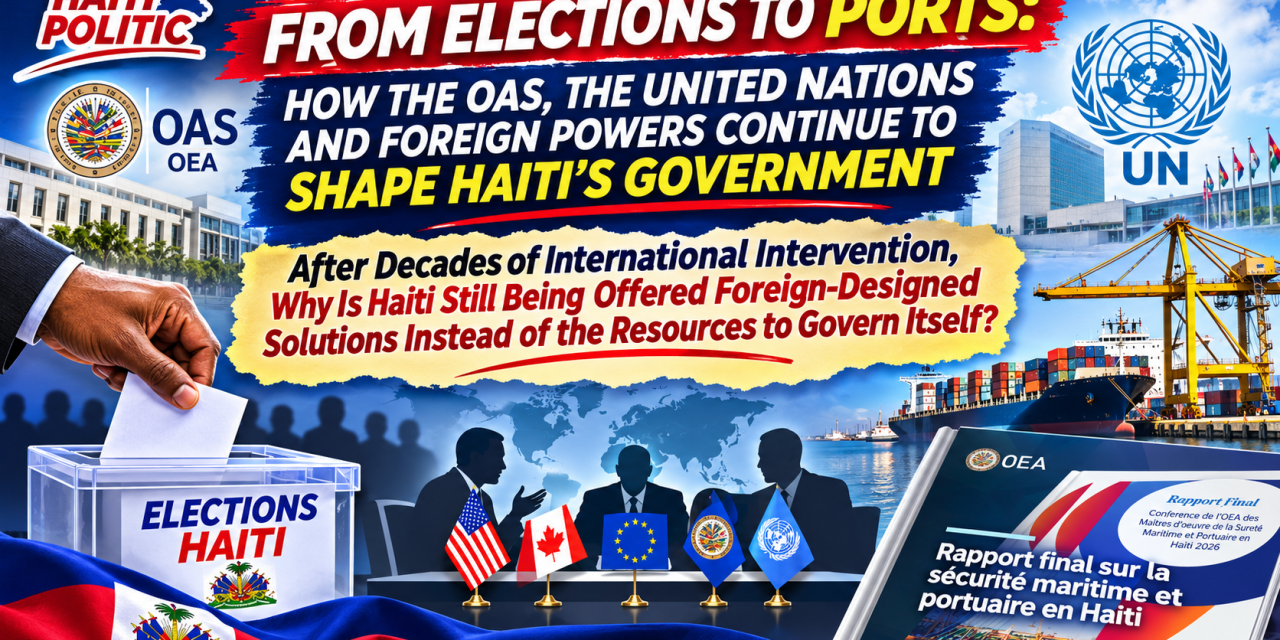
After Decades of International Intervention, Why Is Haiti Still Being Offered Foreign-Designed Solutions Instead of the Resources to Govern Itself?
HAITI POLITIC — SPECIAL INVESTIGATION
November 17, 2026
From the disputed 2010–2011 presidential election to the November 2026 proposal for a new maritime security framework, international organizations have repeatedly positioned themselves at the center of Haiti’s political and institutional crises. The question is no longer simply whether these interventions are intended to help Haiti. It is whether decades of external assistance have strengthened Haitian sovereignty—or perpetuated a system in which foreign institutions retain disproportionate influence over the country’s elections, security, financing and strategic infrastructure.
INTRODUCTION: WHO REALLY DETERMINES HAITI’S FUTURE?
For more than three decades, the Organization of American States (OAS), the United Nations, the United States, Canada and other international partners have played significant roles in Haiti’s political and institutional affairs.
They have participated in electoral observation, political mediation, police training, civil identification, humanitarian assistance, institutional reform and international security operations.
Yet Haiti continues to struggle with political instability, weak public institutions, insecurity, corruption and inadequate national infrastructure.
Now, in November 2026, the OAS has published another proposal—this time concerning the security of Haiti’s ports and maritime trade routes.
The report recommends stronger surveillance, coordinated port-security operations, protection of commercial corridors and new financing arrangements.
It also proposes integrating maritime security cooperation with the broader international security deployment in Haiti.
The proposal raises an uncomfortable historical question:
If international organizations have spent decades assisting Haiti’s government, why does Haiti still lack the institutional capacity to protect its own ports, administer reliable elections and secure its territory?
The answer requires examining the history of international involvement—not merely accepting the latest proposal as another necessary intervention.
It also requires distinguishing documented foreign influence from allegations of deliberate foreign control.
Haiti’s sovereignty cannot be evaluated solely by examining what international organizations say they intend to do.
It must also be evaluated by examining who makes decisions, who controls resources, who determines priorities and who is accountable when programs fail.
PART I — THE OAS HAS BEEN INVOLVED IN HAITI FOR DECADES
1. FROM DIPLOMATIC INTERVENTION TO INSTITUTIONAL ASSISTANCE
Haiti was among the founding members of the Organization of American States in 1948.
However, the OAS’s sustained involvement in Haiti’s modern political crises became particularly visible during the early 1990s.
Following the September 1991 military coup against President Jean-Bertrand Aristide, the organization participated in diplomatic efforts to restore constitutional government.
During the 1990s, the OAS and United Nations jointly operated the International Civilian Mission in Haiti, known as MICIVIH.
The mission focused on human rights monitoring and institutional assistance.
In subsequent years, OAS programs expanded into democratic governance, electoral observation and civil identification.
By the mid-2000s, the organization was involved in supporting the development of Haiti’s national identification system.
This history matters because the OAS is not a newcomer responding to an unfamiliar crisis.
It is an institution with decades of experience participating in Haiti’s political and administrative development.
That experience creates a legitimate expectation of institutional accountability.
What programs were implemented?
How much money was spent?
What improvements were achieved?
Which reforms survived after international assistance ended?
And why do fundamental institutional weaknesses persist?
These questions cannot be answered simply by announcing another technical assistance program.
PART II — THE OAS, THE UN AND HAITI’S ELECTORAL SYSTEM
2. WHO SHOULD CONTROL HAITI’S ELECTIONS?
Under Haiti’s constitutional and electoral framework, responsibility for administering elections belongs to Haitian electoral institutions, principally the Provisional Electoral Council (CEP).
International organizations may provide technical assistance, financing and observation.
But the authority to determine electoral outcomes must remain with Haitian institutions operating under Haitian law.
In practice, however, Haiti’s elections have often depended on international assistance.
That dependence creates an important distinction between formal sovereignty and effective institutional independence.
A country may legally control its elections while remaining dependent on foreign institutions for essential funding, technical systems, logistical support or diplomatic recognition.
When those dependencies become substantial, international partners can acquire influence without formally assuming control of the electoral authority.
This does not establish that every electoral decision is dictated by foreign governments.
It does mean that the structure of international assistance deserves scrutiny.
3. THE OAS AND THE DEVELOPMENT OF HAITI’S NATIONAL IDENTIFICATION SYSTEM
Beginning in 2005, the OAS supported Haiti’s civil identification system through its Universal Civil Identity Program.
That assistance contributed to the establishment and development of the National Identification Office (ONI) and the production of identification documents used in electoral registration.
The objective was to strengthen civil identification and improve the reliability of voter registration.
Yet more than two decades later, access to identification cards remains a major public concern.
In November 2026, public discussion surrounding voter registration again raised questions about the ability of ONI to distribute identification documents efficiently.
This presents a fundamental institutional issue.
Why should Haitian citizens struggle to obtain the identification documents necessary to exercise their voting rights after so many years of institutional assistance?
The OAS’s historical support for ONI does not mean it directly administers the institution today.
Responsibility for current administrative performance belongs to the appropriate Haitian authorities.
Nevertheless, the long-term effectiveness of international assistance should be independently evaluated.
A serious review should examine the funding provided, technology acquired, systems implemented, training delivered and capacity transferred to Haitian administrators.
The purpose should be to establish what worked, what failed and why.
PART III — THE 2010–2011 ELECTION: WHEN INTERNATIONAL INFLUENCE BECAME DECISIVE
4. MIRLANDE MANIGAT, JUDE CÉLESTIN AND MICHEL MARTELLY
The disputed 2010–2011 presidential election remains one of the clearest examples of international involvement influencing a consequential Haitian political decision.
The first round took place on November 28, 2010.
The preliminary results placed former first lady Mirlande Manigat first, government-backed candidate Jude Célestin second and Michel Martelly third.
The results triggered protests and allegations of electoral irregularities.
An OAS expert mission subsequently examined the tabulation process and recommended changes that would place Martelly ahead of Célestin.
The recommendation altered the proposed composition of the presidential runoff.
Martelly ultimately participated in the second round against Manigat and won the presidency.
The role of the United States
During the electoral dispute, Washington exerted diplomatic pressure for the process to move forward in accordance with the internationally supported review.
U.S. Secretary of State Hillary Clinton visited Haiti in January 2011 and met Haitian political leaders.
Her intervention took place during a period of substantial international pressure surrounding the disputed election.
The documented record establishes that the OAS electoral review and U.S. diplomatic pressure influenced the political process that led to Martelly’s participation in the runoff.
However, the stronger allegation that Hillary Clinton personally selected Martelly as president is not established by those facts alone.
Haitian electoral authorities formally administered the election, and voters participated in the runoff.
The central issue is therefore not whether foreign officials physically cast votes.
It is whether the political and diplomatic pressure surrounding the election compromised the independence of Haitian electoral decision-making.
A question that remains relevant in 2026
If an international organization can participate in reviewing disputed electoral results while powerful foreign governments exert diplomatic pressure over the outcome, what safeguards protect the independence of Haitian electoral institutions?
The 2010–2011 experience demonstrates why international election assistance must be examined not only for technical effectiveness but also for its political consequences.
Haiti cannot build lasting electoral legitimacy if citizens believe that foreign diplomatic pressure can determine which candidates advance to the final round.
PART IV — FROM ELECTORAL ASSISTANCE TO POLITICAL DEPENDENCE
5. HOW INTERNATIONAL INFLUENCE CAN OPERATE WITHOUT FORMAL GOVERNMENT CONTROL
Foreign influence does not always require direct administration of another country’s government.
It can operate through financing, technical systems, diplomatic relationships, security cooperation and the conditions attached to international assistance.
In Haiti, several forms of dependence deserve investigation.
Electoral financing
When international partners provide essential election funding, they may influence implementation priorities and timelines.
That influence does not necessarily mean they control electoral results.
But financial dependence can reduce the ability of national institutions to operate independently.
Technical infrastructure
When voter databases, identification systems or electoral technologies depend on foreign technical assistance, questions arise about ownership, maintenance, access and national capacity.
Diplomatic pressure
Foreign governments can influence political negotiations through public statements, diplomatic recognition, sanctions and decisions about assistance.
Security dependence
When national security institutions depend heavily on international deployments, foreign partners may acquire influence over operational priorities and political discussions.
Institutional reform
Externally designed reform programs may shape the structure and procedures of Haitian institutions.
Some reforms may improve governance.
Others may fail to create sustainable domestic capacity.
The critical issue is whether international assistance gradually reduces Haiti’s dependence—or becomes a permanent feature of how the country is governed.
PART V — NOVEMBER 2026: THE OAS TURNS TO HAITI’S PORTS
6. WHY IS THE OAS PROPOSING A MARITIME SECURITY FRAMEWORK NOW?
On November 16, 2026, the OAS announced the publication of a final report addressing maritime and port security in Haiti.
The report followed a conference held in Panama City on March 18–19, 2026.
Canada supported the conference and preparation of the report.
The document identifies weaknesses in maritime surveillance, port protection, institutional coordination, personnel training and security infrastructure.
It proposes several measures, including:
-
A coordinated port-security control structure.
-
Improved maritime surveillance and information sharing.
-
Protection of commercial vessels and transportation corridors.
-
Better personnel screening and professional training.
-
A dedicated financing mechanism for port security.
-
Coordination with the Gang Suppression Force and other security partners.
The recommendations address genuine security vulnerabilities.
But they also raise questions about institutional authority and the future control of Haiti’s strategic infrastructure.
Why now?
The timing is connected to the deterioration of security around commercial routes, the vulnerability of maritime infrastructure and international concerns about trafficking and shipping security.
Yet Haiti’s maritime security weaknesses did not emerge in 2026.
They developed over many years.
That history raises another question:
Why did decades of Haitian government administration and international security assistance fail to produce a maritime security system capable of protecting the country’s principal ports?
A new report should not become a substitute for examining earlier failures.
PART VI — WHO BENEFITS FROM CONTROL OVER HAITI’S PORT SECURITY?
7. PORTS ARE MORE THAN COMMERCIAL FACILITIES
Haiti’s ports are essential to the national economy.
They facilitate the importation of food, fuel, medicine, construction materials and consumer goods.
They also generate customs revenue and support international commerce.
Control over port-security arrangements can provide access to strategically valuable information.
That information may include shipping movements, cargo documentation, commercial activity and security intelligence.
For this reason, maritime security is not merely a technical policing matter.
It is also a question of economic governance and national sovereignty.
The interests of foreign governments
The United States and other regional partners have legitimate interests in secure Caribbean shipping routes and the prevention of illicit trafficking.
Improved security at Haitian ports may benefit regional commerce and reduce risks to foreign vessels.
The interests of international organizations
Organizations participating in maritime security programs may gain additional operational responsibilities and donor-funded activities.
That possibility requires transparent oversight, but it does not by itself prove an improper motive.
The interests of private companies
Port operators, shipping firms, importers, insurers and security contractors may benefit from improved protection.
Companies supplying surveillance technology, vessels, communications systems or consulting services may also receive contracts.
The financial arrangements governing those contracts should be publicly examined.
The interests of the Haitian state
Effective port security could protect customs revenue, reduce trafficking, support economic activity and strengthen national law enforcement.
The crucial question is whether Haitian institutions will retain effective authority over the proposed system.
Improving port security is a legitimate objective. But the existence of a security threat must not become an excuse for arrangements that leave Haiti permanently dependent on foreign institutions to protect its own infrastructure.
PART VII — THE PROBLEM WITH AN INTERNATIONALLY DESIGNED FRAMEWORK
8. HAITIAN LEADERSHIP MUST MEAN MORE THAN A STATEMENT IN A REPORT
International organizations frequently describe their programs as supporting national ownership or Haitian leadership.
But those commitments must be evaluated against the actual distribution of authority.
Who designs the framework?
Who determines operational priorities?
Who controls the financing?
Who chooses equipment suppliers?
Who owns the surveillance technology?
Who manages the intelligence databases?
Who authorizes security operations?
Who audits expenditures?
And who decides when international involvement should end?
These questions determine whether Haitian leadership is substantive or symbolic.
The OAS report does not establish that foreign governments will acquire ownership of Haiti’s ports.
Nor does it prove that the organization intends to take control of the Haitian government.
However, its stated commitment to Haitian leadership does not resolve the concern either.
The real test will be the agreements, contracts, budgets and operational arrangements that determine who exercises authority.
Haiti should not accept a framework merely because it is presented as an international solution.
Its institutions should evaluate whether the proposal serves nationally defined priorities and creates sustainable Haitian capacity.
PART VIII — WHY CAN’T THE HAITIAN NATIONAL POLICE PROTECT HAITI’S PORTS?
9. THE PROBLEM IS NOT THE ABSENCE OF HAITIAN AUTHORITY
Haiti already has institutions responsible for port administration, customs enforcement and maritime security.
The Haitian National Police, including its Coast Guard component, has maritime law-enforcement responsibilities.
The National Port Authority manages public port infrastructure.
The General Customs Administration oversees customs operations and related enforcement functions.
These institutions do not need an international organization to grant them legal authority over Haitian territory.
They need the operational resources and institutional coordination necessary to exercise their responsibilities.
The principal weaknesses
Haiti’s maritime security institutions face significant challenges involving personnel, equipment, maintenance, surveillance capacity and financing.
Insecurity surrounding ports and transportation corridors also complicates operations.
Corruption risks and fragmented coordination can further weaken enforcement.
These problems require long-term institutional investment.
A foreign-designed coordination system may provide technical assistance.
But it cannot substitute for effective national institutions.
The central policy question
Why should Haiti continue relying on externally developed security frameworks rather than establishing a national maritime security strategy led by its own authorities?
International partners could provide equipment, training and financing under Haitian supervision.
The goal should be to make Haitian institutions increasingly capable of operating independently.
The measure of success should be how much security capacity Haiti acquires—not how many international programs remain active.
PART IX — THE MONEY QUESTION
10. WHO WILL FINANCE THE NEW SECURITY SYSTEM?
The OAS maritime report proposes a sustainable financing mechanism for port security.
Among its recommendations is a dedicated fund supported through port-security fees.
Such a mechanism could help pay for equipment maintenance, personnel and infrastructure.
However, the proposal raises important economic questions.
Who would establish the fund?
Who would administer it?
Would private terminal operators contribute?
Would additional charges be imposed on shipping companies and importers?
Could those costs eventually be passed on to Haitian consumers?
Would international organizations exercise oversight over the money?
And would the fund finance activities connected to international security deployments?
The report does not provide a complete financial and legal framework answering these questions.
Canada’s financial involvement
Canada supported the conference that produced the report.
The document also discusses broader Canadian security commitments and regional maritime initiatives.
But financial announcements must be distinguished from actual disbursements and completed projects.
A comprehensive audit should identify money pledged, money transferred, contracts awarded, equipment delivered and operational results achieved.
After decades of international assistance, Haitian citizens deserve more than another announcement about financing. They deserve a transparent accounting of what previous assistance accomplished.
PART X — THE CONNECTION BETWEEN ELECTIONS AND PORTS
11. TWO DIFFERENT SECTORS, ONE FUNDAMENTAL QUESTION
At first glance, electoral administration and maritime security appear to be unrelated.
One concerns democratic representation.
The other concerns national security and international commerce.
But both involve essential functions of a sovereign state.
A government must be able to organize credible elections.
It must also be able to protect its borders, enforce customs laws and secure national infrastructure.
In Haiti, both areas have attracted substantial international assistance.
The OAS has participated in electoral observation and civil identification programs.
The UN has supported electoral institutions and deployed successive missions with security-related mandates.
Now the OAS is proposing additional coordination arrangements for maritime security.
The historical pattern raises an important question:
Are international programs transferring the capacity to govern to Haitian institutions, or are they preserving a system in which essential government functions remain dependent on external assistance?
That is a question about institutional outcomes, not proof of a coordinated foreign conspiracy.
The answer requires examining actual financing, decision-making authority and measurable results.
The 2010–2011 election offers a warning
The disputed election demonstrated how international electoral involvement could become politically consequential.
The OAS review and U.S. diplomatic pressure affected the process through which Martelly advanced to the runoff.
The episode remains relevant because it illustrates the potential consequences of international influence over institutions that should operate independently.
The 2026 port proposal presents another test
If Haiti adopts a new maritime security system, will Haitian institutions control its operations and information?
Will they own the equipment?
Will they supervise procurement?
Will they manage the financing?
And will the program include a credible timetable for reducing foreign dependence?
Without clear answers, the distinction between technical assistance and external influence will remain contested.
PART XI — THE RESPONSIBILITY OF HAITIAN GOVERNMENTS
12. FOREIGN INFLUENCE DOES NOT ERASE DOMESTIC ACCOUNTABILITY
Any serious examination of international involvement must also address the responsibilities of successive Haitian governments.
Haitian political leaders have exercised authority over national budgets, public appointments, procurement and institutional policy.
Corruption, political instability, weak administration and failures to enforce the law have contributed to the deterioration of public institutions.
International organizations cannot be held responsible for every failure of Haitian governance.
But Haitian officials cannot use foreign involvement as an excuse to avoid accountability either.
Both sides should be evaluated according to their actual responsibilities.
Haitian governments should explain why national institutions have remained underfunded or ineffective.
International partners should disclose how their assistance was administered and what measurable outcomes it produced.
Haiti cannot achieve sovereignty merely by criticizing foreign interference. It must also build a government capable of exercising sovereign authority responsibly.
PART XII — WHAT HAITI SHOULD DO DIFFERENTLY
13. DEVELOP A HAITIAN NATIONAL GOVERNANCE FRAMEWORK
Haiti needs a comprehensive national strategy connecting democratic governance, public finance, national identification, electoral administration, policing, customs enforcement and maritime security.
That strategy should be designed through Haitian institutions and subjected to transparent public scrutiny.
Electoral independence
The CEP must be able to administer elections under Haitian law without improper political or diplomatic interference.
National authorities must establish reliable identification and registration systems.
Electoral financing should be transparent, and electoral disputes should be resolved through lawful procedures.
Maritime sovereignty
Haitian institutions must determine port-security priorities and exercise operational authority.
Surveillance systems, intelligence information and equipment purchased for Haitian public institutions should be governed by clear national legal arrangements.
Financial accountability
Public expenditures and international assistance should be subject to independent auditing.
Contracts should identify their beneficiaries, costs and performance requirements.
Institutional capacity
Training and equipment programs should produce measurable improvements in Haitian institutions.
International technical assistance should include a credible transition toward independent national operations.
Democratic oversight
Security and electoral arrangements should remain subject to appropriate Haitian legal and institutional oversight.
International cooperation should help Haiti build the capacity to govern itself—not establish an indefinite system of external supervision.
PART XIII — FIFTEEN QUESTIONS FOR THE OAS, THE UN AND HAITIAN AUTHORITIES
1. After decades of international assistance, why does Haiti remain dependent on foreign-supported electoral and security programs?
2. How much funding has the OAS administered for Haitian electoral and institutional assistance since the 1990s?
3. What measurable results emerged from OAS support for Haiti’s national identification system?
4. What safeguards were adopted after the controversial 2010–2011 electoral review to protect the independence of Haitian electoral authorities?
5. What role did U.S. diplomatic pressure play in the decisions that followed the OAS review of the 2010 presidential election?
6. How much international funding has been committed and disbursed for Haiti’s police, Coast Guard and maritime security institutions?
7. Why have previous assistance programs not produced adequate national maritime surveillance capacity?
8. Who will exercise operational command over the proposed port-security coordination system?
9. Who will own and control the surveillance equipment and intelligence databases?
10. Which companies could receive contracts under the proposed maritime security program?
11. Will private port operators receive protection financed through public or international funds, and what obligations will they assume?
12. Who will manage and audit the proposed port security fund?
13. What operational relationship will exist between Haitian security institutions and the Gang Suppression Force?
14. What independent evaluation will examine the long-term results of OAS and UN assistance to Haiti?
15. What timetable will demonstrate that Haiti can independently administer elections and protect its strategic infrastructure?
CONCLUSION — HAITI MUST STOP BEING GOVERNED THROUGH PERMANENT INTERNATIONAL DEPENDENCE
For decades, Haiti has been the subject of international assistance programs, political missions, electoral observation initiatives and security deployments.
The OAS has participated in important political and administrative processes.
The United Nations has maintained a substantial presence through successive missions.
The United States, Canada and other partners have provided financing, technical assistance and diplomatic support.
Yet Haiti continues to confront institutional weaknesses that many of those initiatives were intended to address.
The disputed 2010–2011 presidential election demonstrated how international involvement could influence major political decisions.
The November 2026 OAS maritime security proposal raises new questions about financing, operational authority and the protection of strategic infrastructure.
These developments do not establish that international organizations secretly control every aspect of Haitian government.
But they provide compelling reasons to examine whether the structure of international assistance has produced sustainable Haitian institutions—or prolonged dependence on foreign resources and decision-making.
The future of Haiti’s elections should not depend on foreign diplomatic pressure.
The protection of Haiti’s ports should not depend indefinitely on internationally designed security systems.
The functioning of Haiti’s government should not require permanent external supervision.
Haitian authorities must assume responsibility for building institutions that are transparent, effective and accountable to the population.
International partners must account for the programs they financed, the decisions they influenced and the results they promised.
The objective should not be isolation from the international community.
It should be cooperation on terms that strengthen Haiti’s independence.
HAITI’S FUTURE MUST BE DESIGNED, FINANCED, GOVERNED AND ACCOUNTED FOR THROUGH HAITIAN INSTITUTIONS.
Haiti does not need another generation of externally managed solutions. It needs the institutional capacity, political accountability and democratic authority to govern itself.
Only Haitians can build a sovereign Haitian state.
HAITI POLITIC — SPECIAL INVESTIGATION
Editorial note: This article combines documented historical events, institutional mandates, the OAS’s November 2026 maritime security recommendations and political analysis. Questions about intentional foreign domination, improper financial benefit or concealed control arrangements remain investigative questions unless supported by specific documentary evidence.