Yonyon’s Letter to Judge Bates Raises Questions About the Martelly–Lamothe Era, Political Relationships, Judicial Corruption, Embassy Visits, and the Continuing Battle for Croix-des-Bouquets
HAITI POLITIC | SPECIAL INVESTIGATION | NOVEMBER 3, 2026
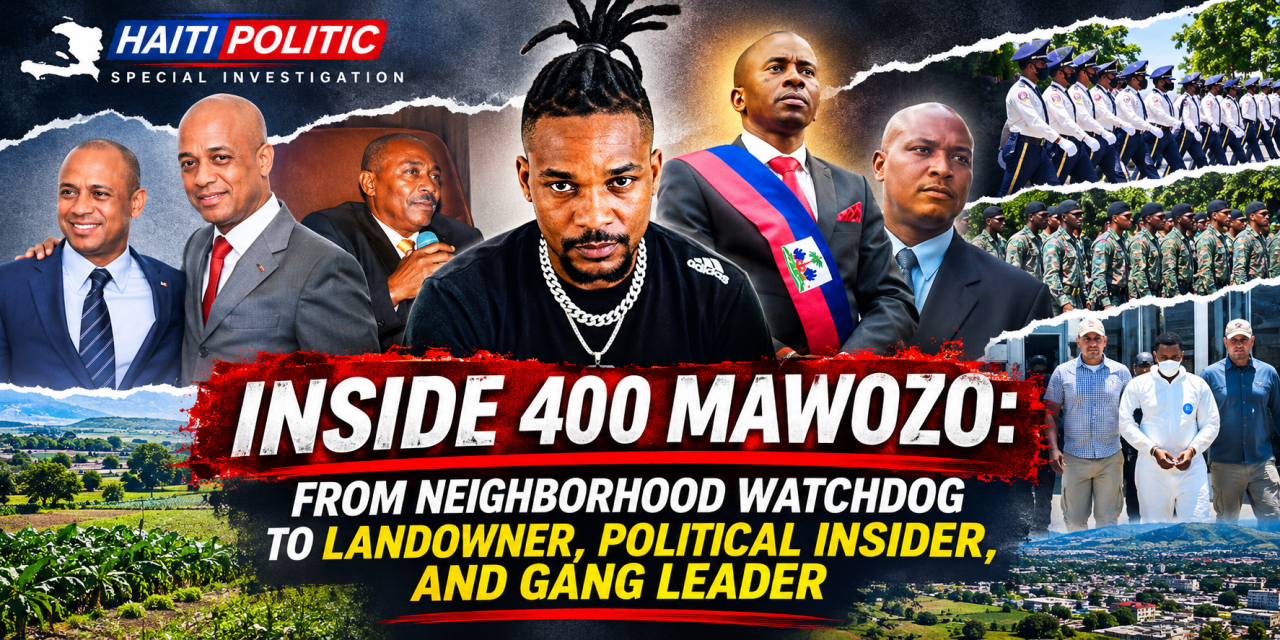
An examination of Joly Germine’s April 16, 2024 letter to U.S. District Judge John D. Bates, the individuals he named, and the historical circumstances surrounding the emergence of 400 Mawozo.
INTRODUCTION — THE LETTER THAT REOPENS THE HISTORY OF 400 MAWOZO
The story of 400 Mawozo is often told through kidnapping, firearms trafficking, extortion, and the organization’s control of territory east of Port-au-Prince.
But a letter written by Joly Germine, widely known as Yonyon, introduces another dimension to that history.
In his April 16, 2024 correspondence to U.S. District Judge John D. Bates, Germine described himself as a former neighborhood security organizer who became a landowner, agricultural entrepreneur, businessman, and participant in Haitian politics.
He also mentioned visiting embassies and traveling to the Dominican Republic and Puerto Rico.
His account raises questions about the relationships between private security, economic interests, political influence, and Haiti’s justice system.
Among the individuals he named were Jean Renel Sénatus, known as Zo Kiki, a former chief prosecutor during the Martelly–Lamothe administration; Mario Bovoi, a prosecutor associated with Croix-des-Bouquets; Judge Djimmy Dubé; and several attorneys and political intermediaries.
Germine accused some of these individuals of participating in improper financial arrangements or political interference.
Those allegations have not been independently established. Sénatus has denied Germine’s accusations.
Nevertheless, the letter offers an investigative starting point for understanding how armed organizations developed influence in communities where public security institutions struggled to maintain authority.
The central question is:
How did an armed network that Germine describes as a neighborhood protection organization become associated with a criminal enterprise capable of controlling roads, intimidating communities, trafficking weapons, and challenging the Haitian state?
And what does that history reveal about the continuing struggle for Croix-des-Bouquets?
PART I — 2011–2012: THE NEIGHBORHOOD WATCHDOG
Yonyon’s account of the organization’s early activities
Germine’s letter begins its account of armed activity around 2011.
He describes residents of La Plaine and surrounding communities experiencing theft, armed robbery, and attacks against their property.
According to Germine, farmers, livestock owners, and businesspeople had become frustrated with the authorities’ inability to provide effective protection.
By 2012, he says, he began organizing young men to confront armed criminals.
He alleges that a former soldier named Jean Claude supplied him with a .38-caliber firearm.
He also claims that a police officer named Wilfrid provided an M1 firearm.
Germine describes acquiring additional weapons using money contributed by local residents and business owners.
He portrays the organization as a neighborhood protection initiative.
The most important aspect of this account is the alleged financing structure: private individuals contributed resources to support armed security outside the formal institutions of the Haitian state.
This arrangement raises questions about accountability.
Who controlled the weapons?
Who determined which communities received protection?
Who supervised the armed personnel?
And what prevented a neighborhood security organization from developing into an independent armed authority?
Germine’s letter does not establish that 400 Mawozo was formally founded in 2012. Other accounts date the organization’s emergence later.
Nor does the letter establish that its early activities were lawful.
But it identifies an environment in which privately financed armed protection allegedly emerged in response to insecurity.
PART II — FROM NEIGHBORHOOD WATCHDOG TO LANDOWNER AND BUSINESSMAN
The passage that changes the investigation
One of the most revealing sections of Germine’s letter concerns his economic activities.
He claims that after the initial period of neighborhood conflict, he began managing extensive landholdings, agricultural operations, and personal business interests.
He then describes becoming involved in politics.
This account is significant because it presents Germine as more than an armed neighborhood organizer.
He portrays himself as someone with property, commercial resources, and relationships beyond his immediate community.
However, the letter does not provide the documentary evidence necessary to establish the extent of those activities.
How much land did Yonyon own?
Germine claims to have controlled extensive parcels of land.
But he does not provide a complete inventory identifying their locations, acreage, purchase dates, acquisition costs, or legal ownership.
This raises several questions.
Were the properties inherited or purchased?
Were they registered in his name?
Were they located in Croix-des-Bouquets, Ganthier, Tabarre, or elsewhere?
Did any of those properties subsequently fall within territory controlled by 400 Mawozo?
And what happened to those properties after his imprisonment?
These questions are especially relevant because Croix-des-Bouquets contains agricultural land, residential communities, and important transportation corridors.
But the existence of landholdings would not establish illegal acquisition.
A land investigation must begin with property titles, not assumptions about criminal ownership.
The agricultural and commercial activities
Germine also describes operating a farm and managing personal business interests.
His account suggests that he regarded himself as an entrepreneur before his imprisonment.
But the letter does not identify the legal structures, employees, revenues, commercial partners, or financial institutions associated with those businesses.
Investigators should determine whether the businesses were registered, whether they maintained financial records, and whether any documented transactions connected them to the armed organization.
The distinction between legitimate business revenue and criminal proceeds is essential.
Germine’s later federal conviction establishes his participation in illegal financial transactions associated with firearms trafficking and gang activity.
It does not automatically establish that every business or agricultural activity he previously described was unlawful.
PART III — YONYON’S TRANSITION INTO POLITICS
Which Haitian politicians did he know?
After discussing his landholdings and business interests, Germine describes becoming involved in politics and interacting with political figures.
This is a significant part of his account.
It suggests that he wanted Judge Bates to understand his activities within a broader political environment.
But the letter does not establish that Germine held elected office, occupied an official party position, or acted on behalf of a particular administration.
The political relationships he describes therefore require independent verification.
The connection to the Martelly–Lamothe era
Germine’s account begins during the presidency of Michel Martelly.
The period also overlaps with the government of Prime Minister Laurent Lamothe.
However, the chronology does not establish that either Martelly or Lamothe personally supported, financed, or directed Germine’s armed activities.
The relevant investigative issue is whether political actors, local intermediaries, or public officials developed documented relationships with armed individuals during that period.
The political gathering scheduled for January 25, 2015
Germine’s letter contains another important detail.
He says he intended to attend a political gathering in Cité Soleil on January 25, 2015.
He describes the gathering as involving candidates opposed to Jean Renel Sénatus.
According to Germine, an associate named Tekyelo, whom he identifies as politically active in Cité Soleil, invited him.
Germine was arrested on January 24, 2015, the day before the planned gathering.
He presents the timing as relevant to his allegation that his arrest was politically motivated.
But the letter does not independently establish that the gathering occurred, that Germine had a formal campaign role, or that the arrest was connected to the event.
These are matters for further investigation.
PART IV — THE EMBASSY CONNECTION: WHICH DIPLOMATIC MISSIONS DID YONYON VISIT?
A revealing but incomplete statement
Germine’s letter includes a reference to visits to embassies.
He also mentions traveling outside Haiti, including to the Dominican Republic and Puerto Rico.
He presents those movements as evidence that he was not attempting to evade law enforcement before his arrest.
The reference raises questions about his international contacts.
But it is important to establish exactly what the document says—and what it does not.
Germine does not identify any embassy by name.
He does not specify whether he visited foreign embassies located in Haiti or Haitian diplomatic missions abroad.
He does not identify an ambassador, consul, diplomatic employee, or government official who met with him.
He also does not establish that his embassy visits were connected to political activities.
Consequently, the letter does not prove that Germine maintained a relationship with a Haitian embassy abroad.
Why the reference deserves investigation
The statement is relevant because Germine also describes political participation and commercial interests.
Investigators should determine whether his embassy visits concerned routine administrative matters, travel documents, visas, commercial activities, or meetings with officials.
The distinction matters.
A visit to an embassy is not evidence of misconduct.
Nor does international travel establish a diplomatic relationship.
However, identifying the missions, dates, and purposes of Germine’s visits could help clarify his movements and activities before January 2015.
The unanswered questions
Which embassies did Germine visit?
When did the visits occur?
Were the visits related to travel documents or commercial transactions?
Did he meet diplomatic personnel?
Were any Haitian officials abroad involved?
And can any of these contacts be verified through independent records?
Until those questions are answered, the embassy reference remains an investigative lead rather than proof of a diplomatic connection.
PART V — JEAN RENEL SÉNATUS: THE MARTELLY–LAMOTHE PROSECUTOR NAMED IN YONYON’S LETTER
Who was Zo Kiki?
Jean Renel Sénatus, known as Zo Kiki, served as Government Commissioner at the Port-au-Prince prosecutor’s office from January 3 to September 27, 2012.
His tenure began under President Michel Martelly and continued into the first months of Prime Minister Laurent Lamothe’s administration.
As Government Commissioner, Sénatus occupied a senior prosecutorial position.
His responsibilities included supervising prosecutions and working with law enforcement.
His tenure ended amid a public dispute with the government.
The controversy surrounding his dismissal
Sénatus alleged that political authorities pressured him to issue arrest warrants against 36 political opponents.
He maintained that he refused to comply.
Government officials disputed his account and provided different explanations for his removal.
The controversy raised questions about prosecutorial independence during the Martelly administration.
But it does not establish that Sénatus participated in the creation or financing of armed groups.
The alleged 2014 firearms arrangement
Germine alleges that an individual named Abraame told him Sénatus had supplied ten firearms.
According to Germine, Abraame subsequently transferred five of those weapons to him.
Germine claims that the alleged arrangement was connected to political support.
He says he refused to support Sénatus.
He further alleges that this refusal contributed to political retaliation and his eventual arrest.
An essential chronological distinction: these allegations concern 2014, approximately two years after Sénatus left the Port-au-Prince prosecutor’s office.
They should not be presented as allegations of firearms transfers carried out while Sénatus held that prosecutorial position.
Sénatus’s response
Sénatus denied Germine’s accusations.
He characterized Germine as a dangerous criminal and defended the law-enforcement operation that led to his arrest.
He also reportedly alleged that Germine had corrupted police officers in Ganthier through regular payments.
These competing accounts raise questions about political relationships, policing, and armed influence.
But neither account establishes the truth of the other’s allegations.
Independent evidence is required.
PART VI — ABRAAME AND THE ALLEGED POLITICAL-WEAPONS CONNECTION
Germine identifies Abraame as an important intermediary.
According to his account, Abraame maintained a relationship with Sénatus and allegedly supplied firearms to Germine.
He also portrays Abraame as a political rival.
Germine claims their dispute concerned political support and influence over local communities.
If independently verified, these allegations could illuminate the relationship between electoral competition and armed influence.
But the letter does not establish Abraame’s full identity or prove that he distributed firearms on behalf of Sénatus.
An investigation should seek communications, witness testimony, campaign records, and evidence concerning the alleged weapons.
PART VII — THE JANUARY 2015 ARREST
Germine says Haitian police arrested him in Ti Goâve on January 24, 2015.
He alleges that officers assaulted him and questioned him about politicians.
He also claims that an officer known as Blan later provided information suggesting political involvement in the operation.
Germine portrays the arrest as retaliation.
Sénatus disputes that interpretation.
He maintains that Germine was the subject of legitimate law enforcement.
The relevant evidence would include arrest warrants, police reports, operational records, and testimony from the officers involved.
The investigation must distinguish allegations of police misconduct from the legal basis for Germine’s detention.
PART VIII — MARIO BOVOI AND THE ALLEGED PAYMENTS WITHIN THE JUSTICE SYSTEM
Germine identifies Mario Bovoi, whom he describes as Government Commissioner in Croix-des-Bouquets.
He alleges that he paid Bovoi $3,000 in connection with efforts to secure his release.
The allegation is relevant because it concerns the judicial jurisdiction associated with the territory where 400 Mawozo later developed substantial influence.
However, Germine’s letter does not establish that Bovoi accepted a bribe or improperly intervened in judicial proceedings.
It also does not establish that Bovoi helped create or protect 400 Mawozo.
The allegation requires independent examination of financial records, official actions, and witness testimony.
PART IX — JUDGE DJIMMY DUBÉ AND THE ALLEGED JUDICIAL ARRANGEMENT
Germine also names Judge Djimmy Dubé.
He alleges that money was requested in connection with efforts to obtain his release.
According to Germine, a woman named Joane Dubé, whom he describes as the judge’s sister, approached him concerning a payment.
He claims that the initial amount was $20,000 and was later reduced to $10,000.
Germine also describes an alleged incident involving inappropriate comments made to his girlfriend.
These are allegations of potential judicial misconduct.
They have not been independently established by the letter.
An investigation would require financial records, testimony, and any relevant judicial or disciplinary proceedings.
PART X — OTHER INDIVIDUALS NAMED IN THE LETTER
Germine describes alleged payments to several individuals involved in his legal proceedings.
He identifies Lemoine Jelen, a government commissioner in Mirebalais, and alleges a payment of $5,000.
He names an attorney called Thelusma and alleges a payment of $7,000.
He describes transferring a taxi truck and additional funds to an attorney named Jacob.
He alleges that his mother entrusted 450,000 gourdes to an attorney named Charles.
He also describes providing 900,000 gourdes to attorney Rebert Cherie.
These claims require careful treatment.
Payments to attorneys can represent legitimate legal fees.
The existence of a payment would not, by itself, establish corruption.
The relevant questions concern the purpose of the transactions and whether any money was intended to influence officials improperly.
Erns Chery and the alleged $150,000 arrangement
Germine also names attorney Erns Chery.
He alleges that Chery claimed connections to Prime Minister Ariel Henry’s administration and requested $150,000 to facilitate his release.
Germine says he paid $50,000 in advance.
He further claims that his involvement in firearms transactions was partly intended to generate additional money.
This allegation raises questions about the relationship between alleged corruption and criminal financing.
But the letter does not establish that Chery received an improper payment or that anyone in the Henry administration participated in wrongdoing.
Germine’s explanation also does not excuse his federal criminal conduct.
PART XI — WHAT THE U.S. FEDERAL COURT RECORD ESTABLISHES
On January 31, 2024, Germine pleaded guilty to federal offenses involving firearms export violations, smuggling, and money laundering.
His signed statement of offense acknowledged participation in a conspiracy involving the movement of firearms from the United States to Haiti.
It also addressed financial transactions involving proceeds of unlawful activity associated with 400 Mawozo, including kidnapping for ransom.
On June 24, 2024, Judge John D. Bates sentenced Germine to 35 years in federal prison.
These findings are essential to understanding the case.
Germine’s account of neighborhood protection, farming, business activities, and political participation does not erase his admitted criminal conduct.
At the same time, his conviction does not independently prove or disprove every allegation he made concerning Haitian public officials.
The court-established crimes and Germine’s disputed allegations must be examined separately.
PART XII — THE TRANSFORMATION OF 400 MAWOZO
The organization associated with Germine eventually became notorious for kidnapping, extortion, firearms trafficking, and territorial control.
The October 2021 kidnapping of 17 North American missionaries brought international attention to the group.
Its activities affected Croix-des-Bouquets and surrounding communities, including strategic transportation routes.
The organization developed the capacity to influence movement, commerce, and public security.
This transformation raises questions about its financing, leadership, access to firearms, and relationships with political or economic actors.
Germine’s letter provides one account of the early history.
But it does not establish a complete chronology of the organization’s development.
Nor does it prove that the armed neighborhood organization he describes in 2012 was identical in membership, structure, or purpose to the criminal enterprise operating years later.
PART XIII — WHY CROIX-DES-BOUQUETS REMAINS STRATEGIC
Croix-des-Bouquets occupies an important position east of Port-au-Prince.
The area connects the capital region to transportation routes leading toward Ganthier, Malpasse, Mirebalais, and the Central Plateau.
Control of these corridors affects commerce, agricultural production, and movement between communities.
Armed groups that dominate strategic roads can impose illegal payments, restrict access, and disrupt economic activity.
The area also contains farmland, businesses, and residential properties.
These characteristics make land ownership and territorial administration relevant to any investigation of armed influence.
The unresolved land question
Germine’s claims about extensive landholdings deserve documentary verification.
Investigators should determine where his properties were located and whether any overlapped with areas later controlled by 400 Mawozo.
They should also examine property disputes, land transfers, and the circumstances under which residents abandoned their homes or businesses.
However, the available letter does not establish that 400 Mawozo was created to protect a specific real-estate project or facilitate illegal land acquisitions.
Such conclusions would require independent evidence.
PART XIV — WILSON JOSEPH AND THE CONTINUING SECURITY CRISIS
Following Germine’s imprisonment, Wilson Joseph, known as Lanmò Sanjou, became the organization’s principal leader.
400 Mawozo continued operating in Croix-des-Bouquets and surrounding areas.
The group has been associated with kidnapping, extortion, and armed confrontation.
Its involvement in broader gang alliances has also affected the security environment.
By 2026, operations involving Haitian and international security personnel had made the region a significant theater of armed confrontation.
The immediate objective of such operations is to confront armed groups and restore public security.
But the longer-term challenge concerns governance.
Who will administer recovered territory?
How will courts and police institutions resume functioning?
How will displaced residents regain access to property?
And how will the state prevent armed organizations from reestablishing control?
PART XV — THE PEOPLE NAMED IN YONYON’S ACCOUNT
| Individual | Connection described | Outstanding investigative question |
|---|---|---|
| Joly Germine (Yonyon) | Armed organizer, claimed landowner and businessman, later convicted in the United States | What independent records establish his early commercial and political activities? |
| Jean Renel Sénatus (Zo Kiki) | Former chief prosecutor under Martelly–Lamothe; later political figure | What evidence supports or contradicts Germine’s disputed allegations? |
| Abraame | Alleged firearms intermediary and political rival | What was his identity and documented role? |
| Jean Claude | Former soldier allegedly supplying a firearm | Can the alleged transfer be verified? |
| Wilfrid | Police officer allegedly supplying an M1 firearm | What was the source of the weapon? |
| Blan | Police officer allegedly discussing Germine’s arrest | Can the account be corroborated? |
| Tekyelo | Political associate who allegedly invited Germine to a gathering | What political organization or campaign was involved? |
| Lemoine Jelen | Prosecutor named in a payment allegation | What was the purpose of the alleged payment? |
| Thelusma | Attorney named in a payment allegation | What services and financial records exist? |
| Mario Bovoi | Croix-des-Bouquets prosecutor named in a payment allegation | Did the alleged transaction occur, and for what purpose? |
| Attorney Jacob | Alleged recipient of a vehicle and funds | What records document the transfer? |
| Attorney Charles | Attorney named in a payment allegation | What was the nature of the transaction? |
| Rebert Cherie | Attorney associated with alleged judicial payments | Were any funds intended for improper influence? |
| Judge Djimmy Dubé | Judge accused in Germine’s account | What independent evidence exists? |
| Joane Dubé | Alleged intermediary in a payment request | Can the alleged communications be verified? |
| Erns Chery | Attorney accused of requesting money for Germine’s release | What evidence supports or contradicts the allegation? |
The individuals listed above have not been established as guilty of misconduct merely because Germine mentioned them.
PART XVI — FIFTEEN QUESTIONS HAITI DESERVES ANSWERED
1. Who financed the armed neighborhood organization Germine describes in 2011–2012?
2. Where were Germine’s alleged extensive landholdings, and who holds legal title to those properties today?
3. What businesses and agricultural operations did Germine manage before January 2015?
4. Which politicians did Germine interact with during the Martelly administration?
5. Did Germine participate in any formal political campaign or organization?
6. Which embassies did Germine visit, and what was the purpose of those visits?
7. Did any Haitian diplomatic official abroad maintain documented contact with Germine?
8. Did Jean Renel Sénatus or anyone acting on his behalf supply firearms to Germine or Abraame in 2014?
9. What do police and judicial records establish about Germine’s January 2015 arrest?
10. Were any Haitian police officers receiving payments from Germine or his associates?
11. Did any judicial officials improperly receive money connected to Germine’s detention or prosecution?
12. When did the neighborhood organization described by Germine evolve into the criminal organization known as 400 Mawozo?
13. What role did control of farmland, commercial property, and transportation corridors play in the organization’s expansion?
14. Did any political or economic actors provide documented financial or logistical support to 400 Mawozo?
15. What institutions will protect residents, property rights, and commercial activity after territory is recovered from armed groups?
CONCLUSION — FROM NEIGHBORHOOD SECURITY TO POLITICAL CONNECTIONS AND TERRITORIAL POWER
Joly Germine’s letter offers a perspective on the early history of armed activity in Croix-des-Bouquets.
He describes organizing neighborhood protection during the Martelly era.
He claims to have accumulated extensive landholdings and operated agricultural and commercial businesses.
He says he became involved in politics and interacted with political figures.
He also mentions visiting embassies and traveling internationally.
His account identifies disputed allegations involving Jean Renel Sénatus and several individuals associated with Haiti’s justice system.
These claims raise important questions about the intersection of private security, economic resources, political relationships, and institutional authority.
But the letter is not proof that the Martelly–Lamothe administration created 400 Mawozo.
It does not establish that Sénatus supplied firearms or participated in criminal activities.
It does not prove that Germine maintained improper relationships with Haitian diplomatic officials.
And it does not establish that the prosecutors, attorneys, or judge he named committed corruption.
Those questions require independent evidence.
What the federal criminal record does establish is Germine’s participation in serious firearms-related and financial crimes associated with 400 Mawozo.
His 35-year prison sentence reflects that criminal responsibility.
The investigation must therefore distinguish the history Germine claims from the conduct established in court.
The most important unanswered question is how armed influence became established and sustained in Croix-des-Bouquets—and whether the institutions responsible for public security, justice, and economic regulation can prevent similar organizations from developing again.
Recovering territory is one part of restoring state authority.
Protecting residents, enforcing the law, resolving property disputes, and ensuring accountability are equally important to a lasting recovery.
HAITI POLITIC — SPECIAL INVESTIGATION
Editorial note: This article examines allegations contained in Joly Germine’s April 16, 2024 letter to Judge John D. Bates. The letter was submitted in connection with his federal sentencing. Allegations against third parties are not treated as established facts. Jean Renel Sénatus has denied Germine’s accusations.