HAITI POLITIC — SPECIAL INVESTIGATION
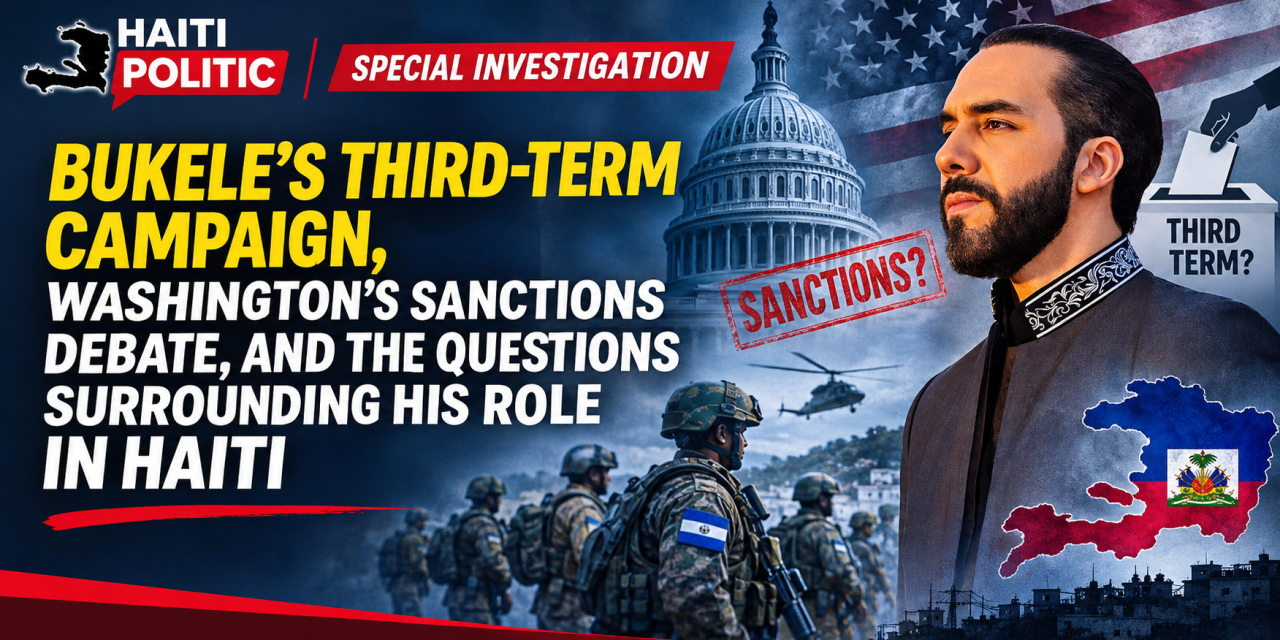
As El Salvador’s president prepares for another election, thousands of Salvadoran troops have entered Haiti, U.S. lawmakers are debating sanctions against his administration, and two governments face growing questions about the legal authority, financing, and objectives of an expanding military operation.
November 5, 2026
THE PRESIDENT, THE ELECTION, AND THE FOREIGN WAR
Nayib Bukele is approaching one of the most consequential political moments of his presidency.
In February 2027, Salvadoran voters are scheduled to elect their next president. Bukele intends to seek another term after constitutional changes removed restrictions that previously prevented indefinite consecutive presidential reelection.
At the same time, his government has dramatically expanded its military involvement in Haiti.
What began as a limited contribution of aviation and medical evacuation personnel to an international security mission has evolved into a deployment involving approximately 2,000 Salvadoran troops, with plans announced for more.
The expansion followed the disappearance of four Salvadoran aviation technicians after an October 18 ambush near Port-au-Prince.
Bukele has described the additional deployment as a rescue operation. Haitian authorities have also presented it as part of broader cooperation against armed gangs.
But the operation raises questions that neither government can resolve through political statements alone.
Who authorized the deployment? Who commands the soldiers? Who is paying? What are their rules of engagement? And when will they leave?
There is also a wider political question.
How does Bukele’s growing military role in Haiti intersect with his presidential campaign, his relationship with Donald Trump, and efforts by some American lawmakers to sanction members of his administration?
The available evidence establishes that these developments are occurring simultaneously.
It does not establish that the Haitian deployment was designed to influence the Salvadoran election or prevent U.S. sanctions.
That distinction is central to this investigation.
PART I — THE THIRD-TERM QUESTION: SECURITY SUCCESS OR CONCENTRATION OF POWER?
Bukele first became president of El Salvador in 2019.
His political reputation has been built largely around an aggressive campaign against criminal gangs.
Under a state of exception introduced in March 2022, Salvadoran authorities conducted mass arrests and expanded military and police operations.
Reported homicide rates declined sharply, contributing to Bukele’s continued popularity.
Supporters credit his administration with restoring freedom of movement and reducing the influence of gangs that previously controlled communities through extortion and violence.
Human rights organizations, however, have documented allegations of arbitrary detention, mistreatment, deaths in custody, and restrictions on due process.
The political debate is therefore not simply about whether violence declined.
It also concerns the legal and institutional costs of achieving that reduction.
A constitutional transformation
In July 2025, lawmakers aligned with Bukele approved constitutional changes permitting indefinite presidential reelection.
The reforms also altered the electoral timetable.
Bukele subsequently secured the nomination of his Nuevas Ideas party for the February 2027 presidential election.
The changes have generated competing interpretations.
Supporters maintain that voters should retain the right to elect a president whose policies they support.
Critics argue that removing presidential term limits weakens constitutional safeguards against the concentration of power.
For Haiti, this debate has particular relevance.
Haitians have experienced repeated constitutional crises, disputed mandates, provisional governments, and political transitions that extended beyond their original timetables.
The Salvadoran experience therefore raises an institutional question:
Can a government’s security accomplishments justify changing constitutional rules that were designed to limit presidential power?
The answer matters beyond El Salvador.
It concerns the relationship between public security, democratic legitimacy, and executive authority throughout the region.
PART II — IS BUKELE LOSING SUPPORT AT HOME?
Recent criticism of Bukele on social media has suggested that he is becoming politically isolated.
Some posts claim that Salvadoran military families oppose the deployment to Haiti.
Others portray the operation as an unnecessary foreign military adventure.
Those claims require examination against available evidence.
An October 2026 CID Gallup survey reported that approximately 86% of Salvadorans approved of the Haiti mission.
At the same time, approximately 82% expressed concern for the Salvadoran personnel involved.
These findings reveal an important distinction.
Public support for a military operation can coexist with substantial anxiety about the safety of the soldiers carrying it out.
Concern among military families does not automatically establish a nationwide collapse in presidential support.
Likewise, strong approval ratings do not eliminate the government’s responsibility to explain why its soldiers are operating abroad.
The questions become especially important when the mission expands from aviation support into a deployment involving thousands of troops.
Salvadoran families have legitimate reasons to demand information about the mission’s objectives, duration, medical support, casualty procedures, and withdrawal conditions.
For Bukele, the operation creates a new test of accountability.
His domestic security policies are being applied to an international environment in which his government does not control the police, courts, prisons, intelligence services, or political institutions.
That difference cannot be overlooked.
PART III — WASHINGTON’S SANCTIONS BILL: S. 2058
While Bukele prepares for another presidential campaign, his administration is also the subject of proposed sanctions legislation in the United States.
On June 12, 2025, Senator Chris Van Hollen introduced S. 2058, the El Salvador Accountability Act of 2025, with Senators Tim Kaine and Alex Padilla as original cosponsors.
The legislation proposes sanctions targeting senior Salvadoran officials and restrictions on certain forms of U.S. assistance.
It emerged amid congressional concerns about human rights, democratic governance, and cooperation between Washington and San Salvador involving people transferred from the United States to Salvadoran detention facilities.
The bill proposes measures including visa restrictions and asset-blocking sanctions.
However, an important distinction must be made.
S. 2058 is proposed legislation. It is not an enacted sanctions law.
The available congressional record shows that it was referred to the Senate Foreign Relations Committee.
There is no verified evidence that it has passed Congress.
Consequently, the bill should not be described as an existing American sanctions order against Bukele.
Why the bill matters
The legislation demonstrates that the Trump administration’s cooperation with Bukele does not enjoy unanimous support in Washington.
Some lawmakers view El Salvador as an important security and migration partner.
Others question the legality, transparency, and human rights implications of that cooperation.
A Congressional Research Service report dated October 6, 2026, identifies additional congressional proposals concerning El Salvador, including H.R. 6878 and measures addressing U.S. funding for Salvadoran detention facilities.
The same report describes closer security and migration cooperation between the Trump and Bukele administrations.
This creates an unusual diplomatic environment.
Bukele is simultaneously a security partner of the American executive branch and the subject of proposed restrictions supported by some American legislators.
But does that mean his involvement in Haiti is intended to protect him from sanctions?
There is currently insufficient evidence to establish such a connection.
An investigation would need to identify communications, agreements, financial arrangements, or other documentary evidence linking the Haitian deployment to the sanctions debate.
Without those records, the connection remains a question rather than a finding.
PART IV — FROM MEDICAL EVACUATION TO THOUSANDS OF SOLDIERS
El Salvador’s participation in Haiti did not begin with the October 2026 ambush.
An official Salvadoran communication to the United Nations dated August 13, 2024, expressed interest in contributing three helicopters and 78 military personnel for medical evacuation operations.
The proposed contribution was limited and specific.
Medical evacuation personnel support security operations by transporting wounded individuals and providing essential aviation capabilities.
They are not necessarily deployed to conduct direct combat operations.
By October 2026, however, the situation had changed dramatically.
Four Salvadoran aviation technicians disappeared following an ambush in the Croix-des-Bouquets area on October 18.
Bukele responded by ordering additional forces into Haiti.
Reuters subsequently reported that approximately 2,000 Salvadoran troops were present by October 28.
El Salvador’s foreign ministry announced plans to send more than 2,000 personnel to support rescue and security operations.
The scale of the deployment immediately raised questions about whether the mission had expanded beyond the original objective of locating the missing technicians.
The central operational problem
A deployment of several dozen aviation personnel is fundamentally different from a deployment involving thousands of soldiers.
The larger operation requires decisions about military command, intelligence coordination, logistics, detention procedures, civilian protection, medical evacuation, and the use of force.
It also raises questions about the relationship between Salvadoran troops and Haiti’s existing security institutions.
Are the soldiers operating under the United Nations-backed Gang Suppression Force?
Are they acting under a separate bilateral agreement?
Do they answer to Salvadoran commanders, Haitian authorities, or an international command structure?
These are not minor administrative details.
They determine who is legally and politically accountable when military operations affect Haitian civilians.
PART V — WHO AUTHORIZED THE DEPLOYMENT?
On October 28, 2026, Haitian Prime Minister Alix Didier Fils-Aimé and President Bukele discussed security cooperation.
The Haitian government described the conversation as reaffirming bilateral coordination within the broader framework of the Gang Suppression Force.
However, subsequent reporting identified continuing uncertainty about the precise legal and operational status of the additional Salvadoran troops.
The United Nations has indicated that most of the newly deployed Salvadoran personnel are not operating within the formal framework of the UN-backed force.
This distinction deserves immediate clarification.
A UN-backed security mission and a separate bilateral military deployment do not necessarily operate under the same legal arrangements, command structure, or accountability procedures.
The Haitian government must therefore explain the legal basis for the Salvadoran presence.
The public deserves to know whether a bilateral agreement was signed, which Haitian authorities approved it, what powers it grants foreign personnel, and how it interacts with existing international security arrangements.
The same questions apply to El Salvador.
Its government should identify the domestic legal authority used to deploy its armed forces abroad.
The legitimacy of a security operation cannot rest exclusively on the assertion that it is necessary. Its legal foundation must also be identifiable.
PART VI — WHO IS PAYING FOR THE OPERATION?
One of the most significant developments came on October 29.
According to Reuters, Bukele stated that his government was covering approximately 90% of the deployment’s costs.
That statement provides an important starting point.
It does not provide a complete financial accounting.
If El Salvador is paying 90%, who is responsible for the remaining 10%?
What expenditures are included in that calculation?
Does the figure cover military salaries, transportation, aviation fuel, equipment, ammunition, intelligence support, medical treatment, insurance, or long-term logistical expenses?
Does Haiti contribute financially?
Are any costs being covered by the United States, international organizations, or private contractors?
And are these expenditures connected to existing international security assistance programs?
These questions require budget documents, contracts, and official financial disclosures.
The available evidence does not establish that Washington is secretly financing the operation or that private companies are profiting from it.
Nevertheless, transparency is particularly important because Haiti already hosts multiple security actors.
Alongside Haitian police and military personnel, international forces are operating in a country where the government has also contracted security services associated with Erik Prince’s company, Vectus Global.
The coexistence of these arrangements creates additional questions about coordination and accountability.
A credible financial investigation must follow actual payments and contracts—not merely political relationships.
PART VII — TRUMP, BUKELE, AND THE POLITICS OF SECURITY
The relationship between Donald Trump and Nayib Bukele is a significant part of this story.
The two administrations have strengthened cooperation on immigration enforcement and security.
In April 2025, Trump hosted Bukele at the White House.
Their governments have also cooperated on arrangements involving individuals transferred from the United States to detention facilities in El Salvador.
These arrangements have attracted congressional scrutiny and legal challenges.
More recently, reporting indicated that Trump expressed support for Bukele following the disappearance of Salvadoran personnel in Haiti.
Axios reported that the two leaders discussed the situation during an October 2026 telephone conversation.
The report also described American support for an expanded Salvadoran deployment.
But diplomatic support is not equivalent to proof of a secret political bargain.
To determine whether Washington influenced the decision to send thousands of troops, investigators would need access to diplomatic communications, funding authorizations, operational agreements, or official statements describing the decision-making process.
Three separate issues must be distinguished:
First, the Trump administration has publicly supported security cooperation with Bukele.
Second, some members of Congress have proposed sanctions and restrictions against his administration.
Third, Bukele has expanded his military involvement in Haiti.
All three are documented developments.
Whether they form part of a negotiated political arrangement remains unproven.
PART VIII — THE MERLO CONNECTION: A QUESTION REQUIRING DOCUMENTARY EVIDENCE
Another issue deserving investigation concerns political advisers and intermediaries operating between Washington, San Salvador, and Haitian political circles.
Damián Merlo has been discussed in connection with regional political relationships involving Bukele and Haitian political figures.
For Haiti Politic, the relevant questions are not simply who knows whom.
The investigation must determine whether any adviser or intermediary participated in discussions concerning the Salvadoran deployment.
Did Merlo attend relevant meetings?
Did he communicate with Salvadoran, Haitian, or American officials about security cooperation?
Did he participate in negotiations involving military assistance, diplomatic recognition, financing, or political commitments?
Did he have any contractual or compensated role?
These questions should be answered through records, interviews, and independently verifiable evidence.
No evidence presented in this investigation establishes that Merlo negotiated the Salvadoran deployment, controlled its financing, or arranged a political exchange involving Bukele and Washington.
Personal or professional connections alone do not establish wrongdoing.
The investigative objective should be to identify any documented role, not to assume one exists.
PART IX — CAN BUKELE’S SECURITY MODEL WORK IN HAITI?
El Salvador and Haiti face different security environments.
Bukele’s domestic campaign against gangs was conducted through Salvadoran state institutions, including the military, police, prisons, courts, and executive government.
In Haiti, Salvadoran forces operate within another sovereign country.
They do not control Haiti’s justice system.
They do not administer Haitian prisons.
They cannot independently reform the Haitian National Police.
They cannot replace the institutions responsible for prosecution, criminal investigations, public administration, and democratic governance.
These limitations matter because military operations alone cannot provide every element required for lasting public security.
A successful security strategy must also address the prosecution of criminal organizations, weapons trafficking, financial networks, territorial control, corruption, and the protection of civilians.
Haiti’s armed groups also operate in a different political and geographical environment.
Many control densely populated urban neighborhoods and have developed relationships with illicit economic networks.
Some recruit minors.
Others use extortion, kidnapping, and territorial violence to finance their operations.
Military tactics developed in El Salvador cannot automatically be transferred to Haiti without adaptation.
There is also a danger in evaluating success solely through arrests or casualties.
An operation may produce short-term tactical gains without restoring functioning courts, public services, or legitimate state authority.
For Haiti, the central objective should be the restoration of effective Haitian institutions capable of maintaining security after foreign troops depart.
PART X — TWO ELECTIONS, TWO DIFFERENT POLITICAL REALITIES
The timing of the deployment adds another dimension.
El Salvador is preparing for its February 2027 presidential election.
Haiti’s Provisional Electoral Council has postponed its own electoral timetable, with the first round of presidential and legislative elections now scheduled for July 18, 2027.
The contrast is significant.
Bukele is seeking another presidential term after constitutional changes expanded his ability to remain in office.
Haiti, meanwhile, is attempting to restore elected government after years of political instability and postponed elections.
Both governments have political interests in demonstrating progress on security.
But those interests are not identical.
For Bukele, the overseas operation creates a new test of his government’s military capabilities and foreign policy.
For Haiti’s transitional authorities, improved security is directly connected to the possibility of holding credible elections.
That creates an important question:
Will the Salvadoran deployment strengthen Haiti’s ability to organize elections, or will it introduce another layer of security authority without clearly defined accountability?
The answer depends on operational results, institutional cooperation, and the legal arrangements governing the mission.
It cannot be determined from political declarations alone.
PART XI — TEN QUESTIONS THAT BUKELE, TRUMP, AND HAITI’S GOVERNMENT SHOULD ANSWER
1. President Bukele: What specific legal authority permitted the deployment of thousands of Salvadoran soldiers to Haiti, and was that authority reviewed by El Salvador’s legislature?
2. President Bukele: What are the precise objectives of the operation beyond rescuing the missing Salvadoran technicians?
3. President Bukele: You stated that El Salvador is covering approximately 90% of the costs. Who is financing the remaining 10%, and will your government publish a detailed budget?
4. President Bukele: What conditions must be satisfied before Salvadoran troops withdraw from Haiti?
5. President Trump: Did the United States formally approve, request, finance, or provide operational support for the expanded Salvadoran deployment?
6. The U.S. Congress: Have lawmakers requested disclosure of communications or agreements concerning the deployment, particularly in light of existing debates about U.S.–El Salvador security cooperation?
7. Haitian Prime Minister Alix Didier Fils-Aimé: What bilateral agreement authorizes the additional Salvadoran troops, and will the complete agreement be published?
8. Haitian authorities: Who exercises operational command over Salvadoran personnel, and what procedures apply if civilians are injured or detained?
9. The United Nations: How does the Salvadoran deployment relate to the Gang Suppression Force, and which personnel fall outside the mission’s formal command structure?
10. All three governments: What measurable outcomes will determine whether the deployment has succeeded, and who will independently verify those results?
PART XII — IS HAITI BECOMING PART OF BUKELE’S POLITICAL STRATEGY?
The timing of Bukele’s military expansion invites political analysis.
He is preparing for another presidential election.
His government is engaged in closer cooperation with Washington.
American lawmakers have introduced legislation proposing sanctions against senior Salvadoran officials.
And thousands of Salvadoran troops have entered Haiti under arrangements that remain insufficiently explained to the public.
These developments create legitimate questions about political incentives.
A successful operation could be presented by Bukele’s administration as evidence of its regional security capabilities.
An unsuccessful or prolonged deployment could generate further questions about military casualties, costs, and the government’s decision-making.
But political consequences should not be confused with proven political motives.
There is no verified evidence that Bukele ordered the Haiti deployment to avoid sanctions, secure Trump’s protection, or improve his position in the 2027 election.
Those theories would require evidence beyond the coincidence of events.
The investigation should therefore concentrate on the documentary record: agreements, expenditures, military orders, diplomatic communications, and measurable operational results.
CONCLUSION — HAITI MUST NOT BE LEFT OUT OF DECISIONS ABOUT ITS OWN SECURITY
Nayib Bukele’s growing military involvement in Haiti is no longer a minor contribution to an international security mission.
It has become a substantial foreign deployment with implications for Haitian sovereignty, Salvadoran military personnel, and regional diplomacy.
The operation takes place while Bukele seeks another presidential term and while Washington remains divided over how to evaluate his administration.
The central issue is not whether Haiti needs help confronting armed gangs.
The country faces a serious security crisis, and international assistance may provide valuable capabilities.
The issue is whether that assistance operates under transparent agreements, lawful authority, clear command structures, and enforceable accountability.
Haitians have a right to know who authorized foreign troops to operate on their territory.
Salvadoran families have a right to know why their relatives have been deployed and what protections they have.
American taxpayers and lawmakers have a right to know whether U.S. resources support the operation.
And all three governments have a responsibility to distinguish public security objectives from political interests.
Haiti’s security cannot become an arrangement in which foreign governments negotiate the terms while Haitian citizens are expected simply to accept the consequences.
The deployment must ultimately be judged by whether it protects civilians, strengthens Haitian institutions, and helps restore legitimate democratic government.
That is the standard against which every participating government should be evaluated.
HAITI POLITIC’S FINAL QUESTION
IS BUKELE HELPING HAITI RESTORE SECURITY, OR IS HAITI BECOMING ANOTHER STAGE FOR INTERNATIONAL POLITICAL AND SECURITY AMBITIONS?
The evidence does not yet establish a definitive answer.
But the agreements, financial records, and operational decisions should be made available so the public can examine them.
Because security without accountability is not a sustainable foundation for national sovereignty.
HAITI POLITIC — FOLLOW THE AGREEMENTS. FOLLOW THE MONEY. DEMAND ACCOUNTABILITY.