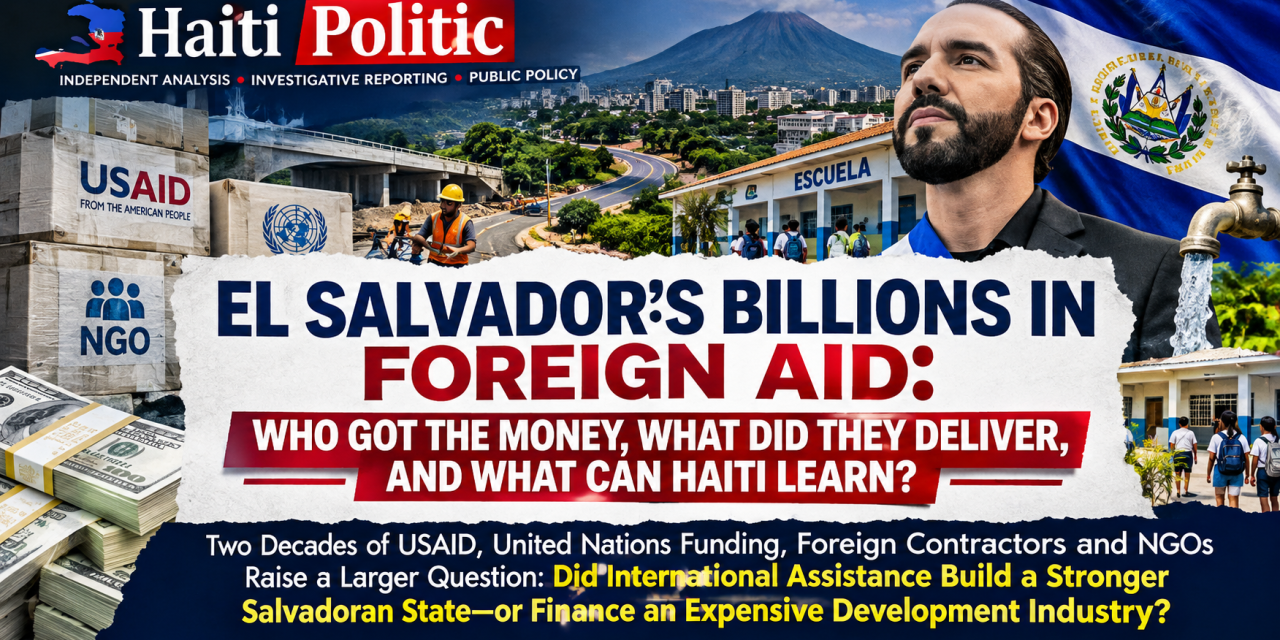
Two Decades of USAID, United Nations Funding, Foreign Contractors and NGOs Raise a Larger Question: Did International Assistance Build a Stronger Salvadoran State—or Finance an Expensive Development Industry?
HAITI POLITIC | SPECIAL INVESTIGATION
November 10, 2026
International Development | Foreign Assistance | Government Accountability
THE BILLIONS-DOLLAR QUESTION
For more than two decades, El Salvador has received billions of dollars in foreign assistance from the United States, European governments, United Nations agencies, international financial institutions, and other development partners.
The money was intended to reduce poverty, strengthen democratic institutions, improve education, create employment, prevent violence, modernize infrastructure, and address the economic conditions contributing to migration.
But after billions of dollars in international assistance, an important question remains:
Who actually received the money, how much was spent administering foreign-funded projects, and what measurable improvements did ordinary Salvadorans receive in return?
The question becomes particularly relevant when examining the political transformation of El Salvador under President Nayib Bukele.
Bukele’s administration has promoted a model of aggressive state intervention against organized crime, centralized decision-making, and national security policies that have attracted international attention and serious human-rights criticism.
Supporters credit his government with dramatically reducing gang violence. Critics question the human cost, constitutional implications, and long-term sustainability of those policies.
Yet another issue receives considerably less attention: the international development industry that operated in El Salvador before and during Bukele’s presidency.
For years, foreign governments financed projects through American consulting firms, international nonprofits, Salvadoran foundations, universities, and multilateral organizations.
Some delivered roads, schools, electricity, drinking water, and other tangible improvements.
Others experienced delays, disappointing economic results, or outcomes that remain difficult to measure.
For Haiti, where foreign assistance has similarly passed through a complicated network of international institutions and nongovernmental organizations, El Salvador offers an opportunity to examine the relationship between foreign financing, national institutions, development, and political sovereignty.
But the comparison must begin with the financial evidence.
I. HOW MUCH FOREIGN AID DID EL SALVADOR RECEIVE?
A preliminary review of historical development-assistance data suggests that El Salvador received approximately $4.8 billion to $5.3 billion in official development assistance between 2006 and 2024.
This is a working estimate, not a fully reconciled accounting of annual disbursements.
The figure includes assistance from multiple international donors and must not be confused with U.S. assistance alone.
Official development assistance can include grants, technical cooperation, humanitarian assistance, and qualifying concessional financing.
It also differs from commercial loans, foreign investment, remittances, and ordinary government borrowing.
The Estimated Financial Picture
| Funding source | Preliminary historical estimate or documented amount |
|---|---|
| Total international ODA, 2006–2024 | Approximately $4.8–$5.3 billion; provisional |
| First U.S. Millennium Challenge Corporation compact | $449.57 million spent |
| Second MCC compact | $277 million originally committed |
| USAID El Salvador portfolio at beginning of 2025 | $1.63 billion in estimated program value |
| U.S. foreign assistance obligations, FY2025 | $138.72 million |
| Complete UN agency expenditures, 2006–2026 | Not yet established |
| Total NGO administrative expenses, 2006–2026 | Not yet established |
These amounts cannot be added together. They cover overlapping programs, different periods, and different financial measurements.
The MCC’s two development compacts are part of the broader foreign-assistance picture, not additional money to be automatically added to the estimated ODA total.
Likewise, the $1.63 billion USAID portfolio represents the estimated value of programs managed at the beginning of 2025—not an additional $1.63 billion in cash delivered that year.
This distinction is essential.
A government may announce a $50 million development program, but the implementing organization may receive only part of that money before the program ends.
The difference between promised funding and actual expenditure can be substantial.
Sources: OECD development-assistance reporting; ForeignAssistance.gov; MCC country reports; USAID Office of Inspector General.
II. THE AMERICAN DEVELOPMENT INDUSTRY: WHO RECEIVED THE CONTRACTS?
One of the most revealing aspects of U.S. foreign assistance is that funding does not necessarily travel directly from Washington to the recipient country’s government.
Instead, American agencies frequently contract private companies and nonprofit organizations to implement projects.
These organizations may manage economic development programs, conduct research, provide technical assistance, train public officials, operate community initiatives, or supervise infrastructure investments.
In El Salvador, identifiable U.S.-funded contractors include:
| Organization | Classification | Documented role |
|---|---|---|
| Palladium International | Private development contractor | Economic competitiveness and development |
| DAI Global | Private development contractor | Development and institutional programs |
| Chemonics International | Private development contractor | Citizen security |
| Creative Associates International | Private development contractor | Development and governance |
| WSP USA Solutions | Private contractor | Technical and development services |
| Nathan Associates | Private contractor | Economic and technical assistance |
| EnCompass | Private contractor | Monitoring, evaluation, and institutional support |
| ARD | Private contractor | Development and technical services |
| Louis Berger Group | Private contractor | Infrastructure and development services |
| Mendez England & Associates | Private contractor | Technical assistance |
These companies are not interchangeable. They have different ownership structures, specialties, contracts, and financial arrangements.
Nor does the existence of a government contract establish wrongdoing.
The legitimate investigative question is whether their publicly funded work delivered results proportionate to its cost.
The Cost of Contracting Development
Consider a $40 million foreign-assistance contract.
The implementing organization may use the money to pay:
-
International and local employees.
-
Technical specialists and consultants.
-
Local subcontractors.
-
Office and transportation expenses.
-
Equipment and project materials.
-
Administrative and indirect costs.
-
Monitoring and evaluation.
-
Direct services to communities.
The entire $40 million is not corporate profit.
Nevertheless, every administrative layer can affect the amount ultimately available for project implementation.
When several organizations participate in the same project, financial transparency becomes even more important.
A U.S. contractor may receive the principal award, subcontract part of the work to another international organization, and then engage local Salvadoran nonprofits.
The public may see the original contract value without seeing how much each intermediary ultimately spent.
That is the accounting gap Haiti Politic considers particularly important.
III. THE NGO NETWORK: INTERNATIONAL NONPROFITS AND SALVADORAN FOUNDATIONS
Private contractors were only one component of El Salvador’s foreign-assistance system.
International NGOs and Salvadoran nonprofit foundations also implemented substantial development programs.
A February 2026 report from the USAID Office of Inspector General identifies several organizations connected to terminated development awards.
Selected USAID-Funded Programs
| Organization | Program | Reported estimated award value |
|---|---|---|
| Palladium International | Economic competitiveness | Approximately $51.7 million |
| Chemonics International | Citizen security | Approximately $43 million |
| Pact | Citizens Empowered | Approximately $35 million |
| Arizona State University | LibrES violence-prevention initiative | Approximately $35 million |
| FEPADE | Education and coexistence | Approximately $20 million |
| Glasswing International and Salvadoran partners | IMAGINA | Approximately $17 million |
| Winrock International | Upper Lempa Watershed | Approximately $12 million |
| Fundación Crisálida | Building Safe Communities | Approximately $10 million |
| Whole Child International | Child protection | Approximately $8.8 million |
These are selected project-value estimates identified in earlier award research, not a complete ranking of all U.S. aid recipients or confirmed amounts disbursed. Individual award amounts require reconciliation against federal award records.
The organizations worked in different sectors, including economic development, violence prevention, education, environmental protection, and child welfare.
Their inclusion does not imply corruption, improper spending, or ineffective implementation.
But the financial structure raises questions that should be answered for every major project.
How much did the lead organization receive?
How much went to local Salvadoran partners?
How much was spent on salaries, consultants, transportation, and administration?
How much financed direct services?
And what measurable outcomes remained after the project ended?
How Many NGOs Received International Funding?
An earlier preliminary estimate suggested that several hundred NGOs may have received international assistance over two decades.
However, no comprehensive, deduplicated recipient database has yet substantiated that number.
Consequently, Haiti Politic cannot responsibly claim that 400, 600, or 900 NGOs received foreign funding without further verification.
The same limitation applies to the total amount of aid managed by NGOs.
A credible count would require matching federal grants, subawards, international donor records, and Salvadoran nonprofit registrations while eliminating duplicate organizational names.
IV. THE UNITED NATIONS: HOW MUCH MONEY REACHED EL SALVADOR?
United Nations agencies also participated in El Salvador’s development and humanitarian assistance system.
Their activities included child protection, migration, refugee assistance, food security, institutional development, and support for vulnerable communities.
Organizations involved in these sectors include UNDP, UNICEF, UNHCR, and the World Food Programme.
However, United Nations financing presents a significant accounting challenge.
A U.S. government contribution may finance a UN program, which then pays an international NGO or local implementing partner.
Counting the original U.S. contribution, the UN expenditure, and the NGO payment as three separate foreign-aid contributions would exaggerate the total.
A Documented Example: UNHCR
UNHCR reported approximately $17.37 million in expenditures associated with its El Salvador operations in 2024.
The reported spending covered protection, assistance, empowerment, and durable solutions.
These categories describe program objectives rather than a complete breakdown of administrative expenses.
The available records do not establish how much of the expenditure was transferred to independent NGOs or how much ultimately reached individual households.
This does not mean the money was wasted.
It means that a complete investigation must follow the financial transactions beyond the first institutional recipient.
The central accountability question is not merely how much money the United Nations reported spending. It is what the money purchased, who delivered the services, and whether the intended beneficiaries experienced measurable improvements.
V. HOW MUCH FOREIGN AID WAS CONSUMED BY ADMINISTRATION?
One of the most frequently debated issues in international development is the cost of managing assistance.
Foreign-funded projects require personnel, financial controls, logistics, auditing, procurement, monitoring, and reporting.
Those functions are not automatically wasteful.
However, excessive administrative layers can reduce the resources available for direct implementation.
The available evidence does not establish a consolidated administrative-expense percentage for all international assistance to El Salvador.
A hypothetical calculation illustrates why the issue deserves scrutiny.
What Administrative Expenses Could Mean for a $5 Billion Portfolio
| Hypothetical administrative rate | Administrative spending |
|---|---|
| 10% | $500 million |
| 15% | $750 million |
| 20% | $1 billion |
| 25% | $1.25 billion |
| 30% | $1.5 billion |
These figures are illustrations, not findings about actual Salvadoran aid expenditures.
It would be misleading to claim that NGOs consumed $1 billion in administrative expenses merely by assuming a 20% rate.
A defensible investigation requires actual financial statements and award-level expenditure reports.
For private contractors, profit must also be distinguished from operating costs.
For nonprofit organizations, administrative expenses should be distinguished from legitimate program delivery costs.
The appropriate measure is not simply whether an organization employed administrators.
It is whether the cost of administration was reasonable in relation to independently verified results.
VI. WHAT DID SALVADORANS ACTUALLY RECEIVE?
The strongest evidence of measurable development results comes from the Millennium Challenge Corporation.
Between 2007 and 2012, MCC spent approximately $449.57 million under its first El Salvador compact.
The program supported transportation, electricity, drinking water, education, and productive development.
Documented Results
According to MCC:
35,412 families gained access to electricity.
Approximately 7,600 households were connected to potable water.
223 kilometers of roads were constructed, improved, or rehabilitated.
Twenty-three bridges were constructed or improved.
The program also supported educational facilities and assistance to farmers and small producers.
These are tangible achievements.
A household connected to electricity has received a measurable benefit.
A community receiving potable water infrastructure has obtained a public asset.
A road connecting isolated communities can improve access to markets, schools, and medical services.
The existence of such improvements demonstrates that foreign assistance can deliver useful infrastructure.
But physical completion does not automatically establish economic success.
The Road Project That Fell Short of Expectations
MCC’s independent evaluation of its northern El Salvador connectivity project offers a particularly important example.
The $268 million project improved roads and bridges, but traffic volumes were lower than projected.
The evaluation found that the project’s estimated economic rate of return had fallen dramatically—from an original projection of 23.9% to approximately 0.2% at compact closeout.
Construction costs also exceeded initial expectations, and parts of the original road-improvement plan were canceled or reduced.
The result was a mixed picture.
The infrastructure existed and reduced travel times, but the projected economic benefits were substantially weaker than expected.
This distinction between completed infrastructure and actual economic return should be central to every foreign-aid evaluation.
Source: MCC, Connecting Northern El Salvador Through Road Improvements, April 2022.
VII. EDUCATION: MEASURABLE PROGRESS, BUT NOT EVERY EXPECTED RESULT
MCC’s second compact, implemented between 2015 and 2020, included major investments in education and workforce development.
The program supported teacher training, school construction, educational reforms, and efforts to improve students’ transition from middle school to secondary education.
MCC reported that more than 4,500 teachers, school directors, and education specialists received training.
By the end of 2021, 47 schools had been constructed or rehabilitated, and approximately 77,578 students were enrolled in MCC-supported schools.
An independent evaluation published in 2024 found positive effects on students’ transitions from middle school to high school.
However, the evaluation did not find consistent improvements in academic achievement.
It also found no measurable effects on several middle-school indicators, including grade progression, repetition, and dropout rates.
These findings illustrate the complexity of development assistance.
A program may improve school attendance or transitions without producing equally strong improvements in academic performance.
It may deliver buildings and training without resolving deeper problems involving educational quality, household poverty, or employment opportunities.
The proper conclusion is neither that the entire program failed nor that every dollar produced the intended result.
The evidence supports a more precise assessment: some objectives were achieved, while others were not.
VIII. THE $1.63 BILLION USAID PORTFOLIO: WHAT HAPPENED IN 2025?
Perhaps the most revealing financial discovery comes from the USAID Office of Inspector General’s February 9, 2026, audit.
At the beginning of 2025, USAID’s El Salvador mission managed 66 programmatic awards with a combined estimated value of $1.63 billion.
The programs addressed economic opportunities, citizen security, government accountability, migration, and institutional development.
Following the Trump administration’s foreign-assistance review, all 66 awards were terminated.
This raises an important question:
How much of the $1.63 billion had already been spent, and how much represented future obligations that would never be disbursed?
The Inspector General’s report does not provide a complete answer.
Its primary purpose was to examine the disposition of physical assets associated with terminated programs.
What the Auditors Found
The audit identified 18 terminated awards with reported priority assets.
Auditors selected nine awards for detailed examination.
Those nine awards contained 40 priority assets purchased for approximately $1.1 million.
The assets had an estimated fair-market value exceeding $780,000 at the time of review.
The assets included vehicles, equipment, and other program-related property.
The auditors found that the selected assets were donated or retained according to USAID-approved disposition plans.
They did not identify discrepancies between the reported asset inventories and approved plans.
This is an important finding.
The audit does not demonstrate that $1.63 billion disappeared.
Nor does it establish that all terminated programs were effective.
It documents a narrower issue: the management and disposition of selected government-funded assets following the termination of development awards.
The broader financial question remains unresolved: how much of the $1.63 billion portfolio was actually disbursed, and what outcomes were achieved before termination?
Source: USAID Office of Inspector General, Report I-000-26-001-P, February 9, 2026.
IX. DID FOREIGN AID HELP DEFEAT EL SALVADOR’S GANGS?
This question requires separating development policy from security policy.
For years, U.S.-funded programs in El Salvador supported citizen security, violence prevention, community development, youth opportunities, and institutional reforms.
Those activities were intended, in part, to address the conditions associated with criminal recruitment and violence.
Yet El Salvador continued to experience severe gang-related insecurity for much of that period.
The country’s security situation subsequently changed dramatically under President Bukele.
His administration expanded policing, imposed a prolonged state of exception, and carried out mass arrests.
Supporters point to falling homicide rates and the restoration of access to communities previously dominated by gangs.
Human-rights organizations have raised serious concerns about arbitrary detention, due process, prison conditions, and abuses associated with the security crackdown.
Both dimensions matter.
A decline in homicide rates is an important public-safety outcome.
But it does not eliminate the need to examine the legality, proportionality, and sustainability of the methods used.
Nor does the available evidence establish that international NGOs caused the security improvements.
The same caution applies to claims that foreign assistance was entirely irrelevant.
Some earlier programs may have improved institutions, community services, or economic conditions without directly producing the subsequent nationwide reduction in violence.
The central analytical mistake would be to confuse the success or failure of individual development projects with the effectiveness of an entirely different national security strategy.
X. BUKele’S EL SALVADOR AND THE QUESTION OF NATIONAL OWNERSHIP
El Salvador’s experience raises a larger political question about who should control national development priorities.
Foreign assistance can provide financing, expertise, equipment, and institutional support.
But international donors often determine which programs qualify for funding, which organizations receive awards, and which performance indicators define success.
Recipient governments may participate in project design while still depending heavily on external financial decisions.
The Millennium Challenge Corporation provides an important counterexample to the idea that all foreign assistance bypasses national institutions.
Its El Salvador compacts were implemented through Salvadoran accountable entities, including FOMILENIO, in partnership with the Salvadoran government.
This structure gave national institutions a direct role in managing major investments.
Other programs relied more heavily on international contractors and nonprofit implementers.
Neither model guarantees success.
The relevant questions are whether national institutions acquire lasting capacity, whether public assets remain functional, and whether governments can sustain the services after donor funding ends.
A foreign-funded school that continues serving students for decades may represent a lasting investment.
A temporary consulting project that ends without transferring skills or institutional capacity may offer a much weaker return.
The ultimate measure of development assistance should be the capacity a country retains after the foreign organization leaves.
XI. WHAT DOES THIS MEAN FOR HAITI?
Haiti and El Salvador have different histories, political institutions, security conditions, and relationships with international donors.
Their experiences should not be treated as interchangeable.
Nevertheless, both countries raise questions about the relationship between foreign assistance and national development.
For decades, Haiti has received international financing intended to strengthen institutions, improve education, expand healthcare, rebuild infrastructure, reduce poverty, and address insecurity.
Much of that assistance has involved foreign governments, UN agencies, international NGOs, and private implementing organizations.
The existence of these intermediaries does not automatically demonstrate waste or corruption.
But it creates an obligation to account for the money.
For Haiti, the essential questions are straightforward.
How much international assistance was actually disbursed?
How much was transferred directly to Haitian public institutions?
How much was managed by international contractors and NGOs?
How much was subcontracted to Haitian organizations?
What percentage financed administration and consulting?
How much resulted in permanent infrastructure?
How many schools, hospitals, water systems, roads, and public institutions remain operational because of those investments?
And how much national capacity survives when international projects close?
The Comparison Haiti Needs
| Accountability question | El Salvador | Haiti |
|---|---|---|
| Total international assistance | Billions documented; complete period requires reconciliation | Requires equivalent reconciliation |
| Foreign contractor involvement | Documented | Documented |
| International NGO involvement | Documented | Documented |
| Direct national implementation | Documented in major MCC programs | Requires project-level comparison |
| Permanent infrastructure outcomes | Several measurable MCC results | Requires comparable outcome inventory |
| Administrative spending | No consolidated percentage established | No comparable consolidated figure established here |
| Security outcomes | Major changes under Bukele, with significant rights concerns | Continuing security and institutional challenges |
| Long-term institutional sustainability | Mixed evidence across programs | Requires independent evaluation |
This comparison should not begin with the assumption that one country’s foreign assistance succeeded and the other’s failed.
It should begin with independently verifiable financial and development indicators.
XII. FOREIGN AID IS NOT THE SAME AS NATIONAL DEVELOPMENT
International assistance can finance useful projects.
It can also create complicated financial relationships involving donors, contractors, nonprofit organizations, consultants, government agencies, and local partners.
A successful development program should leave something valuable behind.
That value may be physical infrastructure, improved public services, stronger institutions, better educational outcomes, or increased economic opportunity.
But measuring success solely by the amount of money spent is inadequate.
A $50 million program is not successful merely because the entire budget was disbursed.
A nonprofit organization is not effective merely because it employed hundreds of people.
A government agency is not strengthened merely because international consultants conducted training sessions.
And a development project should not be declared a failure simply because its results are less visible than a new road or bridge.
The appropriate standard is evidence.
What was the original objective?
How much money was spent?
Who received it?
What changed?
Was the improvement independently verified?
And did the benefit survive after the funding ended?
Those questions should apply equally to foreign contractors, nonprofit organizations, multilateral institutions, and recipient governments.
XIII. THE ACCOUNTABILITY QUESTIONS THAT REMAIN
The available evidence identifies major funding streams, important implementing organizations, and several measurable development outcomes.
But it does not yet provide a complete financial accounting of two decades of international assistance to El Salvador.
Haiti Politic identifies ten questions requiring further investigation:
1. Where is the complete recipient-level accounting of international assistance to El Salvador between 2006 and 2026?
2. How much of the estimated multibillion-dollar assistance total was actually disbursed, rather than merely committed?
3. Which 25 private contractors and NGOs received the largest cumulative U.S. government payments during this period?
4. How much funding did those organizations transfer to Salvadoran subcontractors and local nonprofit partners?
5. What were their actual administrative expenses, indirect costs, and—in the case of private contractors—profits?
6. Which projects produced independently verified improvements in education, employment, public safety, healthcare, and infrastructure?
7. Which programs failed to meet their original objectives, and what explanations did the implementing organizations provide?
8. How much of the foreign assistance helped establish permanent national institutions rather than temporary donor-funded projects?
9. What happened to the unspent balances and unfinished activities associated with USAID’s $1.63 billion portfolio after the 2025 terminations?
10. What lessons can Haiti draw from El Salvador without overlooking the differences between the two countries or the human-rights implications of Bukele’s security policies?
These questions are not allegations of wrongdoing.
They are basic requirements of public financial accountability.
CONCLUSION: BILLIONS SPENT, RESULTS DELIVERED—BUT THE FULL ACCOUNTING IS STILL MISSING
El Salvador’s foreign-aid history cannot be reduced to a simple story of success or failure.
The evidence shows that international assistance helped finance roads, bridges, electricity connections, drinking-water systems, schools, and education programs.
Some investments produced measurable benefits.
Others fell short of economic projections, experienced implementation delays, or delivered mixed results.
The evidence also shows that substantial U.S. assistance passed through private contractors, international nonprofit organizations, universities, and Salvadoran foundations.
What remains unresolved is the complete financial distribution of that assistance.
How much money did each organization ultimately receive?
How much was spent on administration?
How much reached local implementing partners?
How much created permanent national assets?
And how much produced independently measurable improvements in people’s lives?
These questions become even more important when foreign assistance is presented as a solution to insecurity, poverty, institutional weakness, and political instability.
For Haiti, the lesson should not be that all international assistance is harmful.
Nor should it be that foreign financing alone can solve the country’s problems.
The stronger lesson is that international assistance must be judged by what it leaves behind, not by how much money donors announce or how many organizations they finance.
A country cannot measure its development solely by the size of its foreign-aid portfolio.
It must measure development through functioning institutions, accountable public finances, sustainable infrastructure, productive economic activity, access to essential services, and the ability of its citizens to live safely under the rule of law.
El Salvador’s experience raises an important question for Haiti’s political leaders, international partners, and civil society.
If billions of dollars can pass through a country’s development system without a single easily accessible public accounting of every major recipient and measurable outcome, who is ultimately responsible for demonstrating that the money achieved its purpose?
That responsibility belongs to donors, implementing organizations, and recipient governments alike.
And until those records are reconciled, the public deserves something more substantial than promises, announcements, and project photographs.
It deserves the accounts.
HAITI POLITIC | RESEARCH NOTES AND PRIMARY SOURCES
1. U.S. Agency for International Development — Office of Inspector General
Terminated USAID Awards in El Salvador: Assets Were Disposed of According to USAID-Approved Plans.
Report I-000-26-001-P, February 9, 2026.
Documents the $1.63 billion estimated USAID portfolio, 66 terminated awards, and asset-disposition findings.
2. Millennium Challenge Corporation
El Salvador Compact — Closed Compact Report.
Documents the first compact’s $449.57 million expenditure and infrastructure outcomes.
3. Millennium Challenge Corporation
Connecting Northern El Salvador Through Road Improvements.
Independent evaluation, April 2022.
Examines road construction, traffic volumes, costs, and economic returns.
4. Millennium Challenge Corporation
Improving Education Quality in El Salvador.
Independent evaluation, May 2024.
Examines school infrastructure, student transitions, and educational outcomes.
5. ForeignAssistance.gov
U.S. government foreign-assistance database.
Provides country-level obligations, disbursements, implementing partners, and annual reporting.
6. OECD Development Assistance Committee
Creditor Reporting System and official development-assistance statistics.
Provides internationally comparable donor and recipient financial data.
7. United Nations — El Salvador Country Team
Annual results and financial reporting.
Provides information about UN-supported programs, implementing agencies, and development activities.
8. UNHCR
El Salvador Annual Results Report, 2024.
Provides agency-level financial and operational reporting.
HAITI POLITIC — Independent Political Analysis and Investigative Reporting
Editorial disclosure: This investigation distinguishes documented expenditures, estimated project values, preliminary aggregate estimates, and independently evaluated outcomes. The available evidence does not establish that the named organizations engaged in financial misconduct. Additional recipient-level financial records are necessary to determine total administrative costs and final cumulative disbursements.
© 2026 Haiti Politic