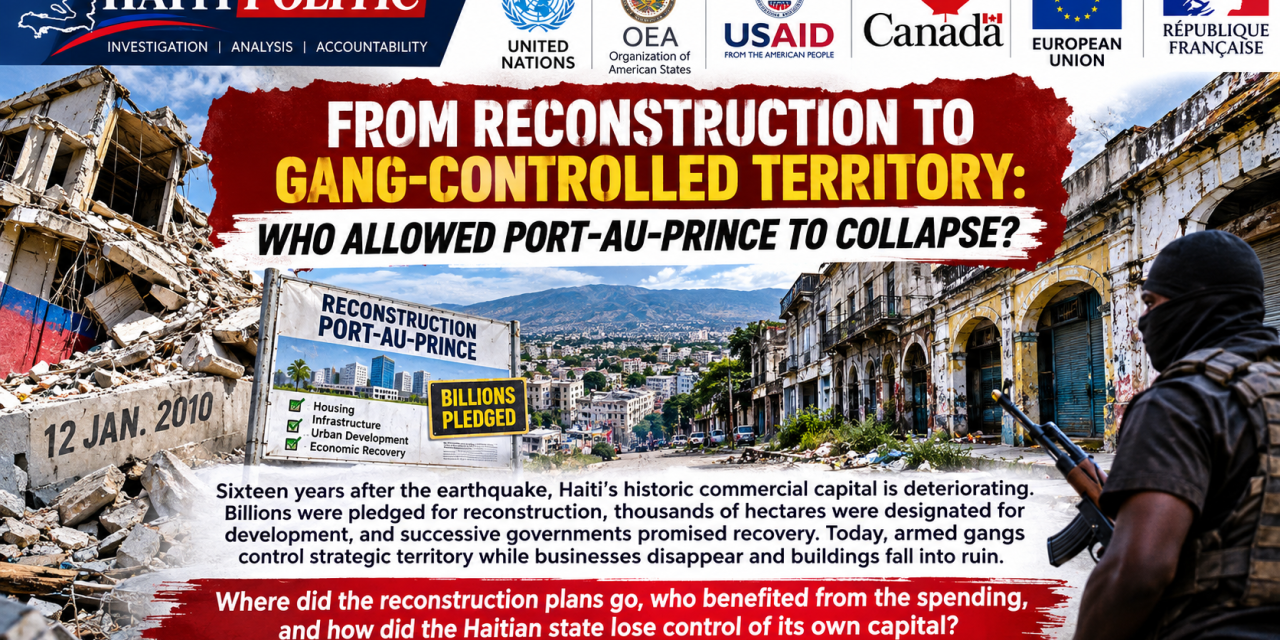
Sixteen years after the earthquake, Haiti’s historic commercial capital is deteriorating. Billions were pledged for reconstruction, thousands of hectares were designated for development, and successive governments promised recovery. Today, armed gangs control strategic territory while businesses disappear and buildings fall into ruin. Where did the reconstruction plans go, who benefited from the spending, and how did the Haitian state lose control of its own capital?
HAITI POLITIC | SPECIAL INVESTIGATION
November 11, 2026
INTRODUCTION: THE CITY THAT HAITI WAS SUPPOSED TO REBUILD
Walk through parts of downtown Port-au-Prince today, and the consequences of Haiti’s prolonged national crisis are impossible to ignore.
Grand-Rue, historically one of the capital’s most important commercial corridors, has experienced severe economic disruption. Buildings damaged by the 2010 earthquake remain part of a deteriorating urban landscape. Insecurity has forced businesses to close or relocate, displaced residents, and undermined public services.
Yet the deterioration of Port-au-Prince did not begin with the latest wave of gang violence.
It developed through overlapping crises involving weak institutions, political instability, disputed property rights, incomplete reconstruction, inadequate public investment, arms trafficking, and the growing economic power of organized criminal groups.
After the earthquake of January 12, 2010, Haiti was promised reconstruction.
The Haitian government announced major development initiatives. International donors pledged billions of dollars. Reconstruction agencies, foreign governments, humanitarian organizations, and private contractors became involved in rebuilding the country.
But sixteen years later, the contrast between the ambitions of reconstruction and the condition of the capital demands a serious investigation.
How did a city that was supposed to be rebuilt become a territory where armed groups can challenge the authority of the state?
And perhaps more importantly:
Did Haiti’s reconstruction failures, political relationships with armed groups, and the financial interests surrounding the capital contribute to the conditions that allowed criminal organizations to expand?
The answer requires following three interconnected histories: the reconstruction of Port-au-Prince, the transformation of its economy, and the rise of armed territorial control.
PART I — THE 2010 EARTHQUAKE AND THE RECONSTRUCTION THAT NEVER FULLY MATERIALIZED
1. January 12, 2010: The disaster that changed the capital
The earthquake devastated Port-au-Prince and surrounding communities.
Government offices collapsed. Commercial buildings were destroyed. Public infrastructure suffered extensive damage. Hundreds of thousands of people lost their homes.
Approximately 1.5 million people were displaced in the immediate aftermath.
The disaster also disrupted the Haitian government’s already limited administrative capacity.
Property records, municipal services, government offices, and economic activity were affected.
For the Haitian state, reconstruction required much more than rebuilding houses.
It required restoring the capital’s economic infrastructure, strengthening public institutions, resolving property disputes, and creating a functioning urban development strategy.
The government and international donors recognized these needs.
The problem was translating reconstruction plans into coordinated, lasting results.
2. The March 2010 land expropriation initiative
Under President René Préval, the government issued a declaration of public utility on March 22, 2010, affecting approximately 5,000 hectares north of Port-au-Prince.
The designated area included land associated with Corail-Cesselesse and the broader Canaan development zone.
The government intended to facilitate emergency relocation and longer-term urban expansion.
The development concept included housing, roads, water systems, sanitation, schools, healthcare facilities, and economic opportunities.
The Corail-Cesselesse relocation camp opened in April 2010.
However, the government’s intervention created complicated legal questions.
A declaration of public utility is not automatically equivalent to completed expropriation.
Haitian law requires procedures concerning property ownership and compensation.
The government needed to identify legitimate owners, establish the legal status of affected parcels, and complete the applicable compensation process.
Questions concerning those steps became part of the broader controversy surrounding development north of the capital.
The unanswered questions
Were all affected properties legally acquired?
Were original owners compensated?
Which government agencies managed the process?
Were private development rights recognized or extinguished?
Did subsequent governments modify or revoke the declaration?
A definitive answer requires examining the original declaration, later publications in Le Moniteur, land records, compensation files, and relevant court decisions.
The available evidence does not justify claiming that every parcel was legally expropriated or that every owner remained uncompensated.
Nevertheless, unresolved land tenure became a major obstacle to orderly development.
3. Canaan and Corail-Cesselesse: From planned development to informal expansion
The government’s original vision was to establish organized communities outside the most heavily damaged areas of Port-au-Prince.
Instead, Canaan expanded rapidly through informal settlement.
Families constructed homes in areas where roads, drainage systems, electricity, public administration, and other essential infrastructure were insufficient.
Property transactions and ownership claims became difficult to regulate.
As the population increased, the state struggled to establish effective municipal administration and public services.
Over time, parts of the broader northern metropolitan area also became affected by armed-group expansion.
The consequences illustrate a critical failure of governance.
The government identified land for development but did not establish a comprehensive, enforceable system of land administration, infrastructure investment, and long-term urban management across the expanding settlement.
The result was not simply an unfinished housing project.
It was an urban development problem that continued to grow.
PART II — THE RECONSTRUCTION MONEY: WHAT WAS PROMISED, WHAT WAS FUNDED, AND WHAT WAS BUILT?
4. The $3.3 billion plan for Port-au-Prince
In August 2011, a redevelopment concept for Port-au-Prince was presented following approximately fourteen months of work by Haitian architects, engineers, planners, and other professionals.
The proposal envisioned a transformed capital.
Its major elements included:
-
A reconstructed government district near Champ de Mars.
-
A modern financial and commercial district.
-
Waterfront redevelopment.
-
Improved transportation infrastructure.
-
Tourism and cultural facilities.
-
An artisans’ village.
-
New public spaces and urban infrastructure.
The estimated cost was approximately $3.3 billion over five years.
But an important distinction must be made.
The $3.3 billion represented a proposed development cost, not proof that $3.3 billion was approved, collected, or spent.
A World Bank retrospective documented the proposal but did not identify a committed outside sponsor for the entire plan.
That raises a fundamental question.
Why did such an ambitious redevelopment proposal fail to produce the comprehensive transformation originally envisioned?
Was the problem financing?
Political leadership?
Administrative coordination?
Land ownership?
Or the absence of an institution capable of implementing the plan over successive administrations?
These questions deserve answers supported by government records.
5. The Haitian government’s 2014–2016 investment plans
During the Martelly administration, Haiti’s public investment strategy included substantial proposed spending on urban renewal and government reconstruction.
The government’s planning documents identified approximately:
| Investment category | Planned amount |
|---|---|
| Urban renewal nationwide | 24.67 billion gourdes |
| Modernization and relocation of central government administration | Approximately 24 billion gourdes |
| Reconstruction and strengthening of democratic institutions | Approximately 3.6 billion gourdes |
| Public administration modernization and decentralization | Approximately 6 billion gourdes |
| Justice and public safety | Approximately 7.5 billion gourdes |
These were national planning figures.
They cannot be presented as money specifically spent on downtown Port-au-Prince.
Nevertheless, they demonstrate that urban reconstruction and institutional modernization were included in government investment priorities.
Even more revealing, Haiti’s revised 2014–2015 public investment budget identified projects specifically involving downtown Port-au-Prince.
These included demolition and debris management within a downtown pilot reconstruction perimeter, along with rehabilitation of roads and drainage systems.
The publicly available budget extract does not establish the complete amounts ultimately spent on those specific activities.
This is where a serious financial investigation should begin.
The Ministry of Economy and Finance, Ministry of Planning, Ministry of Public Works, and relevant implementing agencies should be able to identify project codes, contracts, payment records, and completion reports.
6. The $65 million neighborhood reconstruction project
The Haiti Reconstruction Fund approved approximately $65 million for the Port-au-Prince Neighborhood Housing Reconstruction Project, commonly known as PREKAD.
The project supported housing recovery and infrastructure improvements in selected neighborhoods.
It involved the World Bank and Haiti’s Bureau de Monétisation des Programmes d’Aide au Développement.
A related initiative, PRODEPUR Habitat, received approximately $30 million in financing.
These projects addressed important post-earthquake needs.
But they were not equivalent to a comprehensive rebuilding program for Grand-Rue or the entire historic commercial center.
Their approved financing also cannot automatically be treated as verified final expenditure.
The relevant completion reports must be examined to determine what was disbursed and delivered.
7. The 16/6 program and the Martelly administration
Another prominent reconstruction initiative was the 16/6 project.
Supported by approximately $30 million from the Haiti Reconstruction Fund, the program sought to rehabilitate sixteen neighborhoods and facilitate the return of displaced families from six camps.
International organizations participated in implementation.
The program addressed displacement, housing, and neighborhood rehabilitation.
However, camp closure and housing assistance are not the same as reconstructing a major commercial district.
The distinction matters.
A government can report progress in reducing displacement while still failing to restore the infrastructure and economic activity necessary for a city’s long-term recovery.
8. What happened to U.S. reconstruction funding?
The United States was a major reconstruction partner.
The U.S. Government Accountability Office reported that Congress provided approximately $1.14 billion in supplemental reconstruction funding following the earthquake.
Of the $651 million USAID was responsible for implementing, approximately $336 million had been obligated and $229.5 million disbursed by June 30, 2013.
These figures concerned reconstruction activities across Haiti.
They do not represent spending exclusively in downtown Port-au-Prince.
The GAO documented implementation challenges, including delays and sustainability concerns.
The broader lesson is that large financial commitments do not necessarily produce completed infrastructure on the original schedule.
To understand what happened in downtown Port-au-Prince, investigators must distinguish between money pledged, approved, obligated, disbursed, and actually spent on completed work.
The central financial question
How much money was specifically spent rebuilding Grand-Rue, Champ de Mars, the waterfront, and the historic commercial district between 2010 and 2026?
The available records do not establish one reliable consolidated figure.
That absence of a readily traceable total is itself an important transparency problem.
It is not, however, proof that the money was stolen.
PART III — THE POLITICAL ECONOMY OF ARMED GANGS
9. Gangs did not emerge from the earthquake
Armed political violence existed in Haiti long before January 2010.
Over several decades, certain armed groups developed relationships with political actors.
Some politicians and politically connected individuals have been accused of providing money, weapons, or protection to armed organizations in exchange for electoral influence, intimidation, or territorial control.
The IMF’s 2025 governance diagnostic discusses historical connections among politically exposed persons, economic actors, and armed groups.
The critical issue is that armed organizations can evolve beyond the control of their original sponsors.
A group that initially depends on political financing may eventually develop independent criminal revenue.
Once it controls roads, markets, neighborhoods, or commercial access, it can collect money directly.
At that point, its relationship with political actors may change.
Instead of serving politicians, armed groups can become independent centers of power capable of pressuring politicians and the state itself.
This evolution helps explain why gang violence cannot be addressed exclusively through police operations.
Financial networks and political protection must also be investigated.
10. Territorial control became a criminal business model
Port-au-Prince is not merely Haiti’s political capital.
It is also a major commercial and transportation center.
Control over strategic streets, markets, intersections, and access routes can provide criminal organizations with opportunities to extract revenue.
Armed groups may impose illegal payments on merchants, transportation operators, and residents.
They can interfere with the movement of goods and disrupt access to important economic infrastructure.
This creates a cycle:
Territorial control generates revenue. Revenue sustains armed organizations. Armed organizations acquire weapons and maintain territorial control.
But the system contains a destructive contradiction.
The more violence and extortion increase, the more legitimate economic activity disappears.
Merchants close their businesses.
Customers stop visiting.
Transport operators avoid dangerous routes.
Property owners abandon buildings.
Investors withdraw.
Eventually, the same territory that once generated commercial wealth becomes economically devastated.
This is one plausible mechanism connecting gang territorial control to the deterioration visible in parts of downtown Port-au-Prince.
11. Why Grand-Rue matters
Grand-Rue, officially Boulevard Jean-Jacques Dessalines, historically served as a major commercial corridor.
Its importance extended beyond individual stores.
The surrounding commercial ecosystem depended on warehouses, markets, transportation routes, suppliers, customers, and employees.
When security deteriorates, these activities are disrupted simultaneously.
A business cannot function normally if employees cannot reach the workplace, suppliers cannot deliver merchandise, and customers fear traveling through the neighborhood.
A building may remain physically standing while losing its economic purpose.
Over time, prolonged vacancy and insufficient maintenance accelerate deterioration.
Vegetation grows around structures.
Waste accumulates.
Infrastructure deteriorates.
The street loses the commercial activity that once supported its upkeep.
The physical decline of Grand-Rue is therefore both a consequence of insecurity and evidence of the collapse of the economic systems that previously sustained it.
However, the exact causes of abandonment must be established property by property.
Some buildings may have remained damaged since the earthquake.
Others may have deteriorated later because of insecurity, fire, economic decline, ownership disputes, or prolonged vacancy.
It would be inaccurate to attribute every abandoned building to gangs without examining its history.
PART IV — WHO SUPPLIED THE WEAPONS?
12. Arms trafficking and the militarization of criminal organizations
Haiti does not possess a major domestic firearms manufacturing industry.
Yet armed groups have obtained increasingly powerful weapons.
United Nations reporting has identified illicit firearms trafficking routes involving the United States, the Dominican Republic, and other countries.
Weapons can also enter criminal circulation through theft or diversion from legitimate stockpiles.
A 2025 UN assessment estimated that approximately 270,000 to 500,000 illegal firearms were circulating in Haiti.
That estimate does not mean all those weapons belonged to gangs.
Nevertheless, it demonstrates the scale of the illicit firearms problem.
The availability of weapons allows armed organizations to challenge police operations, attack rival groups, intimidate civilians, and defend territory.
This raises questions about customs enforcement, border controls, financial investigations, and international cooperation.
Who purchases the weapons? Who pays for transportation? Who organizes the shipments? Who receives them? And who protects the trafficking networks?
These questions are essential because territorial control depends on a continuing supply of weapons, ammunition, and financing.
PART V — THE COLLAPSE OF STATE AUTHORITY
13. The disappearance of government institutions
A state does not control territory simply because its police occasionally enter a neighborhood.
Effective territorial authority requires functioning institutions.
Police must be able to operate.
Courts must prosecute crimes.
Public administration must maintain records.
Municipal authorities must provide services.
Businesses must be able to operate legally.
Residents must be able to exercise their property rights.
When these institutions become inaccessible or ineffective, armed organizations can impose coercive systems of control.
The IMF’s governance analysis describes how gangs have developed informal mechanisms of territorial administration and influence.
The problem is not that these organizations provide legitimate government.
It is that the absence of effective public institutions allows coercive power to replace lawful authority.
A neighborhood is not genuinely recovered when armed groups are temporarily pushed out. It is recovered when residents can live, work, travel, and seek justice without criminal permission.
14. Political instability after 2021
The assassination of President Jovenel Moïse in July 2021 intensified Haiti’s institutional crisis.
Successive transitional arrangements struggled to restore stable political authority.
Armed groups expanded their influence during a period of weakened state capacity.
The emergence of the Viv Ansanm alliance allowed previously competing organizations to coordinate some operations against government positions and neighborhoods outside their control.
United Nations experts documented the alliance’s territorial expansion, forced displacement, and attacks against civilians.
UN reporting in 2025 estimated that armed groups controlled approximately 90% of metropolitan Port-au-Prince at that time.
That figure was a historical estimate and should not automatically be treated as the precise situation in November 2026.
The broader conclusion remains significant.
The Haitian state experienced a severe loss of territorial authority while armed organizations developed the capacity to coordinate operations across large parts of the metropolitan area.
PART VI — DID FAILED RECONSTRUCTION CREATE OPPORTUNITIES FOR GANG EXPANSION?
15. The relationship between urban neglect and insecurity
It would be incorrect to argue that the 2010 reconstruction failures directly created Haiti’s armed gangs.
The historical record does not support such a simple explanation.
However, incomplete reconstruction may have contributed to conditions that increased urban vulnerability.
These conditions included:
-
Damaged and abandoned buildings.
-
Inadequate roads and drainage.
-
Unresolved property ownership.
-
Limited municipal services.
-
Economic displacement.
-
Weak public administration.
-
Insufficient investment in vulnerable neighborhoods.
Such conditions do not automatically produce criminal organizations.
But when they exist alongside political instability, illicit financing, and weak law enforcement, they can make communities more vulnerable to armed-group expansion.
The relationship is therefore indirect but important.
Failed reconstruction weakened the urban environment. Armed violence then accelerated economic abandonment and physical deterioration.
The two processes reinforced each other.
16. The connection between Canaan and downtown Port-au-Prince
Canaan and Grand-Rue represent different aspects of Haiti’s urban crisis.
Canaan illustrates the difficulties of large-scale settlement without adequate land administration, infrastructure, and public services.
Grand-Rue illustrates the deterioration of an established commercial district affected by disaster, economic disruption, and insecurity.
These are not identical problems.
Nevertheless, they share a common institutional weakness.
Successive governments struggled to establish durable systems of urban planning, property administration, infrastructure investment, and territorial governance.
The result was an expanding metropolitan area in which the state’s administrative presence often failed to keep pace with changing conditions.
This institutional weakness created opportunities for criminal organizations, although it does not establish that any particular reconstruction project or landowner financed gang activity.
PART VII — WHO BENEFITED FROM THE CRISIS?
17. The economic consequences of commercial displacement
When a commercial district becomes unsafe, economic activity does not simply disappear.
Some businesses close permanently.
Others relocate.
Customers change shopping habits.
Transportation routes shift.
Warehouses and distribution centers move.
Commercial opportunities may emerge elsewhere.
Property values may fall in abandoned neighborhoods while demand increases in safer locations.
These developments can create winners and losers.
However, a crucial distinction must be maintained.
An individual or business benefiting from commercial relocation is not automatically responsible for causing the insecurity that produced it.
Any allegation that a political figure, developer, property owner, or commercial enterprise deliberately financed gang violence to influence property values or commercial activity requires specific evidence.
That evidence could include financial transfers, communications, contracts, ownership records, or corroborated witness testimony.
Without such evidence, the claim remains a hypothesis.
18. What happened to private development interests in Corail-Cesselesse?
The northern development area also attracted private commercial and real-estate interests.
Projects associated with NABATEC are relevant to the history of land development around Corail-Cesselesse.
But an investigation must establish the exact parcels involved, their ownership history, their relationship to the March 2010 declaration, and any subsequent legal disputes.
Questions about private development rights are legitimate.
So are questions about whether government officials had financial or administrative interests in the affected land.
However, the existence of those interests does not establish involvement in gang financing or territorial expansion.
A responsible investigation must separate documented property relationships from unproven allegations.
PART VIII — THE ROLE OF HAITI’S FINANCIAL AND JUDICIAL INSTITUTIONS
19. Where should an anti-corruption investigation begin?
The deterioration of Port-au-Prince is not simply a matter for the Haitian National Police.
It also raises questions about public spending, procurement, financial oversight, and accountability.
Several institutions have important responsibilities.
The CSCCA
The Cour Supérieure des Comptes et du Contentieux Administratif is Haiti’s constitutional institution responsible for important aspects of public financial oversight and administrative litigation.
Its role is especially relevant to reconstruction spending, public contracts, and government accountability.
Investigators should determine whether the CSCCA reviewed downtown reconstruction expenditures and whether its findings led to corrective action.
The ULCC
The Unité de Lutte Contre la Corruption investigates corruption-related conduct within its legal mandate.
It can play a role in examining suspected misconduct involving public officials and public resources.
The UCREF
The Unité Centrale de Renseignements Financiers is central to financial intelligence and the identification of suspicious financial activity.
Investigations into money laundering and the financial networks supporting organized crime require cooperation among financial intelligence authorities, law enforcement, and prosecutors.
The CNMP
The Commission Nationale des Marchés Publics is relevant to public procurement oversight.
Its records can help establish how government contracts were awarded and whether applicable procurement procedures were followed.
The judiciary
Investigative findings must ultimately be supported by lawful prosecution and judicial proceedings where criminal conduct is alleged.
Administrative audits, corruption investigations, and criminal prosecutions are distinct processes.
None can simply replace the others.
Haiti does not lack institutions on paper. Its central challenge is ensuring that those institutions can function independently, coordinate effectively, and produce enforceable results.
PART IX — WHICH GOVERNMENTS SHOULD ANSWER?
20. The Préval administration: The reconstruction framework
President René Préval’s administration governed during the immediate aftermath of the earthquake.
It initiated emergency relocation measures and the March 2010 declaration of public utility.
The administration should be examined for the legal and financial structure of the original reconstruction framework.
Key questions include how land was selected, how ownership was verified, and how compensation obligations were managed.
21. The Martelly administration: Implementation and investment
President Michel Martelly inherited the reconstruction challenge in May 2011.
His administration promoted housing, infrastructure, and urban redevelopment initiatives.
The 2014–2016 investment strategy included substantial proposed allocations for urban renewal and government reconstruction.
The central question is what happened between planning and implementation.
Which downtown projects received actual financing?
Which contractors were paid?
Which projects were completed?
And what happened to the original redevelopment ambitions?
22. The Privert administration: Continuity and accountability
Jocelerme Privert served as provisional president from 2016 to 2017.
His administration inherited unresolved reconstruction, land administration, and institutional problems.
An investigation should establish whether his government reviewed outstanding reconstruction contracts, expropriation disputes, and financial accountability issues.
A short provisional presidency does not carry the same implementation responsibilities as a full presidential term.
Nevertheless, continuity of government includes responsibility for addressing inherited institutional problems.
23. The Moïse administration: Security and urban governance
President Jovenel Moïse governed from 2017 until his assassination in 2021.
His administration confronted worsening political conflict and armed violence.
Investigators should examine the government’s security strategy, financial investigations, arms-trafficking enforcement, and policies for protecting commercial activity.
The question is not whether every gang emerged during his presidency.
It is whether the government’s actions effectively limited the growth of armed organizations.
24. The post-2021 transitional authorities
Successive transitional authorities inherited an increasingly severe security crisis.
Their responsibilities included restoring public order, maintaining government institutions, protecting civilians, and coordinating security assistance.
Their performance should be evaluated against measurable outcomes.
How much territory was recovered?
How long did security gains last?
How many displaced residents returned safely?
Were courts and public services restored?
Did businesses reopen?
A government cannot claim durable success simply because it announces an operation. It must demonstrate that lawful civilian life has returned.
PART X — THE FOREIGN AID AND RECONSTRUCTION ACCOUNTABILITY QUESTION
25. Did international reconstruction financing create a system of dependency?
The international response to Haiti’s earthquake involved numerous foreign governments, development banks, humanitarian organizations, and private contractors.
Not all reconstruction assistance passed through the Haitian treasury.
Some funding was administered directly by international institutions.
Other funds supported Haitian government programs.
This fragmented structure complicated public accountability.
Haitian citizens could see the total amounts pledged internationally without necessarily having access to consolidated records showing who received the money and what was delivered.
That does not establish that foreign aid caused Haiti’s gang crisis.
But it raises legitimate questions about institutional dependency and accountability.
When public services depend heavily on externally managed projects, the government may struggle to develop durable administrative capacity.
Similarly, when reconstruction projects end without sustainable maintenance arrangements, infrastructure can deteriorate.
The central question is whether international assistance strengthened Haitian institutions or left behind projects that depended on continued external intervention.
A serious investigation should examine both successful and unsuccessful programs.
26. Who received the reconstruction contracts?
To follow the money, investigators need to identify the companies and organizations that implemented reconstruction projects.
For each contract, the public should know:
-
The contracting authority.
-
The contractor and relevant subcontractors.
-
The original contract value.
-
Any amendments or cost increases.
-
The amount actually paid.
-
The project’s physical location.
-
The work completed.
-
The agency responsible for inspection.
-
The maintenance arrangements.
-
Any audit findings or legal disputes.
These records would allow investigators to distinguish between ineffective planning, implementation failure, waste, and possible criminal misconduct.
Those are different findings and should not be confused.
PART XI — THE QUESTIONS HAITI’S LEADERS MUST ANSWER
Twenty questions for a national investigation
Reconstruction and land administration
1. What happened to the $3.3 billion redevelopment proposal for Port-au-Prince presented in 2011?
2. How much money was actually appropriated and disbursed for downtown reconstruction between 2010 and 2026?
3. Which companies received contracts for debris removal, road rehabilitation, drainage, and public infrastructure?
4. Which downtown projects were completed, suspended, canceled, or never started?
5. What is the present legal status of the approximately 5,000 hectares designated for public purposes in March 2010?
Government accountability
6. Did the CSCCA audit major reconstruction contracts and expenditures?
7. Were audit recommendations implemented?
8. Did any reconstruction-related investigations result in criminal proceedings or administrative sanctions?
9. Which ministries were responsible for maintaining reconstructed infrastructure?
10. Why was a comprehensive redevelopment strategy for downtown Port-au-Prince not sustained across administrations?
Gang financing and territorial control
11. Which political or economic relationships with armed groups have been established through credible evidence?
12. What are the principal documented sources of revenue for gangs controlling metropolitan territory?
13. Which financial institutions and government agencies are investigating money laundering linked to armed organizations?
14. What evidence exists concerning arms-trafficking networks supplying gangs?
15. Why have armed organizations been able to maintain control over strategically important commercial routes?
Economic deterioration and recovery
16. How many businesses have closed or relocated from downtown Port-au-Prince since 2010?
17. How many commercial buildings remain vacant, damaged, or inaccessible because of insecurity?
18. What happened to the ownership and occupancy of properties along Grand-Rue?
19. What is the government’s current plan for restoring the historic commercial center?
20. How will the government ensure that recovered territory remains under lawful civilian administration rather than returning to gang control?
CONCLUSION — PORT-AU-PRINCE WAS NOT DESTROYED BY ONE CRISIS
The deterioration of Port-au-Prince cannot be explained by a single president, a single earthquake, a single international organization, or a single armed group.
It reflects the accumulation of institutional failures and criminal violence over time.
The earthquake devastated the capital’s physical infrastructure.
Incomplete reconstruction left important urban and economic needs unresolved.
Weak land administration complicated development.
Political relationships helped some armed organizations gain resources and influence.
Arms trafficking increased their capacity for violence.
Criminal territorial control disrupted commercial activity.
Political instability weakened the state’s ability to respond.
And prolonged insecurity accelerated the abandonment of neighborhoods and businesses.
These developments reinforced one another.
But the distinction between documented facts and unresolved allegations remains essential.
The existence of reconstruction failures does not prove that reconstruction money financed gangs.
The existence of political relationships with armed groups does not establish that every administration or political figure sponsored them.
The relocation of businesses does not prove that property owners or developers deliberately created insecurity.
Those claims require specific evidence.
What is already clear is that Haiti’s capital has suffered a prolonged failure of public security, urban governance, and economic recovery.
The challenge is not merely to remove armed groups from streets. It is to restore the institutions, economic opportunities, and public services that make lawful civilian life possible.
That means investigating financial networks, enforcing arms-trafficking laws, strengthening judicial accountability, resolving property disputes, and developing a realistic plan to rebuild downtown Port-au-Prince.
It also means holding reconstruction authorities accountable for what they promised, what they spent, and what they delivered.
THE FINAL QUESTION
If Haiti’s government and international partners spent sixteen years promising to rebuild Port-au-Prince, why does the capital still lack the security, infrastructure, and functioning institutions necessary to protect its historic commercial center?
The answer will not be found in political speeches or military announcements alone.
It will be found in public contracts, land records, financial transactions, court files, reconstruction reports, and the testimony of the people who lived through the city’s decline.
Port-au-Prince needs more than another promise of reconstruction. It needs a documented accounting of the past and a credible plan for restoring its future.
DOCUMENTARY SOURCES AND RESEARCH REFERENCES
1. World Bank — Haiti: What Did We Learn?
Post-earthquake housing and urban reconstruction, including the proposed $3.3 billion Port-au-Prince redevelopment concept.
https://documents1.worldbank.org/curated/en/699481494923590147/pdf/115025-WP-PUBLIC-haiti-what-did-we-learn.pdf
2. Government of Haiti — Revised Public Investment Budget, 2014–2015
Official investment document identifying downtown demolition, debris-management, and infrastructure rehabilitation projects.
https://budget.gouv.ht/storage/app/uploads/public/5f4/212/0b1/5f42120b13c6b613970892.pdf
3. World Bank — PREKAD Implementation Completion and Results Report
Documentation concerning the Port-au-Prince Neighborhood Housing Reconstruction Project.
https://documents1.worldbank.org/curated/en/338511510321829472/pdf/Implementation-Completion-and-Results-Report-Port-au-Prince-Neighborhood-Housing-Reconstruction-P125805-11012017.pdf
4. U.S. Government Accountability Office — Haiti Reconstruction
Reviews of U.S. reconstruction funding, implementation challenges, and sustainability concerns.
https://www.gao.gov/products/gao-13-558
5. International Monetary Fund — Haiti Governance Diagnostic, 2025
Analysis of governance weaknesses, corruption risks, political-economic relationships, and organized criminal activity.
https://www.elibrary.imf.org/view/journals/019/2025/039/article-A001-en.xml
6. United Nations Security Council — Panel of Experts on Haiti, 2025
Reporting on armed organizations, territorial control, security challenges, and illicit networks.
https://digitallibrary.un.org/record/4091504
7. United Nations Office on Drugs and Crime — Haiti Security and Criminal Markets Reporting
Research concerning firearms trafficking, organized crime, and territorial control.
https://www.unodc.org/
8. Haiti Reconstruction Fund — Project and Financial Reporting
Project approvals, implementing agencies, and reconstruction financing.
https://www.haitireconstructionfund.org/
HAITI POLITIC — SPECIAL INVESTIGATION
Independent political analysis, public accountability, and the questions Haiti’s leaders must answer.