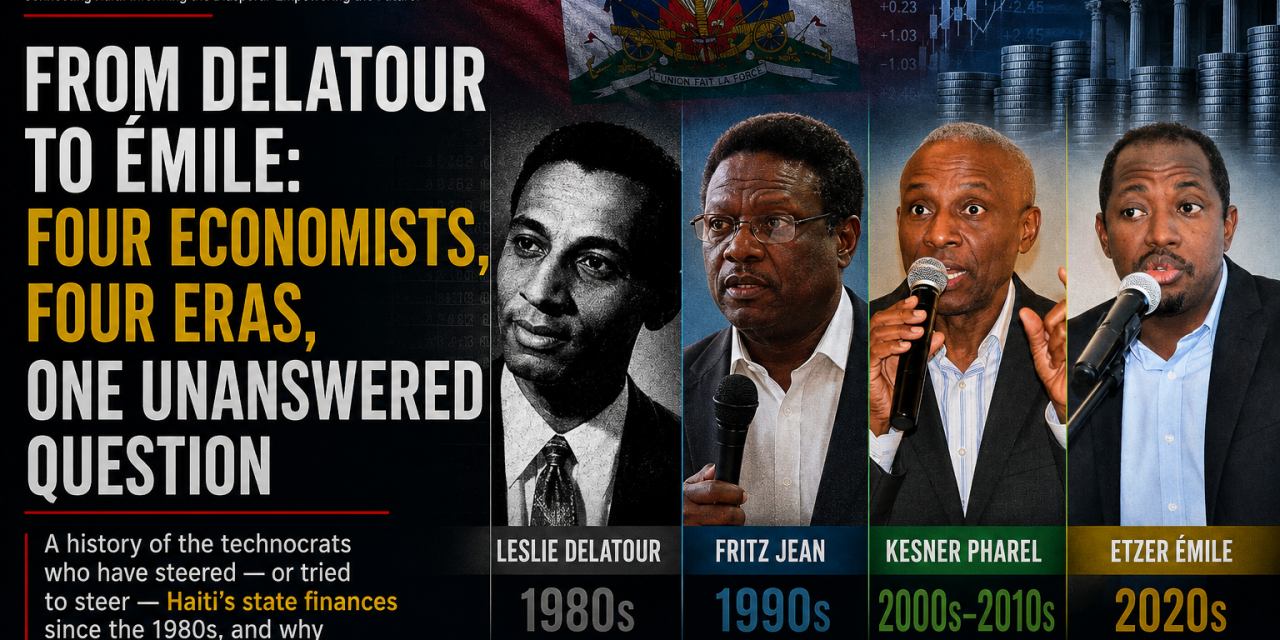
A history of the technocrats who have steered — or tried to steer — Haiti’s state finances since the 1980s, and why expertise alone has never been enough
Haiti’s modern economic history can be read, in part, through the careers of a small number of trained economists who moved in and out of the state’s financial machinery across five decades of crisis. Leslie Delatour, Fritz Jean, Kesner Pharel, and Etzer Émile represent four different generations, four different ideological starting points, and four different relationships to formal state power — yet all four became, in their respective eras, among the most influential economic voices in the country. Examining their backgrounds side by side reveals both the persistence of technical talent in Haiti and the structural limits that talent has consistently run into.
Leslie Delatour (1948–2001): The Chicago-School Reformer
Leslie Delatour holds a distinct place in Haitian economic history as the country’s most consequential — and most controversial — architect of structural liberalization. Born in 1948, Delatour earned a bachelor’s degree in economics at the University of Quebec in 1971, a master’s degree in international economics from Johns Hopkins University in 1975, and trained at the University of Chicago — the intellectual home of the free-market economics associated with Milton Friedman. He described himself, in a 1987 interview with Reason magazine, as “a liberal in the old-fashioned sense of the word,” meaning a committed free-market advocate, having previously worked as a World Bank consultant.
Delatour entered Haitian government service in 1982 under Finance Minister Marc Bazin during the Jean-Claude Duvalier administration, and rose to become Haiti’s Minister of Finance from 1986 to 1987, in the volatile period immediately following Duvalier’s fall. He later served as Governor of the Bank of the Republic of Haiti (BRH), the central bank, from 1994 to 1998. In both roles, he pursued fiscal discipline, currency stabilization, and aggressive economic liberalization — including large-scale privatization of state enterprises — in close coordination with the IMF and World Bank. His tenure produced measurable currency gains: the gourde appreciated from roughly 6.25 to 5.25 per U.S. dollar during his time as finance minister, and again from about 18:1 to 14.5:1 during his central bank governorship.
But Delatour’s reforms are remembered as much for their costs as their technical success. His trade liberalization policies — particularly the removal of tariff protections on rice and other staples — are widely cited as having undermined Haitian domestic agriculture, accelerating rural-to-urban migration into an already overcrowded Port-au-Prince. At the height of his influence, Le Monde Diplomatique dubbed him “all-powerful” within Haiti’s economic policy apparatus — a description that captured both his technical dominance and the concentration of power his position represented. Delatour died of cancer in 2001.
Fritz Jean (b. 1956): From Central Bank to the Presidential Council
Fritz Alphonse Jean represents a different professional arc — one that moved from technical central banking into the highest levels of political leadership, including, remarkably, two separate stints at the top of Haitian governance decades apart. Born in Cap-Haïtien in 1956, Jean studied economics and mathematics in New York, at Fordham University and the New School for Social Research, before returning to Haiti to teach at the State University of Haiti from 1987 to 1991.
Jean’s public finance career began at the BRH, where he was named vice-governor in 1996 and became governor in February 1998, serving until 2001 — a tenure immediately following Delatour’s own governorship. Between assignments, he served as Dean of the Faculty of Social, Economic, and Political Sciences at Université Notre Dame d’Haïti (2005–2009) and as president of YMCA-Haiti (2007–2010). He is also a founding member of the Haitian Stock Exchange and has served since 2012 as president of the Chamber of Commerce, Industry and Professions of Nord-Est.
Jean’s political roles have been unusually significant for an economist: he served as Haiti’s Prime Minister briefly in 2016, appointed by interim president Jocelerme Privert to help stabilize a paralyzing electoral crisis. Nearly a decade later, he returned to the pinnacle of Haitian governance as the third chairman of the Transitional Presidential Council, serving from March to August 2025 — placing him, at two separate moments in Haiti’s post-2000 history, at the literal head of the Haitian state during periods of acute institutional crisis. His 2013 book, Haiti: The End of an Economic History, reflects on the structural failures he witnessed across his career.
Kesner Pharel (b. and educated in Les Cayes and Washington, D.C.): The Public Educator
Kesner Pharel’s influence has run through a different channel than Delatour’s or Jean’s: rather than occupying the top seat at the central bank or the presidency, Pharel has built his career primarily as Haiti’s most visible economic communicator and private-sector consultant. Raised in Les Cayes, Pharel attended George Washington University, initially studying electrical engineering before graduating with a double degree in economics and political science. He went on to earn a master’s degree in sports management from the Université de Lyon in France and later a master’s degree in public administration from Harvard University.
Pharel began his professional career at the Central Bank of Haiti, working in its economic directorate and the governor’s office from 1985 to 1994 — meaning his tenure there overlapped directly with the early period of Delatour’s influence over Haitian monetary policy. In 1994, he left to found Groupe Croissance, an economic, finance, and management consulting firm he still leads as chairman and CEO. Unlike Delatour and Jean, Pharel has not held a cabinet-level or central-bank governorship position; his influence instead comes through decades of weekly public economic commentary on Radio-Télé Métropole’s “Rendez-Vous Économique,” extensive advisory work with municipal governments on budgeting and development planning, and his role as a pioneer of technology-in-education initiatives through EDUCATECH. For this sustained public role in economic education, Pharel has been honored with the title “Trésor National Vivant” (Living National Treasure) — one of Haiti’s highest civic honors.
Etzer Émile (b. 1985): The Digital-Era Economist
Etzer Émile represents the youngest and most digitally native generation of this lineage. Born September 1, 1985, in Cavaillon, Émile studied economics at Université Quisqueya in Port-au-Prince between 2004 and 2008, and sociology at the Faculty of Human Sciences of the State University of Haiti (UEH). In 2008, he received a Taiwan Scholarship, spending a year studying Mandarin at National Central University before earning an MBA in Finance and Banking from Tamkang University in Taiwan in 2011. He has since received additional professional training at Harvard Kennedy School, Oklahoma State University, and institutions in Belgium, Mexico, and Guatemala focused on economic development and entrepreneurship, and was selected in 2017 for the U.S. State Department’s International Visitor Leadership Program on international trade.
Unlike the three economists before him, Émile has not held a central bank or cabinet post. His influence instead runs through a combination of academia, entrepreneurship, and mass media: he is a lecturer and Director of the Center for Entrepreneurship and Innovation at Université Quisqueya, founder and CEO of the consulting firm Haïti Efficace, and president of Fondation Avenir, a nonprofit focused on economic education. He hosts economic programming on Radio Vision 2000 and Télé Caraïbes, and has authored roughly thirty published articles along with a best-selling 2017 book, provocatively titled Haiti Has Chosen to Become a Poor Country: Twenty Reasons to Prove It — a title that itself signals a sharply critical, structurally focused analysis of Haitian underdevelopment. He has also conducted cost-benefit research with the Copenhagen Consensus Center on Haitian development priorities including poverty, energy, and agriculture.
Why Have Haiti’s Best-Trained Economists Failed to Make Haiti Prosper?
Laid side by side, these four careers span nearly the entire modern history of Haitian state finance — from the final years of the Duvalier dictatorship, through the democratic transition of the 1990s, the post-2004 instability, the 2010 earthquake recovery, and into the current, still-unresolved crisis of the 2020s. Each figure brought genuine, internationally validated technical credentials: Chicago and Johns Hopkins economics training for Delatour; a central-banking and academic pedigree for Jean; Harvard public administration for Pharel; and a globally networked, multi-continental economic education for Émile. None of them lacked competence. And yet Haiti today remains the poorest country in the Western Hemisphere, with the state’s basic monopoly on territorial control contested by armed groups, its currency chronically unstable, and its economy still overwhelmingly dependent on remittances and informal activity.
Several structural explanations, drawn directly from these four careers, help account for that gap between individual expertise and national outcome:
1. Technical policy authority has never been separated from political instability. Every one of these economists’ most consequential roles — Delatour’s finance ministry and central bank governorship, Jean’s central bank tenure, prime ministership, and council chairmanship — sat inside a state apparatus that changed leadership constantly, often through unconstitutional or extra-electoral means. A currency stabilized under one governor’s watch, as the gourde was under both Delatour and Jean, has no institutional protection against being destabilized by the next change in government, coup, or crisis. Technical competence at the top of an unstable state produces temporary technical results, not durable ones.
2. Reform packages designed for macroeconomic indicators have repeatedly collided with Haiti’s underlying social structure. Delatour’s liberalization is the starkest example: currency and fiscal metrics improved by conventional measures, while the policy simultaneously gutted the rural agricultural base that had sustained a large share of the population outside the formal economy — arguably worsening the very poverty and urban overcrowding that has since fed into gang recruitment and political instability. Technically sound policy, judged by the standards of international financial institutions, can still generate socially destabilizing outcomes if it is not matched to the realities of who bears its costs.
3. Influence without institutional power has its own ceiling. Pharel and Émile represent a model of economic leadership built on public education, private consulting, and media influence rather than direct control of fiscal or monetary levers. That model has real value — an informed public and a trained business class are prerequisites for any recovery — but it also means neither figure has had the direct authority to implement the structural changes they diagnose. Émile’s own book title suggests he sees this gap clearly: identifying twenty reasons Haiti has “chosen” poverty is a diagnosis, not a governing mandate.
4. No single economist, however capable, controls the security environment their policies depend on. This is perhaps the most decisive factor of the current era specifically. Fritz Jean’s second stint at the pinnacle of Haitian leadership, as Transitional Presidential Council chairman in 2025, occurred while armed groups already controlled the large majority of Port-au-Prince — a security collapse entirely outside any economist’s technical toolkit to solve. Investment, tax collection, trade, and basic commerce all require a baseline of territorial state control that no fiscal or monetary policy can substitute for. An economist can design an excellent budget; they cannot, by themselves, make it collectible in gang-controlled territory.
5. Haiti’s economic leadership has rarely had durable, protected institutional independence. Central bank governorships have changed hands repeatedly across political transitions; finance ministries turn over even faster. Compare this to countries that have achieved sustained macroeconomic stabilization, which typically pair capable technocrats with legally insulated institutions — independent central banks, professionalized civil services, and multi-year policy continuity across changes in political leadership. Haiti has had capable individuals in the relevant seats. It has not had the institutional scaffolding that would let their work outlast their own tenure.
The honest answer, drawing across all four careers, is not that these economists individually failed through incompetence or lack of vision — the historical record does not support that conclusion. It is that Haiti has repeatedly asked highly trained individuals to produce durable national prosperity using tools (a finance ministry post, a central bank chair, a media platform, a council chairmanship) that were never matched with the political stability, social buy-in, and institutional protection those tools require to work at national scale. Delatour’s currency gains evaporated once his government fell. Jean’s central bank stability didn’t prevent the political chaos that later required him twice to step into the very highest levels of crisis leadership. Pharel and Émile have built influence precisely because direct policy power, in Haiti’s current landscape, offers no guarantee of being able to implement what one knows needs to be done.
The deeper implication is uncomfortable but important: Haiti’s problem has not primarily been a shortage of economic expertise. It has been the absence of a stable political and security foundation on which that expertise could reliably be built.
Sources: Wikipedia, Inter-American Dialogue, Copenhagen Consensus Center, Reason magazine (1987 interview with Leslie Delatour), IBTimes UK, Fondation Avenir, and the subjects’ own published biographies.