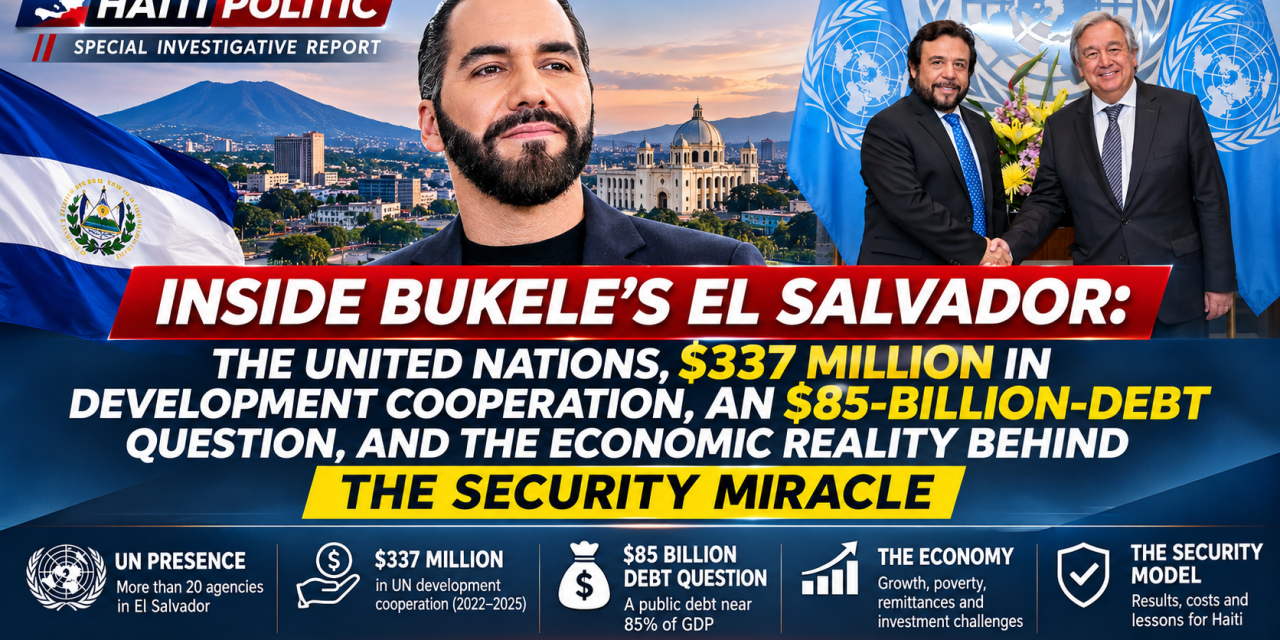
While Nayib Bukele promotes El Salvador’s security transformation and expands his country’s involvement in Haiti, official records reveal extensive UN cooperation, an IMF rescue program, high public debt, persistent poverty, and an economy heavily dependent on money sent home by Salvadorans living abroad.
HAITI POLITIC | SPECIAL INVESTIGATIVE REPORT
November 9, 2026
By Haiti Politic Investigative Desk
THE PRESIDENT WHO PROMOTES SECURITY ABROAD WHILE HIS ECONOMY STILL NEEDS INTERNATIONAL SUPPORT
For years, President Nayib Bukele has presented El Salvador as a country transformed by a dramatic campaign against organized crime.
His government points to declining homicide rates, the weakening of powerful criminal organizations, increased tourism, and growing investor confidence.
His supporters argue that El Salvador demonstrates what determined political leadership can accomplish when traditional security policies fail.
Now, with Salvadoran involvement in Haiti attracting international attention, Bukele’s security model has become part of a broader debate about foreign intervention, national sovereignty, and the future of international assistance.
On November 8, 2026, a social media post by Guillaume Herblot argued that Bukele’s actions had exposed decades of failure by the United Nations and the international community in Haiti.
The post suggested that El Salvador’s approach had accomplished what successive UN missions and international security arrangements could not.
But that argument overlooks an important part of El Salvador’s own development story.
El Salvador has not separated itself from the United Nations or the international financial system.
On the contrary, official records show that Bukele’s government maintains extensive relationships with UN agencies, the International Monetary Fund, the World Bank, and other development institutions.
The country has received substantial international cooperation while continuing to confront major economic challenges.
The central question is therefore more complicated than whether Bukele has succeeded where the UN failed.
How much of El Salvador’s transformation depends on domestic policy, and how much is supported by international financing, development cooperation, remittances, and external economic assistance?
And if El Salvador continues to depend on international institutions to address its own economic problems, what lessons can realistically be transferred to Haiti?
PART I — THE UNITED NATIONS IS DEEPLY EMBEDDED IN EL SALVADOR’S DEVELOPMENT SYSTEM
1. MORE THAN 20 UN AGENCIES AND PROGRAMS
The United Nations maintains an extensive institutional presence in El Salvador.
Its 2024 annual results reporting identifies 22 UN agencies, funds, and programs participating in the country’s 2022–2026 Sustainable Development Cooperation Framework.
They include major international organizations responsible for development, public health, education, food security, migration, labor, environmental protection, and institutional governance.
Among them are:
UNDP — United Nations Development Programme
Supports development planning, institutional capacity, governance, and economic initiatives.
UNICEF — United Nations Children’s Fund
Works on children’s rights, education, health, and social protection.
WHO/PAHO — World Health Organization/Pan American Health Organization
Provides technical assistance on public health and health systems.
UNODC — United Nations Office on Drugs and Crime
Works on crime prevention, justice systems, organized crime, and related institutional issues.
IOM — International Organization for Migration
Addresses migration and related humanitarian and development challenges.
UNHCR — United Nations High Commissioner for Refugees
Works with refugees, asylum seekers, and displaced populations.
FAO — Food and Agriculture Organization
Supports agriculture, food systems, and rural development.
WFP — World Food Programme
Addresses food insecurity and nutrition.
UN Women
Supports gender equality and women’s participation.
ILO — International Labour Organization
Addresses employment standards, labor rights, and decent work.
Other participating organizations include UNESCO, UNFPA, UNOPS, UNEP, UN-Habitat, UNIDO, UNAIDS, ITU, IFAD, ECLAC, OHCHR, and UNDRR.
Not every organization maintains a separate permanent office in El Salvador. Some participate through regional operations.
Nevertheless, the institutional relationship is extensive.
El Salvador is not a country operating outside the United Nations system.
It is an active participant in that system.
PART II — THE $337 MILLION UN COOPERATION PROGRAM
2. HOW MUCH MONEY HAS THE UN INVESTED IN EL SALVADOR?
On October 15, 2025, the United Nations in El Salvador announced that approximately $337 million had been invested through its Sustainable Development Cooperation Framework since 2022.
The announcement followed a meeting between Salvadoran government representatives and UN officials.
Participants included Vice Minister of Foreign Affairs Adriana Mira, Secretary of Commerce and Investment Miguel Kattán, and UN Resident Coordinator Raúl Salazar.
The cooperation program covered three principal development priorities:
First: Social well-being, rights, and inclusion.
Second: Economic transformation toward an inclusive and environmentally sustainable development model.
Third: Sustainable peace.
These priorities were jointly established by the Salvadoran government and the UN system.
The $337 million figure represents reported cooperation investments, not a direct cash payment to Bukele or an unrestricted transfer to his administration.
It includes development activities implemented through different organizations and arrangements.
Nevertheless, the figure demonstrates the substantial scale of UN-supported development cooperation in El Salvador.
THE FIRST UNANSWERED QUESTION
How much of the $337 million was implemented directly through Salvadoran government institutions?
How much was administered by UN agencies?
How much went to private contractors, nongovernmental organizations, or other implementing partners?
And what independently verified results were achieved?
Those questions are relevant to any country receiving international development assistance.
They are particularly relevant when the same government promotes its experience as a model for another country.
Source: United Nations in El Salvador, October 15, 2025.
PART III — EL SALVADOR’S ECONOMY: THE NUMBERS BEHIND THE POLITICAL IMAGE
3. ECONOMIC GROWTH HAS IMPROVED, BUT STRUCTURAL PROBLEMS REMAIN
The International Monetary Fund’s October 1, 2026 assessment reported that El Salvador’s economy had performed better than previously expected.
The IMF identified improved security, investment, private consumption, tourism, and remittances as important drivers of growth.
According to the IMF:
| Economic indicator | 2024 | 2025 | 2026 projection |
|---|---|---|---|
| Real GDP growth | 2.6% | 3.9% | 4.5% |
| Average inflation | 0.9% | 0.3% | 2.7% |
| Nominal GDP | $34.9 billion | $36.7 billion | $39.4 billion |
| Public debt, including specified pension obligations | 87.7% of GDP | 87.6% | 85.0% |
| Overall fiscal balance | -4.6% of GDP | -2.9% | -2.3% |
These figures show a country experiencing stronger economic activity.
They also show a government carrying a substantial debt burden.
For context, the World Bank reports that El Salvador’s economic growth averaged approximately 2.1% annually between 2000 and 2024.
That long-term performance was constrained by insecurity, weak productivity, limited investment, and other structural problems.
The recent improvement therefore matters.
But it does not mean those underlying challenges have disappeared.
SECURITY IMPROVEMENTS AND ECONOMIC GROWTH
The World Bank acknowledges that El Salvador’s reduction in crime has helped strengthen investor confidence.
Reduced insecurity can improve economic conditions by allowing businesses to operate more freely, lowering certain operating costs, and encouraging tourism.
However, lower crime alone cannot resolve problems involving education, workforce productivity, public debt, investment, and employment.
Security can create conditions for development. It cannot substitute for a comprehensive economic development strategy.
PART IV — THE PUBLIC DEBT PROBLEM
4. AN ECONOMY APPROACHING $40 BILLION, WITH PUBLIC DEBT EQUIVALENT TO 85% OF GDP
One of El Salvador’s most important economic challenges is public debt.
According to the IMF’s October 2026 projections:
Nominal GDP in 2026: Approximately $39.4 billion.
Public debt ratio: Approximately 85% of GDP.
That implies a public debt stock of roughly $33.5 billion, using the IMF’s specified nonfinancial public-sector debt measure.
This is not the same as saying the government has $33.5 billion in immediately payable bills.
Public debt includes obligations with different maturities and financing arrangements.
Nevertheless, a debt burden of this magnitude creates pressure on public finances.
The government must continue servicing debt while financing education, healthcare, infrastructure, public administration, and security.
WHY DOES THE DEBT MATTER?
High public debt can increase financing costs and reduce the government’s flexibility during economic downturns.
It can also limit the resources available for long-term development.
For a country trying to expand infrastructure and improve social services, this creates difficult budget decisions.
The IMF has emphasized the need for fiscal consolidation and improved debt management.
The objective is to place public debt on a more sustainable trajectory.
AN IMPORTANT DISTINCTION
The IMF projects that El Salvador’s debt ratio will decline to approximately 85% in 2026.
However, its projections also show the ratio increasing to approximately 89.2% in 2027, partly because of the recognition of accrued pension-related obligations.
This illustrates why a single year’s improvement does not necessarily resolve the long-term debt challenge.
PART V — THE IMF’S $1.4 BILLION PROGRAM
5. WHY DOES BUKELE’S GOVERNMENT NEED AN IMF FINANCING AGREEMENT?
On February 26, 2025, the IMF approved a 40-month Extended Fund Facility arrangement worth approximately $1.4 billion for El Salvador.
The program was designed to support macroeconomic stability, fiscal consolidation, financial resilience, and governance reforms.
On October 1, 2026, the IMF announced completion of the second and third reviews of the arrangement.
That decision permitted an additional disbursement of approximately $138 million.
The IMF reported progress in fiscal adjustment and reserve accumulation.
It also emphasized the importance of continued reforms.
WHAT DOES THE IMF REQUIRE?
The program includes commitments involving fiscal discipline, debt sustainability, public-sector management, pension reform, financial oversight, and transparency.
It also addresses the government’s involvement in Bitcoin-related activities.
The IMF has called for reducing state involvement in Bitcoin operations and improving disclosure of public crypto-asset holdings.
THE POLITICAL CONTRADICTION WORTH EXAMINING
Bukele’s administration promotes an image of national strength and independence.
Yet its economic stabilization program involves substantial financing and policy commitments negotiated with an international financial institution.
This does not mean El Salvador has surrendered its sovereignty.
Governments routinely negotiate financing agreements with the IMF.
But such agreements involve commitments that can influence fiscal policy and government spending.
The relevant question is whether the benefits of economic stabilization are reaching ordinary Salvadorans while the government implements the required adjustments.
PART VI — THE PENSION SYSTEM: ANOTHER MAJOR FINANCIAL PRESSURE
6. THE BILLIONS OWED TO RETIREMENT FUNDS
El Salvador’s pension system represents another important source of fiscal pressure.
The IMF’s October 2026 assessment identifies pension-related obligations as a significant issue.
Its 2027 debt projections include recognition of approximately $2.3 billion in accrued but unpaid interest owed to private pension funds.
The IMF has called for pension reforms intended to improve long-term financial sustainability.
These reforms are politically sensitive.
They can affect retirement financing, government obligations, and the future security of workers.
THE QUESTION FOR SALVADORAN WORKERS
How will the government meet its pension obligations while maintaining fiscal discipline?
Will reforms affect contribution requirements, retirement conditions, or benefit calculations?
And how will the government protect lower-income retirees?
The IMF has recommended reforms, but the precise consequences depend on the legislation ultimately adopted.
A financial stabilization program cannot be evaluated solely by its effect on bond markets.
It must also be examined through its consequences for workers and retirees.
PART VII — POVERTY: THE ECONOMIC REALITY BEHIND THE SECURITY SUCCESS
7. MILLIONS STILL FACE ECONOMIC HARDSHIP
The World Bank reported that El Salvador’s official poverty rate increased from 26.8% in 2019 to 30.3% in 2023.
More recent figures in the IMF’s October 2026 report put the share of the population below the poverty line at 24.3% in 2025.
These measurements refer to different reporting years and should be interpreted within their respective statistical definitions.
They nevertheless show that poverty remains a substantial development challenge.
WHAT DOES THIS MEAN?
A decline in gang violence can improve everyday life.
Families may feel safer traveling, operating businesses, or sending children to school.
But safety does not automatically guarantee sufficient household income.
People still need stable employment, affordable housing, access to healthcare, quality education, and opportunities for economic advancement.
The World Bank identifies access to quality jobs and improvements in human capital as major priorities.
THE QUESTION
Can El Salvador transform its security improvements into sustained increases in household income and productive employment?
That is a central economic test.
The government’s security record and the country’s poverty statistics must be examined together rather than treated as competing political slogans.
PART VIII — THE REMITTANCE ECONOMY
8. EL SALVADOR STILL DEPENDS HEAVILY ON MONEY SENT FROM ABROAD
El Salvador’s economy is closely connected to Salvadorans living outside the country, particularly in the United States.
Remittances are an important source of household income and domestic consumption.
The IMF identifies strong remittance inflows as one of the factors supporting economic growth.
The World Bank likewise describes remittance-financed consumption as a longstanding feature of the Salvadoran economy.
WHY DOES THIS MATTER?
Money sent home by migrants helps families purchase food, pay rent, finance education, and support local businesses.
It can also stimulate construction and retail activity.
But heavy reliance on remittances creates vulnerabilities.
If migrants face unemployment, immigration restrictions, or other economic difficulties abroad, household incomes in El Salvador may be affected.
THE LONG-TERM DEVELOPMENT QUESTION
Can El Salvador create enough productive jobs at home to reduce households’ dependence on income earned abroad?
This requires investment in education, manufacturing, agriculture, technology, infrastructure, and other productive sectors.
A country may achieve greater public security while still depending heavily on the labor and earnings of its diaspora.
PART IX — FOREIGN INVESTMENT AND ECONOMIC COMPETITIVENESS
9. WHY HAS FOREIGN DIRECT INVESTMENT REMAINED A CHALLENGE?
The World Bank identifies investment and productivity as longstanding constraints on El Salvador’s economic development.
Although improved security has helped strengthen investor confidence, the country continues to face structural barriers.
These include infrastructure gaps, workforce skills, access to quality employment, and the need for a predictable business environment.
The U.S. Congressional Research Service reported in October 2026 that El Salvador recorded the lowest level of foreign direct investment among Central American countries in 2025, citing a UN regional commission.
This is an important distinction.
Greater security may improve a country’s attractiveness to investors without automatically producing large or sustained foreign investment inflows.
Investors also evaluate regulatory stability, legal protections, workforce capacity, energy costs, logistics, and market access.
THE CHALLENGE FOR BUKELE
Can the government convert improved security into long-term productive investment?
And can that investment create employment opportunities beyond construction, tourism, and consumer services?
These questions matter because sustainable economic development requires more than short-term growth.
PART X — BITCOIN AND THE COST OF ECONOMIC EXPERIMENTATION
10. THE IMF CONTINUES TO PRESS FOR GREATER TRANSPARENCY
Bukele attracted international attention in 2021 when El Salvador adopted Bitcoin as legal tender.
The policy became a central element of his government’s international economic image.
However, the IMF repeatedly expressed concerns about financial stability, fiscal risks, and public-sector exposure to cryptocurrency.
Under the 2025 financing agreement, the government committed to reforms involving its Bitcoin-related activities.
In October 2026, the IMF again emphasized the need to reduce state involvement in Bitcoin operations and improve disclosure of public crypto-asset holdings.
THE QUESTIONS THAT REMAIN
How much public money has been committed to Bitcoin-related activities?
What assets does the public sector hold?
How are those holdings valued?
What are the government’s realized gains or losses?
And what safeguards protect taxpayers from financial volatility?
The existence of Bitcoin holdings does not establish that the government has suffered losses.
Likewise, increases in Bitcoin’s market price do not automatically establish realized public profits.
A reliable assessment requires transaction records, custody information, and consistent accounting.
Economic innovation should be accompanied by financial transparency.
PART XI — THE WORLD BANK’S ROLE IN EL SALVADOR
11. INTERNATIONAL DEVELOPMENT FINANCING EXTENDS BEYOND THE UNITED NATIONS
The UN is not El Salvador’s only major international development partner.
The World Bank reported that, as of October 2025, its portfolio in El Salvador totaled approximately $1.812 billion.
The portfolio included investment operations, development-policy financing, and trust funds.
The projects addressed education, healthcare, transportation, water infrastructure, renewable energy, local development, and employment.
This financing is separate from the UN’s reported $337 million in cooperation investments.
It is also separate from the IMF’s $1.4 billion financing arrangement.
These figures represent different types of financial commitments and activities.
They should not be added together and described as unrestricted cash received by the Salvadoran government.
Nevertheless, they demonstrate the importance of international institutions in the country’s development strategy.
THE BIGGER PICTURE
El Salvador receives development cooperation from the UN.
It has a substantial World Bank project portfolio.
It operates under an IMF-supported stabilization program.
And its economy benefits from large remittance inflows.
These relationships are not inherently evidence of weakness or policy failure.
They are part of the country’s economic structure.
But they complicate claims that El Salvador’s transformation has occurred independently of international assistance.
PART XII — EL SALVADOR AND HAITI: TWO DIFFERENT INTERNATIONAL RELATIONSHIPS
12. WHY THE COMPARISON REQUIRES MORE THAN POLITICAL RHETORIC
El Salvador and Haiti both maintain relationships with UN agencies and international financial institutions.
However, their security situations and institutional histories are substantially different.
El Salvador has pursued its domestic security campaign through its own national institutions.
Haiti has experienced prolonged political instability, armed-group territorial control, and successive international security interventions.
The UN Stabilization Mission in Haiti, MINUSTAH, operated from 2004 to 2017.
Later international arrangements have involved different mandates and command structures.
The Multinational Security Support mission and the Gang Suppression Force should not be treated as identical to a traditional UN peacekeeping operation.
Their legal authorizations, operational leadership, financing, and accountability arrangements require separate examination.
WHAT DOES THIS MEAN FOR BUKELE’S INVOLVEMENT IN HAITI?
The success of a domestic security policy in El Salvador does not automatically establish that the same approach can be transferred to Haiti.
The countries differ in geography, institutions, armed-group structures, legal systems, economic resources, and political conditions.
A meaningful assessment of Salvadoran involvement in Haiti would require verified information about operational outcomes, civilian protection, financial costs, and Haitian institutional participation.
It would also require a clear understanding of who exercises operational authority.
THE SOVEREIGNTY QUESTION
El Salvador cooperates extensively with UN development agencies while retaining domestic command of its security institutions.
That arrangement raises a legitimate question for Haiti:
What forms of international assistance could strengthen Haitian institutions without creating long-term dependence on foreign operational leadership?
The answer must be grounded in Haiti’s legal framework, institutional capacity, and the specific agreements governing international assistance.
PART XIII — THE ECONOMIC COST OF EL SALVADOR’S HAITI INVOLVEMENT
13. WHO PAYS FOR THE MISSION?
El Salvador’s participation in Haiti’s security situation raises financial questions that have not been answered by the economic records examined in this report.
The country faces substantial public debt, pension obligations, poverty, and ongoing fiscal adjustment.
At the same time, its government is participating in an international security initiative.
The relevant questions concern the actual financing arrangements.
Does El Salvador pay directly from its national budget?
Are costs reimbursed by another government or international organization?
Who finances transportation, equipment, salaries, logistics, and operational support?
Are private contractors involved?
And what oversight mechanisms apply?
Without the mission’s financial agreements and expenditure records, it would be inappropriate to claim that Salvadoran taxpayers are bearing all the costs.
It would be equally inappropriate to assume that the operation costs El Salvador nothing.
THE ECONOMIC ACCOUNTABILITY QUESTION
How does the government ensure that international security commitments do not undermine domestic spending priorities?
This question is particularly relevant when a country is implementing an IMF-supported fiscal adjustment program.
PART XIV — TEN QUESTIONS FOR PRESIDENT BUKELE, THE UNITED NATIONS, AND INTERNATIONAL FINANCIAL INSTITUTIONS
1. How much of the $337 million in UN cooperation investments was implemented directly through Salvadoran government institutions?
2. Which UN-supported programs have produced independently measurable improvements in employment, education, health, and poverty reduction?
3. What specific economic outcomes does Bukele’s government attribute to its domestic security campaign, and how are those outcomes measured?
4. How will El Salvador reduce its substantial public debt while protecting essential social spending?
5. What measures will ensure that IMF-supported fiscal reforms do not disproportionately burden lower-income households?
6. How will the government address pension obligations while protecting workers and retirees?
7. What is the strategy for reducing long-term dependence on remittances?
8. What reforms will improve productive investment and the availability of quality jobs?
9. What are the complete financial terms of El Salvador’s involvement in Haiti?
10. Will the Salvadoran and Haitian governments publish the relevant security agreements, expenditure records, and accountability mechanisms?
HAITI POLITIC | FINAL ANALYSIS
EL SALVADOR’S SECURITY TRANSFORMATION AND ITS UNFINISHED ECONOMIC AGENDA
The official record presents a complex picture of El Salvador under Nayib Bukele.
The country has experienced a substantial reduction in crime.
Economic growth has strengthened.
Investor confidence has improved.
Tourism and construction have contributed to economic activity.
These developments are reflected in assessments by the IMF and World Bank.
But the same institutions identify major economic challenges.
El Salvador continues to carry substantial public debt.
Its pension system creates significant long-term obligations.
Poverty remains a concern.
The economy continues to rely heavily on remittances.
Foreign investment and productivity remain important development challenges.
And the government is implementing a major IMF-supported economic program.
At the same time, El Salvador maintains extensive cooperation with the United Nations.
The UN has reported approximately $337 million in development investments through its cooperation framework since 2022.
The World Bank maintains a substantial project portfolio.
These relationships demonstrate that El Salvador’s development strategy involves both domestic policy and international cooperation.
WHAT THE EVIDENCE DOES NOT ESTABLISH
It does not establish that the UN controls Bukele’s government.
It does not establish that international assistance caused El Salvador’s security improvements.
It does not establish that Bukele’s involvement in Haiti is financed through the UN’s domestic development program in El Salvador.
And it does not establish that a security approach developed in El Salvador will necessarily produce the same results in Haiti.
Those are separate questions requiring separate evidence.
THE CENTRAL QUESTION FOR HAITI
The debate should not be reduced to choosing between the United Nations and Nayib Bukele.
The more important issue is whether international assistance can strengthen national institutions while preserving democratic accountability, financial transparency, and domestic operational authority.
For El Salvador, the challenge is translating security improvements into lasting economic development.
For Haiti, the challenge is rebuilding institutions capable of protecting the population and managing public resources.
Both countries face questions about sovereignty, institutional capacity, and international dependence.
And both deserve an honest accounting of the financial arrangements behind government policies.
THE QUESTION THAT REMAINS
IF EL SALVADOR CONTINUES TO RELY ON UN DEVELOPMENT COOPERATION, IMF FINANCING, WORLD BANK PROJECTS, AND REMITTANCES TO ADDRESS ITS ECONOMIC CHALLENGES, WHAT DOES ITS EXPERIENCE ACTUALLY DEMONSTRATE ABOUT THE ROLE OF INTERNATIONAL ASSISTANCE IN NATIONAL DEVELOPMENT?
The answer cannot be established through political slogans alone.
It requires measurable results, transparent financial records, and independent scrutiny.
Security outcomes matter. Economic outcomes matter. Sovereignty matters. And financial accountability matters.
For Haiti, the lesson is not that one foreign leader or international institution possesses a universal solution.
It is that sustainable security and development ultimately require institutions capable of delivering results and answering to the people they serve.
HAITI POLITIC
Independent Investigative Journalism | International Affairs | Economic Development | Public Accountability
November 9, 2026
EDITORIAL NOTE: This report distinguishes official economic data, institutional arrangements, and documented financial commitments from political interpretations. IMF figures for 2026 and 2027 are projections, not final outcomes. The article does not assume that international development financing constitutes unrestricted government revenue or that Salvadoran security policies can be directly replicated in Haiti.