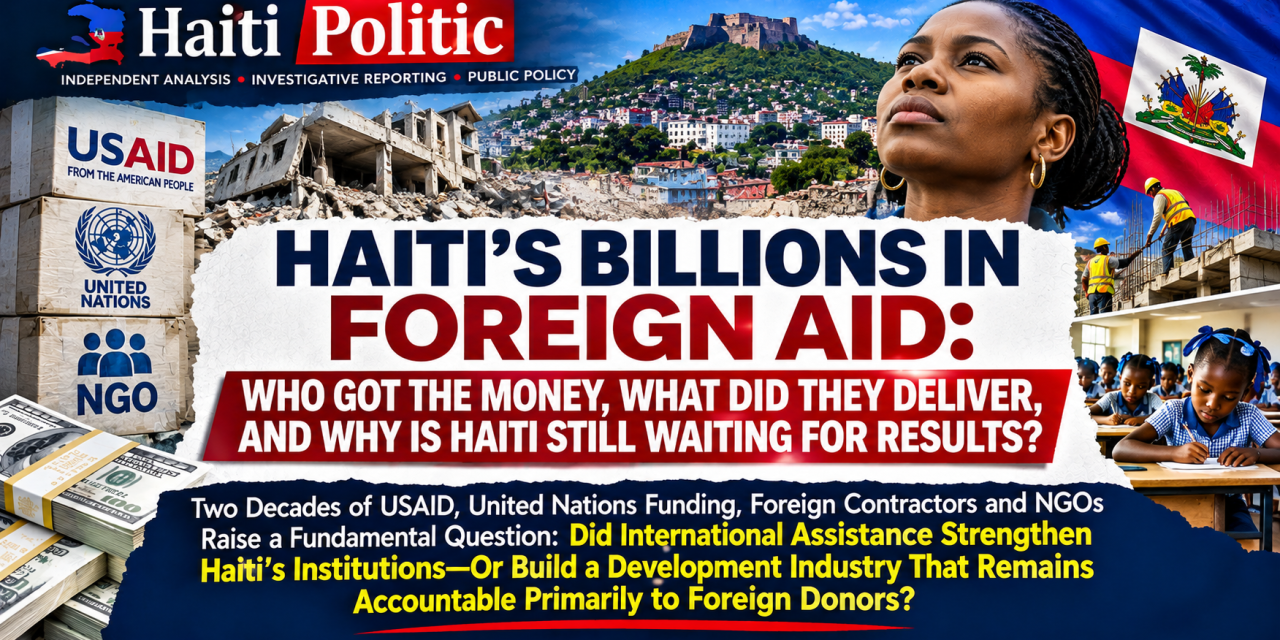
Two Decades of USAID, United Nations Funding, Foreign Contractors and NGOs Raise a Fundamental Question: Did International Assistance Strengthen Haiti’s Institutions—or Build a Development Industry That Remains Accountable Primarily to Foreign Donors?
HAITI POLITIC | SPECIAL INVESTIGATION
November 10, 2026
Foreign Assistance | USAID | United Nations | NGOs | Government Accountability | International Development
THE BILLIONS-DOLLAR QUESTION HAITI DESERVES ANSWERED
For more than two decades, Haiti has received billions of dollars in international assistance.
The money came from the United States, Canada, France, European institutions, international financial organizations, United Nations agencies, humanitarian foundations, and other development partners.
The stated objectives were substantial.
Rebuild infrastructure. Strengthen democratic institutions. Improve healthcare. Expand education. Support agriculture. Reduce poverty. Develop the Haitian National Police. Improve public administration. Create employment. Restore security.
Following the devastating January 12, 2010 earthquake, international donors announced an extraordinary reconstruction effort.
Governments pledged billions.
Humanitarian organizations mobilized.
Private contractors received development awards.
International NGOs expanded their operations.
United Nations agencies coordinated assistance.
Yet more than sixteen years after the earthquake, Haiti continues to face profound institutional, economic, and security challenges.
This does not mean every foreign-funded project failed.
Hospitals received support. Families obtained shelter. Communities received emergency assistance. Public facilities were improved. Health programs delivered services to vulnerable populations.
But the country’s continuing difficulties raise questions about the effectiveness, accountability, and sustainability of international assistance.
How much money was actually spent?
Who received it?
How much went to foreign contractors and NGOs?
How much reached Haitian institutions?
What measurable improvements did Haitians receive?
And perhaps most importantly:
What remains in Haiti after the foreign-funded projects end?
Haiti Politic examined official development-assistance statistics, U.S. congressional oversight reports, USAID financial records, United Nations reporting, and independent research.
The findings reveal a complicated financing system, measurable accomplishments, documented shortcomings, and significant gaps in public accountability.
I. HOW MUCH FOREIGN AID DID HAITI RECEIVE?
The first challenge is determining what qualifies as foreign assistance.
International donors report different financial measurements, including commitments, obligations, disbursements, humanitarian expenditures, concessional loans, and technical assistance.
These categories cannot automatically be combined.
For this investigation, the most useful starting point is official development assistance, commonly known as ODA.
According to OECD-derived World Bank statistics, Haiti received approximately $15.7 billion in net ODA between 2006 and 2019.
This figure is calculated by adding the annual amounts reported for those fourteen years.
Haiti’s Official Development Assistance
| Year | Net ODA received |
|---|---|
| 2006 | $531.54 million |
| 2007 | $622.63 million |
| 2008 | $824.62 million |
| 2009 | $990.76 million |
| 2010 | $2.89 billion |
| 2011 | $1.51 billion |
| 2012 | $1.27 billion |
| 2013 | $1.15 billion |
| 2014 | $1.08 billion |
| 2015 | $1.05 billion |
| 2016 | $1.07 billion |
| 2017 | $981.25 million |
| 2018 | $997.16 million |
| 2019 | $726.47 million |
| TOTAL | Approximately $15.70 billion |
Source: OECD Development Assistance Committee statistics, reproduced in the World Bank’s development indicators.
These are historical net ODA figures expressed in current U.S. dollars.
They do not represent money deposited exclusively into the Haitian government’s treasury.
ODA can finance programs implemented by international organizations, foreign contractors, humanitarian agencies, and other entities.
It can also include qualifying concessional financing and technical cooperation.
The $15.7 billion total does not include assistance reported for 2020 through 2026.
Consequently, the full twenty-year amount is higher, but a reliable cumulative figure for 2006–2026 requires reconciling the remaining annual OECD records.
The documented $15.7 billion is already sufficient to justify a detailed public accounting of where the assistance went and what it accomplished.
II. THE 2010 EARTHQUAKE: WHEN HAITI BECAME A GLOBAL RECONSTRUCTION PRIORITY
The January 2010 earthquake fundamentally changed Haiti’s relationship with international donors.
The disaster killed an estimated hundreds of thousands of people, destroyed public and private infrastructure, and displaced large portions of the population.
Governments, humanitarian organizations, private foundations, and individuals mobilized extraordinary financial assistance.
A 2013 analysis published by the Center for Global Development estimated that approximately $9 billion in public and private funding had been disbursed following the earthquake.
The analysis reported that the United States had pledged approximately $3.85 billion and disbursed around $2.25 billion in public funds at that point.
However, these figures include different categories of assistance and should not be added to the OECD total.
Some of the funding overlaps.
The Center for Global Development also raised concerns about the difficulty of tracking ultimate recipients and independently evaluating results.
That problem became one of the defining characteristics of Haiti’s reconstruction effort.
International donors could report billions in spending.
Implementing organizations could report projects and activities.
But connecting those expenditures to lasting improvements in Haitian institutions and infrastructure proved considerably more difficult.
The issue was not simply whether money had been allocated.
It was whether the system could demonstrate what the money achieved.
III. USAID: $2.3 BILLION ALLOCATED FOR RECONSTRUCTION AND DEVELOPMENT
The U.S. Government Accountability Office provides one of the most detailed official examinations of American reconstruction assistance to Haiti.
In an April 2021 report, GAO examined USAID funding from fiscal years 2010 through 2020.
Its findings were significant.
USAID had allocated approximately $2.3 billion for reconstruction and development activities.
As of September 30, 2020:
-
Approximately 95% had been obligated.
-
Approximately 89% had been disbursed.
-
USAID had financed 440 reconstruction and development activities.
Using the rounded $2.3 billion allocation, the 89% disbursement rate corresponds to approximately $2.05 billion.
This is an approximate calculation, not a separately audited exact disbursement figure.
Where USAID Allocated the Money
| Sector | Allocated funding | Share |
|---|---|---|
| Health and disabilities | $798 million | 35% |
| Economic and food security | $557 million | 25% |
| Governance and rule of law | $336 million | 15% |
| Operating and other expenses | $198 million | 9% |
| Shelter | $128 million | 6% |
| Energy | $109 million | 5% |
| Education | $88 million | 4% |
| Ports | $45 million | 2% |
| Transportation and technical services | $6 million | Less than 1% |
Figures are rounded, and percentages may not total exactly 100%.
The largest allocations went to healthcare, economic and food security, and governance.
Those three sectors accounted for approximately three-quarters of the funding.
The $198 million operating-and-other-expenses category is particularly relevant to an investigation of administrative spending.
However, it would be incorrect to classify that entire amount as NGO overhead.
The category covers USAID operating and other expenses, not a complete accounting of administrative costs incurred by every contractor and nonprofit organization.
The distinction matters.
A credible financial investigation must separate government operating costs, contractor overhead, legitimate project expenses, and corporate profit.
Source: GAO-21-263, April 2021.
IV. WHO IMPLEMENTED THE 440 USAID PROJECTS?
One of GAO’s most revealing findings concerns the organizations responsible for implementing USAID-funded activities.
Between fiscal years 2010 and 2020:
| Implementing organization location | Number of activities |
|---|---|
| U.S.-based organizations | 269 |
| Haiti-based organizations | 117 |
| Multilateral and other foreign organizations | 54 |
| TOTAL | 440 |
This means:
61.1% of the activities were implemented by U.S.-based organizations.
26.6% were implemented by Haiti-based organizations.
12.3% were implemented by multilateral organizations or organizations based elsewhere.
These percentages describe the number of activities, not the distribution of dollars.
A single large infrastructure contract may involve substantially more money than several smaller community projects.
Nevertheless, the figures demonstrate the central role of U.S.-based organizations in Haiti’s reconstruction system.
They also raise an important question about national ownership.
If most reconstruction activities are implemented by organizations headquartered outside Haiti, how much institutional capacity remains with Haitian organizations after the contracts expire?
The answer depends on the project.
Foreign organizations may employ Haitian professionals, subcontract local companies, transfer technology, or strengthen public institutions.
But those benefits must be documented rather than assumed.
A foreign-funded project should not be judged only by whether it was completed. It should also be judged by whether Haitian institutions can sustain its benefits.
V. THE FOREIGN CONTRACTORS: WHO RECEIVED THE DEVELOPMENT BUSINESS?
USAID’s international development model relies heavily on contractors and implementing partners.
In Haiti, these have included major U.S. development companies, nonprofit organizations, multilateral agencies, and Haitian enterprises.
A February 2025 USAID Inspector General briefing explicitly identified organizations ranging from the World Food Programme to Chemonics International and the Haitian company Group Croissance S.A.
Independent research by the Center for Economic and Policy Research has also examined the concentration of USAID spending among major U.S.-based development contractors.
Among the organizations identified in Haiti-related foreign-assistance research are:
| Organization | Type | Documented connection |
|---|---|---|
| Chemonics International | U.S. private contractor | USAID-funded implementation |
| DAI Global | U.S. private contractor | Development contracting |
| World Food Programme | UN agency | Food and humanitarian assistance |
| Group Croissance S.A. | Haitian company | USAID implementing partner |
| Other U.S. contractors | Private companies | Reconstruction and development |
| International nonprofit organizations | NGOs | Health, humanitarian and development programs |
| Haitian nonprofit organizations | Local NGOs | Community and development implementation |
This is not a ranking of the largest recipients.
A complete ranking would require consolidating contract and grant records from USAspending.gov, ForeignAssistance.gov, and USAID award databases.
It would also require distinguishing direct recipients from subcontractors.
The Contractor Accountability Question
When USAID awards a large contract to a private development company, the contract may finance legitimate services, including:
-
Technical assistance.
-
Engineering and construction.
-
Project management.
-
Local employment.
-
Training.
-
Procurement.
-
Monitoring and evaluation.
-
Administrative support.
The entire award is not corporate profit.
But the public should be able to determine how much was spent on each function.
A $50 million contract should produce more than a press release announcing its objectives.
It should produce an accessible financial record and independently measurable results.
VI. HOW MUCH MONEY WENT TO HAITIAN ORGANIZATIONS?
For years, international development organizations have promoted the principle of locally led development.
The argument is straightforward.
Haitian organizations understand local conditions, employ Haitian professionals, and may be better positioned to sustain programs after foreign funding ends.
However, local organizations also face legitimate challenges involving financial controls, technical capacity, security, and access to donor procurement systems.
GAO’s March 2023 report found that USAID had taken steps to strengthen Haitian organizations but had not consistently tracked important information about local partnerships.
The agency subsequently improved its reporting.
According to GAO’s follow-up information:
USAID/Haiti reported that the share of funding going to local partners increased from 10% in fiscal year 2021 to 22% in fiscal year 2022.
As of August 2023, the mission reported 50 awards, including 13 awarded to local organizations.
That represented 26% of the award count.
These figures do not establish that all remaining funding went to American contractors.
Other recipients included international organizations and different categories of implementing partners.
Nevertheless, they demonstrate that direct local funding represented a minority share during the periods examined.
This raises a larger institutional question.
If international assistance is intended to strengthen Haiti, should the development system measure success partly by how much responsibility Haitian institutions can eventually assume?
Local ownership should not mean abandoning financial oversight.
It should mean combining national responsibility with transparent procurement, independent audits, and measurable performance.
VII. THE UNITED NATIONS: HUMANITARIAN SERVICES AND THE QUESTION OF LONG-TERM RESULTS
The United Nations has played a major role in Haiti’s humanitarian and development landscape.
Its agencies have supported food assistance, education, healthcare, child protection, migration, public administration, and emergency response.
UNICEF’s 2024 humanitarian reporting provides examples of measurable assistance.
According to UNICEF, its interventions reached more than 970,000 people, including approximately 470,000 children, during 2024.
The agency reported:
-
More than 103,000 children, parents, and caregivers receiving mental-health or psychosocial support.
-
Approximately 401,000 people receiving safe-water and hygiene assistance.
-
Nearly 459,000 children screened for wasting.
-
More than 48,000 cases of severe child wasting treated.
-
Approximately $1.9 million in humanitarian cash transfers to 9,500 households.
UNICEF reported mobilizing approximately $43.5 million for its humanitarian interventions.
These are important service-delivery results.
However, they should not be confused with a complete assessment of Haiti’s long-term development.
Providing emergency water supplies is not the same as constructing a sustainable public water system.
Delivering emergency medical assistance is not the same as financing a permanent national healthcare network.
Both types of intervention may be necessary.
But they serve different purposes.
The question is whether emergency assistance is accompanied by investments that reduce the need for repeated emergency interventions.
The UN Accounting Challenge
Funding can pass through several institutional layers.
A donor government may contribute to a UN agency.
The agency may contract an international organization.
That organization may subcontract a Haitian nonprofit.
The Haitian nonprofit may purchase supplies or deliver services.
Each institution may report financial activity associated with the same original funding.
A proper accounting must avoid counting those transactions as separate donor contributions.
It must also distinguish agency administration from program delivery expenses.
The total administrative cost of UN-funded activities in Haiti over the past twenty years has not been established in this investigation.
VIII. WHAT DID HAITI ACTUALLY RECEIVE? THE GAO FINDINGS
The most important question is not simply how many projects were funded.
It is what those projects delivered.
In March 2023, GAO published a detailed examination of selected U.S.-funded reconstruction activities.
The findings were mixed.
Of eight major infrastructure activities reviewed:
Four had been completed.
Two were still ongoing at the time of the review.
Two had been canceled because costs exceeded initial expectations.
GAO identified several completed improvements.
These included:
-
Construction of a power plant.
-
Construction of 906 homes.
-
Improvements to 24 health and public facilities.
These are tangible accomplishments.
However, the report also documented delays, cost increases, reduced project scope, and weaknesses in planning and performance measurement.
The Housing Project: 4,000 Planned, 906 Built
One particularly revealing example involved permanent housing.
USAID originally planned to construct approximately 4,000 homes.
Ultimately, the program constructed 906 homes.
That represents approximately 22.7% of the original target.
The shortfall was associated with construction costs that proved substantially higher than anticipated.
The 906 homes were real benefits for the households that received them.
But the difference between the original promise and final delivery deserves scrutiny.
A development agency should not receive the same performance assessment for delivering 906 homes as it would for delivering the 4,000 originally planned.
At the same time, the reasons for the shortfall must be examined fairly, including land availability, construction conditions, inflation, security, and unrealistic initial estimates.
The evidence supports a conclusion of serious planning and implementation problems.
It does not, by itself, establish fraud.
IX. CARACOL: INFRASTRUCTURE, INDUSTRIAL DEVELOPMENT AND UNFINISHED EXPECTATIONS
The Caracol Industrial Park became one of the most visible symbols of Haiti’s post-earthquake reconstruction strategy.
The project sought to support manufacturing, employment, electricity generation, and economic activity in northern Haiti.
USAID financed related infrastructure, including a power plant.
The broader industrial development strategy depended on complementary investments.
Electricity, transportation, port infrastructure, industrial facilities, and private-sector employment were expected to reinforce one another.
But GAO’s 2013 investigation identified concerns about the interdependence and sustainability of those investments.
The agency reported that USAID had allocated approximately $170.3 million toward a power plant and port intended to support the industrial park.
The power plant’s first phase was completed in time to supply electricity to the park’s initial tenant.
However, other infrastructure activities experienced difficulties.
The broader lesson is that development investments cannot be evaluated in isolation.
A power plant may be technically successful while the surrounding economic strategy falls short.
A factory may create jobs without generating the scale of employment originally projected.
A port may be planned but delayed or canceled because costs become prohibitive.
The public deserves an accounting of both the infrastructure delivered and the economic results.
For Caracol, that means examining actual employment, wages, electricity service, operating costs, infrastructure maintenance, and the extent to which Haitian businesses benefited.
X. DID USAID’S DEVELOPMENT PROGRAMS ACHIEVE THEIR OBJECTIVES?
GAO’s March 2023 report reviewed 29 evaluations of USAID development activities.
The evaluations covered economic and food security, governance, and healthcare.
GAO found that at least half of the assessed results were successful, while at least one-third were unsuccessful.
This is an important finding.
It contradicts the simplistic claim that all USAID programs failed.
It also contradicts the assumption that spending billions automatically produced successful development.
The results were mixed.
Some projects improved services and institutional processes.
Others did not meet their objectives.
GAO identified examples involving property-tax systems and judicial oversight.
An activity improved property-tax administration.
Another fell short of its objectives for strengthening judicial oversight.
These outcomes demonstrate why independent evaluation matters.
The number of training sessions conducted does not necessarily establish that a government institution became more effective.
The number of workshops organized does not necessarily establish that public administration improved.
And the number of people attending a program does not automatically establish long-term economic benefits.
Development should be measured through outcomes, not merely activities.
XI. WHAT ABOUT THE HAITIAN NATIONAL POLICE?
Foreign governments have spent years supporting the Haitian National Police through training, equipment, institutional assistance, and other programs.
The United States Department of State has played an important role through its Bureau of International Narcotics and Law Enforcement Affairs.
But GAO’s 2023 investigation identified an important weakness.
The State Department had not adequately evaluated the overall effectiveness of its police-development activities.
Implementers frequently reported outputs such as training sessions.
However, those reports did not consistently establish whether the assistance improved investigative capacity or other operational outcomes.
This distinction is critical.
Training 1,000 police officers is a measurable activity.
But it does not necessarily demonstrate that the police can investigate more crimes, protect more communities, or secure more convictions through lawful procedures.
An effective evaluation should examine:
-
Operational readiness.
-
Investigative capacity.
-
Equipment availability.
-
Geographic coverage.
-
Institutional accountability.
-
Public confidence.
-
Respect for human rights.
-
Sustainability of training and maintenance.
As of March 2026, GAO indicated that work toward an independent evaluation was being restarted following the U.S. foreign-assistance pause.
The absence of a completed overall evaluation limits what can be concluded about the long-term effectiveness of this assistance.
XII. THE 2025 USAID SHUTDOWN: WHAT HAPPENED TO HAITI’S PROJECT ASSETS?
A May 13, 2026 report from the USAID Office of Inspector General examined the consequences of terminating development awards in Haiti.
The audit identified 32 terminated awards with activities in Haiti.
Auditors selected eight awards involving priority physical assets for detailed review.
Those assets had a combined purchase value of approximately $4.2 million.
They included armored vehicles, port construction materials, and health commodities.
The findings were troubling.
By August 31, 2025, approximately $1.4 million in selected assets remained undisposed.
That included:
-
Approximately $566,000 in port rehabilitation materials.
-
Approximately $784,000 in health commodities.
The Inspector General raised concerns about delayed disposition, unclear responsibilities, and the risk of theft, waste, or abuse.
The audit also identified weaknesses in procedures for approving the disposition of armored vehicles.
However, the report did not establish that the $1.4 million had been stolen or misappropriated.
The concern was that assets remained awaiting proper disposition under circumstances that increased their vulnerability.
This distinction is important.
A risk of loss is not proof that a loss occurred.
Nevertheless, the findings raise questions about the consequences of abruptly terminating assistance programs without completing asset transfers and closeout procedures.
For Haiti, where public institutions already face significant resource constraints, unused medical supplies and unfinished infrastructure materials represent more than an accounting concern.
They may represent delayed services and missed opportunities.
XIII. HOW MUCH MONEY DID NGOs AND CONTRACTORS SPEND ON ADMINISTRATION?
This is one of the most important unanswered questions.
International assistance involves multiple categories of expenditure.
Contractors may charge for personnel, management, logistics, procurement, technical services, security, and indirect costs.
Nonprofit organizations may report program expenses, fundraising, and management costs.
UN agencies have their own financial reporting systems.
These categories are not directly interchangeable.
A contractor’s profit is not the same as an NGO’s administrative overhead.
Likewise, a project manager’s salary may be a legitimate program expense rather than waste.
A Hypothetical Illustration
Consider the approximately $15.7 billion in net ODA reported for Haiti between 2006 and 2019.
If administrative and intermediary costs hypothetically represented different shares of that total, the arithmetic would be:
| Hypothetical rate | Amount |
|---|---|
| 10% | $1.57 billion |
| 15% | $2.35 billion |
| 20% | $3.14 billion |
| 25% | $3.92 billion |
| 30% | $4.71 billion |
These are mathematical illustrations, not estimates of actual administrative expenses in Haiti.
The available evidence does not justify applying any one of these percentages to the entire foreign-aid portfolio.
It would also be misleading to assume the remaining funds were all direct assistance to Haitian households.
Infrastructure, medical supplies, teachers, engineers, and local service providers are legitimate program expenditures.
The real investigation must examine each major award’s financial structure.
How much was paid to the prime recipient?
How much was subcontracted?
How much went to Haitian employees and suppliers?
How much was spent on administration?
How much represented contractor profit?
And how much financed services or infrastructure that continued after the project ended?
Without that information, a claim that NGOs consumed a specific number of billions in overhead would be unsupported.
XIV. HAITI AND EL SALVADOR: TWO COUNTRIES, TWO DEVELOPMENT EXPERIENCES
The findings become especially interesting when compared with El Salvador.
Both countries have received substantial international assistance.
Both have relied on U.S. contractors, nonprofit organizations, multilateral agencies, and local implementing partners.
Both have experienced security challenges.
However, their histories and institutional conditions differ significantly.
A Preliminary Comparison
| Indicator | Haiti | El Salvador |
|---|---|---|
| Net ODA, 2006–2019 | Approximately $15.7 billion | Requires equivalent verified calculation |
| U.S. reconstruction and development assistance | Approximately $2.3 billion allocated, FY2010–2020 | Two MCC compacts totaling approximately $738 million committed |
| Foreign contractors | Significant documented involvement | Significant documented involvement |
| Local implementing organizations | 117 of 440 USAID activities, FY2010–2020 | Local partners involved in multiple programs |
| Infrastructure outcomes | Power plant, 906 homes, 24 improved facilities among selected activities | Roads, bridges, electricity and water connections |
| Documented implementation problems | Delays, cost increases, canceled projects | Delays and weaker-than-projected economic returns in some programs |
| Complete administrative-cost accounting | Not established | Not established |
| Security-policy outcomes | Continuing severe security challenges | Major reported reductions in homicide under Bukele, alongside serious rights concerns |
This comparison is preliminary.
The financial periods, aid definitions, and program types must be standardized before drawing conclusions about which country received more assistance per person or achieved better development returns.
Nevertheless, the evidence raises an important institutional question.
Why do some foreign-funded investments leave functioning public assets while others struggle to produce sustainable results?
The answer cannot be reduced to the presence or absence of NGOs.
It requires examining governance, security, infrastructure planning, project design, corruption risks, institutional capacity, and donor accountability.
XV. THE PROBLEM WITH MEASURING DEVELOPMENT BY MONEY SPENT
One of the most persistent weaknesses in international development is the tendency to emphasize financial commitments and project activity.
A donor announces $100 million.
An implementing organization launches a program.
A government official attends a ceremony.
A report identifies thousands of beneficiaries.
But the public may still struggle to determine whether the original problem was solved.
For Haiti, a more meaningful evaluation would ask:
Did the project reduce the cost of electricity?
Did it improve access to healthcare?
Did it increase agricultural productivity?
Did it create sustainable employment?
Did it strengthen judicial institutions?
Did it improve police investigative capacity?
Did it reduce the need for future emergency assistance?
Did it leave Haitian organizations capable of continuing the work?
And did it produce benefits that lasted beyond the donor’s funding cycle?
These questions are especially important when projects depend on foreign consultants and temporary implementation structures.
A successful development program should ultimately reduce dependence on the implementing organization.
It should help create conditions under which national institutions can perform the same functions.
XVI. WHO SHOULD BE HELD ACCOUNTABLE?
Accountability cannot rest exclusively with international donors.
Haitian public institutions also have responsibilities.
Governments must establish credible national priorities, maintain public financial controls, enforce procurement standards, and protect infrastructure investments.
International organizations must report accurately on expenditures and outcomes.
Private contractors must fulfill their contractual obligations.
Nonprofit organizations must demonstrate that their spending advances their stated missions.
And donors must evaluate whether their financing models strengthen or bypass national capacity.
The public deserves access to the information necessary to evaluate all these actors.
This is not an argument that every foreign-funded project should be administered directly by the Haitian government.
In some circumstances, humanitarian organizations may be better positioned to deliver urgent services.
In others, government institutions may provide the most sustainable implementation structure.
The appropriate choice depends on capacity, transparency, urgency, and measurable results.
But the long-term objective should be clear:
International assistance should strengthen Haiti’s ability to govern and develop itself, rather than create permanent dependence on external project managers.
XVII. TEN QUESTIONS HAITI POLITIC WANTS ANSWERED
After reviewing two decades of development assistance, Haiti Politic identifies ten questions requiring further investigation.
1. What is the complete amount of official development assistance disbursed to Haiti between 2006 and 2026?
The historical records establish approximately $15.7 billion between 2006 and 2019. The remaining years require reconciliation.
2. Which 25 international NGOs and private contractors received the largest cumulative U.S. government awards for Haiti?
A complete ranking requires consolidated federal contract and grant records.
3. How much of the funding was paid directly to Haitian public institutions and Haitian implementing organizations?
The available evidence shows that foreign-based organizations implemented a majority of USAID reconstruction activities during 2010–2020.
4. How much did implementing organizations spend on administration, international consultants, and indirect costs?
A consolidated total has not been established.
5. How much of the assistance produced permanent infrastructure?
GAO documented completed projects but also delays, cancellations, and reduced scope.
6. Why did USAID construct only 906 of the approximately 4,000 homes originally planned?
GAO identified higher-than-expected costs and unrealistic planning assumptions.
7. What were the final economic and employment outcomes of the Caracol Industrial Park and its supporting infrastructure?
The full long-term economic return requires further evaluation.
8. How effective was international assistance intended to strengthen the Haitian National Police?
GAO identified shortcomings in outcome evaluation.
9. What happened to the assets associated with the USAID awards terminated in 2025?
The Inspector General identified approximately $1.4 million in selected assets awaiting disposition as of August 31, 2025.
10. What permanent institutional capacity did Haiti gain from two decades of foreign assistance?
This question requires comparing financial expenditures with independently verified improvements in public administration, healthcare, education, infrastructure, economic opportunity, and security.
CONCLUSION: HAITI RECEIVED THE MONEY. THE PUBLIC DESERVES THE FULL ACCOUNTING.
The evidence does not support the claim that all foreign assistance to Haiti was wasted.
Official records document healthcare services, humanitarian assistance, infrastructure construction, housing, institutional support, and other measurable accomplishments.
But the evidence also documents serious problems.
Projects were delayed.
Budgets increased.
Infrastructure plans were reduced.
Some activities were canceled.
Local organizations received a minority of direct USAID funding during the periods examined.
And government auditors repeatedly identified weaknesses in planning, monitoring, and performance evaluation.
The most revealing finding may be that the international development system can report billions of dollars in assistance while still leaving important questions about ultimate recipients and long-term outcomes unanswered.
That is not proof of widespread corruption.
It is evidence of an accountability problem that deserves continued investigation.
Haiti does not need another generation of development promises without transparent financial reporting.
It needs functioning institutions, accountable public finances, sustainable infrastructure, reliable healthcare, effective education, productive agriculture, employment opportunities, and a justice system capable of protecting the population.
International assistance can contribute to those objectives.
But it cannot substitute for national leadership, institutional responsibility, and public accountability.
The success of foreign assistance should not be measured by the number of NGOs operating in Haiti, the number of contracts awarded, or the amount of money donors announce.
It should be measured by the lasting improvements Haitians experience.
After approximately $15.7 billion in net official development assistance between 2006 and 2019 alone, the public has every reason to demand a complete accounting.
Not simply a list of projects.
Not another collection of donor announcements.
Not photographs of ribbon-cutting ceremonies.
But a financial record showing who received the money, how it was spent, and what results remain.
WHO RECEIVED THE BILLIONS?
WHAT DID THEY DELIVER?
AND WHAT DOES HAITI HAVE TO SHOW FOR IT TODAY?
Those questions deserve documented answers from international donors, implementing organizations, and Haitian authorities alike.
Haiti deserves the accounts.
HAITI POLITIC | SOURCES AND RESEARCH REFERENCES
1. OECD / World Bank — Net Official Development Assistance Received, Haiti
Historical annual ODA data, 2006–2019.
2. U.S. Government Accountability Office
Haiti: USAID Funding for Reconstruction and Development Activities since the 2010 Earthquake.
GAO-21-263, April 2021.
3. U.S. Government Accountability Office
Haiti: USAID and State Should Improve Management and Assessment of Reconstruction Activities.
GAO-23-105211, March 2023.
4. U.S. Government Accountability Office
Haiti Reconstruction: USAID Infrastructure Projects Have Had Mixed Results and Face Sustainability Challenges.
GAO-13-558, June 2013.
5. USAID Office of Inspector General
Haiti: Risks to U.S. Foreign Assistance.
February 2025.
6. USAID Office of Inspector General
Terminated USAID Awards in Haiti: USAID Approved Disposition Plans for Selected Assets, but Some Approval Procedures Were Unclear and Disposition Was Incomplete.
Report 1-000-26-002-P, May 13, 2026.
7. UNICEF Haiti
Humanitarian Situation Report No. 11 — End-of-Year 2024.
January 2025.
8. Center for Global Development
U.S. Spending in Haiti: The Need for Greater Transparency and Accountability.
9. Center for Economic and Policy Research
Where Does the Money Go? A Look at USAID Spending in Haiti.
10. United Nations Sustainable Development Group
UN in Action — Haiti.
Country cooperation framework and annual results reporting.
HAITI POLITIC
Independent Political Analysis | Investigative Reporting | Public Accountability
Editorial disclosure: This investigation distinguishes official development assistance, allocated funding, obligations, disbursements, project counts, and independently documented results. The identification of an organization as a recipient or implementing partner does not imply misconduct. Where complete financial records are unavailable, the article identifies the limitation rather than assigning unsupported figures.
© 2026 Haiti Politic