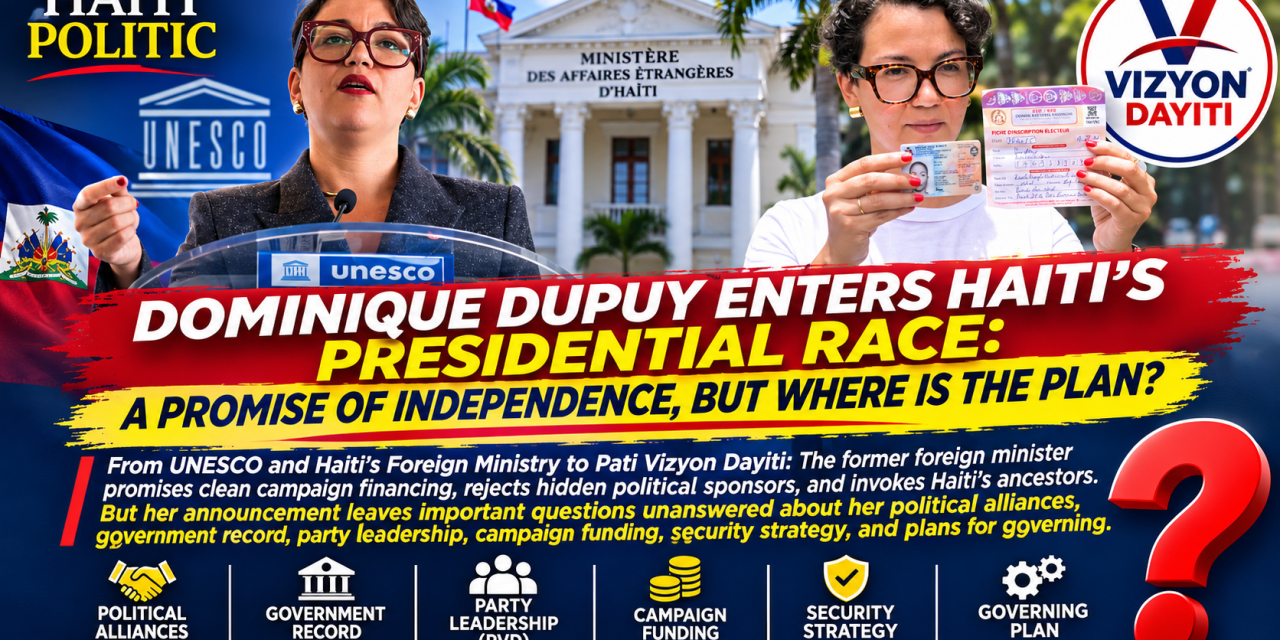
From UNESCO and Haiti’s Foreign Ministry to Pati Vizyon Dayiti: The former foreign minister promises clean campaign financing, rejects hidden political sponsors, and invokes Haiti’s ancestors. But her announcement leaves important questions unanswered about her political alliances, government record, party leadership, campaign funding, security strategy, and plans for governing.
By Haiti Politic | Political Investigation & Analysis
November 11, 2026
INTRODUCTION: DOMINIQUE DUPUY HAS ANNOUNCED HER CANDIDACY. NOW COMES THE ACCOUNTABILITY TEST.
Former Haitian Minister of Foreign Affairs Dominique Dupuy has announced that she registered on the electoral platform of the Conseil Électoral Provisoire (CEP) under the banner of Pati Vizyon Dayiti (PVD).
In a video lasting approximately three minutes and twenty seconds, Dupuy presents her decision as the culmination of a journey across Haiti, conversations with citizens, reflection on the country’s history, and a personal commitment to national transformation.
Her message emphasizes political independence, clean campaign financing, support from the diaspora, and loyalty to the Haitian people rather than powerful sponsors.
She also invokes her ancestors, visits to historical sites, and spiritual guidance.
These themes may explain the values she wants associated with her candidacy.
But presidential leadership requires more than a declaration of values.
A presidential candidate must explain how those values will translate into decisions, institutions, budgets, and measurable results.
That is where Dupuy’s announcement leaves significant unanswered questions.
The video offers a personal narrative, but comparatively little information about the policies she would pursue or the political organization that would help her implement them.
For Haiti Politic, the central issue is not whether Dominique Dupuy has the right to seek the presidency.
She does.
The issue is whether her announcement provides voters with enough information to evaluate her political independence, leadership record, and governing proposals.
1. REGISTRATION IS NOT THE SAME AS OFFICIAL APPROVAL
Dupuy states in the video:
“Mwen fèk enskri sou platfòm KPE a anba banyè pati Vizyon Ayiti.”
In English:
“I have just registered on the CEP platform under the banner of the Vizyon Ayiti party.”
The reference to KPE is the Haitian Creole acronym for the Provisional Electoral Council, commonly abbreviated CEP in French.
Her announcement establishes that she is publicly claiming to have completed the online registration step.
Contemporary electoral tracking also identifies her among preliminary presidential registrants under PVD.
However, the distinction between registration and approval matters.
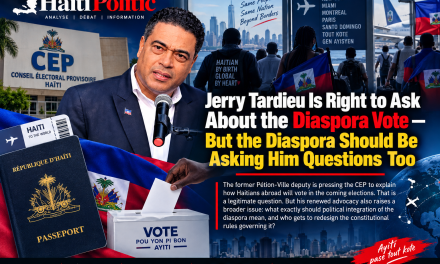
According to the CEP’s November 10, 2026 notice, online presidential and legislative registration closes on November 15, while the deadline for submitting supporting documents is November 30.
The electoral authority must still examine the required documentation before determining which candidacies are accepted.
An online registration does not automatically establish that a candidate has satisfied every legal eligibility requirement.
That principle applies to Dupuy and every other presidential aspirant.
The appropriate next step is publication of the candidate’s completed file and the CEP’s subsequent determination.
2. SHE SAYS SHE TRAVELED THROUGHOUT HAITI. WHAT DID SHE LEARN?
Dupuy explains that before making her decision, she wanted to travel across the country, meet citizens, listen to their frustrations, and understand their disappointment.
She describes finding love, determination, and a desire to rebuild the nation.
Listening to citizens is an important part of political engagement.
But the announcement does not identify the communities she visited, the organizations she consulted, or the specific recommendations that emerged.
Nor does it explain how those conversations shaped her policy priorities.
This leaves several questions.
Which departments did she visit?
Did she meet farmers, displaced families, teachers, nurses, business owners, and local government officials?
What did those groups identify as their most urgent needs?
Did her team document the consultations?
Will the findings be published?
A listening tour becomes politically meaningful when the candidate demonstrates how public concerns have influenced a concrete governing program.
Otherwise, voters are left with an account of the candidate’s personal experience rather than a record they can examine.
3. ANCESTRAL LEGACY IS NOT A SUBSTITUTE FOR A GOVERNMENT PROGRAM
One of the most personal moments in Dupuy’s announcement comes when she describes visiting her grandmother’s grave and historical sites associated with Haiti’s ancestors.
She says she sought guidance before entering what she considers a major struggle in her life.
She also refers to blessings from the invisible world and the legacy left by previous generations.
These statements reflect her personal beliefs and understanding of Haiti’s historical identity.
There is nothing inherently inconsistent between spiritual reflection and democratic leadership.
But personal conviction and public policy serve different purposes.
Haiti’s ancestors can inspire a political vision. They cannot replace a national budget, a security strategy, or a plan for public administration.
The announcement does not explain how Dupuy intends to address several urgent national problems.
Among them are armed violence, displaced populations, weak public institutions, limited access to education and healthcare, unemployment, and corruption.
It does not specify her priorities for the first hundred days of a presidency.
Nor does it describe the institutional reforms she would seek.
The relevant question is therefore not whether her historical or spiritual references are sincere.
It is whether they will be accompanied by a governing program that voters can evaluate.
4. “I HAVE NO HIDDEN MASTER”: A POWERFUL CLAIM THAT REQUIRES TRANSPARENCY
Perhaps the most politically significant passage of Dupuy’s speech concerns her independence.
She declares:
“M pa gen manman, m pa gen papa, pa gen parenn, pa gen marenn, pa gen mèt kache.”
She then says:
“Se nou menm ki pou sèl chèf mwen.”
The message is that she has no hidden political sponsor and intends to answer to the Haitian people.
That is an important commitment.
But political independence is not established by declaration alone.
It can be assessed through financial disclosures, political relationships, decision-making procedures, and public accountability.
Dupuy has previously held senior positions within Haiti’s diplomatic and executive institutions.
She served as Haiti’s ambassador and permanent delegate to UNESCO before becoming Minister of Foreign Affairs in 2024.
Her earlier political trajectory also included her proposed participation in the 2024 presidential transition arrangements.
Those experiences do not prove that she is controlled by any political actor.
They do, however, make her political relationships and institutional record relevant subjects for examination.
A candidate who promises freedom from hidden influence should be prepared to explain her known political alliances, financial relationships, and the role of those who helped her enter public office.
That is not an accusation.
It is a transparency standard.
5. SHE PROMISES CLEAN CAMPAIGN MONEY. WHERE ARE THE FINANCIAL DISCLOSURES?
Dupuy makes another significant declaration.
She says her campaign will be supported by money from Haitians, the diaspora, honest work, and people who care about the country.
She rejects money associated with trafficking, violence, corruption, and other illicit activities.
The commitment is clear.
The verification mechanism is not.
Her announcement does not explain how donations will be collected, recorded, screened, or disclosed.
It does not identify the campaign’s financial officers.
It does not describe donor limits, internal controls, or procedures for identifying beneficial owners when contributions come through businesses.
Nor does it explain how the campaign would handle donations from individuals with government contracts or other potential conflicts of interest.
These omissions do not establish that her campaign has received improper funding.
They show that the announcement offers a promise without describing how the promise will be independently verified.
What would meaningful transparency look like?
A campaign could publish periodic financial statements identifying total contributions, major donors where disclosure is legally permitted, expenditure categories, and outstanding financial obligations.
It could also establish procedures for reviewing suspicious contributions and documenting rejected donations.
Clean campaign financing should be a verifiable practice, not merely a political slogan.
Dupuy’s announcement creates an opportunity for her campaign to demonstrate that distinction.
6. THE DIASPORA QUESTION: WHO DONATES, WHO DECIDES, AND WHO BENEFITS?
Dupuy specifically identifies Haiti’s diaspora as a potential source of campaign support.
The diaspora plays an important economic and social role in Haiti.
Its members support families, businesses, educational initiatives, healthcare services, and community organizations.
Political participation by Haitians abroad also raises important questions about representation.
But diaspora support is not automatically free of conflicts of interest.
Campaigns should explain how contributions from abroad will comply with Haitian electoral law and applicable financial regulations.
They should also clarify whether donors will receive any privileged access to the candidate or influence over future appointments and contracts.
There is a further question.
If diaspora contributions help finance the campaign, what political representation and accountability mechanisms does Dupuy propose for Haitians living abroad?
Her announcement does not address this issue.
It is possible to welcome diaspora support while insisting that financial contributions do not purchase political influence.
That principle should apply to donors inside Haiti as well.
7. FROM UNESCO TO THE FOREIGN MINISTRY: WHAT IS DOMINIQUE DUPUY’S GOVERNMENT RECORD?
Dupuy is not entering public life for the first time.
She has held significant diplomatic responsibilities.
Her service at UNESCO included work associated with Haiti’s cultural representation and the international recognition of soup joumou as intangible cultural heritage.
She subsequently served as Minister of Foreign Affairs in 2024.
These positions are relevant to evaluating her experience.
But experience should be examined through documented responsibilities and results.
What diplomatic initiatives did she lead?
What institutional reforms did she attempt?
What agreements did she negotiate?
Which commitments were implemented?
What measurable outcomes resulted from her tenure?
What constraints prevented other initiatives from succeeding?
And what lessons did she learn from serving in government during Haiti’s continuing political and security crisis?
Her announcement does not address these questions.
A former minister seeking the presidency has an opportunity to explain not only what she hopes to accomplish, but also what her previous public service demonstrates about her ability to govern.
That assessment should recognize the limited duration of her ministerial tenure and distinguish responsibilities she personally controlled from decisions made by other authorities.
8. PATI VIZYON DAYITI: WHO LEADS THE PARTY, AND HOW WAS DUPUY SELECTED?
Dupuy announces her registration under Pati Vizyon Dayiti.
That makes the party an essential part of the story.
A presidential candidacy is not simply an individual undertaking.
It involves a political organization with rules, leadership, financial responsibilities, and a governing platform.
Public reporting has identified Gesner Céus Joseph as PVD’s national secretary-general and Sony Jean as an executive secretary.
However, the announcement does not introduce the party’s executive committee or explain how Dupuy became its presidential nominee.
It does not identify the party’s founding members.
Nor does it describe the nomination process.
These are important questions because party governance can provide insight into how a candidate approaches institutional accountability.
Haiti Politic wants to know:
Who founded PVD?
Who currently serves as party president?
Who are the members of its national executive committee?
What are their professional and political backgrounds?
How is the party financed?
What internal process selected Dominique Dupuy?
Was there a competitive nomination procedure?
What authority do ordinary party members have?
How are disagreements resolved?
Does the party publish its statutes and financial information?
A party promising democratic transformation should be prepared to demonstrate democratic accountability within its own organization.
9. DOES DUPUY SHARE PVD’S POLITICAL IDEOLOGY?
PVD has publicly presented itself through themes of national sovereignty, Dessalinian heritage, social justice, and political transformation.
Those themes may overlap with Dupuy’s references to Haiti’s ancestors and national identity.
But ideological compatibility requires more than similar language.
What is Dupuy’s economic philosophy?
Does she support greater state participation in strategic industries?
What role does she envision for private enterprise?
How would she reform taxation?
What is her position on agricultural protection and domestic production?
How would she finance public services?
What are her views on foreign assistance and international financial institutions?
How does she define Haitian sovereignty in practical diplomatic terms?
The announcement does not establish her positions on these questions.
Voters need to understand whether Dupuy is advancing an established party program, helping create a new one, or primarily using PVD as an electoral vehicle.
Each possibility has different implications for party accountability.
The party should clarify its relationship with the candidate.
10. THE SECURITY CRISIS: WHERE IS THE OPERATIONAL PLAN?
Any presidential candidacy in Haiti must confront the country’s security crisis.
Armed groups have affected transportation, commerce, education, healthcare, and the ability of citizens to move safely.
The crisis also raises questions about territorial control, police capacity, judicial enforcement, and the protection of civilians.
Dupuy’s announcement emphasizes national transformation but does not provide a security strategy.
That leaves important policy questions unanswered.
What would be her approach to strengthening the Haitian National Police?
How would she address police recruitment, training, equipment, and accountability?
What role would she assign to the Armed Forces of Haiti?
How would she coordinate security operations with prosecutors and courts?
What would be her policy toward foreign security assistance?
How would she protect displaced families?
What safeguards would she establish against abuses during security operations?
How would she measure progress?
These are not minor details.
They concern the state’s ability to protect its population.
A presidential announcement need not contain an entire security plan, but a candidate should eventually provide one that explains objectives, resources, responsibilities, and civilian protections.
11. CORRUPTION: WILL DUPUY REFORM THE INSTITUTIONS HAITI ALREADY HAS?
Dupuy promises political independence and rejects illicit campaign financing.
But fighting corruption inside a government requires much more than rejecting suspicious donations.
Haiti already has institutions responsible for financial oversight and anti-corruption enforcement.
They include:
CSCCA: The constitutional Court of Accounts, responsible for public financial oversight and administrative and financial jurisdiction.
ULCC: The Anti-Corruption Unit, which investigates suspected corruption.
UCREF: The financial intelligence institution responsible for analyzing suspicious financial activity within its legal mandate.
CNMP: The public procurement oversight and regulatory institution.
IGF: The General Finance Inspectorate, which examines public financial management.
Judicial authorities: The institutions responsible for criminal proceedings and judicial decisions.
Haiti also established a specialized anti-corruption judicial mechanism in April 2025.
The International Monetary Fund subsequently identified continuing implementation and institutional-capacity challenges.
Dupuy’s announcement does not explain how she would strengthen these institutions.
Would she support publishing government contracts?
Would she strengthen asset-declaration verification?
Would she protect independent financial investigations?
Would she require ministries to respond publicly to CSCCA findings?
Would she support implementation of the specialized anti-corruption mechanism?
Would she publish the financial interests of senior government appointees, consistent with applicable law?
A promise of clean campaign financing is relevant to political integrity. It is not yet a comprehensive anti-corruption policy.
12. “THE PEOPLE ARE MY ONLY BOSS”: HOW WOULD THAT PRINCIPLE WORK IN GOVERNMENT?
Dupuy tells her audience that the people will be her only authority.
She also invites citizens to guide, support, and criticize her.
This is an important democratic commitment.
But accountability requires institutions and procedures.
Would her administration publish regular performance reports?
Would citizens have access to government spending information?
Would public consultations influence budget priorities?
Would her ministers be required to disclose conflicts of interest?
Would independent institutions be permitted to investigate officials without political interference?
Would she support transparent public appointments?
How would citizens challenge administrative decisions?
And how would she respond when public criticism conflicts with her government’s political interests?
A government that claims to answer to the people must create ways for the people to verify its decisions and demand explanations.
That is the difference between a political promise and an accountability mechanism.
13. THE WARNING ABOUT “DARK MACHINES”: WHO OR WHAT DOES SHE MEAN?
Toward the end of the announcement, Dupuy warns that hostile forces will mobilize against her.
She suggests that opposition will intensify but says her supporters should not be afraid.
Political candidates can face misinformation, intimidation, and unfair attacks.
Those risks deserve serious attention.
But the expression she uses remains undefined.
Is she referring to political opponents?
Disinformation campaigns?
Powerful financial interests?
Individuals involved in corruption?
Or threats against her personal security?
Her announcement does not specify.
A candidate can legitimately warn against intimidation while distinguishing documented threats from ordinary political criticism.
That distinction matters because criticism, investigative journalism, and public questioning are essential parts of democratic accountability.
Dupuy explicitly invites criticism in her speech.
That invitation should extend to difficult questions about her record, party, donors, and policies.
14. A PERSONAL MISSION IS NOT YET A NATIONAL GOVERNING PROGRAM
The final portion of Dupuy’s announcement emphasizes gratitude, perseverance, collective determination, and the importance of her personal mission.
It is a message centered on identity, values, and political commitment.
But the recording contains little detail about public administration.
It does not establish a proposed budget.
It does not identify the first legislative reforms she would pursue.
It does not present a timetable for security improvements.
It does not explain how the government would finance education, healthcare, or infrastructure.
It does not identify a cabinet-selection process.
And it does not explain how PVD would work with other political forces to implement legislation.
This does not prove that Dupuy lacks a governing program.
She may present one separately.
It means that the announcement itself should be understood as a declaration of candidacy, not as a detailed presidential platform.
That is a distinction voters and journalists should preserve.
15. TEN KEY QUESTIONS FOR DOMINIQUE DUPUY AND PATI VIZYON DAYITI
QUESTION 1 — THE POLITICAL PARTY
Who founded Pati Vizyon Dayiti, who currently controls its executive leadership, and what internal process resulted in your selection as its presidential candidate?
Will PVD publish its statutes, founding-member list, current leadership roster, and nomination procedures?
QUESTION 2 — POLITICAL INDEPENDENCE
You say you have no hidden political sponsor. What concrete disclosures are you willing to make about the individuals and organizations that supported your previous appointments and your current candidacy?
How will voters distinguish political relationships from improper influence?
QUESTION 3 — CAMPAIGN FINANCING
You promise that your campaign will reject illicit money. Will you publish periodic financial reports identifying campaign contributions, expenditures, major donors where legally permitted, and the procedures used to screen donations?
Who will independently verify those reports?
QUESTION 4 — THE DIASPORA
You say the diaspora will help finance your campaign. What safeguards will prevent financial contributors, whether in Haiti or abroad, from receiving privileged political access, appointments, or government contracts?
What representation reforms do you propose for Haitians living overseas?
QUESTION 5 — YOUR GOVERNMENT RECORD
During your service at UNESCO and as Haiti’s Minister of Foreign Affairs, what were your most significant measurable achievements, what initiatives did not succeed, and what lessons from those experiences would shape your presidency?
Will you publish a detailed assessment of your public-service record?
QUESTION 6 — SECURITY AND SOVEREIGNTY
What is your operational strategy for restoring security, strengthening the Haitian National Police, protecting displaced citizens, and defining the role of foreign security assistance?
What objectives would you pursue during your first hundred days?
QUESTION 7 — CORRUPTION AND PUBLIC FINANCES
What reforms would you propose for the CSCCA, ULCC, UCREF, CNMP, and Ministry of Economy and Finance to prevent corruption and ensure that credible financial investigations lead to lawful consequences?
Would you require public reporting on government contracts and implementation of audit recommendations?
QUESTION 8 — ECONOMIC POLICY
What is PVD’s economic program, and how would your administration finance it?
What are your positions on taxation, domestic production, agriculture, employment, private investment, foreign assistance, and public debt?
QUESTION 9 — FOREIGN POLICY AND INTERNATIONAL INFLUENCE
Having served as foreign minister, how would you define Haiti’s relationship with the United States, Canada, France, the United Nations, the OAS, CARICOM, and international financial institutions?
What specific safeguards would protect Haitian decision-making while allowing necessary international cooperation?
QUESTION 10 — PUBLIC ACCOUNTABILITY
You say the Haitian people will be your only boss. What binding transparency and accountability measures would you support so citizens can scrutinize your administration, investigate misconduct, and challenge government decisions?
Would those commitments apply equally to your political allies and opponents?
CONCLUSION: THE CANDIDACY IS ANNOUNCED. THE GOVERNING PLAN STILL NEEDS EXPLANATION.
Dominique Dupuy has made a clear political announcement.
She says she has registered under Pati Vizyon Dayiti.
She promises independence from hidden sponsors.
She rejects illicit campaign financing.
She invokes Haiti’s history, national identity, and the determination of ordinary citizens.
She invites public criticism and presents her candidacy as a collective effort.
Those are identifiable commitments.
But they are not yet a comprehensive governing program.
Her announcement leaves unanswered questions about the structure of PVD, her political alliances, campaign financing, institutional reform, security policy, and economic priorities.
Her previous government experience also warrants a documented assessment.
None of these questions establishes wrongdoing.
Nor does the absence of detailed policies from a short announcement prove that she lacks them.
It does, however, establish the need for further disclosure.
Haitian voters should be able to examine not only what a presidential candidate promises, but also the institutions, financing, policies, and accountability mechanisms through which those promises would be implemented.
For Dominique Dupuy and Pati Vizyon Dayiti, the next stage of public scrutiny should focus on those details.
HAITI POLITIC’S CENTRAL QUESTION
DOMINIQUE DUPUY SAYS SHE HAS NO HIDDEN SPONSORS, NO POLITICAL MASTER, AND NO INTENTION OF ACCEPTING DIRTY MONEY. WHAT DOCUMENTS, POLICIES, AND INDEPENDENT SAFEGUARDS WILL ALLOW HAITIAN VOTERS TO VERIFY THOSE COMMITMENTS?
A declaration of independence is a political promise. Demonstrable transparency is how that promise becomes accountable.
HAITI POLITIC — SPECIAL POLITICAL INVESTIGATION
November 11, 2026
SOURCES AND EDITORIAL METHODOLOGY
Primary source: Dominique Dupuy’s November 11, 2026 candidacy-announcement video, supplied with a Haitian Creole transcript and an automated summary.
Electoral source: Conseil Électoral Provisoire, November 10, 2026 notice concerning candidate registration and document-submission deadlines.
Institutional background: Public information concerning Dominique Dupuy’s diplomatic and ministerial service, Haiti’s financial oversight institutions, and the IMF’s governance assessments.
Editorial distinction: Statements attributed to Dupuy are drawn from her announcement. Questions about campaign financing, political relationships, and PVD’s organization are requests for disclosure, not allegations of undisclosed misconduct.
The automated transcript contains minor transcription uncertainties. Exact wording should be checked against the recording before being used as a verbatim quotation in further reporting.