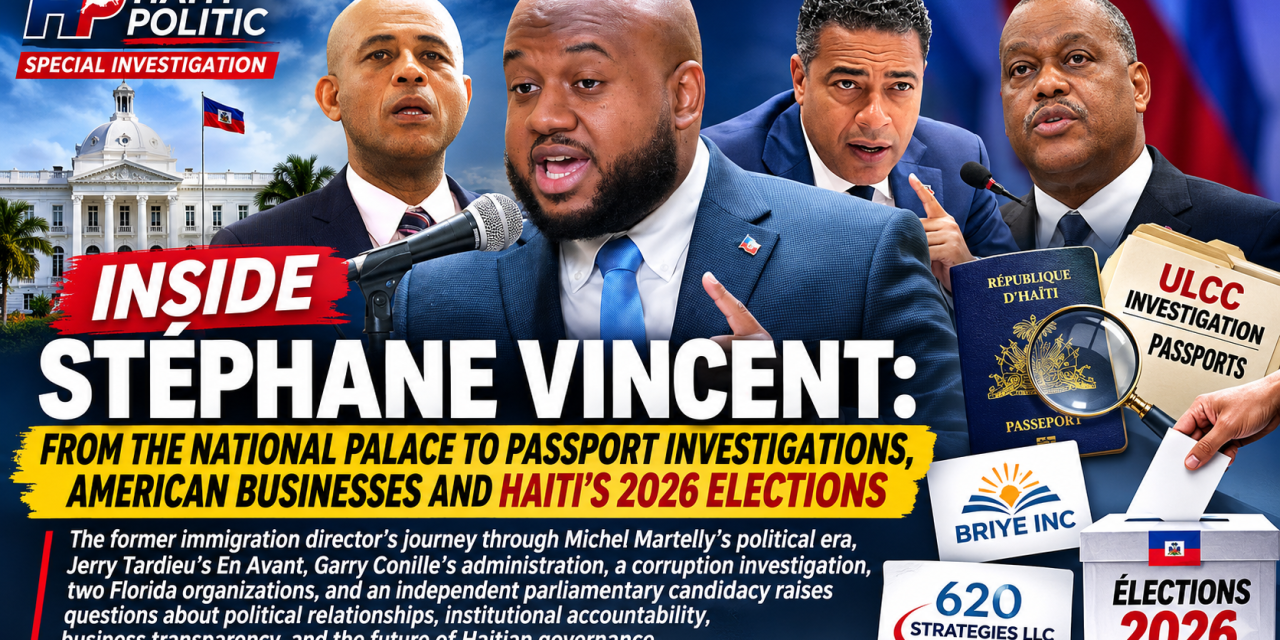
The former immigration director’s journey through Michel Martelly’s political era, Jerry Tardieu’s En Avant, Garry Conille’s administration, a corruption investigation, two Florida organizations, and an independent parliamentary candidacy raises questions about political relationships, institutional accountability, business transparency, and the future of Haitian governance.
HAITI POLITIC | SPECIAL INVESTIGATION
November 12, 2026
INTRODUCTION: WHO IS STÉPHANE VINCENT?
At 33 years old, Stéphane Vincent has accumulated a professional and political résumé that spans Haitian government institutions, American universities, private consulting, nonprofit leadership, and electoral politics.
He has worked in or around political institutions associated with several Haitian administrations, served as a senior official in Jerry Tardieu’s En Avant political organization, advised Prime Minister Garry Conille, and briefly directed Haiti’s Directorate of Immigration and Emigration (DIE).
He also identifies himself as the founder of a Florida consulting firm, 620 Strategies, and leads a Florida nonprofit organization called BRIYE INC.
In 2026, Vincent publicly promoted the completion of his doctoral studies at the University of Pennsylvania, launched a civic initiative called the Table de la Relève Nationale, and announced his candidacy for deputy of Pétion-Ville.
Yet one chapter of his career remains particularly consequential.
In May 2025, Haiti’s Anti-Corruption Unit (ULCC) released findings alleging irregularities in passport production during his leadership of the immigration directorate.
Vincent denied wrongdoing and challenged the investigation.
The allegations have not been established as criminal guilt.
Now, as he seeks elected office, his professional history raises a broader question:
What does Stéphane Vincent’s career reveal about the relationship between political networks, public appointments, government accountability, private business, and electoral ambition in Haiti?
1. THE NATIONAL PALACE: AN 18-YEAR-OLD ENTERS HAITI’S POLITICAL WORLD
One of the most revealing details about Vincent’s early career emerged from his November 11, 2026, appearance on the Haitian podcast De Tout et De Rien.
According to an account of the interview provided to Haiti Politic, Vincent stated that he had worked at Haiti’s National Palace when he was 18 years old.
Vincent was reportedly born in 1993.
That would place his employment around 2011.
The timing is significant.
Michel Martelly became president of Haiti on May 14, 2011, succeeding René Préval.
If Vincent began working at the National Palace after Martelly’s inauguration, his early government employment would fall within the Martelly administration.
However, the precise dates remain unverified.
Haiti Politic has not obtained Vincent’s original appointment letter, employment contract, payroll records, or a complete authenticated transcript of the podcast interview.
Consequently, the evidence does not yet establish which president’s administration hired him.
Nevertheless, the statement raises legitimate questions.
How did an 18-year-old obtain employment at Haiti’s presidential headquarters?
Who recruited him?
What responsibilities did he hold?
Was he employed as a government official, adviser, assistant, intern, or contractor?
And how long did he remain there?
These questions matter because early access to government institutions can help explain the development of a public official’s subsequent professional relationships.
But access alone does not establish political patronage or misconduct.
2. OLIVIER MARTELLY: A PERSONAL CONNECTION TO THE FORMER PRESIDENT’S FAMILY
During the same podcast discussion, Vincent reportedly described a close relationship with Olivier Martelly, son of former President Michel Martelly.
The full nature and history of that relationship remain to be documented.
Was the relationship established before Vincent’s reported National Palace employment?
Did it develop during Martelly’s presidency?
Or did the two become acquainted through later professional or social activities?
These distinctions are important.
A personal relationship with a former president’s family does not establish improper influence.
However, when someone later holds senior government positions, the public has a legitimate interest in understanding the professional relationships that shaped that person’s career.
For Vincent, the question is particularly relevant because his subsequent government appointments placed him in institutions responsible for sensitive administrative functions.
The issue is not whether Vincent knows Olivier Martelly. It is whether any personal relationship influenced a public appointment, government contract, or administrative decision.
No documentary evidence reviewed for this article establishes such influence.
3. FROM HAITI TO WASHINGTON: A 2014 MEETING WITH CONGRESSMAN HAKEEM JEFFRIES
A Facebook post dated March 26, 2014, provides another window into Vincent’s early professional activities.
The post shows Vincent at a meeting with a man he identified as U.S. Congressman Hakeem Jeffries.
Vincent explained that he was participating in an advocacy effort concerning proposed reductions in federal student financial assistance.
He referred to New York University, NYU Washington, and discussions about student loans and grants.
The post is relevant because it places Vincent in American civic and academic circles approximately three years after his reported National Palace employment.
It also raises questions about his educational and employment timeline.
Had Vincent already left Haiti to pursue studies in the United States?
Was he still employed by a Haitian government institution?
What academic program was he pursuing?
The available photograph establishes a reported congressional meeting in the context of student advocacy.
It does not establish that Vincent worked for Congressman Jeffries, maintained an ongoing political relationship with him, or held American citizenship.
A meeting with a member of Congress is not evidence of a political alliance or improper influence.
4. JERRY TARDIEU AND EN AVANT: FROM POLITICAL PARTNERSHIP TO SEPARATE PATHS
Vincent later became closely associated with former Pétion-Ville deputy Jerry Tardieu.
Contemporary reporting identified Vincent as a co-founder of Tardieu’s En Avant political party.
By June 2023, he was publicly identified as deputy national coordinator responsible for political affairs.
This was a senior leadership position.
Vincent’s role included participation in political discussions during a period when Haiti was struggling to establish a credible transition and restore constitutional government.
His relationship with Tardieu therefore extended beyond casual political association.
They were organizational collaborators.
But by July 2026, Vincent was publicly presenting a new initiative outside En Avant.
On July 15, Port-au-Prince Post published an interview in which Vincent discussed his political history and the creation of the Table de la Relève Nationale.
He described the new initiative as a distinct chapter rather than a personal rupture or continuation of his previous party activities.
That statement is important because it provides Vincent’s own explanation of the transition.
However, it does not establish when he formally left En Avant or whether any disagreements preceded his departure.
By October 2026, Vincent was presenting himself as an independent parliamentary candidate.
Meanwhile, Jerry Tardieu was pursuing his own presidential ambitions.
The documented change is political and organizational. A personal falling-out between the two men has not been established.
For Haiti Politic, several questions remain.
Did Vincent formally resign from En Avant?
Did he disagree with the party’s leadership or electoral strategy?
Did Tardieu support Vincent’s appointment to the immigration directorate?
And does En Avant support his independent parliamentary candidacy?
These questions deserve answers from both men.
5. GARRY CONILLE APPOINTS VINCENT TO HAITI’S IMMIGRATION DIRECTORATE
On August 9, 2024, Vincent was installed as director of Haiti’s Directorate of Immigration and Emigration.
He had previously served as a technical adviser to Prime Minister Garry Conille.
His appointment placed him at the head of an institution responsible for one of the most sensitive functions of the Haitian state: administering passports and immigration-related services.
The appointment came during a period of considerable public frustration over delays in passport production.
Shortly after taking office, Vincent announced measures intended to address a backlog of more than 10,000 passports awaiting processing.
The directorate temporarily suspended production of new passports to concentrate on outstanding applications.
At the time, Vincent publicly emphasized efficiency, transparency, and improved service delivery.
Those commitments would later become relevant to the investigation into his administration.
His tenure was brief.
By November 2024, he had been replaced.
A short tenure does not establish misconduct. But it makes the timeline of administrative decisions, system access, and financial controls especially important.
6. THE ULCC PASSPORT INVESTIGATION: WHAT WAS ALLEGED?
In May 2025, Haiti’s Anti-Corruption Unit released findings concerning alleged irregularities at the Directorate of Immigration and Emigration.
Reporting on the investigation described approximately 556 passports allegedly produced using tax stamps that had not been properly supplied through the Directorate General of Taxes.
The questioned transactions reportedly occurred between September 23 and November 25, 2024.
The alleged financial loss was estimated at approximately 3.656 million Haitian gourdes.
Investigators also examined the reported use of a passport-processing account associated with the name Fernando Victor.
The ULCC recommended judicial action concerning the alleged irregularities.
These were investigative allegations, not criminal convictions.
Vincent rejected the accusations.
His lawyers challenged the ULCC’s findings and requested that the case be dismissed, arguing that the report did not establish a criminal offense attributable to their client.
On October 8, 2025, Vincent appeared before investigative judge Walther Wesser Voltaire.
Following the hearing, Vincent expressed willingness to cooperate with the justice system while criticizing what he considered an investigation focused too narrowly on one individual rather than broader institutional weaknesses.
The current judicial disposition has not been independently established for this article.
Haiti Politic has not verified a final conviction, acquittal, or dismissal of the allegations.
The central questions therefore remain unresolved.
Who authorized the questioned passport transactions?
Who controlled the relevant user accounts?
What did the electronic audit logs show?
Were the disputed tax payments actually collected?
And what evidence directly attributes responsibility to Vincent rather than other officials or systemic failures?
The answers should come from the underlying ULCC report, financial records, technical logs, and judicial proceedings.
7. THE WASHINGTON EMBASSY PASSPORT SCANDAL: IS THERE A CONNECTION?
Another Haitian passport scandal emerged from operations involving the Haitian Embassy in Washington, D.C.
The earlier investigation concerned alleged unauthorized passport processing involving applicants outside the United States.
In June 2021, U.S. authorities reportedly intercepted approximately 400 passport applications originating from Haitian nationals in Chile, accompanied by financial instruments totaling approximately $50,000.
The subsequent Haitian investigation involved embassy personnel and questions about consular oversight, financial controls, and passport-production procedures.
Among the officials associated with the investigation were former ambassador Bocchit Edmond and consular personnel.
Edmond had previously served as Haiti’s representative to the Organization of American States during Michel Martelly’s presidency and later became ambassador to Washington under President Jovenel Moïse.
The Washington scandal occurred more than three years before Vincent became immigration director.
There is no verified evidence establishing that Stéphane Vincent participated in the Washington operation.
Nevertheless, the two investigations raise similar institutional questions.
How were passport-production systems controlled?
Who could authorize passport issuance?
Could officials create or use unauthorized accounts?
How were fees collected and reconciled?
And what mechanisms existed to detect irregular transactions?
Those similarities justify examining Haiti’s passport-administration controls across different periods.
They do not establish that the same individuals participated in both scandals.
8. THE JOVENEL MOÏSE ASSASSINATION CASE: A CONNECTION THAT REMAINS UNPROVEN
The Washington passport irregularities were detected shortly before President Jovenel Moïse was assassinated on July 7, 2021.
That chronological proximity has generated questions about whether unauthorized passport operations could have facilitated international travel or identity concealment.
However, a chronological overlap is not proof of a criminal connection.
The federal assassination proceedings in Miami have examined financing, international coordination, recruitment, and the movement of individuals involved in the conspiracy.
A credible investigation into any passport connection would require comparing passport recipients, travel records, financial transactions, and individuals identified in the assassination proceedings.
No verified evidence reviewed for this article connects Stéphane Vincent to the assassination conspiracy.
Likewise, the information examined does not establish that the Washington passport scandal facilitated the assassination.
These are separate investigations unless documentary evidence demonstrates otherwise.
9. BRIYE INC: A FLORIDA NONPROFIT WITH QUESTIONS ABOUT ITS PUBLIC RESULTS
On May 4, 2023, BRIYE INC was incorporated in Florida.
Florida corporate records identify Stéphane Vincent as president, director, and registered agent.
The organization is listed under Florida document number N23000005550 and federal Employer Identification Number 36-5068139.
Its publicly stated mission focuses on education and opportunities for Haitian youth.
Available nonprofit information identifies BRIYE as a federally recognized 501(c)(3) organization.
The organization’s website presents a board and advisory structure involving professionals from education, finance, healthcare, and other fields.
However, the public information examined for this investigation does not independently establish the number of scholarships awarded, the amount of educational assistance distributed, or the organization’s annual expenditures.
No detailed Form 990 financial statements were obtained.
That does not establish that BRIYE failed to file required federal reports.
Smaller tax-exempt organizations may qualify to submit Form 990-N, which contains limited financial information.
There is also a difference between the board information presented on BRIYE’s website and the officer information in Florida’s corporate registry.
Such differences can result from legitimate board changes or distinctions between directors and advisers.
Nevertheless, they warrant clarification.
The appropriate question is not whether BRIYE is a fake nonprofit. Its legal registration is documented. The question is whether its publicly claimed charitable mission can be supported by verifiable programs, expenditures, and results.
Because Vincent is pursuing elected office, the organization should also be able to explain how it separates charitable resources from political activities.
No evidence reviewed establishes that BRIYE improperly financed his campaign.
10. 620 STRATEGIES: A SECOND FLORIDA ENTITY
On January 21, 2025, 620 Strategies LLC was registered in Florida.
The official corporate record identifies:
Company: 620 Strategies LLC
Florida document number: L25000035500
Registration date: January 21, 2025
Status: Active
Authorized member: Stéphane Vincent
In a June 2026 Facebook announcement, Vincent promoted the company as a consulting firm focused on trust-centered advisory services.
Its marketing materials identify financial services, telecommunications, and aviation as sectors of interest.
These industries are notable because they involve substantial regulatory oversight.
Vincent’s prior experience in immigration administration may be relevant to his professional qualifications.
However, the company’s promotional materials do not establish that it has contracts with airlines, financial institutions, or government agencies.
Nor do they establish that it has access to government immigration databases.
The company was registered after Vincent left the immigration directorate.
That timing makes it appropriate to examine whether any subsequent consulting arrangements involved institutions with which he had previously interacted as a government official.
But there is no verified evidence of an improper contract or conflict of interest.
The most useful records would include corporate ownership disclosures, publicly reportable contracts, and any financial declarations required by Haitian law.
11. FLORIDA REAL ESTATE, NEW YORK BUSINESSES AND AMERICAN COURT RECORDS
Haiti Politic also examined preliminary information concerning Vincent’s possible property ownership and legal history in the United States.
The Florida corporate registry identifies two organizations associated with his name:
BRIYE INC — 2023
620 Strategies LLC — 2025
However, no personally owned real estate in Florida or New York has been independently established through a verified deed.
Similarly, no New York business registration has been confidently attributed to him.
No U.S. federal or state court proceeding has been conclusively matched to Vincent from the records reviewed.
These findings have limitations.
A business address does not establish property ownership.
An individual’s name may appear in multiple records belonging to different people.
And publicly indexed court searches are not equivalent to a complete search of federal PACER and state court databases.
The absence of an identified property or court case should not be presented as proof that none exists.
For a political candidate, the more relevant question is whether he has complied with applicable asset-disclosure and conflict-of-interest requirements.
12. THE UNIVERSITY OF PENNSYLVANIA DOCTORATE
Vincent publicly identifies himself as a Doctor of Education from the University of Pennsylvania.
His academic credentials have attracted attention because of his use of the title “Dr.” in political communications.
Unlike several other aspects of his biography, the University of Pennsylvania provides direct institutional corroboration of his doctoral studies.
Penn’s Graduate School of Education announced his final dissertation defense for March 24, 2026.
The dissertation was titled:
“Migration, Trust and Fintech: Financial Inclusion of U.S.-Based Haitian Immigrants Amid Policy Shifts.”
Vincent subsequently published material indicating that his dissertation had been approved and that he had completed his doctoral studies.
His reported academic background also includes graduate education in organizational leadership and technology-related law.
The precise conferral dates and details of some additional qualifications require separate verification.
Nevertheless, the university’s official dissertation-defense announcement provides substantial support for his doctoral academic history.
His research topic is particularly relevant to his public career because it examines migration, institutional trust, and financial technology among Haitian immigrants in the United States.
That raises an interesting policy question:
How does Vincent propose to apply his research on institutional trust to the Haitian immigration administration, where he previously held leadership responsibilities and later faced allegations of administrative irregularities?
Academic credentials do not establish guilt or innocence in a corruption investigation.
But they can provide a basis for evaluating a candidate’s stated policy expertise.
13. TABLE DE LA RELÈVE NATIONALE: A NEW POLITICAL DIRECTION?
On July 10, 2026, Vincent launched the Table de la Relève Nationale (TRN) in Pétion-Ville.
The initiative was presented as an independent civic platform intended to bring together professionals, academics, entrepreneurs, and civil-society representatives.
Its stated priorities included national security, constitutional governance, political transition, leadership renewal, and reconstruction.
In a July 15 interview with Port-au-Prince Post, Vincent explained that TRN was not intended to become a political party or electoral organization.
He also described the initiative as a new chapter distinct from his previous political involvement with En Avant.
That explanation deserves attention because Vincent subsequently announced his own parliamentary candidacy.
The two activities are not necessarily incompatible.
An individual may participate in civic initiatives while separately pursuing elected office.
However, the organizational separation should be transparent.
Does TRN endorse candidates?
Does it share donors or personnel with Vincent’s campaign?
Has it published the policy papers and proposals announced at its launch?
And how does it maintain its stated independence?
These are legitimate questions for an organization whose founder is now seeking public office.
14. AN INDEPENDENT CANDIDATE FOR PÉTION-VILLE
On October 22, 2026, Vincent issued a press release announcing that he had completed online registration with Haiti’s Provisional Electoral Council.
He presented himself as an independent candidate for deputy of Pétion-Ville.
The statement thanked supporters and claimed that more than 5,000 sympathizers had contributed to reaching that stage.
On November 9, Radio Télé Ginen reported that Vincent had submitted his candidacy documents.
These developments establish that he publicly entered the parliamentary candidacy process.
However, online registration and submission of documents are not equivalent to final approval by the CEP.
His eligibility remains subject to the applicable electoral rules and verification procedures.
Questions concerning nationality, residency, required documentation, and any legally relevant judicial proceedings must be evaluated under Haitian law.
Vincent’s American educational and business activities do not establish that he is a U.S. citizen.
No verified evidence reviewed for this article confirms American citizenship.
His nationality should not be inferred from photographs, university attendance, or business registrations.
15. FROM POLITICAL CONNECTIONS TO PUBLIC ACCOUNTABILITY
The most striking feature of Vincent’s biography is the number of institutions and political environments through which he has moved.
His reported National Palace employment dates to approximately the beginning of Michel Martelly’s presidency.
He has described a personal relationship with Olivier Martelly.
He later held a leadership role in Jerry Tardieu’s En Avant.
He became a technical adviser to Prime Minister Garry Conille.
He directed Haiti’s immigration administration.
He subsequently faced a ULCC investigation, which he contested.
He leads a Florida nonprofit and identifies himself as the founder of an American consulting company.
He completed advanced academic studies in the United States.
And he now seeks to represent Pétion-Ville in Haiti’s Parliament.
These facts describe a varied professional and political career.
They do not establish that Vincent’s appointments were improper or that his business activities violated the law.
But they do create legitimate public-interest questions about government recruitment, political independence, financial transparency, and accountability.
The central issue is whether Vincent can provide clear, documented explanations of his government service, the allegations against his former administration, his organizational relationships, and his plans for elected office.
TEN QUESTIONS HAITI POLITIC WANTS STÉPHANE VINCENT TO ANSWER
1. THE NATIONAL PALACE AND MICHEL MARTELLY
You reportedly stated on De Tout et De Rien that you worked at Haiti’s National Palace when you were 18 years old. Since you were born in 1993, that places your employment around 2011. Who hired you, which president was in office, what was your official position, and how long did you work there?
Will you release documentation confirming your employment?
2. OLIVIER MARTELLY AND POLITICAL RELATIONSHIPS
You reportedly described a close relationship with Olivier Martelly. When did that relationship begin, and did it ever involve government appointments, consulting arrangements, business activities, or political projects?
Can you clarify whether the relationship was exclusively personal or also professional?
3. JERRY TARDIEU AND EN AVANT
You were a senior official and reported co-founder of Jerry Tardieu’s En Avant political party. Why did you leave its leadership, and what is your relationship with Tardieu today?
Did disagreements over party leadership, political strategy, or your appointment to government contribute to your departure?
4. THE IMMIGRATION APPOINTMENT
Who recommended you to Prime Minister Garry Conille for appointment as director of immigration in August 2024?
What qualifications and professional experience were considered, and did you receive support from political figures or organizations?
5. THE ULCC PASSPORT INVESTIGATION
The ULCC raised allegations concerning hundreds of passport transactions and approximately 3.656 million gourdes in disputed tax revenue during your tenure. What is your detailed response to those findings?
Who controlled the passport-production accounts, what do the system logs establish, and what is the current judicial status of the case?
6. THE WASHINGTON PASSPORT SCANDAL
Before becoming immigration director, did you have any professional involvement with the Haitian Embassy in Washington, its passport-production systems, or officials named in the 2021 consular investigation?
Did you ever work with Bocchit Edmond, Gélorme Juste, or other individuals involved in that investigation?
7. BRIYE INC AND CHARITABLE TRANSPARENCY
You lead BRIYE INC, a Florida nonprofit established in 2023. How much money has the organization raised, how much has it spent on charitable programs, and how many Haitian students have directly benefited?
Will you release its IRS filings, financial statements, scholarship records, and current board documentation?
8. 620 STRATEGIES AND PRIVATE BUSINESS INTERESTS
You established 620 Strategies LLC in Florida after leaving the immigration directorate. Who are its clients, and has the company provided paid services to Haitian government institutions, airlines, telecommunications companies, or financial institutions?
Will you disclose any contracts that could create a conflict of interest with your previous public responsibilities or future parliamentary duties?
9. NATIONALITY, RESIDENCY AND ELECTORAL ELIGIBILITY
You have studied, worked, and established businesses in the United States. Can you clarify your nationality and demonstrate that you meet the constitutional and electoral eligibility requirements for deputy of Pétion-Ville?
Has the CEP formally validated your candidacy, and will you make the relevant eligibility determination public?
10. TRN, POLITICAL INDEPENDENCE AND YOUR PLAN FOR PÉTION-VILLE
In July 2026, you presented the Table de la Relève Nationale as a nonpartisan civic initiative. Three months later, you announced an independent parliamentary candidacy. How do you separate TRN, BRIYE INC, 620 Strategies, and your political campaign?
What concrete legislative proposals would you introduce to improve government accountability, passport administration, public finances, and services for Pétion-Ville residents?
CONCLUSION: A CAREER THAT DESERVES DOCUMENTED ANSWERS
Stéphane Vincent’s professional history reflects several important features of contemporary Haitian public life: movement between political organizations, government appointments, international education, private consulting, nonprofit activity, and electoral ambition.
His experience also presents an opportunity to examine how public officials are recruited, how administrative decisions are supervised, and how allegations of misconduct are resolved.
The available evidence establishes his former leadership of Haiti’s immigration directorate, his documented political relationship with En Avant, his association with TRN, and his involvement in two Florida-registered organizations.
It also establishes that he faced serious allegations arising from a ULCC investigation and that he disputed those allegations.
What remains unresolved includes the precise history of his National Palace employment, the nature of his relationship with Olivier Martelly, the final judicial disposition of the passport investigation, the financial activities of his organizations, and the official validation of his parliamentary candidacy.
These are questions that should be answered through documents and direct responses.
Haiti Politic does not conclude that Stéphane Vincent participated in the Washington embassy passport scandal, President Jovenel Moïse’s assassination, or any unproven criminal scheme.
Nor does the existence of a political relationship, a nonprofit organization, or an American business establish corruption.
The public-interest standard is straightforward:
A candidate seeking authority over public institutions should be prepared to explain his own record within those institutions.
Vincent has publicly emphasized trust, transparency, leadership, and institutional reform.
His parliamentary candidacy provides an opportunity to demonstrate those principles through disclosure, documentation, and substantive answers.
THE QUESTION IS NO LONGER ONLY WHO STÉPHANE VINCENT KNOWS.
IT IS WHAT HIS PUBLIC RECORD SHOWS, WHAT REMAINS UNEXPLAINED, AND HOW HE PROPOSES TO EARN THE PUBLIC’S TRUST.
HAITI POLITIC
Independent Reporting | Political Accountability | Investigative Analysis