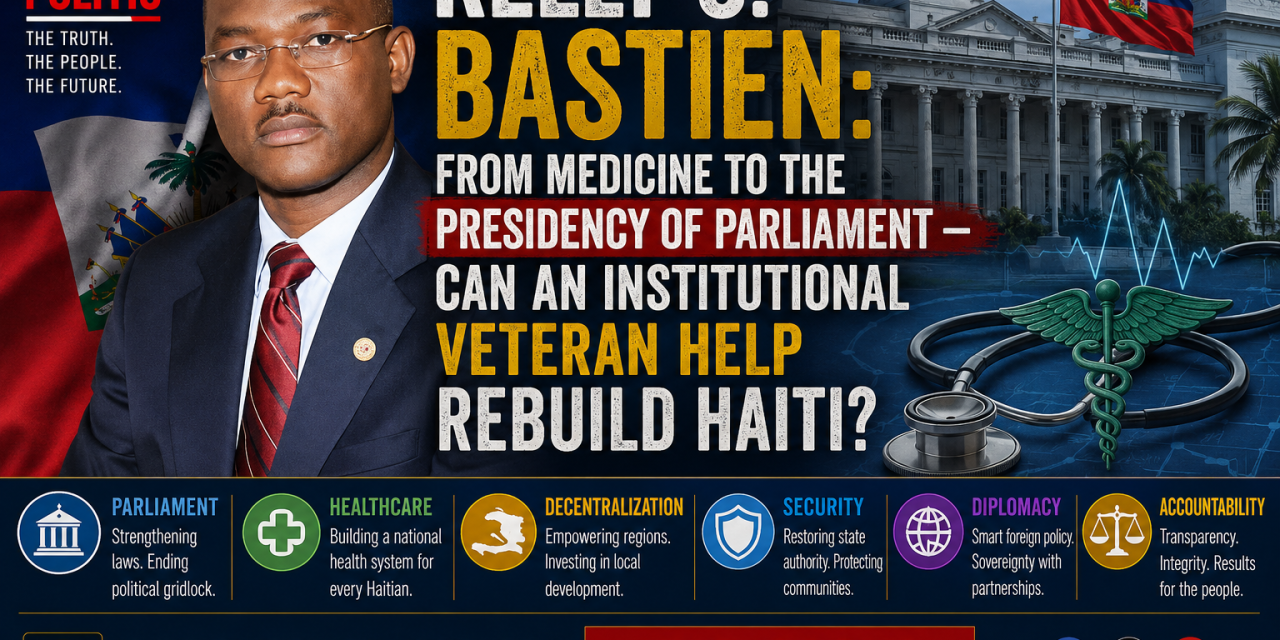
🇭🇹 HAITI POLITIC | INVESTIGATIVE PROFILE
Parliament. Healthcare. Decentralization. Security. Diplomacy. Accountability.
This profile does not endorse, rank, or recommend Kelly C. Bastien or any political movement. It summarizes documented third-party reporting, identifies gaps in the public record, and poses questions voters may use to reach their own conclusions.
🔎 WHO IS KELLY C. BASTIEN?
Kelly Clédor Bastien has something relatively unusual on a Haitian political résumé: experience in medicine, regional public health, the Chamber of Deputies, the Senate, parliamentary leadership, and international/academic cooperation.
Born in 1965 in Acul-du-Nord, Bastien trained as a physician at the State University of Haiti. A 2007 Le Nouvelliste profile reported that his medical career included serving as a department head at Hôpital Justinien in Cap-Haïtien, director of Hôpital de Limbé, and coordinator of a health program for an NGO.
Politics eventually became the dominant part of his public career.
A 1997 interparliamentary record identifies Bastien as president of Haiti’s Chamber of Deputies, noting that he had been elected in October 1995, became vice-president of the Chamber and assumed its presidency in January 1997. Significantly, that record also identifies the physician-politician as a member of parliamentary committees dealing with health and the status of women.
He subsequently returned to national legislative office, winning election to the Senate in 2006 under the Lespwa banner. He later became president of the Senate.
That makes Bastien’s record worth examining for a simple reason:
He cannot present himself merely as someone who observed Haiti’s institutional problems from outside. He has operated inside the system at some of its highest levels.
And that creates both an argument for experience—and a demand for accountability.
🏛️ THE PARLIAMENTARY RECORD
Experience—or membership in the old system?
Bastien’s strongest political credential may also produce the hardest question about his future.
He has presided over the Chamber of Deputies and Senate, giving him firsthand knowledge of how Haiti’s executive and legislature interact—and how those relationships break down.
His record also contains examples of attempting to keep parliamentary processes moving. During controversy surrounding the validation of newly elected senators in 2009, Radio Métropole reported that Bastien argued the validation process should not be blocked for political reasons and called senators into internal debate over the dispute.
But institutional experience creates a legitimate counter-question:
If experienced political leaders understood the weaknesses of the system years ago, why did those weaknesses survive?
A future Bastien platform therefore needs to go beyond saying that he knows Parliament.
It needs to explain what he would change about Parliament.
🎯 QUESTIONS FOR BASTIEN
1. Ending parliamentary paralysis: What specific changes to parliamentary rules, constitutional mechanisms or budget procedures would prevent minority blocs from repeatedly freezing government operations?
2. Procurement versus political bargaining: Would he support a fully transparent electronic procurement system where government contracts, winning bidders, beneficial owners, contract amendments and payments are publicly searchable?
3. Legislative accountability: Would he support publication of legislators’ attendance, votes, declared assets and constituency spending?
4. Governing without buying consensus: Having negotiated inside Parliament, where exactly does legitimate compromise end and patronage begin?
🩺 THE DOCTOR IN POLITICS
Could healthcare become Bastien’s strongest policy test?
Unlike candidates whose careers have been almost exclusively political, Bastien possesses documented professional experience in healthcare.
His work at Justinien Hospital and Limbé Hospital means questions about Haiti’s health system should therefore be especially specific.
Haiti does not simply need another promise to “improve healthcare.”
A physician seeking renewed national leadership should be able to answer:
How much will it cost? Who pays? Who administers it? And what measurable services will citizens receive?
The larger issue is sovereignty.
For decades, international organizations, charities, religious institutions and NGOs have filled enormous gaps in Haitian healthcare.
Foreign assistance can save lives.
But when essential services depend upon external projects, who actually controls national health policy?
🎯 QUESTIONS FOR BASTIEN
5. A Haitian national health system: Does Bastien favor some form of universal public insurance, a tax-funded national health service, or a mixed public-private model?
6. Decentralization: What minimum package of emergency, maternity, surgical and diagnostic services should be guaranteed in every department?
7. Healthcare financing: What percentage of government expenditure should health receive—and where would the additional money come from?
8. Medical brain drain: What salaries, housing, security protections or professional incentives could realistically persuade Haitian doctors and nurses abroad to return?
9. NGO sovereignty: Should international health NGOs be required to integrate their projects, budgets and outcome data into a Haitian government health strategy?
A physician-politician should be judged here not on rhetoric, but on numbers, implementation and measurable outcomes.
🗺️ THE NORTH: A TEST CASE FOR DECENTRALIZATION
Bastien’s political identity has deep roots in northern Haiti.
That gives him an opportunity to answer another fundamental question:
Can Haiti develop several functioning regional centers instead of forcing virtually everything through Port-au-Prince?
His later career provides an interesting clue.
In 2022, the Public University of the North in Cap-Haïtien appointed Bastien Director of Partnership and International Cooperation. Reports said the appointment was connected with efforts involving restructuring, modernization and development of the university.
That role potentially connects three themes that rarely appear together in Haitian politics:
regional development + universities + international cooperation.
But appointment is not accomplishment.
The public deserves measurable evidence of what partnerships were actually negotiated, how much financing they generated, which programs were implemented, and what lasting institutional capacity resulted.
🎯 QUESTION FOR BASTIEN
10. Show the results: What concrete partnerships, funding, academic exchanges, infrastructure projects or employment programs resulted from his international-cooperation work at UPNCH?
🤝 LESPWA, INITE AND THE PRÉVAL POLITICAL FAMILY
Bastien’s political history cannot be separated from Lespwa and the political networks surrounding René Préval.
He entered the Senate under Lespwa in 2006 and later became associated with Inite. Reporting from 2012 described Bastien and Joseph Lambert as former Lespwa leaders and founding members of the Inite platform created during Préval’s presidency.
That history can be interpreted in very different ways.
Supporters can point toward experience in coalition management and institutional negotiation.
Critics can reasonably ask whether figures from those political generations represent enough of a break from the structures that ultimately failed to deliver durable institutions.
Neither interpretation should simply be assumed.
Bastien should answer it.
🎯 QUESTIONS FOR BASTIEN
11. What did the Préval-era political model get right?
12. What did it get wrong?
13. Which policies or political practices from Lespwa/Inite would he explicitly refuse to reproduce today?
Those answers would tell voters much more than simply invoking the stability of an earlier era.
⚡ THE 2020 POLITICAL DISPUTE
Bastien’s reputation as a negotiator deserves scrutiny as well.
In 2020, he left the Secteur Démocratique et Populaire amid a public dispute surrounding contacts with PHTK.
Bastien said he had been authorized by leading SDP figures to hold discussions with PHTK; SDP leaders publicly disputed that characterization and demanded that he produce evidence of such a mandate.
The episode matters because it illustrates the difficult boundary between political mediation and opaque political negotiation.
Bastien subsequently continued advocating opposition unity and acknowledged that the opposition lacked a clear alternative for governing if President Jovenel Moïse left office.
That admission deserves renewed attention.
🎯 QUESTION FOR BASTIEN
14. When Haiti’s political opposition demanded the removal of governments without possessing a viable governing alternative, did that strategy contribute to institutional instability?
And another:
15. Should major negotiations between competing political blocs be documented and publicly disclosed instead of conducted through informal intermediaries?
🌎 FOREIGN POLICY: EXPERIENCE IS NOT A DOCTRINE
This may be the biggest unanswered part of a possible Bastien national platform.
His 2022 university appointment explicitly concerned international cooperation.
But international contacts are not the same thing as a national foreign-policy doctrine.
Haiti’s next generation of leaders will have to define relationships with the United States, Dominican Republic, CARICOM, Canada, France, the United Nations, African states and the Haitian diaspora while simultaneously reducing Haiti’s dependence on outside actors.
The contradiction is enormous:
Haiti needs international cooperation while desperately needing greater national autonomy.
So what would a Bastien doctrine actually be?
🎯 FOREIGN-POLICY QUESTIONS
16. United States: What should Haiti seek from Washington beyond security assistance, migration negotiations and humanitarian aid?
17. Dominican Republic: What would his framework be for migration, border security, trade, customs cooperation and Haitian-Dominican economic relations?
18. Diaspora: Should qualified dual nationals have greater opportunities to serve in government and elected office?
19. International aid: Should foreign assistance increasingly pass through Haitian institutions, and what auditing safeguards would make donors willing to do that?
20. Diplomacy for investment: Would Haitian embassies receive measurable annual targets for attracting investment, opening export markets and mobilizing diaspora capital?
21. Security assistance: Where should Haitian sovereign command begin and foreign operational authority end?
Without answers to those questions, “sovereignty” remains a slogan rather than foreign policy.
🚨 SECURITY: CONSENSUS DOESN’T REMOVE ROADBLOCKS
Bastien’s institutional temperament could become either an advantage or a liability in today’s security environment.
Negotiating legislation requires compromise.
Restoring territorial control requires command capacity, intelligence, logistics, courts, prisons, financial investigations and functioning institutions.
A serious security proposal therefore needs numbers.
🎯 QUESTIONS FOR BASTIEN
22. How many additional PNH officers does Haiti need?
23. What should Haiti spend annually on policing and national defense?
24. What precisely should the FAD’H do that the PNH should not?
25. How would the government secure the highways connecting Port-au-Prince with Cap-Haïtien and other regional economic centers?
26. How would UCREF, customs authorities and financial investigators be used against the financiers and weapons suppliers behind armed organizations—not merely street-level gunmen?
27. What happens after territory is recovered? Police occupation alone cannot substitute for courts, schools, utilities, jobs and municipal government.
💰 FOLLOW THE MONEY
Every serious Haitian political platform eventually encounters the same question:
WHO PAYS?
Hospitals cost money.
Police cost money.
Universities cost money.
Roads cost money.
Courts cost money.
Diplomacy costs money.
Decentralization costs money.
A credible Bastien economic program therefore needs to identify revenue before promising expenditure.
Would he prioritize:
Customs modernization? Property taxation? Digital tax collection? Anti-smuggling enforcement? Formalization of large businesses? Diaspora bonds? Public-private partnerships? International development financing?
And perhaps most importantly:
Would his government publish the national government’s revenues and expenditures online in near real time?
📊 HAITI POLITIC | PUBLIC RECORD MATRIX
| AREA | DOCUMENTED EXPERIENCE | QUESTION STILL TO ANSWER |
|---|---|---|
| Medicine | Physician; reported leadership roles at Justinien and Limbé hospitals. | Can medical experience become a financially sustainable national health system? |
| Chamber of Deputies | Became Chamber president in 1997. | What structural parliamentary reforms would he implement today? |
| Senate | Elected Senator for the North under Lespwa in 2006 and later headed the Senate. | Does long institutional experience represent expertise or continuity with an unsuccessful political order? |
| Coalition politics | Associated with Lespwa/Inite; later involved in opposition politics and political negotiations. | Can consensus-building occur transparently rather than through elite bargaining? |
| International cooperation | Appointed UPNCH Director of Partnership and International Cooperation in 2022. | What measurable partnerships and results followed? |
| Foreign policy | Public record reviewed here establishes international-cooperation experience but not a comprehensive presidential doctrine. | What exactly would a “Bastien Doctrine” toward Haiti’s major international partners contain? |
⚖️ THE CENTRAL QUESTION
Kelly C. Bastien does not enter the conversation as an inexperienced outsider.
His documented résumé spans medicine, Parliament, political coalitions and university international cooperation.
That is precisely why the standard should be higher.
The question isn’t simply:
“Does Kelly Bastien have experience?”
Clearly, he does.
The more consequential questions are:
What did that experience produce?
What did he learn when the institutions around him failed?
What would he now change?
Which old political practices would he reject—even when they benefit his own allies?
And ultimately:
🇭🇹 CAN A MAN WHO KNOWS HAITI’S POLITICAL SYSTEM FROM THE INSIDE HELP TRANSFORM IT—OR WOULD HIS RETURN REPRESENT ANOTHER RECYCLING OF THE SAME POLITICAL CLASS?
That conclusion belongs to Haitian citizens, not to this article.
THE RECORD. THE QUESTIONS. THE ANSWERS. THE PEOPLE DECIDE.
#HaitiPolitic #KellyBastien #Haiti #PolitiqueHaitienne #ForeignPolicy #Healthcare #Parliament #Security #Accountability #Decentralization #Diplomacy #Ayiti