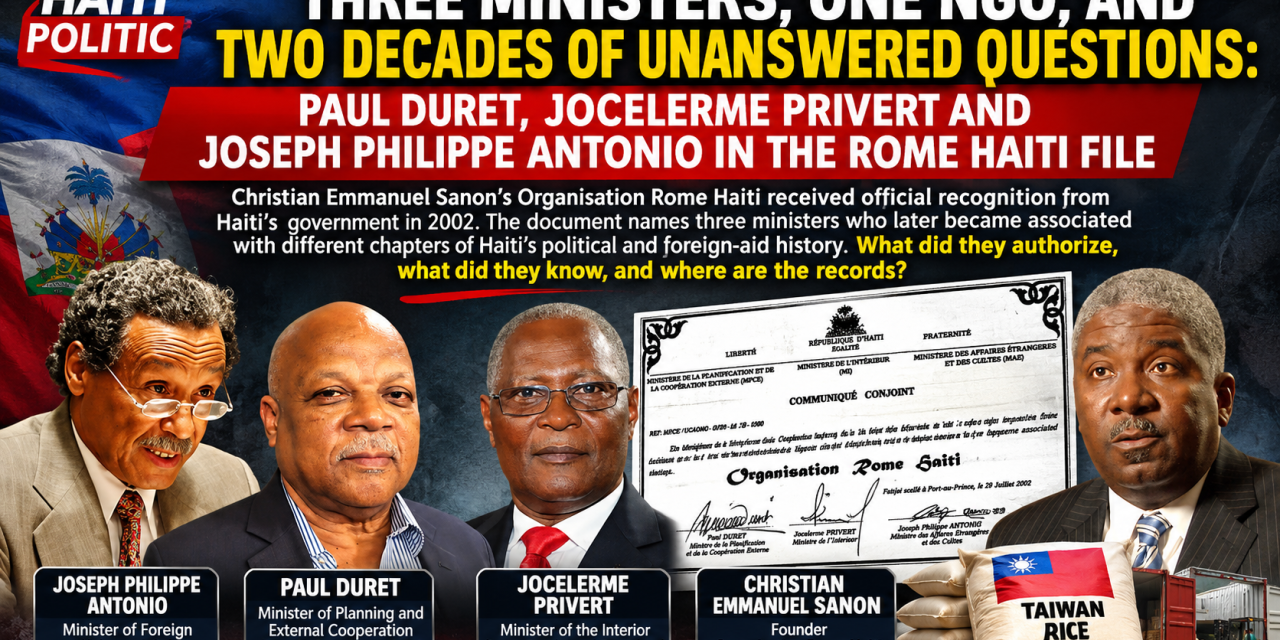
Christian Emmanuel Sanon’s Organisation Rome Haiti received official recognition from Haiti’s government in 2002. The document names three ministers who later became associated with different chapters of Haiti’s political and foreign-aid history. What did they authorize, what did they know, and where are the records?
HAITI POLITIC | SPECIAL INVESTIGATION
November 12, 2026
INTRODUCTION: THREE MINISTERS WHO MUST ANSWER QUESTIONS
Christian Emmanuel Sanon’s name became internationally known following the assassination of Haitian President Jovenel Moïse on July 7, 2021.
But nearly two decades before that tragedy, Sanon was associated with a humanitarian organization that obtained official recognition from the Haitian government.
That organization was Organisation Rome Haiti (ORH).
A government document dated July 29, 2002, reproduced in Florida corporate filings nearly a decade later, identifies three Haitian ministers in connection with the organization’s recognition.
They were:
Paul Duret, Minister of Planning and External Cooperation.
Jocelerme Privert, Minister of the Interior.
Joseph Philippe Antonio, Minister of Foreign Affairs and Cults.
All three served under President Jean-Bertrand Aristide.
Their names appear in a document concerning an organization whose founder would later become a defendant in the criminal proceedings arising from the assassination of President Moïse.
That historical connection warrants serious investigation.
But the questions go beyond Sanon’s later legal troubles.
They concern how Haiti recognized nongovernmental organizations, how foreign assistance was administered, whether government institutions monitored NGO activities, and whether public officials maintained adequate records of organizations operating under government authorization.
The July 2002 document does not establish that any of the three ministers committed wrongdoing.
It does, however, provide a concrete basis for demanding explanations about the responsibilities exercised by their ministries.
Haiti Politic believes Paul Duret, Jocelerme Privert, and Joseph Philippe Antonio should each be asked to explain what their ministries reviewed, approved, and monitored in the Rome Haiti recognition process.
The central question is straightforward:
How did Organisation Rome Haiti obtain government recognition, what activities did it subsequently conduct, and what did the responsible ministries know?
1. THE 2002 DOCUMENT THAT CONNECTS THREE MINISTERS
AN OFFICIAL RECOGNITION UNDER THE ARISTIDE ADMINISTRATION
On July 29, 2002, a Haitian government document recognized Organisation Rome Haiti as a nongovernmental organization authorized to pursue development activities.
The document identifies three ministries involved in the recognition:
-
Ministry of Planning and External Cooperation.
-
Ministry of the Interior.
-
Ministry of Foreign Affairs and Cults.
The ministers named were Paul Duret, Jocelerme Privert, and Joseph Philippe Antonio.
The document also references registration file B-0300 and identifies an organizational address on Boulevard du 15 Octobre in Tabarre.
The recognition is significant because it establishes that Rome Haiti had an administrative history predating the January 2010 earthquake.
It also shows that the organization entered Haiti’s official NGO recognition system during the Aristide administration.
The document was later included in Organisation Rome Haiti’s application to register as a foreign nonprofit corporation in Florida.
However, several important records remain missing from the investigation.
Where is the original application?
Who prepared the organization’s statutes?
Who were its directors in 2002?
What development projects did it propose?
What information did the government require about its financial resources?
And what obligations did the organization assume after receiving recognition?
The complete administrative file B-0300 is essential to answering these questions.
The document establishes the ministers’ official involvement in the recognition process. It does not establish that they personally knew Sanon or supervised his organization’s daily operations.
2. PAUL DURET: THE MINISTER AT THE INTERSECTION OF FOREIGN AID AND NGO OVERSIGHT
FROM GOVERNMENT DEVELOPMENT PLANNING TO AGRICORP S.A.
Of the three ministers named in the Rome Haiti document, Paul Duret has a particularly relevant professional history for an investigation into foreign assistance.
As Minister of Planning and External Cooperation, Duret occupied a government position associated with development planning and international cooperation.
His ministry was among the institutions responsible for Haiti’s framework governing nongovernmental organizations.
This placed the ministry at an important intersection between foreign donors, international development programs, and local organizations seeking government recognition.
The first question for Duret concerns his ministry’s handling of Rome Haiti.
What review did the Ministry of Planning and External Cooperation conduct before the organization received recognition in July 2002?
Did the ministry examine its proposed development activities?
Did it verify the organization’s leadership?
Did it request financial information?
Did it maintain subsequent reports?
And did Rome Haiti ever receive assistance through programs coordinated by the ministry?
The recognition document does not answer those questions.
THE JANUARY 2004 TAIWANESE RICE DONATION
Duret’s role in foreign assistance is independently documented in a January 18, 2004, Taipei Times report.
According to the newspaper, Taiwan donated approximately 3,000 metric tonnes of rice, valued at US$500,000, to Haiti.
The donation was announced during a January 15 ceremony attended by Taiwan’s ambassador, Hsieh Hsin-ping, and Haiti’s foreign minister, Joseph Philippe Antonio.
Paul Duret accepted the donation on behalf of the Haitian government.
The rice was intended for vulnerable populations, particularly people affected by flooding.
The report stated that the Haitian government would distribute the assistance.
This establishes Duret’s participation in a specific foreign-aid transaction.
But it does not establish that he personally distributed the rice, selected beneficiaries, or awarded contracts connected to the donation.
Nor does the report connect the donation to Organisation Rome Haiti.
Nevertheless, the transaction raises legitimate historical accountability questions.
Which Haitian agency received the rice?
Who handled storage and transportation?
Which organizations distributed it?
Were beneficiary lists or delivery records maintained?
Did Taiwan receive a final accounting?
These questions are important because accepting foreign assistance on behalf of a government is only one stage of the aid process.
The ultimate public-interest question is whether assistance reached its intended beneficiaries.
AGRICORP S.A.: THE PRIVATE-SECTOR CONNECTION
A 2007 development study associated with the Inter-American Development Bank identifies Duret as head of Agricorp S.A. and a former Minister of Planning.
The study describes his involvement in agricultural development initiatives near Forêt des Pins, including dairy production and sawmill-related activities.
This establishes a later private-sector role in agricultural development.
However, the available evidence does not establish Agricorp’s complete ownership structure, financing arrangements, or any connection to Rome Haiti.
It also does not establish that Agricorp participated in the Taiwanese rice donation.
Those distinctions matter.
Duret’s career provides legitimate grounds to examine the relationship between government development policy and private agricultural initiatives.
But a professional transition from public office to private business is not itself evidence of misconduct.
THE QUESTIONS FOR PAUL DURET
Haiti Politic asks:
Did your ministry conduct substantive due diligence before recognizing Rome Haiti?
Did you personally meet Christian Emmanuel Sanon?
Did Rome Haiti receive foreign assistance coordinated through your ministry?
What records document the distribution of Taiwan’s 2004 rice donation?
What were Agricorp S.A.’s sources of financing, and did the company receive government or donor-funded contracts?
These questions require documentary answers.
3. JOCELERME PRIVERT: WHAT DID THE MINISTRY OF THE INTERIOR KNOW?
THE FORMER MINISTER WHO LATER BECAME HAITI’S PROVISIONAL PRESIDENT
Jocelerme Privert’s name appears in the July 2002 recognition document in his capacity as Minister of the Interior.
He later served as Haiti’s provisional president from 2016 to 2017.
His involvement in the recognition process deserves scrutiny because the Ministry of the Interior was one of the government institutions named in the document.
The relevant question is not simply whether Privert’s name appears.
It is what his ministry actually did.
Did the ministry examine Rome Haiti’s legal status?
Did it review the organization’s statutes?
Did it verify its officers?
Did it maintain correspondence with Sanon?
Did it receive subsequent reports concerning the organization’s activities?
And did it authorize any public resources, facilities, or other benefits?
These questions become especially important when considered alongside Sanon’s later claims about humanitarian activities following the 2010 earthquake.
THE ALLEGED GOVERNMENT-ASSIGNED AREA BETWEEN CARREFOUR AND LÉOGÂNE
Journalist Jacqueline Charles reported Sanon’s claim that the Haitian government provided his nonprofit organization access to an area between Carrefour and Léogâne following the earthquake.
The claim requires verification.
It does not identify the precise location.
It does not establish whether the arrangement involved temporary access, humanitarian coordination, a land-use agreement, or a property transfer.
It also does not identify the Haitian officials who authorized it.
The timing matters.
The earthquake occurred in January 2010 under President René Préval.
Michel Martelly assumed the presidency in May 2011.
Privert’s appearance in the 2002 recognition document does not establish his involvement in a post-earthquake arrangement years later.
Nevertheless, the alleged project provides a reason to investigate Rome Haiti’s government relationships over time.
Did the organization maintain contact with Haitian authorities after 2002, and did those contacts lead to additional authorizations?
That question cannot be answered from the recognition document alone.
THE QUESTIONS FOR JOCELERME PRIVERT
Haiti Politic asks:
Did you personally review or approve Rome Haiti’s recognition?
Did you meet Christian Emmanuel Sanon?
What documentation did your ministry require?
Did the Ministry of the Interior subsequently monitor the organization?
Are the records associated with registration B-0300 still available?
Would you support their public release, subject to applicable legal requirements?
The answers could clarify the historical record without relying on speculation.
4. JOSEPH PHILIPPE ANTONIO: THE FOREIGN MINISTRY’S ROLE IN ROME HAITI
INTERNATIONAL COOPERATION, DIPLOMACY AND NGO RECOGNITION
Joseph Philippe Antonio served as Haiti’s Minister of Foreign Affairs and Cults.
His name appears alongside Duret and Privert in the 2002 recognition document.
The Ministry of Foreign Affairs had responsibilities involving Haiti’s diplomatic relations and international agreements.
Its inclusion in the NGO recognition document raises questions about the administrative procedures applied to organizations with international activities.
What role did the ministry play in reviewing Rome Haiti?
Did it examine the organization’s foreign partners?
Did it receive information concerning international funding?
Did it verify the organization’s legal status or proposed overseas relationships?
And did it maintain correspondence concerning the organization’s humanitarian activities?
These questions are particularly relevant because Rome Haiti later registered in Florida as a foreign nonprofit corporation.
However, the 2011 Florida registration does not establish that Antonio participated in or knew about that later filing.
ANTONIO AND THE 2004 TAIWANESE RICE DONATION
Antonio also appears in the January 2004 Taipei Times report concerning Taiwan’s donation of 3,000 tonnes of rice.
He attended the ceremony as Haiti’s foreign minister.
Duret accepted the assistance on behalf of the Haitian government.
This demonstrates that Antonio and Duret participated in the same documented foreign-assistance event.
But the article does not establish that Antonio supervised distribution or that the donation had any connection to Rome Haiti.
The historical relevance lies in the officials’ documented responsibilities within Haiti’s international cooperation system.
THE QUESTIONS FOR JOSEPH PHILIPPE ANTONIO
Haiti Politic asks:
What was the Foreign Ministry’s role in recognizing Rome Haiti?
Did your ministry review the organization’s international partnerships?
Were any foreign donors or humanitarian organizations identified in its application?
Did the ministry maintain records of Rome Haiti’s activities abroad?
Were any diplomatic agreements or official communications issued concerning the organization?
Can those records be made available for public examination?
5. CHRISTIAN EMMANUEL SANON: WHAT DID ROME HAITI ACTUALLY ACCOMPLISH?
THE HUMANITARIAN CLAIMS THAT REQUIRE EVIDENCE
Christian Emmanuel Sanon reportedly stated that he brought approximately 300 doctors and nurses to Haiti after the January 2010 earthquake.
According to the account reported by Jacqueline Charles, the medical professionals worked in different locations.
Sanon also claimed that the Haitian government provided his nonprofit access to an area between Carrefour and Léogâne.
These are substantial claims.
But the documents reviewed so far do not independently establish their accuracy.
A humanitarian deployment involving hundreds of medical professionals would ordinarily generate records.
Those might include organizational correspondence, medical partnerships, transportation arrangements, professional credentials, funding reports, and documentation of services provided.
Haiti Politic therefore asks:
Who were the medical professionals?
Which organizations recruited them?
Where did they work?
How long did they remain?
Who financed the operation?
How many patients received care?
Which Haitian government agencies coordinated with Rome Haiti?
And what happened to the alleged humanitarian project between Carrefour and Léogâne?
The answers could establish whether Rome Haiti’s claimed activities were supported by verifiable evidence.
Legal recognition as an NGO does not independently prove that its claimed humanitarian projects were completed.
6. THE FLORIDA CORPORATE RECORDS: SANON AND FREDERICK J. BERGMANN
A SECOND DOCUMENTARY CHAPTER
On November 23, 2011, Organisation Rome Haiti Corporation registered in Florida as a foreign nonprofit corporation.
The Florida Division of Corporations identifies:
Corporate name: Organisation Rome Haiti Corporation
Document number: F11000004708
Registration date: November 23, 2011
Jurisdiction: Haiti
Registered agent: Christian Sanon
Officer: Christian Sanon
Status: Inactive
The application describes the organization’s purpose as humanitarian and identifies July 29, 2002, as its original incorporation date.
That date corresponds to the Haitian recognition document.
FREDERICK J. BERGMANN’S ROLE
The Florida filing materials also identify Frederick J. Bergmann, CPA, as a participant in the registration process.
A November 21, 2011, letter identifies Bergmann as a director.
This creates an additional question about Rome Haiti’s governance.
Was Bergmann a director of the Haitian organization?
Did he provide accounting services?
Was he involved in financial reporting?
Did he help manage the organization’s corporate compliance?
What was the duration of his involvement?
The available documents do not establish his complete responsibilities.
They also do not establish that he controlled donations or participated in the alleged 2010 medical deployment.
THE 2012 ADMINISTRATIVE REVOCATION
Florida records show that the organization’s registration was administratively revoked on September 28, 2012, for failure to file an annual report.
That is relevant to its corporate history.
However, administrative revocation for failing to file an annual report does not establish fraud or misuse of nonprofit funds.
Nor does it necessarily establish that the organization ceased operating in Haiti.
The next investigative step is to obtain corporate governance and financial records that clarify what happened after the Florida registration.
7. DID FOREIGN AID, GOVERNMENT RECOGNITION AND PRIVATE DEVELOPMENT INTERSECT?
THREE SEPARATE RECORDS THAT SHOULD NOT BE CONFUSED
The investigation now includes three distinct historical matters.
First: The July 2002 government recognition of Organisation Rome Haiti, involving ministries headed by Duret, Privert, and Antonio.
Second: The January 2004 Taiwanese rice donation, accepted on behalf of Haiti by Duret during a ceremony attended by Antonio.
Third: Duret’s later involvement with Agricorp S.A. and agricultural development initiatives.
These matters illustrate the institutional environment in which government officials, foreign donors, NGOs, and private development organizations operated.
But they do not establish a common financial arrangement.
There is no verified evidence in the records reviewed that Taiwan’s rice donation financed Rome Haiti.
There is no verified evidence that Agricorp S.A. financed Sanon’s organization.
There is no verified evidence that Privert, Duret, and Antonio coordinated private financial benefits through the NGO recognition process.
The legitimate investigative question is whether additional records reveal connections that are not apparent in the existing documents.
Shared officials and overlapping institutional responsibilities are investigative leads—not proof of an undisclosed financial network.
8. WHY THE THREE MINISTERS SHOULD FACE PUBLIC ACCOUNTABILITY QUESTIONS
GOVERNMENT AUTHORIZATION MUST BE ACCOMPANIED BY DOCUMENTATION
The recognition of an NGO is an official government action.
It creates a legitimate expectation that the responsible institutions followed the applicable procedures and maintained records.
The three ministers named in the 2002 document should therefore be asked to explain their ministries’ respective roles.
That does not mean each minister personally examined every page of the application.
Administrative procedures often involve civil servants, technical reviewers, and delegated authority.
But senior officials may still be appropriate sources for clarifying how those procedures operated.
Haiti Politic’s position is that public accountability requires access to the records behind government decisions.
The original recognition file could help establish whether Rome Haiti met the requirements applicable at the time.
Subsequent records could reveal whether the organization submitted reports, received assistance, or obtained additional government authorizations.
If those records are missing, the government should explain whether they were destroyed, transferred, archived, or otherwise unavailable.
The public deserves a factual account.
9. DOES THE 2002 DOCUMENT CONNECT THE MINISTERS TO THE MOÏSE ASSASSINATION?
THE LIMITS OF THE EVIDENCE
Christian Emmanuel Sanon later became a defendant in the criminal proceedings arising from President Jovenel Moïse’s assassination.
That development makes his earlier activities relevant to understanding his personal and organizational history.
However, the July 2002 NGO recognition does not establish that any of the three ministers knew about, supported, or participated in the alleged assassination conspiracy.
The recognition occurred approximately nineteen years before the assassination.
The available documents do not establish a personal political alliance between Sanon and the ministers.
They do not establish that the ministers financed Sanon’s later political activities.
And they do not establish that any minister was involved in the assassination.
The investigation must therefore maintain a clear distinction between historical administrative responsibility and criminal allegations.
The former is supported by the recognition document.
The latter is not supported by the evidence reviewed.
10. FIFTEEN QUESTIONS THE THREE FORMER MINISTERS SHOULD ANSWER
FIVE QUESTIONS FOR PAUL DURET
1. What due diligence did the Ministry of Planning and External Cooperation conduct before recognizing Organisation Rome Haiti in July 2002?
2. Did Rome Haiti subsequently receive government-coordinated foreign assistance, and what records document any such support?
3. What role did your ministry play in monitoring the organization’s activities and financial reporting?
4. Which agencies distributed Taiwan’s 3,000-tonne rice donation in 2004, and what records establish delivery to beneficiaries?
5. What were Agricorp S.A.’s funding sources, and did it receive government contracts or donor-supported financing?
FIVE QUESTIONS FOR JOCELERME PRIVERT
6. Did you personally review or approve the recognition of Organisation Rome Haiti?
7. Did you know or meet Christian Emmanuel Sanon before or after July 2002?
8. What records did the Ministry of the Interior maintain concerning the organization’s leadership and operations?
9. Did your ministry authorize any government facilities, resources, or benefits for Rome Haiti during your tenure?
10. Would you support the release of the complete administrative file associated with registration B-0300?
FIVE QUESTIONS FOR JOSEPH PHILIPPE ANTONIO
11. What role did the Ministry of Foreign Affairs and Cults play in recognizing Organisation Rome Haiti?
12. Did the ministry examine the organization’s foreign partners, donors, or proposed international activities?
13. Did your ministry receive subsequent correspondence concerning Rome Haiti’s humanitarian operations?
14. What records exist concerning the Foreign Ministry’s participation in the January 2004 Taiwanese rice donation?
15. Would you support making publicly disclosable ministry records concerning Rome Haiti available to independent investigators?
11. THE DOCUMENTS THAT COULD SETTLE THE QUESTIONS
The next stage of this investigation should focus on obtaining original records.
The most important documents include:
The complete 2002 NGO recognition file: Registration B-0300, including application materials, statutes, leadership records, and government correspondence.
Ministry oversight records: Reports or correspondence from the Ministry of Planning, Ministry of the Interior, and Ministry of Foreign Affairs.
Rome Haiti’s financial records: Donations, grants, expenditures, bank records where lawfully obtainable, and audited statements if any were prepared.
Medical deployment documentation: Records supporting Sanon’s claim that approximately 300 doctors and nurses participated in post-earthquake humanitarian operations.
The alleged land or project authorization: Any agreement involving the area between Carrefour and Léogâne.
Taiwanese rice donation records: Shipping, receipt, storage, distribution, and beneficiary documentation.
Agricorp S.A. records: Corporate ownership, project financing, and publicly available government or donor contracts.
Florida corporate governance records: Documents clarifying Bergmann’s role and the organization’s activities following its 2011 registration.
Without these materials, important questions will remain unresolved.
CONCLUSION: THREE MINISTERS, THREE SETS OF RESPONSIBILITIES, ONE DEMAND FOR TRANSPARENCY
The July 29, 2002, government recognition of Organisation Rome Haiti provides a concrete historical record linking Christian Emmanuel Sanon’s organization to three Haitian ministries.
Paul Duret headed Planning and External Cooperation.
Jocelerme Privert headed the Ministry of the Interior.
Joseph Philippe Antonio headed Foreign Affairs and Cults.
Their names appear in the recognition document.
Duret and Antonio also appear in independent reporting concerning Taiwan’s January 2004 rice donation.
Duret’s later role at Agricorp S.A. provides an additional lead concerning agricultural development and private-sector activities.
Sanon’s reported claims about bringing 300 medical professionals to Haiti and obtaining access to an area between Carrefour and Léogâne remain unverified.
The Florida corporate filings provide evidence of the organization’s subsequent registration in the United States and identify Frederick J. Bergmann as another person associated with its administration.
Together, these records raise important questions about government recognition, NGO governance, foreign assistance, and public accountability.
But they do not establish that the three former ministers participated in a coordinated financial scheme or had knowledge of Sanon’s later alleged criminal activities.
Haiti Politic is not accusing these officials of crimes on the basis of their names appearing in a government document.
It is demanding an explanation of the government decisions made under their authority.
If the recognition was routine and properly documented, the records should help establish that.
If the organization subsequently received public assistance, the relevant transactions should be traceable.
And if Rome Haiti carried out the humanitarian projects Sanon described, independent documentation should help verify those accomplishments.
The Haitian public deserves answers grounded in evidence.
PAUL DURET, JOCELERME PRIVERT AND JOSEPH PHILIPPE ANTONIO: WHAT DID YOUR MINISTRIES KNOW ABOUT CHRISTIAN EMMANUEL SANON’S ROME HAITI — AND WHERE ARE THE RECORDS?
HAITI POLITIC
Independent Investigation | Foreign Aid | NGO Accountability | Political Transparency
SOURCES AND VERIFICATION NOTES
1. Haitian government recognition document, July 29, 2002. Reproduced in the Florida corporate filing for Organisation Rome Haiti Corporation. The document identifies Paul Duret, Jocelerme Privert, and Joseph Philippe Antonio.
2. Florida Division of Corporations. Organisation Rome Haiti Corporation, document F11000004708, registered November 23, 2011; administratively revoked September 28, 2012.
3. Frederick J. Bergmann correspondence, November 21, 2011. Included in the Florida corporate filing; identifies Bergmann as a director in connection with the registration.
4. Taipei Times, January 18, 2004. Report documenting Taiwan’s 3,000-tonne rice donation, Paul Duret’s acceptance of the assistance, and Joseph Philippe Antonio’s attendance.
5. Development study associated with the Inter-American Development Bank, 2007. Identifies Paul Duret as head of Agricorp S.A. and describes agricultural development initiatives near Forêt des Pins.
6. Jacqueline Charles, November 2026. Social media report describing Sanon’s claims concerning approximately 300 medical professionals and a government-authorized humanitarian location between Carrefour and Léogâne.
Editorial disclosure: The available evidence does not establish financial misconduct by Duret, Privert, Antonio, or Bergmann. The original NGO administrative file, financial statements, alleged land authorization, and medical deployment records have not been independently obtained. The uploaded video concerning Duret has not been reviewed for this version.