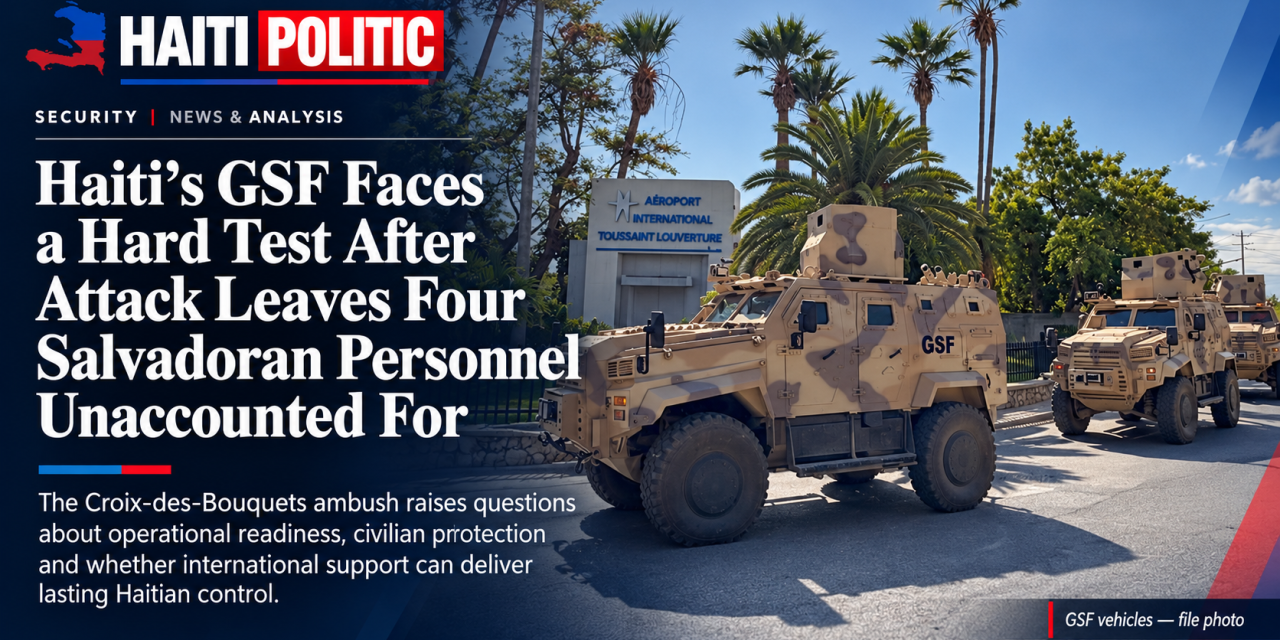
The Croix-des-Bouquets ambush raises questions about operational readiness, civilian protection and whether international support can translate into lasting Haitian control.
Haiti Politic | News and Analysis
October 19, 2026
An attack on Salvadoran personnel serving with Haiti’s Gang Suppression Force has brought renewed urgency to a question that should have guided the mission from the beginning: how prepared is an international force to confront armed groups while helping restore the authority of a sovereign Haitian state?
Four Salvadoran aviation technicians remained unaccounted for in reporting published Monday after their armored vehicle was attacked Sunday, October 18, in Croix-des-Bouquets. According to the Associated Press, citing El Salvador’s military, explosives struck the vehicle and it caught fire; the men escaped it, but their whereabouts remained unknown. Attempts to reach them were impeded by fighting. U.S. Ambassador Mike Waltz condemned the attack and said the coalition would not be intimidated into withdrawing. [1]
That account does not establish that the four men were killed or captured. Their reported status must remain distinct from speculation about their fate.
A foreseeable threat—and a demand for answers
The immediate priority is locating the missing personnel. The wider policy question is whether the force’s planning, resources and coordination match the dangers it has been authorized to confront.
An international deployment into an environment dominated by armed groups must anticipate ambushes, disrupted movement and attempts to undermine its credibility. Recognizing those risks does not justify attacks or establish that a particular incident could have been prevented. It does mean that diplomatic expressions of determination should be accompanied by a rigorous review of what happened.
Authorities should explain, as far as operational security permits, how the personnel’s movement was coordinated, what support was available and what lessons will change future practice. The information currently available does not establish negligence, a breakdown in command or the full sequence of the attack.
One ambush cannot, by itself, demonstrate that the entire mission has failed. Equally, a promise to remain deployed cannot substitute for evidence that the mission is improving security.
The mandate is broader than maintaining a presence
The GSF is a UN-authorized multinational mission, not a UN peacekeeping operation. The distinction matters: responsibility is shared among the participating states, the force’s leadership, Haitian authorities and the international support arrangements. [2]
On September 29, the Security Council renewed the force’s mandate through March 31, 2027. The Council’s published account records Haiti’s demand for the personnel, equipment and operational capabilities needed for full deployment. It also records Haiti’s insistence that recovered territory must be held, public services restored and gangs prevented from returning. [3]
These were identified concerns before Sunday’s attack. The incident gives renewed weight to them, although it does not establish which capability, if any, was deficient during this particular operation.
For Haiti Politic, the central test is whether international assistance expands the Haitian state’s ability to protect people and govern. Foreign personnel can support that goal; their continued presence is not itself proof that the goal is being achieved.
A credible assessment should track whether roads remain accessible, communities can return safely, public institutions resume functioning and Haitian security services can sustain protection after an operation ends.
That also requires civilian safeguards. Residents should have reliable channels to report abuse, obtain information and seek accountability. The Security Council’s renewal explicitly stresses compliance with applicable international law, including human rights law. [3]
Security must reach the networks behind the guns
A response focused exclusively on armed confrontations risks leaving the systems that replenish criminal groups intact.
On October 14, the Security Council renewed Haiti’s sanctions regime, including arms-embargo measures. Its account emphasizes preventing illicit arms trafficking and diversion, strengthening border controls and addressing the financing and support networks behind violence. [4]
The policy implication is clear: international partners should apply the same determination to tracing weapons, investigating illicit financing and enforcing sanctions that they express when promising military action. Investigations should follow evidence through suppliers, intermediaries, cargo movements and recipients, without treating legitimate shipping businesses as collectively responsible.
Haitian authorities must also account for how security assistance strengthens national institutions. Sovereignty requires both protection against external overreach and an effective, accountable state capable of serving its population.
Sunday’s attack is a serious test of the GSF. A responsible response combines efforts to locate the missing personnel with a review of readiness, protection for surrounding communities and clear measures of progress.
The standard should remain the one Haitians have the greatest reason to demand: lasting security, functioning institutions and increasing Haitian control over the country’s future.
Reporting note: This article reflects information available in the sources reviewed on October 19. The longer quotation attributed to Mike Waltz in the supplied screenshot has not been independently authenticated and is not reproduced here.
Sources:
[1] Associated Press, October 19, 2026: https://apnews.com/article/haiti-gangs-salvador-attack-military-dd5d4b617fc526d3f7d994274732fc7e
[2] UN Security Council meeting coverage index, September 29 entry: https://press.un.org/en/haiti
[3] UN Security Council, September 29, 2026: https://press.un.org/en/2026/sc16466.doc.htm
[4] UN Security Council, October 14, 2026: https://press.un.org/en/2026/sc16476.doc.htm