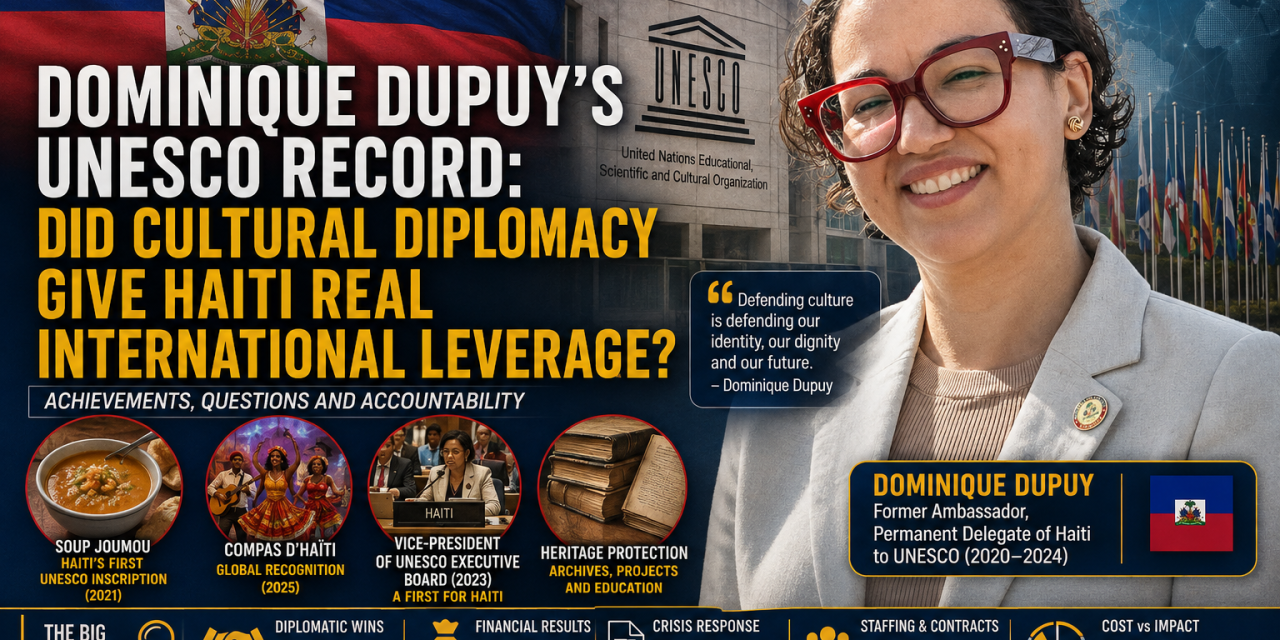
🇭🇹🌍 Before becoming Haiti’s Minister of Foreign Affairs in 2024, Dominique Dupuy spent roughly three years representing Haiti at one of the country’s most strategically important multilateral institutions: UNESCO.
Her tenure coincided with extraordinary national instability—but also with several unusually visible victories for Haitian cultural diplomacy.
Soup Joumou entered UNESCO’s Intangible Cultural Heritage list.
Haiti reached the vice-presidency of UNESCO’s Executive Board for the first time.
Haiti advanced toward membership of the Intergovernmental Committee for the Safeguarding of the Intangible Cultural Heritage.
A UNESCO Chair in History and Heritage was approved for the State University of Haiti.
A major safeguarding project for the metal-cutting artisans of Noailles received UNESCO support.
And during the collapse of security in Port-au-Prince in March 2024, Dupuy used UNESCO’s Executive Board to deliver an unusually forceful appeal about Haiti’s emergency.
Those are significant developments.
But an investigation requires something more difficult than repeating accomplishments.
WHAT DID DOMINIQUE DUPUY HERSELF DELIVER—and what resulted from broader Haitian institutions, communities and UNESCO programs?
And beyond cultural recognition:
WHAT WAS THE RETURN ON HAITI’S DIPLOMATIC INVESTMENT IN PARIS?
The available record provides evidence of achievement.
It also leaves important financial and administrative questions unanswered.
Let the documents—and ultimately the Haitian people—decide.
👤 WHO IS DOMINIQUE DUPUY?
Dupuy was appointed Haiti’s Permanent Delegate to UNESCO in 2020, serving until 2024. UNESCO records from her tenure identify her as Haiti’s Ambassador and Permanent Delegate.
Her academic background differs from the traditional career-diplomat route.
Public biographical information reports that she studied social sciences at Vanier College and earned a Bachelor’s degree in International Development from McGill University in 2012, with additional studies at Lancaster University. She is also reported to speak Haitian Creole, French, English and Spanish.
After leaving the Permanent Delegation, Dupuy became Minister of Foreign Affairs, Religious Affairs and Haitians Living Abroad in June 2024. UNESCO records subsequently identify her participating in the organization’s Executive Board in that ministerial capacity.
But her UNESCO years provide a particularly useful case study because they produced outcomes that can actually be examined.
🍲 ACCOMPLISHMENT #1 — SOUP JOUMOU
The strongest symbol of Dupuy’s UNESCO tenure is unquestionably Soup Joumou.
On December 16, 2021, UNESCO’s Intergovernmental Committee inscribed Joumou soup on the Representative List of the Intangible Cultural Heritage of Humanity.
And this was not simply another cultural designation.
It was Haiti’s first element inscribed on that list.
UNESCO recognized the soup’s profound relationship with Haiti’s independence, freedom, dignity, identity and social cohesion.
There is another remarkable element.
The nomination was processed through an exceptional procedure, connected to Haiti’s extraordinary circumstances. UNESCO’s General Assembly subsequently endorsed that procedure and expressed solidarity with Haiti following natural disasters and profound social and political turmoil.
That was a real multilateral victory.
⚠️ BUT WHO DESERVES THE CREDIT?
This is where an investigative assessment must resist personality politics.
The Haitian government’s own announcement explicitly credited numerous contributors:
the Haitian National Commission for Cooperation with UNESCO;
the Haitian government;
students, professors and researchers at the State University of Haiti;
community organizations in Haiti and the diaspora;
photographers and videographers;
experts and translators;
and
national and international media.
UNESCO’s decision also notes that Soup Joumou had already been identified through a heritage-inventory project dating to 2011 and entered Haiti’s National Register of Cultural Heritage in 2020.
Therefore:
SOUP JOUMOU WAS NOT THE ACCOMPLISHMENT OF ONE DIPLOMAT ALONE.
But Dupuy’s delegation was operating at the critical diplomatic stage when the nomination was submitted and ultimately secured.
That makes a more precise question appropriate:
WHAT EXACTLY DID HER DELEGATION DO TO CONVERT A HAITIAN CULTURAL DOSSIER INTO A UNANIMOUS UNESCO DECISION?
Which governments were approached?
Which ambassadors were persuaded?
What coalition was assembled?
Who agreed to support the exceptional procedure?
How many bilateral meetings occurred?
Those details would reveal the architecture behind the victory.
🏛️ ACCOMPLISHMENT #2 — HAITI REACHES UNESCO’S EXECUTIVE LEADERSHIP
October 27, 2023 produced another important development.
Haiti was elected by acclamation as a Vice-President of UNESCO’s Executive Board.
Contemporary reporting described it as the first time in Haiti’s 77 years of UNESCO membership that the country reached that position.
Dupuy had initially campaigned for something even bigger:
THE PRESIDENCY OF UNESCO’S EXECUTIVE BOARD.
Haiti publicly circulated her candidacy after first announcing it within the Latin America and Caribbean group in November 2022.
The presidency campaign did not ultimately succeed.
But Haiti obtained a vice-presidency.
That distinction matters.
An investigative article should acknowledge both the objective that was not achieved and the significant position that was obtained instead.
🌎 THE GRULAC QUESTION
Vice-presidency was more than ceremonial.
Contemporary reporting said Haiti would help represent the Latin American and Caribbean constituency within the Executive Board’s governance structure.
That potentially gave Haiti something it frequently lacks internationally:
INSTITUTIONAL LEVERAGE.
But winning a position and using a position are two different performance indicators.
So the retrospective question is unavoidable:
What did Haiti obtain because it held that vice-presidency?
How many Haitian proposals were incorporated into UNESCO programs?
How much additional funding reached Haiti?
What initiatives benefited Caribbean states?
What GRULAC positions did Haiti successfully negotiate?
Which Haitian priorities entered UNESCO’s budget or program?
The title is documented.
The complete measurable return from the title is less obvious from the public record reviewed for this investigation.
🏺 ACCOMPLISHMENT #3 — HAITI MOVES INTO THE INTANGIBLE HERITAGE COMMITTEE
Another development was unfolding simultaneously.
In late 2023, Dupuy publicly announced that Haiti was moving toward becoming a member of UNESCO’s Intergovernmental Committee for the Safeguarding of the Intangible Cultural Heritage for the first time.
UNESCO’s current country record confirms Haiti as a Committee Member for 2024–2028.
That matters because Soup Joumou demonstrated how valuable UNESCO’s intangible-heritage machinery can be to Haiti.
Committee membership potentially gives Haiti greater institutional experience and visibility inside the system that evaluates and safeguards living cultural heritage.
But again:
WHAT WILL HAITI DO WITH THE SEAT?
Institutional access only becomes diplomatic power when it produces outcomes.
🎓 ACCOMPLISHMENT #4 — A UNESCO CHAIR AT THE STATE UNIVERSITY OF HAITI
One of the most concrete and less-discussed achievements of Dupuy’s tenure involved higher education.
In April 2022, UNESCO’s UNITWIN/UNESCO Chairs Programme accepted a proposal establishing a UNESCO Chair in History and Heritage at the Université d’État d’Haïti.
The Haitian government stated that the project had been formally submitted on April 29, 2021 under the leadership of Haiti’s Permanent Delegation and the Haitian National Commission for Cooperation with UNESCO.
This is important because it moves beyond symbolic diplomacy.
A university chair can build:
research capacity
academic networks
technical expertise
heritage knowledge
and
international university cooperation.
That is the type of institutional outcome Haiti’s foreign policy should be producing.
But even here, accountability requires follow-through:
How much financing accompanied the Chair?
How many researchers participated?
How many students benefited?
How many international partnerships resulted?
What research was produced?
Approval is one performance metric.
Impact is another.
🎨 ACCOMPLISHMENT #5 — NOAILLES AND CULTURAL SURVIVAL DURING THE SECURITY CRISIS
UNESCO’s records identify a major project beginning in October 2023 to support artists and artisans in the village of Noailles, protecting Haiti’s metal-cutting heritage amid the security crisis.
The project runs from October 2023 to October 2026.
UNESCO lists its amount at:
US$280,092.
This is precisely the type of number that should appear in diplomatic performance reporting.
Not merely:
“UNESCO supports Haiti.”
But:
$280,092.
A defined project.
A defined community.
A defined timeline.
There was also a US$75,000 regional capacity-building project beginning in 2022 involving nomination-file preparation for Small Island Developing States in Latin America and the Caribbean.
And UNESCO World Heritage records show US$33,325 approved in September 2023 for a project concerning seismic threats and conservation of monuments in Haiti’s National History Park.
These are tangible resources.
But attribution again requires caution.
UNESCO projects involve UNESCO itself, Haitian national institutions, technical specialists, communities and sometimes multiple states.
Therefore, the question for Dupuy is not simply:
“Did this happen while you were ambassador?”
It should be:
WHAT ROLE DID YOUR DELEGATION PLAY IN SECURING EACH DOLLAR?
🚨 MARCH 2024 — WHEN DIPLOMACY BECAME CRISIS ADVOCACY
Perhaps the most dramatic moment of Dupuy’s UNESCO tenure occurred during the 219th Session of UNESCO’s Executive Board.
Port-au-Prince was experiencing catastrophic insecurity.
Instead of delivering a conventional technical intervention, Dupuy used the Executive Board floor to describe the collapse occurring in Haiti.
Le Nouvelliste reported the intervention on March 19, 2024 and documented her argument that Haiti’s education, science and culture were being overwhelmed by the national emergency.
The speech attracted attention.
But oversight requires asking the question that follows every powerful speech:
WHAT HAPPENED NEXT?
Did UNESCO release emergency money?
Did additional heritage protection begin?
Did displaced students receive assistance?
Were educational programs financed?
Were Haitian archives protected?
Did UNESCO deploy emergency experts?
How much?
Where?
When?
A speech can mobilize political attention.
Diplomatic performance should measure what that attention produced.
📊 THE FUNDING QUESTION
UNESCO’s public records help establish at least some financial benchmarks.
For Haiti, UNESCO’s Intangible Cultural Heritage portal lists projects including:
US$280,092 — Noailles artisans and metal-cutting heritage
US$75,000 — regional capacity-building for intangible-heritage nominations
and other programs predating Dupuy’s tenure.
The World Heritage Centre separately records 13 approved international-assistance requests for Haiti totaling US$316,035 historically, although most of that total spans periods well outside Dupuy’s mandate.
That last distinction is crucial.
An ambassador cannot claim historical UNESCO assistance as a personal accomplishment.
A serious performance report should isolate:
ONLY THE FUNDS SECURED, APPROVED OR MATERIALIZED DURING THE 2020–2024 TENURE—and explain the delegation’s role in obtaining them.
🎶 WHAT ABOUT COMPAS?
Dupuy’s tenure is also relevant to the eventual UNESCO inscription of Compas d’Haïti.
But chronology must be respected.
Compas was ultimately inscribed in 2025, after Dupuy had left the Permanent Delegation. UNESCO’s current Haiti record lists Compas in 2025, cassava bread in 2024 and Soup Joumou in 2021.
Therefore, the final Compas inscription cannot accurately be presented as a completed achievement of her 2020–2024 tenure.
The proper retrospective question is:
WHAT GROUNDWORK DID THE DUPUY DELEGATION COMPLETE BEFORE HER DEPARTURE?
Was the inventory completed?
Were communities consulted?
Was the nomination drafted?
Which technical experts participated?
What diplomatic advocacy had already begun?
And what remained for her successors?
That would properly divide credit between successive administrations.
⚠️ NOW COME THE HARDER QUESTIONS: STAFFING, CONTRACTS AND PUBLIC MONEY
Diplomatic accomplishments do not eliminate the obligation for financial transparency.
The opposite is true.
Successful missions should be able to document both their achievements and their costs.
Your oversight questions raise concerns regarding advisory and promotional contracts and staffing at the Paris delegation between 2020 and 2024.
For this investigation, however, we should draw an important line:
QUESTIONS ARE NOT EVIDENCE OF WRONGDOING.
I did not find sufficiently authoritative public documentation in the sources reviewed to responsibly state as fact that Dupuy improperly awarded contracts or misused public funds.
Therefore, no such allegation should be presented as established fact.
But asking for records is entirely legitimate.
And those records should be straightforward to produce if they exist.
📑 SIX QUESTIONS DOMINIQUE DUPUY SHOULD ANSWER ABOUT HER 2020–2024 RECORD
I. INTANGIBLE CULTURAL HERITAGE
1️⃣ SOUP JOUMOU: SHOW US THE DIPLOMATIC ARCHITECTURE
UNESCO confirms the historic inscription.
The Haitian government confirms the broad coalition of institutions and communities behind the dossier.
Now provide the diplomatic record.
Which countries did the delegation lobby?
Which governments committed support?
Who backed the exceptional procedure?
How many bilateral consultations occurred?
What diplomatic obstacles had to be overcome?
And regarding Compas:
What percentage of the eventual nomination dossier was completed before Dupuy left UNESCO?
The public should know where one administration’s work ended and another’s began.
2️⃣ EXECUTIVE BOARD: WHAT DID THE VICE-PRESIDENCY PRODUCE?
Haiti’s 2023 vice-presidency was historically significant.
Now quantify it.
During Haiti’s leadership role:
How many Haitian proposals were adopted?
How many GRULAC initiatives did Haiti lead?
What budget allocations did Haiti influence?
What programs were redirected toward Caribbean priorities?
What additional resources reached Haiti?
If the office produced institutional leverage, publish the evidence.
II. CRISIS ADVOCACY
3️⃣ AFTER THE 219TH SESSION SPEECH—WHAT ARRIVED IN HAITI?
The March 2024 intervention is documented.
Now connect advocacy to outcomes.
Within 30, 60 and 90 days of that speech:
How much emergency financing was approved?
What educational support was mobilized?
What cultural sites received assistance?
Which UNESCO experts were deployed?
What emergency mechanisms were activated?
How many beneficiaries were reached?
If nothing immediate resulted, say so.
Transparency includes unsuccessful diplomacy as well as successful diplomacy.
4️⃣ HOW WAS HAITI’S CULTURAL MEMORY PROTECTED DURING THE BLOCKADES?
During the deterioration of security and mobility in Haiti:
What systems protected:
archives?
museum collections?
historical documents?
digitized records?
research materials?
communications between UNESCO, the Paris delegation and Haitian institutions?
Was an emergency digitization program created?
Were backup archives stored outside vulnerable locations?
Were cultural institutions given emergency equipment?
If so:
publish the project names, funding and beneficiaries.
III. ADMINISTRATIVE AND FINANCIAL ACCOUNTABILITY
5️⃣ WHO WORKED FOR THE DELEGATION—and HOW WERE THEY SELECTED?
For every consultant, adviser, communications professional or outside contractor financed through Haitian public funds between 2020 and 2024, disclose:
Name or contracting entity
Position or service
Selection procedure
Contract duration
Contract amount
Funding source
Deliverables
Evidence of completion
Authorizing authority
If competitive procurement was required, provide the tender documentation.
If an exemption applied, identify the legal authority.
This is not an accusation.
IT IS BASIC PUBLIC-SECTOR ACCOUNTABILITY.
6️⃣ WHAT DID THE PARIS MISSION COST VERSUS WHAT DID IT BRING HOME?
This may be the most important retrospective question.
Publish, year by year:
Mission operating budget
Payroll
housing allowances
travel
representation expenses
receptions
consultancies
communications
promotional activities
extraordinary appropriations
and
all other material public expenditures.
Then place beside those costs:
UNESCO grants secured
projects approved
technical assistance obtained
scholarships or academic opportunities created
heritage funding
institutional programs
and
other measurable benefits to Haiti.
Not because diplomacy must literally generate a financial profit.
It does not.
But citizens have a right to understand:
WHAT DID THE STATE SPEND—and WHAT DID THE STATE ACHIEVE?
⚖️ THE PRELIMINARY RECORD
Based on publicly verifiable evidence, it would be difficult to characterize Dupuy’s UNESCO tenure as diplomatically invisible.
The record contains significant developments:
✔️ Soup Joumou became Haiti’s first element on UNESCO’s Representative List of Intangible Cultural Heritage.
✔️ Haiti obtained the vice-presidency of UNESCO’s Executive Board for the first time.
✔️ Haiti moved into the Intergovernmental Committee for the Safeguarding of Intangible Cultural Heritage for the 2024–2028 period.
✔️ A UNESCO Chair in History and Heritage was approved at the State University of Haiti following a proposal led by the Permanent Delegation and National Commission.
✔️ UNESCO records a US$280,092 Noailles heritage project beginning during her tenure.
✔️ She used the Executive Board platform to internationalize Haiti’s catastrophic security situation in March 2024.
Those are documented facts.
❓ WHAT REMAINS UNCLEAR?
A different category of information remains much harder to establish from the public sources reviewed:
❓ Complete 2020–2024 delegation expenditures
❓ Housing and representation allowances
❓ Consultant and advisory contracts
❓ Competitive procurement records
❓ Complete staffing costs
❓ Event-hosting expenditures
❓ Exact financial return attributable specifically to the delegation
❓ Country-by-country lobbying records behind major UNESCO votes
❓ Quantified emergency assistance directly resulting from the March 2024 intervention
Those gaps matter.
They should not be filled with speculation.
They should be filled with records.
🇭🇹 DID DOMINIQUE DUPUY REPRESENT A DIFFERENT MODEL OF HAITIAN DIPLOMACY?
There is evidence for the public to evaluate.
Her UNESCO strategy placed considerable emphasis on cultural diplomacy, institutional elections and Haitian visibility within multilateral governance.
That approach produced several recognizable outcomes.
But cultural visibility alone cannot repair Haiti’s foreign policy.
The harder question is whether cultural influence can be converted into:
MONEY.
EDUCATION.
INSTITUTIONAL CAPACITY.
HERITAGE PROTECTION.
INTERNATIONAL COALITIONS.
TECHNICAL ASSISTANCE.
POLITICAL LEVERAGE.
That is where the next generation of Haitian diplomacy must be measured.
📊 IMAGINE A DIFFERENT STANDARD
Every Haitian ambassador completing a mandate could be required to publish a Diplomatic Performance & Financial Report containing:
💰 Total mission expenditure
💵 External funding mobilized
📜 Agreements concluded
🏛️ International positions won
🎓 Academic opportunities created
🌍 Coalitions assembled
🎨 Cultural assets protected
📚 Programs implemented
👥 Number of direct beneficiaries
📑 Contracts awarded
✈️ Representation and travel costs
📊 Cost-to-outcome analysis
Then Haiti would no longer need to evaluate ambassadors based on rumors, political loyalties, photographs or personalities.
The country could evaluate them based on evidence.
📢 DOMINIQUE DUPUY SHOULD HAVE THE OPPORTUNITY TO ANSWER
A fair investigation does not begin with a predetermined verdict.
It begins with documentation.
The historical record establishes several important achievements during her tenure.
The public financial record available through ordinary online sources is considerably less complete.
So the appropriate next step is not accusation.
It is disclosure.
PUBLISH THE 2020–2024 PERFORMANCE REPORT.
Publish the budgets.
Publish the contracts.
Publish the lobbying record where confidentiality no longer applies.
Publish the grants.
Publish the beneficiaries.
Publish the institutional results.
Separate what Dupuy inherited from what her delegation initiated.
Separate what UNESCO financed independently from what Haitian diplomacy successfully mobilized.
Separate announcements from completed outcomes.
And then—
🇭🇹 LET THE HAITIAN PEOPLE DECIDE.
Did Dominique Dupuy demonstrate that Haiti can convert culture into diplomatic power?
Did that diplomatic power generate sufficient tangible benefits for Haitians?
And does her UNESCO record offer lessons for a different model of Haitian foreign policy?
There is already evidence of significant accomplishments.
There are also legitimate unanswered questions.
THE DOCUMENTS SHOULD SETTLE THE DEBATE.
#Haiti #DominiqueDupuy #UNESCO #HaitianDiplomacy #ForeignPolicy #SoupJoumou #PatrimoineHaitien #CultureHaitienne #Accountability #Transparency #PublicFunds #DiplomatieCulturelle #Investigation #UNESCOHaiti