🇭🇹🇺🇳 Geneva may be thousands of kilometers from Port-au-Prince, but decisions taken there can directly affect the lives of Haitians.
The city hosts the United Nations Human Rights Council, WHO, UNHCR, ILO, UNAIDS, humanitarian agencies, international legal institutions and scores of organizations controlling technical assistance, emergency financing and global standards.
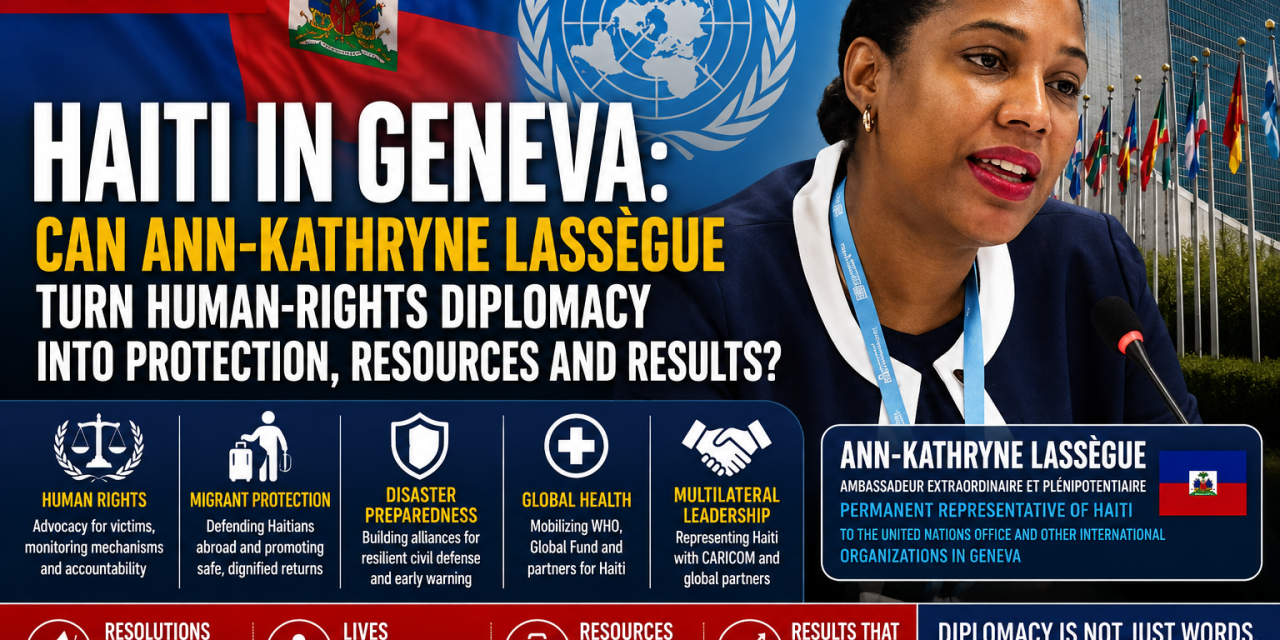
Representing Haiti at this diplomatic crossroads is Ambassador Ann-Kathryne Lassègue, Ambassador Extraordinary and Plenipotentiary and Permanent Representative of Haiti to the United Nations Office and other international organizations in Geneva.
Haiti’s Ministry of Foreign Affairs lists her as the head of the Geneva mission, while the UN records that she formally presented her credentials as Permanent Representative on February 17, 2025.
Her assignment therefore raises an important question:
CAN HAITI TURN GENEVA DIPLOMACY INTO SOMETHING HAITIANS CAN ACTUALLY MEASURE?
Can speeches about human rights produce monitoring mechanisms?
Can refugee diplomacy protect Haitian migrants?
Can disaster negotiations produce equipment?
Can WHO diplomacy deliver medicine and financing?
Can international resolutions strengthen institutions inside Haiti?
And can Lassègue demonstrate a different model of foreign policy—one judged not by ceremonies and diplomatic access, but by results?
The public record reveals some significant developments.
It also reveals major unanswered questions.
👤 WHO IS ANN-KATHRYNE LASSÈGUE?
Unlike an appointee arriving in Geneva without prior diplomatic experience, Lassègue has spent years inside Haiti’s foreign service.
According to the United Nations, she served as:
🇧🇯 Minister-Counsellor at Haiti’s Embassy in Benin — 2012–2014
🇨🇦 Minister-Counsellor at Haiti’s Embassy in Canada — 2014–2021
🇨🇦 Acting Head of Mission in Canada — 2020–2021
🇺🇳 Minister-Counsellor at Haiti’s Geneva Mission — August 2021–May 2024
🇺🇳 Acting Head of Mission in Geneva — beginning June 2024
and finally:
🇺🇳 Ambassador and Permanent Representative — February 17, 2025.
The UN also reports that she previously worked as a Programme Assistant with the World Food Programme in Haiti.
Her academic résumé is directly relevant to the Geneva portfolio.
She holds:
🎓 a Master’s in International Development and Globalization — University of Ottawa
🎓 a Master’s in International Relations — City University of New York
🎓 a bachelor’s degree in Political Science — Queens College
🎓 a bachelor’s degree in Sociology — University of Bordeaux.
This background matters because Geneva diplomacy is highly technical.
Negotiators must understand international law, humanitarian systems, development, migration, health diplomacy and multilateral procedure.
Lassègue appears to possess substantial institutional exposure.
But qualifications answer only one question:
Can she do the job?
Performance answers the more important one:
WHAT HAS THE JOB PRODUCED FOR HAITI?
⚖️ ACCOMPLISHMENT #1 — A SIGNIFICANT HUMAN RIGHTS COUNCIL RESULT
One development during Lassègue’s tenure deserves particular attention.
At the 61st Session of the UN Human Rights Council in March 2026, Haiti introduced draft resolution A/HRC/61/L.34, concerning technical assistance and capacity-building to improve Haiti’s human-rights situation.
Lassègue personally introduced Haiti’s resolution before the Council.
It was:
ADOPTED WITHOUT A VOTE.
That is a meaningful diplomatic result.
Why?
Because the resolution did substantially more than express concern.
The adopted text extended the mandate of the Independent Expert on the human-rights situation in Haiti for another year and requested additional attention to:
children,
women and girls,
human trafficking,
and
the human-rights impact of illicit arms trafficking.
Even more importantly, the Council requested that the UN Secretary-General provide the Office of the High Commissioner for Human Rights with the financial, technical and logistical resources necessary to establish an OHCHR office in Haiti.
That is not merely a speech.
That is an institutional mandate.
And Haiti was identified as a principal sponsor of the resolution, which was also formally submitted with Guatemala and Monaco.
🧐 BUT NOW COMES THE PERFORMANCE TEST
Passing a resolution is Stage One.
Implementation is Stage Two.
If an OHCHR presence is established or strengthened inside Haiti:
How many investigators will be deployed?
How many Haitian institutions will receive technical assistance?
How much money will be allocated?
Will victims be systematically documented?
Will gang-related sexual violence be tracked?
Will weapons flows be traced?
Will evidence preservation improve?
Will Haitian police and judicial authorities receive technical assistance?
Those are the numbers that should eventually determine whether the 2026 resolution becomes a diplomatic accomplishment with domestic consequences—or another international text with limited impact.
🩸 HUMAN RIGHTS: HAITI HAS A DOCUMENTATION CRISIS
The Human Rights Council’s decision itself demonstrates the magnitude of the problem.
The resolution calls for continued monitoring and more focused analysis of vulnerable populations, trafficking and illicit weapons.
This makes Lassègue’s mission uniquely important.
Geneva is where Haiti can demand that international mechanisms help document:
mass killings
sexual violence
kidnappings
forced displacement
attacks against children
human trafficking
attacks on schools and hospitals
and
violations committed amid organized armed violence.
The issue is therefore not merely whether Haiti speaks during Human Rights Council sessions.
The question is whether Haiti’s delegation converts those interventions into durable monitoring infrastructure.
🚨 QUESTION #1 — WHERE IS THE HUMAN-RIGHTS TRACKING SYSTEM?
Following Haiti’s successful 2026 resolution:
What new reporting mechanism exists?
Does Haiti now maintain a formal information-sharing structure connecting:
OHCHR
the Independent Expert
Haitian human-rights organizations
the Ministry of Justice
the Haitian National Police
women’s organizations
hospitals
and
organizations assisting displaced people?
How many incidents have been documented through mechanisms strengthened under the current mandate?
If Haiti’s Geneva diplomacy helped create new reporting capacity, publish the numbers.
💰 SANCTIONS: AN IMPORTANT JURISDICTIONAL DISTINCTION
There is another issue requiring precision.
International asset freezes and travel bans targeting individuals connected to Haiti’s security crisis are principally associated with UN Security Council sanctions mechanisms, centered in New York—not the Human Rights Council in Geneva.
Therefore, it would be misleading to judge Lassègue’s Geneva mission as though it directly controlled Security Council sanctions.
But Geneva still matters.
Evidence collected through human-rights mechanisms, humanitarian organizations and international legal networks can potentially inform broader international accountability efforts.
So the fair oversight question is:
WHAT INFORMATION-SHARING OR LEGAL COORDINATION HAS THE GENEVA MISSION FACILITATED?
Has the mission established structured communication among Geneva institutions and the Haitian authorities responsible for financial crimes, judicial cooperation and sanctions implementation?
The public sources reviewed for this investigation do not establish a quantified Lassègue-led sanctions enforcement mechanism.
That should be clarified through an official performance report.
🧳 ACCOMPLISHMENT #2 — HAITIAN MIGRANTS AND THE UNHCR PLATFORM
Migration is one area where Lassègue appears to have made Haiti’s position visible.
During the UNHCR Executive Committee debate on October 8, 2025, she publicly addressed the forced mobility affecting Haitians and called for a collective response based on human rights, dignity and international solidarity.
According to her publicly documented account of the exchange, then-UN High Commissioner Filippo Grandi acknowledged Haiti’s crisis and reiterated the appeal that states refrain from forced returns of Haitians contrary to the international principle of non-refoulement.
This is significant.
Because Haiti’s foreign policy has a responsibility not only toward citizens inside Haiti.
It also has a responsibility toward Haitians facing dangerous migration conditions abroad.
⚠️ BUT ONE LEGAL CLAIM REQUIRES CLARIFICATION
Your oversight questions ask what Lassègue has done to pressure UNHCR to issue “binding regional guidelines.”
UNHCR can issue authoritative protection guidance and recommendations.
But it generally does not create binding regional law by itself in the way a treaty or national legislature can.
Therefore, a more precise performance question is:
WHAT UNHCR PROTECTION POSITION HAS HAITI SUCCESSFULLY HELPED SECURE—and which states changed behavior because of it?
That is measurable.
How many states accepted protection recommendations?
How many paused forced returns?
How many Haitian nationals benefited?
Which governments rejected Haiti’s position?
That is the diplomatic record citizens deserve to see.
🇹🇷 ACCOMPLISHMENT #3 — DIRECT DIPLOMACY OVER HAITIANS IN TÜRKİYE
Another concrete episode occurred in late 2025.
Lassègue met with Türkiye’s Ambassador Burak Akçapar concerning Haitians living in Türkiye.
The publicly reported objective was to explore mechanisms for Haitians who wished to return voluntarily to Haiti and to obtain Turkish cooperation toward a safe, organized process.
Reporting states that the discussion ended with an agreement in principle to continue exchanges and examine available options.
That is evidence of diplomatic intervention.
But again:
A MEETING IS NOT YET A REPATRIATION PROGRAM.
How many Haitians registered?
How many requested return?
How many received documents?
How many flights were arranged?
Who paid?
Were reintegration services provided after arrival?
Were vulnerable individuals medically screened?
Those figures would determine whether the intervention became operational.
🌪️ ACCOMPLISHMENT #4 — OPENING A CIVIL-DEFENSE CHANNEL
On October 6, 2025, Lassègue met the Secretary-General of the International Civil Defence Organization — ICDO.
According to the ICDO, the discussion focused on:
disaster-risk reduction
emergency preparedness
civil-defense capacity-building
training
knowledge exchange
and
possible project-based cooperation for Haiti.
The ICDO publicly stated its readiness to explore practical technical cooperation with Haiti.
This is strategically important.
Haiti repeatedly faces:
earthquakes
hurricanes
flooding
landslides
and
institutional limitations in emergency response.
A diplomatic mission capable of obtaining training, communications technology and civil-defense equipment would create immediate national value.
But the ICDO announcement itself describes prospective areas of cooperation.
That means the key question remains:
WHAT WAS ACTUALLY DELIVERED?
🛰️ ACCOMPLISHMENT #5 — DISASTER TECHNOLOGY DIPLOMACY WITH TAIWAN
In August 2025, Lassègue joined a delegation of diplomatic representatives visiting Taiwan’s National Science and Technology Center for Disaster Reduction — NCDR.
The NCDR says the visitors received briefings on Taiwan’s disaster-risk reduction technologies and applications and exchanged experience concerning disaster management.
That exposure could be useful to Haiti.
Taiwan has sophisticated systems involving:
risk mapping
meteorological information
earthquake preparedness
early warning
emergency data integration
and
disaster-response coordination.
But diplomatic tourism and technology transfer are not the same thing.
So the performance question is simple:
WHICH TECHNOLOGY DID HAITI ACTUALLY ADOPT?
Did Haiti receive:
software licenses?
technical training?
data platforms?
early-warning applications?
GIS tools?
emergency communication systems?
hardware?
technical missions?
If yes, identify them.
If the visit remained primarily an exchange of experience, say so.
🏥 HEALTH DIPLOMACY: GENEVA MAY BE ONE OF HAITI’S MOST IMPORTANT POSTS
Lassègue’s mission also represents Haiti before the world’s central health institutions.
In February 2026, she joined Haiti’s Minister of Public Health at the 158th Session of WHO’s Executive Board.
Haiti participated as an Executive Board member in deliberations concerning universal health coverage, primary care, infectious and noncommunicable diseases, emergency preparedness and stronger health systems.
That gives Haiti access.
But access needs to become resources.
💵 THE WHO NUMBERS ARE LARGE—BUT ATTRIBUTION MATTERS
WHO estimates that 4.9 million Haitians will need health assistance in 2026, amid insecurity, displacement, recurrent cholera and severe disruption of health facilities.
WHO’s 2026 Haiti emergency appeal identifies approximately:
US$19.17 MILLION
in funding requirements for Haiti’s humanitarian health response.
WHO also records emergency allocations affecting Haiti, including:
US$300,000 for Haiti’s humanitarian crisis in 2025
and
US$100,000 for Haiti’s mpox response in May 2025.
These are real figures.
But they should not automatically be credited to Lassègue personally or to the Geneva mission.
WHO funding results from institutional processes involving Haiti’s Ministry of Health, PAHO/WHO, donors and numerous partners.
So the oversight question becomes:
HOW MUCH OF THAT FUNDING DID THE GENEVA MISSION DIRECTLY HELP MOBILIZE?
That is a very different question.
💉 WHAT ABOUT THE GLOBAL FUND?
Lassègue and the Geneva mission have participated in global-health forums, including UNAIDS processes. Public participant records document her involvement in UNAIDS governance meetings during her Geneva service.
But from the sources reviewed for this investigation, I could not establish a specific dollar amount in new Global Fund grants personally negotiated or secured by Lassègue’s mission.
That does not mean no contribution occurred.
It means the attribution is not established publicly.
And that distinction matters.
If the mission helped negotiate grant renewals, remove administrative bottlenecks or protect Haitian funding during donor negotiations:
PUBLISH THE DOCUMENTATION.
🌎 ANOTHER DIMENSION: CARICOM DIPLOMACY
There is another potentially important aspect of Lassègue’s position.
Her public professional record identifies her as having acted as Coordinator of the UN branch of the CARICOM Ambassadors Group in Geneva during a 2025 event concerning reparatory justice for slavery, deportation and colonialism.
That provides Haiti with a potentially valuable diplomatic platform.
Small states rarely maximize influence by acting alone.
CARICOM coordination can multiply Haiti’s negotiating weight.
The challenge is converting regional solidarity into specific gains for Haiti.
📊 WHAT CAN BE VERIFIED SO FAR?
The public record reviewed for this investigation establishes several significant elements.
✔️ Lassègue is an experienced diplomat with service in Benin, Canada and Geneva before becoming Permanent Representative.
✔️ Haiti successfully sponsored a 2026 Human Rights Council resolution adopted without a vote, with Lassègue introducing the text.
✔️ The resolution extends the Independent Expert’s mandate and calls for resources toward an OHCHR presence in Haiti.
✔️ Lassègue used UNHCR diplomacy to raise protection concerns involving Haitians facing forced mobility and return.
✔️ She opened discussions with Türkiye concerning Haitians seeking assisted return.
✔️ She engaged the ICDO regarding civil-defense training and technical cooperation.
✔️ She participated in exchanges with Taiwan’s NCDR regarding disaster-risk technology.
✔️ She participates in Haiti’s representation before WHO and other Geneva-based health institutions.
That is evidence of activity—and in the Human Rights Council case, a concrete multilateral outcome.
But several larger questions remain unanswered.
📑 SEVEN QUESTIONS AMBASSADOR ANN-KATHRYNE LASSÈGUE SHOULD ANSWER
I. HUMAN RIGHTS & INTERNATIONAL LAW
1️⃣ AFTER THE HRC RESOLUTION, WHAT CHANGED ON THE GROUND?
The 2026 resolution was adopted.
Now publish the implementation dashboard.
How many:
human-rights monitors?
investigations?
documented incidents?
victim interviews?
technical-assistance missions?
training programs?
reports?
How much financial and logistical support has been committed?
When will the expanded OHCHR capacity requested by the Council become fully operational?
2️⃣ SANCTIONS AND INTERNATIONAL ACCOUNTABILITY
Recognizing that UN Security Council sanctions are principally handled through New York:
What Geneva-based legal or evidence-sharing mechanisms has Haiti nevertheless established to support international accountability?
Has the mission connected:
OHCHR evidence
financial-crime information
human-rights documentation
international legal networks
and
Haitian investigative authorities?
What information-sharing protocols exist?
What measurable enforcement outcome resulted?
II. MIGRATION & REFUGEE PROTECTION
3️⃣ TÜRKİYE: HOW MANY PEOPLE WERE ACTUALLY HELPED?
After the meeting with Türkiye’s ambassador:
How many Haitian nationals requested assistance?
How many received documentation?
How many returned?
What did the program cost?
Who financed travel?
What assistance awaited returnees in Haiti?
Diplomacy should eventually move from an agreement in principle to a list of beneficiaries.
4️⃣ UNHCR: WHICH COUNTRIES CHANGED THEIR POLICIES?
Haiti has publicly defended non-refoulement.
Now provide the diplomatic results.
Which governments did Lassègue’s mission formally approach?
Which accepted Haiti’s protection arguments?
How many deportations were delayed or prevented?
How many asylum seekers received additional legal protection?
Which governments refused?
A serious foreign policy should document both victories and failures.
III. CIVIL DEFENSE & DISASTER PREPAREDNESS
5️⃣ ICDO: WHERE ARE THE TRAINING AND EQUIPMENT?
After the October 2025 ICDO meeting:
How many Haitian civil-protection officers were trained?
What equipment was transferred?
What projects were approved?
What dollar value?
What timeline?
What areas of Haiti benefited?
If projects remain under negotiation, publish their status.
6️⃣ TAIWAN NCDR: WHICH TECHNOLOGIES CAME HOME?
Following Lassègue’s NCDR visit:
Which disaster-management applications were transferred to Haiti?
Did the country obtain:
early-warning software?
risk mapping?
GIS platforms?
technical assistance?
data-sharing architecture?
training?
hardware?
What Haitian agency now uses that technology?
If none has yet been adopted, what is preventing implementation?
IV. HEALTH DIPLOMACY
7️⃣ WHO & GLOBAL FUND: SHOW THE MONEY, MEDICINES AND BENEFICIARIES
Since Lassègue became Permanent Representative:
What additional financing did the mission help secure through:
WHO?
PAHO?
Global Fund?
UNAIDS?
Gavi or other Geneva-linked health institutions?
For every intervention, disclose:
amount
donor
approval date
recipient
purpose
supplies delivered
communities served
and
implementation status.
How many cholera kits?
How many medicines?
How many hospital supplies?
How much laboratory equipment?
How much emergency financing?
These are the numbers Haitians should be able to see.
⚖️ OUR PRELIMINARY ASSESSMENT
Ann-Kathryne Lassègue’s record cannot fairly be reduced to diplomatic appearances.
The 2026 Human Rights Council resolution is a substantive achievement.
Haiti sponsored the initiative.
Lassègue introduced it.
The Council adopted it without a vote.
And the decision strengthened monitoring obligations while calling for the financial, technical and logistical resources necessary for a stronger OHCHR presence in Haiti.
That matters.
Her experience before becoming ambassador is also substantial and directly relevant to Geneva diplomacy.
There are additional signs of an active agenda involving migration, civil defense, disaster technology, health diplomacy and CARICOM cooperation.
But there is an equally important limitation:
THE PUBLIC RECORD SHOWS MORE EVIDENCE OF NEGOTIATIONS AND INTERNATIONAL ENGAGEMENT THAN OF COMPLETE, QUANTIFIED DOWNSTREAM RESULTS INSIDE HAITI.
That does not prove the results do not exist.
It means they need to be published.
🇭🇹 CAN ANN-KATHRYNE LASSÈGUE BRING SOMETHING NEW TO HAITIAN FOREIGN POLICY?
Possibly.
Her background suggests a diplomat comfortable with the technical side of multilateral institutions.
And Geneva offers exactly the environment where technical diplomacy can produce practical consequences.
But Haiti needs a different way to measure diplomatic success.
Not:
“How many meetings did the ambassador attend?”
Instead:
How many resolutions did Haiti initiate?
How much international financing was secured?
How many Haitians were protected?
How many experts were deployed?
How many officers were trained?
How much equipment was delivered?
How many migrants received assistance?
How many health facilities benefited?
How many international commitments became operational?
That is results-based diplomacy.
📊 IMAGINE A GENEVA PERFORMANCE DASHBOARD
Every quarter, Haiti’s mission could publish:
⚖️ Human-rights resolutions secured
📑 International monitoring mechanisms activated
💰 Humanitarian financing mobilized
🏥 Health grants and medical supplies obtained
🧳 Migrants and refugees assisted
🌪️ Civil-protection resources secured
🛰️ Technology-transfer projects implemented
🤝 CARICOM initiatives coordinated
🎓 Training opportunities obtained
📊 Commitments versus completed deliverables
Then Haitians would no longer need to guess whether diplomacy works.
They could measure it.
🚨 A CRITICAL PRINCIPLE FOR THIS INVESTIGATION
The public should also reject two equally flawed approaches.
Do not automatically credit an ambassador with every UN program operating in Haiti simply because it occurred during her tenure.
But do not dismiss successful diplomacy simply because several institutions participated.
Attribution should be documented.
If the Geneva mission negotiated it:
show the correspondence.
If the Ministry of Health obtained it:
credit the Ministry.
If WHO initiated it independently:
credit WHO.
If CARICOM delivered it:
credit CARICOM.
If Lassègue personally built the coalition:
document that contribution.
That is how serious public accountability works.
📢 PUBLISH THE PERFORMANCE REPORT
Ambassador Lassègue should be given the opportunity to respond with evidence.
Not rumors.
Not partisan attacks.
Not promotional language.
Evidence.
PUBLISH:
the resolutions.
the negotiations.
the budgets.
the funding.
the equipment.
the beneficiaries.
the agreements.
the implementation timelines.
the unfinished projects.
and even the diplomatic initiatives that failed.
Because failure is also information from which a country can learn.
Then—
🇭🇹 LET THE HAITIAN PEOPLE DECIDE.
Is Ann-Kathryne Lassègue transforming Haiti’s Geneva mission into a center of results-driven multilateral diplomacy?
Can Haiti use international law to protect its citizens?
Can Geneva diplomacy deliver medical resources, refugee protections and disaster capabilities?
Can international solidarity finally be converted into measurable national capacity?
The Human Rights Council resolution demonstrates that diplomacy can produce institutional results.
Now comes the harder question:
CAN THOSE INTERNATIONAL RESULTS REACH THE HAITIAN PEOPLE?
That should be the standard.
ACCOUNTABILITY.
TRANSPARENCY.
IMPLEMENTATION.
RESULTS.
#Haiti #AnnKathryneLassegue #UnitedNations #Geneva #HumanRights #UNHCR #WHO #HRC #HaitianDiplomacy #ForeignPolicy #Migration #DisasterPreparedness #GlobalHealth #CARICOM #Accountability #Transparency #Investigation