
🇭🇹 HAITI POLITIC | INVESTIGATIVE INSTITUTIONAL PROFILE
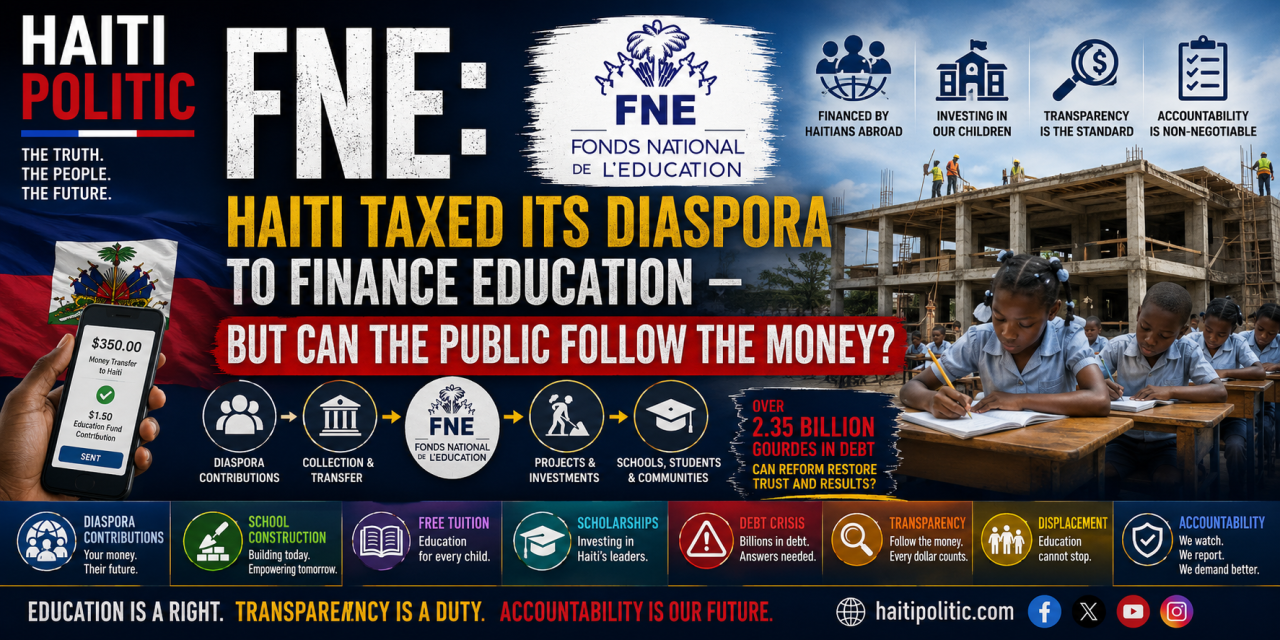
Diaspora contributions. School construction. Free tuition. Scholarships. Debt. Transparency. Displacement. Accountability.
For more than a decade, Haitians abroad have been asked to participate in one of the country’s most ambitious promises: help finance education through dedicated charges associated with international money transfers and telephone calls.
The institution ultimately created by law to manage education financing is the Fonds National de l’Éducation (FNE).
The concept is powerful: Haiti should not have to wait for foreign donors every time it needs to build a school, buy desks, support students or finance educational programs.
But an investigative assessment of the FNE has to ask a harder question:
Has Haiti built a sustainable national education fund—or another public institution where citizens struggle to connect money collected with measurable results delivered?
This is not an accusation of wrongdoing. It is an accountability question about an institution managing public resources for Haitian children.
And some claims circulating about the FNE—including information supplied for this investigation—need correction or further verification.
🏛️ WHAT EXACTLY IS THE FNE?
The FNE is an autonomous public education-financing institution under the supervision of Haiti’s Ministry of National Education and Vocational Training (MENFP).
Its legal foundation is the law of August 17, 2017, published in Le Moniteur on September 22, 2017. The institution says it became operational in 2019.
Its mandate goes well beyond constructing schools.
The law gives the FNE a role in financing school tuition, early-childhood facilities, school construction and rehabilitation, furniture and educational materials, education for students with disabilities, vocational and technical education, and school-canteen programs.
That makes the FNE potentially one of Haiti’s most consequential long-term institutions.
Security protects today’s child. Education determines what kind of country that child inherits.
💵 THE DIASPORA CONNECTION: FOLLOW THE MONEY
One feature makes the FNE particularly sensitive politically.
According to the institution itself, an important source of its resources comes from charges associated with international transfers and international telephone calls involving Haiti. The FNE specifically describes a US$1.50 charge on money transfers, alongside revenues connected to international calls.
That creates an unusual accountability relationship.
A Haitian working in Miami, Montreal, Boston, New York, Paris or elsewhere sends money home.
Part of the financing mechanism associated with those transactions is supposed to support Haitian education.
So the diaspora has every reason to ask:
How much was collected?
When was it transferred to the FNE?
Where was it spent?
Which school received it?
How many children benefited?
And can an ordinary citizen verify those answers without knowing somebody inside the government?
Those questions are not hostility toward the FNE.
They are exactly what public financing requires.
🏗️ WHAT HAS THE FNE ACTUALLY ACCOMPLISHED?
There are documented achievements.
The FNE has financed the Programme Spécial de Gratuité de l’Éducation (PROSGATE), which supports schooling costs and contract teachers. Its own mandate also covers infrastructure, educational materials and other interventions.
Its website currently identifies construction or rehabilitation projects in departments including the Nord, Grand’Anse, Nippes and Ouest.
And in August 2025, the institution reported committing 146.582 million gourdes to 58 schools across five departments—Nord, Nord-Est, Nord-Ouest, Centre and Artibonite—for rehabilitation, relocation, electrical systems, sanitation, equipment and furniture.
The FNE also created the Programme d’Appui aux Écoles et Familles d’Élèves Victimes de l’Insécurité (PAEF). In June 2025, selected families and schools were instructed to receive their subsidies through the Banque Nationale de Crédit.
That matters because Haiti’s educational emergency has fundamentally changed.
The challenge is no longer simply:
“How many schools can Haiti build?”
It is increasingly:
“How do you educate children when families are displaced, neighborhoods become inaccessible and schools themselves are forced out of conflict zones?”
The FNE developed a framework to identify school-age children in displacement camps and described reintegration, psychosocial support and continued learning as intended components of an emergency educational response.
That is an important evolution in its mission.
🚨 THEN CAME THE 2.35-BILLION-GOURDE WARNING
This is where the investigation becomes much more serious.
In March 2025, the FNE publicly acknowledged major weaknesses discovered during an internal review.
The institution reported liabilities totaling approximately 2.354 billion gourdes.
According to the FNE’s account, the problems included fragmented accounting, reliance on Excel files, inconsistent financial statements, inadequate consolidation of accounts, insufficient transaction traceability and commitments that exceeded available resources.
That distinction is important:
A liability is not automatically evidence that money was stolen.
The reported problem involved mismatches among construction progress, contractual commitments, payments and the timing of revenue collections.
But for an institution built around public confidence, not having a reliable consolidated picture of its own financial position is itself a major governance problem.
The fundamental question therefore changes.
It isn’t simply:
“Was money stolen?”
It is:
“How did an institution responsible for protecting education money reach a point where its accounting systems could not provide a sufficiently reliable picture of its obligations?”
📲 FNECONNECT: TRANSPARENCY REVOLUTION OR JUST A DIGITAL FRONT DOOR?
The FNE subsequently announced accounting reforms and FNEConnect.
The platform allows students and other applicants to establish accounts, submit financing applications and track their requests. The FNE says the system is intended to improve accessibility and transparency.
But an important correction is necessary.
FNEConnect should not currently be portrayed as a complete public system tracing every diaspora dollar from collection to classroom.
The FNE’s own current webpage says the platform remains in a testing phase, with school-pupil and university-student application forms among the services presently available.
That’s considerably different from a public expenditure dashboard.
What Haiti ultimately needs is something more ambitious:
COLLECTION → TREASURY/REMITTANCE → FNE → CONTRACT → SCHOOL → CONTRACTOR → PAYMENT → COMPLETION → INDEPENDENT AUDIT
Every major project should eventually be traceable through that chain.
🔎 A MAJOR FACT-CHECK: WHO ACTUALLY RUNS THE FNE?
The information provided for this investigation states that Professor Jefnie Toussaint was installed as Director General on August 17, 2026, succeeding Élysé Colagène.
I could not independently verify that claim from the current official FNE materials or the fresh search results reviewed for this article.
In fact, the FNE’s current personnel directory identifies Elysé Colagène as Director General, while an official FNE article dated April 21, 2026 also identifies him in that position.
The same official directory records Sterline Civil as Director General from February 18 through September 19, 2025, following Jean Ronald Joseph’s December 2021–February 2025 tenure.
Therefore, until an appointment decree, official installation notice or another authoritative source establishes otherwise, Haiti Politic should not present the Toussaint appointment as confirmed fact.
That correction illustrates exactly why institutional investigations matter.
⚖️ WHO CONTROLS THE CONTROLLER?
The FNE is autonomous—but not institutionally isolated.
Its official governance structure places the Minister of National Education as president of its Board of Directors and the Minister of Economy and Finance as vice-president. The Directorate General implements strategies determined by the board.
That creates an unavoidable political question:
How autonomous can an education fund remain during an election season when senior government officials participate directly in its governance?
Schools are extraordinarily valuable politically.
A politician can put his name on a school rehabilitation.
A government can announce subsidies.
A constituency can suddenly receive furniture.
A politically connected organization can request financing.
Consequently, the firewall separating educational need from electoral patronage has to be exceptionally strong.
The FNE introduced tighter financing procedures in 2025, requiring structured documentation and routing certain school infrastructure requests through departmental education directorates and MENFP validation.
That is movement in the right direction.
But procedure is only as credible as the public’s ability to audit the outcome.
🎯 THE QUESTIONS HAITI POLITIC WOULD PUT DIRECTLY TO FNE LEADERSHIP
1. THE 2.35 BILLION GOURDES
Publish the complete aging schedule.
How much is owed to contractors, schools, teachers, suppliers and other creditors?
Which obligations have subsequently been paid?
How much remains outstanding today?
And which administrations authorized the original commitments?
2. THE DIASPORA MONEY
For every fiscal year, publish:
Amount assessed → amount collected → amount transferred → amount received by FNE → amount committed → amount disbursed.
If the diaspora finances education, the diaspora should be able to see the complete chain.
3. CONTRACTORS
Who received the largest FNE construction contracts?
Were they competitively selected?
Who are the beneficial owners of those companies?
How many projects were completed on time?
How many exceeded their original budgets?
How many remain unfinished?
4. FNECONNECT
Will FNEConnect eventually become a genuine open-data platform where citizens can see contracts, schools, disbursements, construction progress, beneficiaries and audit findings—not merely submit applications?
5. INDEPENDENT AUDITS
Will leadership publish annual audited financial statements and project-performance reports in searchable formats?
And will the institution publicly disclose the implementation status of every significant audit recommendation?
6. CONFLICT-ZONE EDUCATION
How much of the FNE budget is now explicitly reserved for displaced students, relocated schools, emergency learning centers, psychosocial assistance and secure distance-learning infrastructure?
7. POLITICAL INDEPENDENCE
What prevents a minister, board member, director general, political party or presidential candidate from directing FNE resources toward politically strategic constituencies?
And will all grants approved during an election period be publicly disclosed before voting?
🌎 THE FOREIGN-POLICY QUESTION NOBODY SHOULD IGNORE
At first glance, the FNE is not a foreign-policy institution.
Look closer.
It sits directly at the intersection of Haiti and its diaspora.
That makes it part of a larger question about Haitian sovereignty.
For decades, Haiti has financed essential social services through combinations of foreign aid, NGOs, multilateral institutions and emergency programs.
The FNE represents a different proposition:
Haitians financing Haitian human capital.
If administered transparently, that model could strengthen domestic sovereignty.
If administered poorly, it can produce the opposite effect: distrust among Haitians abroad and another argument that public resources cannot safely pass through Haitian institutions.
That is why FNE accountability isn’t merely an accounting issue.
It is a state-capacity issue.
📊 HAITI POLITIC — INSTITUTIONAL ASSESSMENT
| AREA | POTENTIAL STRENGTH | QUESTION THAT REMAINS |
|---|---|---|
| National financing | Dedicated mechanism for education | Can every major revenue stream be independently reconciled? |
| Infrastructure | Documented school construction and rehabilitation | Are cost, contractor and completion records fully public? |
| PROSGATE | Supports schooling and contract personnel | Can outcomes be measured against money spent? |
| Diaspora participation | Converts remittance activity into domestic education financing | Does the diaspora receive adequate transparency in return? |
| Emergency education | Programs increasingly address insecurity and displacement | Can interventions scale with the crisis? |
| Digital reform | FNEConnect could modernize access | It is still in testing and is not yet a complete public expenditure tracker. |
| Financial governance | Reform plans acknowledge accounting weaknesses | The reported 2.35-billion-gourde liabilities remain a major accountability test. |
| Institutional autonomy | FNE has legal administrative and financial autonomy | Can that autonomy withstand electoral and executive pressure? |
🧭 THE VERDICT BELONGS TO THE PUBLIC
The FNE should not automatically be described as either a success story or a corruption story.
The evidence presents something more complicated.
Haiti created an institution capable of financing schools, students, teachers, infrastructure and emergency educational interventions with nationally generated resources.
That is significant.
But the same institution publicly acknowledged serious accounting weaknesses and liabilities exceeding 2.35 billion gourdes, triggering reforms aimed at restoring financial control and traceability.
So the standard should now be higher.
Not another press conference.
Not another ribbon cutting.
Not another photograph of officials handing over a check.
Show the collection.
Show the contract.
Show the school.
Show the students.
Show the results.
Show the audit.
Because when Haitian families and the diaspora contribute to education, transparency is not a favor the government gives them.
It is part of the transaction.
🇭🇹 HAITI POLITIC
THE QUESTION: Can the Fonds National de l’Éducation become a model for transparent Haitian self-financing—or will weaknesses in accounting, political governance and public traceability undermine one of Haiti’s most important experiments in educational sovereignty?
Let the people examine the record. Let the FNE answer the questions. Let the evidence decide.
#HaitiPolitic #FNE #EducationHaiti #Haiti #DiasporaHaitienne #PROSGATE #Education #Accountability #Transparency #Gouvernance #HaitiDiaspora #SchoolInfrastructure #FollowTheMoney