Entrepreneur. Industrialist. Former presidential candidate. Advocate of decentralization.
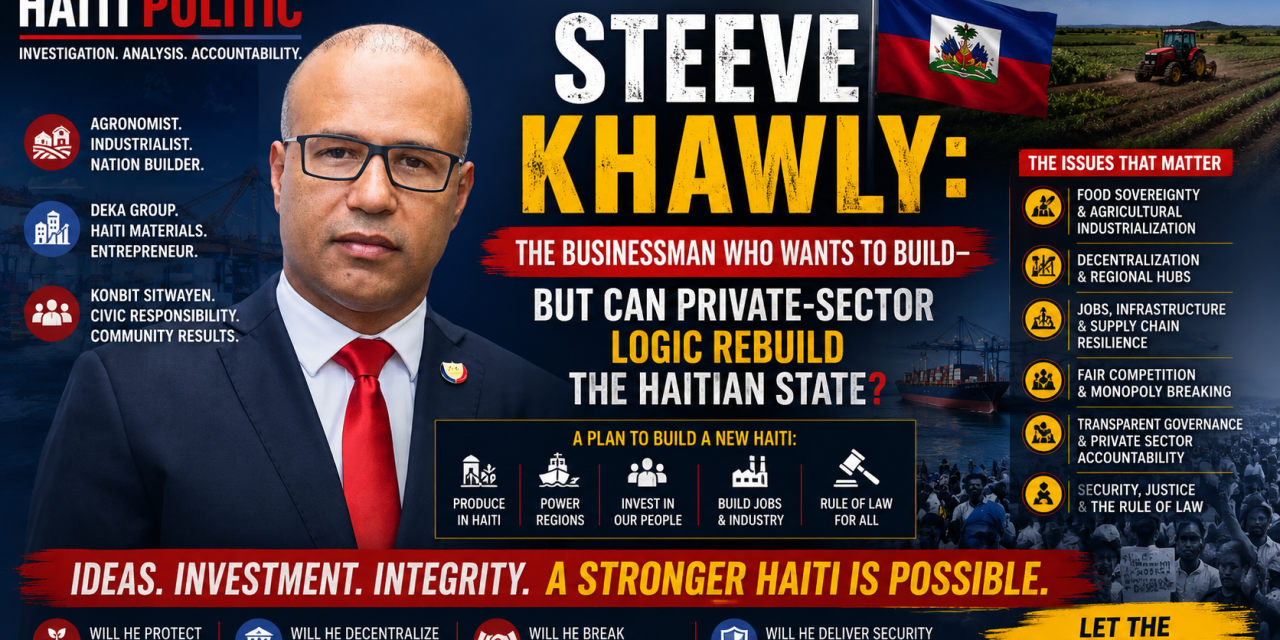
Steeve Khawly offers Haitian voters a profile different from that of the career parliamentarian or lifelong government bureaucrat. His political argument has historically centered on a relatively simple proposition: Haiti needs a state that works, an economy that produces, jobs that pay, and institutions capable of delivering services outside Port-au-Prince.
But Haiti has heard promises of modernization before.
So the question for Haiti Politic is not whether Khawly understands business.
The question is whether business experience can be converted into democratic, accountable and effective national leadership.
And there is another issue his record cannot escape: Bouclier’s relationship with Haiti’s previous governing establishment.
Here is the investigation.
🔎 WHO IS STEEVE KHAWLY?
Khawly is a Haitian businessman who entered national politics as the presidential candidate of Réseau Bouclier National (BOUCLIER) in the 2015 election. Contemporary reporting described him as an agro-industrial entrepreneur and documented a platform emphasizing state reform, decentralization, employment, private-sector development, justice reform and professionalization of the police.
His 2015 candidacy never became a major electoral force. Preliminary results reported at the time gave Khawly roughly 1.08% of the presidential vote, placing him well behind Jovenel Moïse, Jude Célestin, Jean-Charles Moïse and Maryse Narcisse.
That result creates the first major question surrounding any renewed Khawly national project:
Was 2015 simply too early for his message—or did voters reject it?
🏗️ THE KHAWLY ARGUMENT: MAKE THE STATE WORK
Khawly’s 2015 platform was considerably broader than a simple pro-business campaign.
He advocated reforming government around services to citizens, making decentralization operational, modernizing legislation, reforming justice, professionalizing the Haitian National Police, promoting enterprises, creating employment and using tourism and culture as engines of economic activity and international visibility.
Those ideas sound particularly relevant today.
Haiti’s problem, however, has rarely been an absence of plans.
It has been execution.
A president cannot manage Haiti like a privately held corporation. Parliament, courts, municipalities, unions, opposition parties, civil society and independent institutions all have legitimate authority.
So Haiti Politic would ask:
🎤 QUESTION #1 — CAN YOU BUILD INSTITUTIONS YOU DON’T CONTROL?
Mr. Khawly, entrepreneurs succeed partly because they can establish a hierarchy and demand execution.
Democracy doesn’t work that way.
How would you govern when Parliament rejects your budget, unions resist your reforms, courts block executive actions, and mayors demand powers you do not want to surrender?
What evidence from your career demonstrates an ability not merely to manage—but to build consensus?
🌾 AGRICULTURE: PRODUCE IN HAITI OR KEEP IMPORTING?
This could be one of the strongest areas for a Khawly candidacy.
His public political profile has been associated with agro-industry, business development and employment creation.
And Haiti’s economic vulnerability raises a fundamental national-security question:
What happens to a country that cannot reliably feed itself?
A serious Khawly economic platform therefore needs numbers—not slogans.
🎤 QUESTION #2 — WHAT EXACTLY WOULD YOU PROTECT?
Would a Khawly administration impose targeted tariffs on imported agricultural products that compete directly with Haitian farmers?
Would farmers receive subsidized credit?
Would government guarantee purchases from Haitian producers for schools, hospitals, prisons and the armed forces?
Would the state finance irrigation?
Cold storage?
Regional processing centers?
Agricultural insurance?
Farm-to-market roads?
And most importantly:
Where would the money come from?
Because “produce nationally” means very little without a financing mechanism.
⚓ DECENTRALIZATION: CAN HAITI SURVIVE WITHOUT PORT-AU-PRINCE?
One of the more interesting elements of Khawly’s earlier political program was his explicit call to make decentralization and deconcentration operational, with public services closer to citizens.
That proposal deserves renewed scrutiny.
For generations, Haiti concentrated enormous political, financial and administrative power in Port-au-Prince.
The consequences are now painfully visible.
When the capital becomes paralyzed, much of the country becomes paralyzed with it.
Imagine instead:
CAP-HAÏTIEN → Northern commercial hub
LES CAYES → Southern logistics and agricultural hub
JACMEL → Tourism, culture and regional commerce
GONAÏVES → Artibonite logistics and agro-processing
HINCHE → Central Plateau agricultural hub
That is decentralization as economic security—not merely constitutional theory.
🎤 QUESTION #3 — WILL YOU GIVE LOCAL GOVERNMENTS REAL MONEY?
Politicians have promised decentralization for decades while keeping the money in Port-au-Prince.
Would President Khawly allow municipalities to retain a defined percentage of taxes collected in their jurisdictions?
Would regional governments receive independent development budgets?
Would customs revenue collected at regional ports partly remain in those regions?
And would he support transparent public dashboards allowing citizens to see every gourde collected and every gourde spent?
If not, decentralization remains another campaign slogan.
💰 THE BUSINESS-ELITE QUESTION
This is where Khawly should face particularly aggressive scrutiny.
Business expertise can be an enormous presidential asset.
But in Haiti, it can also create serious conflicts of interest.
A businessman entering the presidency would potentially oversee taxation, customs policy, procurement, import rules, infrastructure contracts, industrial incentives and regulations affecting sectors in which business associates operate.
That demands extraordinary transparency.
🎤 QUESTION #4 — WILL YOU OPEN THE BOOKS?
Before asking Haitians to entrust him with the Treasury, would Khawly voluntarily publish:
His assets?
Corporate interests?
Beneficial ownership interests?
Major liabilities?
Companies from which he would divest?
Campaign donors?
Would he place relevant commercial interests into an independently administered structure while serving?
Would every major government contract be searchable online?
Would politically connected companies be required to disclose their real beneficial owners before bidding?
Those aren’t anti-business policies.
They’re pro-competition policies.
⚠️ THE BOUCLIER–PHTK QUESTION CANNOT BE IGNORED
This is perhaps the biggest political challenge to an outsider narrative.
The Inter-Parliamentary Union’s account of Haiti’s 2015 elections identified Bouclier, led by Steeve Khawly, among parties allied with PHTK in the parliamentary landscape.
But the history is more complicated than simply labeling Khawly a PHTK candidate.
During the 2015 presidential campaign, Radio Métropole reported attempts at rapprochement between PHTK and Bouclier while also reporting Khawly attacking the record of Haiti’s governments and distancing himself electorally from PHTK.
That ambiguity deserves examination rather than partisan simplification.
🎤 QUESTION #5 — HOW INDEPENDENT WAS BOUCLIER?
Mr. Khawly:
What exactly was Bouclier’s relationship with PHTK?
Which alliances did you personally authorize?
Which did you oppose?
What government appointments, contracts or political concessions—if any—resulted from cooperation between the organizations?
And looking backward:
What responsibility does Bouclier accept for the political system it participated in?
A reform candidate cannot ask voters to examine everyone else’s past while exempting his own coalition history.
👮 SECURITY: BUSINESS CANNOT FUNCTION WITHOUT TERRITORIAL CONTROL
Khawly’s 2015 platform already advocated professionalizing the police and establishing a national defense capacity.
Today that question is dramatically more urgent.
Factories cannot operate when highways are blocked.
Farmers cannot reach markets.
Containers cannot move safely.
Investors cannot insure projects.
Tourism cannot recover.
Banks cannot lend normally.
Security policy is economic policy.
🎤 QUESTION #6 — WHAT IS YOUR SECURITY DOCTRINE?
How many additional police officers does Haiti require?
What would they cost?
How much would be allocated to intelligence?
Border surveillance?
Coast guard capabilities?
Anti-kidnapping units?
Financial investigation?
Weapons interdiction?
Would Khawly support continued international security assistance?
If yes, under what Haitian command structure?
If no, what domestic force replaces it, on what timetable, and with what budget?
Promises to “eliminate gangs” are easy.
Building an accountable security institution capable of surviving the next presidency is much harder.
🌎 AND WHAT WOULD PRESIDENT KHAWLY’S FOREIGN POLICY ACTUALLY BE?
This is an area where his older campaign material leaves important questions unanswered.
Haiti’s foreign policy has too often oscillated between dependency and confrontation.
Neither has produced sustainable sovereignty.
A commercially oriented president might attempt something different:
economic diplomacy.
Instead of measuring diplomatic success by international conferences attended, measure:
➡️ Export contracts signed
➡️ Haitian products entering foreign markets
➡️ Diaspora investment mobilized
➡️ Foreign factories established outside Port-au-Prince
➡️ Technology transferred
➡️ Agricultural partnerships created
➡️ Scholarships secured
➡️ Ports and energy projects financed
But that creates another question.
🎤 QUESTION #7 — WHO WOULD HAITI ALIGN WITH?
Would Khawly maintain Haiti’s traditional strategic relationship with the United States?
Deepen relations with CARICOM?
Seek greater commercial integration with Latin America?
Expand relations with African states?
Recognize Taiwan or pivot toward Beijing?
Pursue investment from Gulf countries?
And how would he negotiate with the Dominican Republic, Haiti’s most consequential—and complicated—economic neighbor?
A serious presidential candidate should have answers before entering the National Palace.
📊 HAITI POLITIC ASSESSMENT
| AREA | POTENTIAL STRENGTH | QUESTION THAT REMAINS |
|---|---|---|
| 🏭 Private Sector | Operational and entrepreneurial perspective | Can corporate experience translate into democratic governance? |
| 🌾 Production | Agro-industrial orientation | Can policy reduce imports without raising food prices? |
| 🏗️ Infrastructure | Development-focused approach | Where does financing come from? |
| 🏛️ Decentralization | Explicit part of his 2015 platform | Will municipalities actually receive fiscal power? |
| 💼 Employment | Central element of his previous campaign | Can Haiti create formal jobs during extreme insecurity? |
| 👮 Security | Previously advocated police professionalization | What is the measurable modern security plan? |
| 🌎 Foreign Policy | Potential for commercially driven diplomacy | His detailed geopolitical doctrine remains unclear |
| 🗳️ Political Independence | Presented himself as a change candidate | Bouclier’s historical relationship with PHTK requires explanation |
| 📉 Electoral Record | National campaign experience | His 2015 result was only about 1.08% |
The documented electoral and historical entries above are based on contemporary election reporting and institutional records.
🧭 THE BIGGER QUESTION
Steeve Khawly represents a recurring proposition in Haitian politics:
Maybe Haiti needs fewer professional politicians and more builders.
It is an attractive argument.
But Haiti has also learned something else.
A successful businessman does not automatically make a successful president.
Companies require management.
Republics require institutions.
Companies can pursue efficiency.
Governments must balance efficiency with rights, accountability, regional equality, transparency and democratic opposition.
Khawly therefore should not be judged merely on whether he knows how to build businesses.
He should be judged on whether he can explain—in detail—how he would help build a state that continues functioning after Steeve Khawly leaves office.
🇭🇹 HAITI POLITIC — LET THE PEOPLE DECIDE
STE EVE KHAWLY:
🏭 INDUSTRIAL ENTREPRENEUR?
🌾 PRODUCTION-DRIVEN REFORMER?
🏗️ DECENTRALIZATION ADVOCATE?
🤝 ESTABLISHMENT ALLY?
🇭🇹 OR A BUSINESS CANDIDATE WITH A MODEL HAITI HAS NOT YET SERIOUSLY TESTED?
The evidence should decide—not campaign advertising.
What should Steeve Khawly be required to answer before Haitians consider giving him the presidency?
👇 LET THE PEOPLE DECIDE.
#HaitiPolitic #SteeveKhawly #Haiti #HaitiElections #HaitiPolitics #Ayiti #Leadership #Decentralization #Agriculture #HaitiEconomy #ForeignPolicy #LetThePeopleDecide