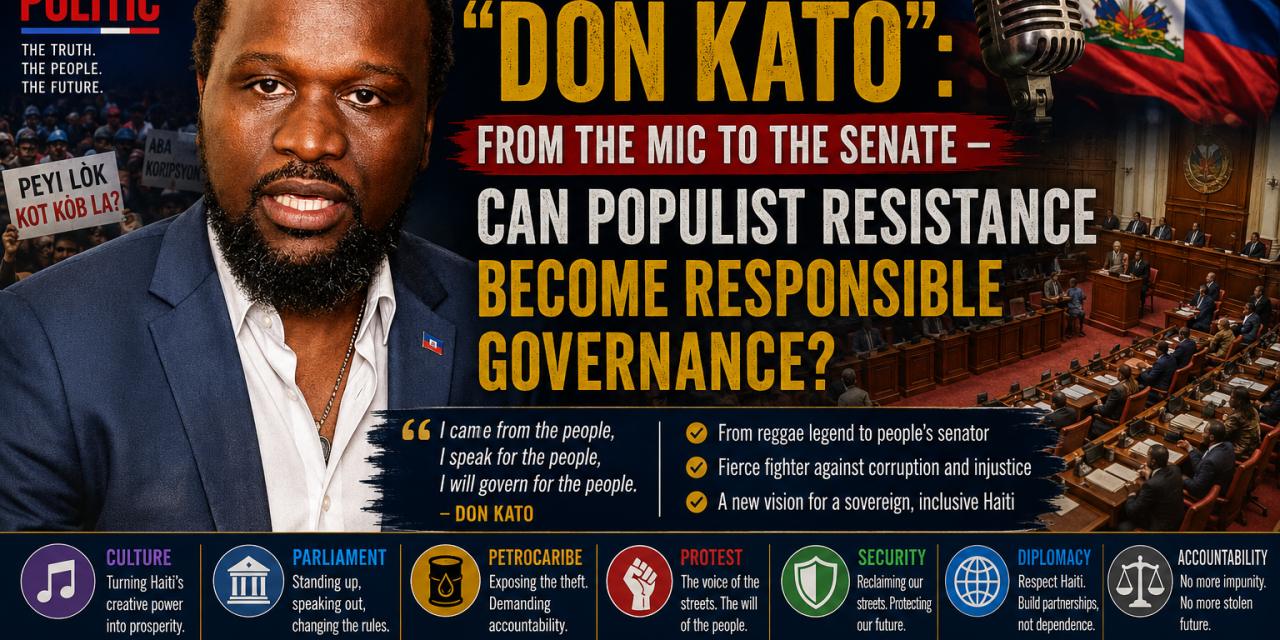
Culture. Parliament. PetroCaribe. Protest. Security. Diplomacy. Accountability.
Antonio Chéramy—better known as Don Kato—offers an unusual case study in Haitian politics. He did not emerge primarily from the traditional pipelines of law, business, diplomacy or public administration. He built his national identity through music, cultural activism and political protest, then converted that popularity into electoral power.
But an investigation of Chéramy in 2026 cannot simply repeat the familiar story of the rebellious musician who challenged Haiti’s establishment. His record now includes elected office, participation in a major PetroCaribe investigation, confrontational parliamentary tactics—and, critically, a 2025 U.S. State Department corruption designation.
That development materially changes the questions Haiti Politic believes should be asked about his political future.
This article does not endorse, rank, or recommend Chéramy or any other Haitian political figure. It summarizes documented third-party reporting and identifies questions voters can use to make their own judgment.
🎤 1 | BEFORE THE SENATE: THE POLITICAL ARTIST
Long before Don Kato became Senator Chéramy, Brothers Posse had transformed music into a vehicle for political commentary.
The group emerged in the 1990s, blending reggae, rock, roots and Haitian rhythmic traditions. Sources documenting the band’s history also identify Chéramy with the Mouvement des Artistes pour la Paix, which organized peace-oriented concerts in popular neighborhoods.
His political message became especially visible during Michel Martelly’s presidency. Academic research from Oxford University Press describes Brothers Posse as one of the musical voices criticizing the Martelly government through successive Carnival productions.
That matters.
Chéramy demonstrated something many conventional politicians struggle to achieve:
He could communicate political grievances through culture.
Music gave him direct access to young people and working-class communities without requiring the machinery of a traditional political party.
Then he tested whether cultural influence could become electoral power.
It did.
🗳️ 2 | FROM DON KATO TO SENATOR CHÉRAMY
Running under VERITE, Chéramy won election as a senator representing the Ouest department in 2015.
Contemporary reporting recorded 297,260 votes for him, while Haiti-Référence lists his election on October 25, 2015, swearing-in on January 11, 2016 and end of mandate in January 2020.
That victory deserves attention.
The Ouest isn’t an obscure electoral constituency. It contains Haiti’s capital and an enormous concentration of the country’s population, economic activity and political institutions.
Chéramy had therefore accomplished something significant:
He converted celebrity into an actual electoral mandate.
And when elected, he publicly promised to represent disadvantaged Haitians and to be a “clean” senator.
The harder question is what happened once the protest artist entered the institution he had spent years criticizing.
💰 3 | PETROCARIBE: FROM PROTEST MUSIC TO INVESTIGATION
One important part of Chéramy’s legislative record deserves more attention than celebrity politics usually receives.
He was one of the five senators on the Special Senatorial Commission investigating PetroCaribe.
The commission reported serious anomalies, irregularities and suspected misconduct in the management of PetroCaribe-funded projects.
Oxford’s study of Haitian political music also notes that, while serving as senator, Chéramy used Carnival music to issue a political warning concerning the PetroCaribe scandal.
So there is a substantive accomplishment voters can examine:
Don Kato did not merely sing about corruption. He participated in a parliamentary investigation into one of Haiti’s defining public-finance controversies.
But that creates another question.
❓ Where were the institutional results?
Investigations expose problems.
Governments must prevent them.
If Chéramy seeks major national power again, voters could reasonably ask:
What legislation did your years in Parliament produce that would make another PetroCaribe-scale failure structurally harder?
Would he support searchable public procurement databases?
Beneficial-ownership disclosure?
Real-time CSCCA review of major contracts?
Publication of government payments?
Automatic conflict-of-interest declarations?
The difference between denouncing corruption and engineering institutions that prevent corruption is enormous.
✊🏿 4 | THE POLITICS OF DISRUPTION
Here lies one of the biggest contradictions in the Don Kato political story.
His supporters can point to a politician willing to resist executive power rather than quietly negotiate with it.
His critics can point to a legislator whose opposition politics contributed to institutional paralysis.
In 2019, minority opposition senators repeatedly prevented proceedings surrounding the government’s proposed prime minister. Contemporary accounts describe severe disorder surrounding one Senate session, including protesters entering Parliament and clashes inside the institution.
The distinction between Chéramy’s own actions and those of protesters around him must be maintained; reporting about disorder surrounding opposition activity should not automatically be treated as proof that an individual senator personally committed every act attributed to demonstrators.
Nevertheless, the broader political question remains.
❓ When does resistance become paralysis?
Haiti has experienced governments unable to govern, legislatures unable to legislate and opposition movements capable of stopping the country without necessarily creating a functioning replacement.
A future Chéramy platform therefore has to explain something fundamental:
If obstruction was legitimate when he believed the executive was wrong, what institutional rules would he accept when opponents use identical tactics against him?
🛣️ 5 | PEYI LÒK: WHO PAID THE PRICE?
This deserves uncomfortable scrutiny across Haiti’s political class—not only for Don Kato.
Street mobilization became one of the country’s most powerful political weapons.
But political shutdowns carry economic consequences.
The wealthy can stockpile supplies.
Politicians have networks.
Large businesses may absorb temporary disruption.
A Madan Sara, motorcycle driver, street vendor or day laborer often cannot.
That produces a question Haitian politicians who supported prolonged shutdown strategies should have to answer publicly:
❓ Was the economic damage worth the political result?
And more importantly:
What did those tactics actually accomplish institutionally?
Changing a government and changing a system are not necessarily the same thing.
🏛️ 6 | DON KATO ALSO BROKE WITH HIS OWN POLITICAL PLATFORM
His political record is not simply one of partisan obedience.
In 2018, Chéramy left VERITE.
Reporting at the time connected his departure partly to disagreement over government financing of political parties and his belief that VERITE had moved too close to the executive.
Supporters may interpret that as evidence of independence.
Critics can ask a different question:
Can a politician who repeatedly breaks with political structures build the disciplined organization required to govern?
Haiti desperately needs political parties that survive individual personalities.
A presidency without a durable legislative coalition can quickly become another chapter of paralysis.
🚨 7 | THE 2025 U.S. CORRUPTION DESIGNATION CHANGES THE INVESTIGATION
Any current profile of Antonio Chéramy must address a major development that is absent from the background supplied in the question.
On September 22, 2025, the U.S. State Department publicly designated former Senator Antonio Chéramy under Section 7031(c) for what it described as involvement in “significant corruption” while in public office.
The Department alleged that Chéramy and former deputy Arnel Bélizaire abused their positions by interfering with Haitian governmental processes. The designation generally makes Chéramy and immediate family members ineligible for entry into the United States.
This is an allegation/designation by the U.S. government; it should not be rewritten as a Haitian criminal conviction.
But politically, it is extremely significant.
For a politician whose public identity has long rested on anti-corruption activism, it creates an obvious accountability test.
🔎 QUESTIONS DON KATO SHOULD ANSWER
What exact conduct does he believe prompted the U.S. designation?
Does he categorically deny the allegations?
Has Washington supplied evidence to him or his attorneys?
Will he voluntarily disclose financial records covering his Senate years?
Will he publish campaign donors and major financial supporters?
Would he submit himself and senior members of his movement to independent asset declarations?
And perhaps most importantly:
If transparency should apply to Haiti’s ruling establishment, will Don Kato apply exactly the same standard to himself?
That is the test.
🌎 8 | FOREIGN POLICY: SOVEREIGNTY IS A SLOGAN UNTIL THERE IS A STRATEGY
Chéramy has publicly used strongly nationalist language regarding foreign diplomatic influence.
For example, after controversy concerning his U.S. visa in 2019, he criticized what he characterized as unequal “colonial” relations involving foreign diplomats.
But Haiti needs more than anti-intervention rhetoric.
A president must simultaneously manage relations with:
🇺🇸 United States
🇩🇴 Dominican Republic
🇨🇦 Canada
🇫🇷 France
🇪🇺 European Union
🇨🇦 CARICOM partners
🌎 OAS
🇺🇳 United Nations
🌍 African partners
🌏 emerging economic partners
And Haiti’s diplomatic challenge is particularly difficult because foreign policy intersects directly with migration, sanctions, security assistance, weapons trafficking, trade and development finance.
So Haiti Politic would ask Chéramy:
❓ WHAT IS THE DON KATO DOCTRINE?
Not:
“Are you against foreigners?”
That is too simplistic.
Instead:
What should Haiti ask from foreign governments—and what should Haiti refuse?
Would security assistance be accepted?
Under whose command?
What would Haiti offer investors?
What diplomatic strategy would address illegal weapons entering Haiti?
How would relations with the Dominican Republic be managed?
How would diaspora capital be converted into productive investment rather than consumption alone?
What new alliances would Haiti pursue?
Those answers would reveal whether Chéramy has developed a foreign policy doctrine or primarily a sovereignty narrative.
🎨 9 | HIS MOST INTERESTING ECONOMIC OPPORTUNITY MAY BE CULTURE
This is where Chéramy potentially brings experience unlike most conventional politicians.
Haiti exports culture constantly.
Music.
Painting.
Fashion.
Film.
Dance.
Cuisine.
Carnival.
Craftsmanship.
Digital content.
Yet the people creating that intellectual property often capture remarkably little long-term value from it.
A former professional musician should understand that problem intimately.
So ask him:
Can Haiti build a real creative economy?
That means copyright enforcement.
Royalty collection.
Digital payment infrastructure.
Professional music publishing.
Film incentives.
Cultural tourism.
Arts education.
Creative-business financing.
International distribution.
Protection of Haitian intellectual property.
This is one area where Chéramy’s cultural career could potentially translate into distinctive policy knowledge.
But voters should demand numbers.
How many jobs?
How much investment?
Which laws?
Which institutions?
Which budget?
🔫 10 | SECURITY: THE QUESTION NO HAITIAN POLITICIAN CAN ESCAPE
There is no meaningful economic policy without territorial security.
There is no cultural economy without venues.
No industrial economy without transportation.
No tourism without airports and roads.
No functioning democracy without citizens capable of reaching polling stations.
Therefore Chéramy’s political project ultimately faces the same test confronting every potential national leader:
HOW DO YOU RESTORE THE STATE’S MONOPOLY ON LEGITIMATE FORCE WHILE PRESERVING THE RULE OF LAW?
If he opposes indefinite foreign security dependence, what replaces it?
How many additional police officers?
What salary?
What equipment?
What intelligence architecture?
What border surveillance?
What anti-arms-trafficking strategy?
What prison capacity?
What judicial capacity?
What annual security budget?
And where does the money come from?
“Sovereignty” without operational capacity is not sovereignty.
📊 HAITI POLITIC | THE DON KATO ACCOUNTABILITY FILE
| AREA | DOCUMENTED RECORD | QUESTION STILL OPEN |
|---|---|---|
| 🎤 Culture | Major political-cultural career with Brothers Posse | Can cultural influence become economic policy? |
| 🗳️ Electoral strength | Won an Ouest Senate seat with nearly 300,000 votes | Can that coalition become national? |
| 💰 PetroCaribe | Participated in the Senate investigative commission | What permanent anti-corruption architecture resulted? |
| ✊🏿 Opposition | Major confrontational opponent of executive governments | Can resistance politics become coalition governance? |
| 🏛️ Institutions | Used parliamentary obstruction against governments he opposed | Would he accept similar opposition if governing? |
| 🌎 Foreign policy | Strong sovereignty-oriented rhetoric | What is the detailed diplomatic doctrine? |
| 🎨 Creative economy | Unusually deep cultural-sector experience | Can that experience become jobs and exports? |
| 🚨 Accountability | U.S. designated him in 2025 for alleged significant corruption | What is his detailed response and supporting evidence? |
| 🔐 Security | Nationalist political orientation | What is the financed operational security plan? |
🗣️ THE CENTRAL QUESTION
Antonio Chéramy’s career presents Haiti with an interesting political experiment.
An artist became an activist.
The activist became a senator.
The senator became an institutional opponent.
Now the question is whether that trajectory could ever produce an effective national executive.
His supporters can cite cultural authenticity, electoral appeal, opposition credentials and participation in the PetroCaribe investigation.
His critics can cite confrontational parliamentary politics, questions about whether protest translated into durable institutions, and—now—the serious 2025 U.S. corruption designation.
Neither side should get the last word without evidence.
The bigger challenge is one that confronts virtually Haiti’s entire political generation:
It is easier to identify what failed than to demonstrate how you would build what comes next.
For Don Kato, protest songs are no longer enough.
Neither are speeches.
Neither is popularity.
A politician seeking national leadership should be able to show the Haitian public a measurable program for security, taxation, justice, education, production, diplomacy, decentralization and institutional accountability.
Then the public can judge the record against the promises.
🇭🇹 THE RECORD. THE QUESTIONS. THE ANSWERS. THE PEOPLE DECIDE.
#HaitiPolitic #AntonioCheramy #DonKato #Haiti #PetroCaribe #HaitiPolitics #ForeignPolicy #Accountability #Security #Diaspora #BrothersPosse #Gouvernance #Ayiti