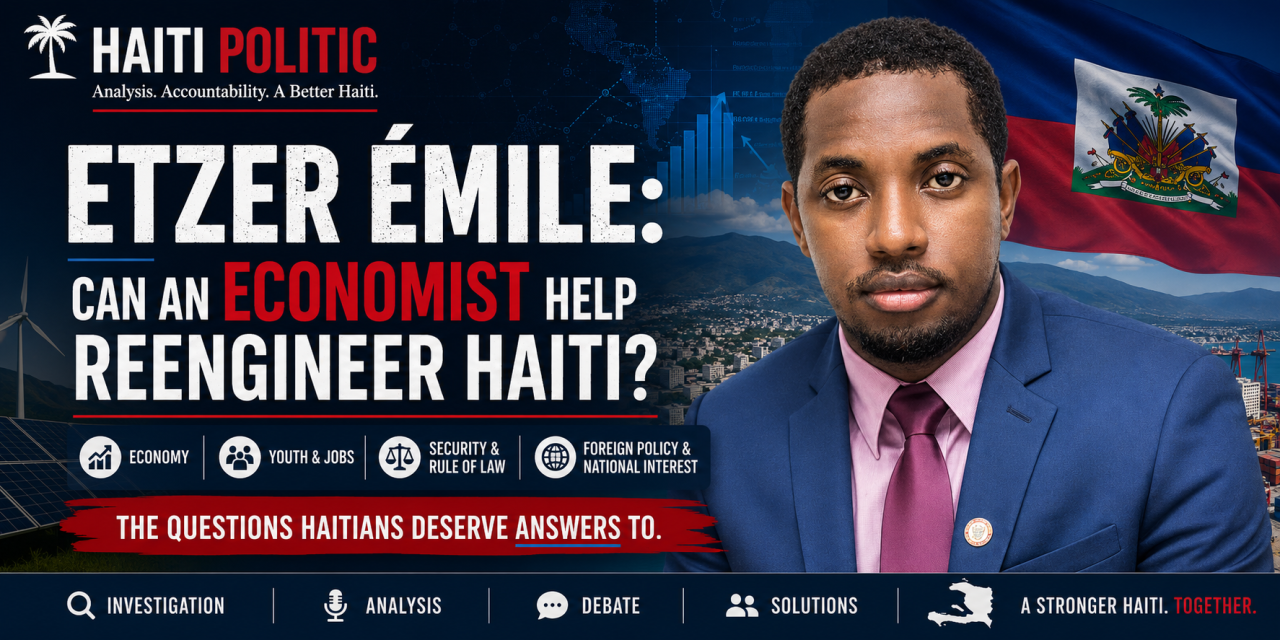
Economist. Professor. Entrepreneur. Author. Consultant. Civic educator.
Etzer S. Émile has spent years explaining why Haiti’s economy fails to produce prosperity.
But there is a much harder question:
Could he actually govern the system he has spent years analyzing?
And beyond economics, could a technocrat like Émile offer Haiti something different in foreign policy, security, institutional reform and political leadership?
This is not an endorsement.
It is not an attack.
It is an examination of the record—and the questions Haitians should ask before converting intellectual credibility into political credibility.
Let the people decide.
🇭🇹 WHO IS ETZER ÉMILE?
Émile is a Haitian economist associated with Cavaillon in Haiti’s South Department.
His academic background includes economics studies at Université Quisqueya and sociology studies at the Université d’État d’Haïti. He later pursued graduate studies in Taiwan in finance and banking and participated in executive training programs dealing with economic development, entrepreneurship and innovation, including programs associated with Harvard Kennedy School and Oklahoma State University.
But his résumé extends beyond the classroom.
Émile has worked as a professor and entrepreneurship-program leader at Université Quisqueya, business consultant, economic commentator and entrepreneur.
His consulting company, Haïti Efficace, says it has advised Haitian companies, SMEs, government ministries, business associations and international organizations on market research, financing, strategy, institutional capacity and business development.
He has also consulted or worked on projects involving Haitian ministries and organizations such as the World Bank, WFP and other international partners.
That gives Émile something relatively unusual in Haitian public debate:
experience touching academia, business, government programs, international development and civil society.
But advising institutions is fundamentally different from commanding the Haitian state.
That distinction matters.
📚 THE BOOK THAT BUILT HIS NATIONAL PROFILE
In 2017, Émile published:
Haïti a choisi de devenir un pays pauvre: Les vingt raisons qui le prouvent.
The 251-page book examines Haiti’s economic deterioration, political failures, institutional decline, development model and what it characterizes as decades of destructive policy choices.
The provocative argument behind the title is important.
Émile’s analysis places substantial responsibility for Haiti’s condition on Haitian decisions and institutions, rather than explaining virtually every national failure exclusively through foreign interference.
That philosophy could have major implications for governing.
Because if bad domestic policy helped create Haiti’s economic disaster, then changing presidents—or blaming Washington, Paris, Ottawa, the UN or international organizations—cannot by itself solve it.
Institutions must change.
🏢 ENTREPRENEURSHIP: THEORY OR PROVEN MODEL?
Émile founded and leads Haïti Efficace, a consulting operation established in Haiti in 2014 and later organized as a registered partnership. Its stated areas of expertise include economics, finance, administration, marketing, statistics, project management and organizational development.
He also founded Fondation Avenir, which focuses on education, technology, entrepreneurship, economic empowerment and civic development for Haitian youth.
The foundation reports more than 1,950 beneficiaries and partnerships across several areas of youth development. Those numbers are the foundation’s own reported figures and should therefore be treated as organizational claims rather than independently audited impact measurements.
Then came another interesting development.
🚀 AYITILAB
On June 29, 2026, Fondation Avenir, Haiti’s Ministry of Commerce and Industry and ESIH formally launched AyitiLAB, an accelerator intended to help young Haitians transform technology ideas into viable businesses capable of creating jobs.
It strengthens Émile’s argument that Haiti should create entrepreneurs rather than merely wait for government or NGOs to create employment.
But AyitiLAB is new.
Therefore, its existence should not yet be confused with demonstrated national-scale economic results.
The experiment has begun. The verdict has not.
💰 THE ECONOMIC CASE FOR ÉMILE
There is little question that economics would be Émile’s strongest policy territory.
His earlier academic work examined Haiti’s financial system and the difficulty private businesses face obtaining credit. His later work has addressed electricity, exports, public administration and economic development.
Those questions are even more urgent today.
The World Bank reports that Haiti’s economy contracted for a seventh consecutive year in 2025, with real GDP declining 2.7%, while inflation remained extremely high.
So Émile should be challenged to move beyond diagnosis.
QUESTION #1 — THE DIASPORA
Haiti receives enormous financial support from Haitians abroad.
World Bank data place personal remittances at approximately 16.9% of GDP in 2024.
But remittances overwhelmingly function as private household resources—not a national infrastructure strategy.
Mr. Émile:
What legislation would you propose to convert a voluntary portion of diaspora wealth into productive investment?
Would you create:
Diaspora infrastructure bonds?
A Haitian sovereign development fund?
Diaspora-backed municipal bonds?
Investment guarantees?
Matching funds for regional businesses?
And most importantly:
How would you convince Haitians abroad to entrust their money to institutions belonging to a state many of them do not trust?
⚡ QUESTION #2 — WHAT DO YOU DO WITH EDH?
Émile has previously written critically about Electricité d’Haïti (EDH) and its financial burden on the Haitian state.
Electricity remains one of Haiti’s fundamental development constraints. The World Bank continues to describe electricity access and energy reliability as major obstacles to economic and social development.
So diagnosis is no longer enough.
Would an Émile administration:
Privatize portions of EDH?
Create regional electricity concessions?
Use public-private partnerships?
Break the utility into generation, transmission and distribution entities?
Require forensic audits?
Expand solar microgrids and independent power generation?
Or maintain EDH as a vertically integrated state enterprise?
An economist seeking executive responsibility should eventually have to put numbers, deadlines and legislation behind the answer.
🗺️ QUESTION #3 — CAN HAITI EXIST OUTSIDE PORT-AU-PRINCE?
This could become one of Émile’s most important tests.
Haiti cannot continue concentrating political administration, finance, universities, corporate headquarters, hospitals and economic opportunity overwhelmingly around Port-au-Prince.
Émile comes from Cavaillon.
So the question becomes personal as well as economic:
Could Cavaillon become part of a new Haitian development model?
Imagine regional economic corridors built around:
🌾 agriculture and agro-processing
☀️ renewable energy
🏭 light manufacturing
💻 digital services
🏨 tourism
🚢 logistics
🎓 technical education
Would an Émile government provide temporary corporate tax incentives to companies establishing operations outside the capital?
Would municipalities retain a larger percentage of locally generated tax revenue?
Would regional development banks receive capitalization?
Decentralization must eventually become a budget—not a slogan.
👩🏾💻 QUESTION #4 — HOW DO YOU FINANCE HAITI’S ENTREPRENEURS?
This may be the issue Émile understands better than many conventional politicians.
He has spent years around entrepreneurship programs and business development.
But Haiti’s entrepreneurs encounter the same structural wall repeatedly:
capital.
Traditional bank lending is difficult for startups without collateral, predictable revenue or formal financial histories.
So what happens under an Émile economic program?
Would Haiti create:
A startup credit-guarantee authority?
Public-private venture funds?
Digital credit scoring?
Diaspora co-investment funds?
Tax incentives for angel investors?
Special SME lending windows?
Training young entrepreneurs without creating financing mechanisms risks producing highly educated entrepreneurs who still cannot finance companies.
🛒 QUESTION #5 — THE INFORMAL ECONOMY
The World Bank has described roughly 80% of Haitian workers as operating in the informal labor market.
These people cannot simply be treated as tax evaders.
For many Haitians, informality is survival.
So how would an Émile administration formalize businesses without destroying them?
One possibility would be a bargain:
GOVERNMENT OFFERS:
simple digital registration, microcredit eligibility, pension access, insurance, legal protection and reduced startup taxation.
BUSINESSES OFFER:
registration, basic accounting and gradually increasing tax compliance.
The principle should be simple:
Make becoming legal more profitable than remaining invisible.
But Émile should explain whether that—or something entirely different—is his actual policy.
🔫 THE QUESTION ECONOMICS CANNOT ANSWER
Here lies the greatest uncertainty surrounding any economist entering Haitian national leadership:
SECURITY.
Economic expertise cannot substitute for command of police institutions, intelligence, borders, customs, courts and national security policy.
And Haiti’s crisis has moved far beyond ordinary criminality.
International sanctions have documented relationships involving political figures and gang financing or arming. The U.S. Treasury, for example, sanctioned former parliamentarian Prophane Victor in 2024 for his alleged role in forming, supporting and arming gangs.
The United States subsequently designated Viv Ansanm as a terrorist organization in 2025 and sanctioned individuals accused of materially supporting the coalition.
Therefore Émile—or anyone seeking national leadership—must answer:
FOLLOW THE MONEY.
Would his government establish specialized financial-intelligence investigations targeting:
💰 gang financiers
🔫 weapons networks
🏢 shell companies
⚓ compromised import channels
🏦 money laundering
👔 politically connected sponsors?
And would those investigations continue even when they reach powerful businessmen or political allies?
That is where anti-corruption rhetoric becomes dangerous—and meaningful.
👦🏾 QUESTION #7 — WHAT HAPPENS TO GANG-AFFILIATED YOUTH?
Security operations can capture or kill gang commanders.
They cannot eliminate the economic conditions producing replacement recruits.
Any serious Haitian security strategy therefore needs both coercion and prevention.
What would Émile propose for Disarmament, Demobilization and Reintegration (DDR)?
Who qualifies?
Who does not?
How are serious violent offenders separated from coerced or low-level recruits?
Who pays for rehabilitation?
Where do participants receive vocational training?
Who employs them afterward?
And how does government prevent a DDR program from becoming a financial reward for joining a gang?
These are extraordinarily difficult questions.
But presidents do not get to avoid difficult questions.
🌎 THE BIGGEST UNKNOWN: FOREIGN POLICY
This may be the least tested dimension of Émile’s public résumé.
His documented experience is strongest in economics, entrepreneurship, consulting, education and development.
That is not the same as negotiating geopolitical relationships.
Haiti’s next generation of leadership will have to deal simultaneously with:
🇺🇸 United States
🇨🇦 Canada
🇫🇷 France
🇩🇴 Dominican Republic
🇹🇼 Taiwan
🇨🇳 China
🇪🇺 European Union
🌎 CARICOM and OAS
🇺🇳 United Nations
🏦 IMF, World Bank and IDB
The central question should not be:
“Are you pro-America or anti-America?”
That debate is too simplistic.
The serious question is:
What is Haiti’s national interest?
A Haitian president should be capable of cooperating with Washington without surrendering policy ownership.
Working with the UN without outsourcing Haitian sovereignty.
Negotiating with international financial institutions without allowing donors to substitute projects for national planning.
Working with the Dominican Republic while firmly defending Haitian interests.
And mobilizing the diaspora as an economic and diplomatic network rather than treating Haitians abroad primarily as remittance senders.
⚠️ AND HAITI’S INTERNATIONAL MODEL ITSELF DESERVES SCRUTINY
For years, Haiti’s politics have been profoundly influenced by international actors and arrangements commonly associated with the Core Group and broader donor architecture.
But international involvement has not produced durable political stability.
The situation in 2026 makes that failure impossible to ignore.
At the UN Security Council in July, CARICOM reported that elections originally contemplated for August 2026 could no longer occur on that timetable. Voter registration had only begun in July, and Haitian authorities were discussing a revised electoral calendar amid the security crisis.
That should force every prospective Haitian leader to answer a fundamental question:
Will Haiti continue adapting its domestic strategy to international programs—or require international programs to adapt to a Haitian national strategy?
Those are two very different models of foreign policy.
🏛️ THE POLITICAL PROBLEM
Perhaps the greatest question surrounding Etzer Émile is not economics.
It is power.
Running seminars is not running Haiti.
Advising companies is not commanding the Haitian National Police.
Writing about dysfunctional institutions is not reforming them.
Teaching entrepreneurship is not negotiating legislation.
Managing consultants is not managing competing political factions.
And intellectual credibility does not automatically create an electoral organization.
As of this review, I found substantial documentation of Émile’s economic, academic, consulting and civic work, but not enough reliable public evidence to characterize a fully developed presidential campaign, national party machinery or governing coalition.
That distinction should remain explicit.
So Haitians should ask him:
WHO STANDS WITH YOU?
Which political parties?
Which peasant organizations?
Which provincial leaders?
Which diaspora organizations?
Which unions?
Which business associations?
Which women’s organizations?
Which youth movements?
Which civil-society networks?
And perhaps most importantly:
What compromises would you refuse to make—even if refusing them costs you power?
📊 THE ETZER ÉMILE TEST
| AREA | POTENTIAL STRENGTH | UNANSWERED RISK |
|---|---|---|
| Economy | Deep economic and business-development background | Can analysis become executable national policy? |
| Entrepreneurship | Years of engagement with entrepreneurs and SMEs | Can programs scale from hundreds or thousands to millions? |
| Youth | Fondation Avenir and education initiatives | Civic popularity does not automatically produce political organization |
| Private Sector | Extensive consulting exposure | Can he regulate powerful interests he may previously have worked around? |
| Public Administration | Consulting exposure to ministries | Advising government differs dramatically from controlling bureaucracy |
| Security | Economic-development perspective may address recruitment conditions | Limited demonstrated executive national-security record |
| Foreign Policy | International education and development exposure | No comparable record yet of high-level geopolitical negotiation |
| Politics | Technocratic image could appeal to voters tired of traditional politicians | A fragmented Haitian state requires coalition-building and political combat, not economics alone |
🧭 THE CASE FOR HIM
Émile represents an intriguing proposition.
What if Haiti elevated leadership from people who have spent years studying how economies actually function?
What if government measured programs by return on investment?
What if ministries had performance indicators?
What if diaspora money could finance productive assets?
What if entrepreneurship replaced permanent dependence?
What if provincial economic development became measurable government policy?
What if foreign aid were forced to operate within a Haitian national investment strategy?
These questions explain why a figure like Émile deserves serious examination.
⚖️ THE CASE FOR SKEPTICISM
But Haiti has seen intelligent people before.
Haiti has seen economists before.
Haiti has seen technocrats before.
Haiti has seen internationally respected professionals before.
The Haitian state’s problem is not merely a shortage of intelligent policy proposals.
It is also the ability to enforce decisions against armed groups, corrupt networks, monopolistic interests, dysfunctional institutions and political actors whose survival depends on preventing reform.
An economist can design reform.
A president must survive the forces threatened by it.
That is a profoundly different skill.
🇭🇹 THE QUESTIONS ETZER ÉMILE SHOULD ANSWER BEFORE HAITI DECIDES
1. What is your first 100-day economic program?
2. What five laws would you send to Parliament first?
3. What is your plan for EDH?
4. How would you turn diaspora capital into investment without confiscating or politically controlling remittances?
5. How would you decentralize economic opportunity outside Port-au-Prince?
6. How would startups obtain affordable capital?
7. How would you formalize informal workers without impoverishing them?
8. Who finances Haiti’s gangs—and would you prosecute financiers regardless of their wealth or political connections?
9. What is your DDR strategy?
10. What is your doctrine toward the United States, Canada, France, the Dominican Republic, CARICOM, the UN and international financial institutions?
11. What would you tell Washington when Haiti’s national interest conflicts with American policy?
12. What political coalition could actually pass your reforms?
13. Who would be permitted to finance your political movement—and whose money would you refuse?
14. Would you publicly disclose campaign donors and major financial interests?
15. What measurable results should Haitians use after two years to determine whether your government has failed?
🇭🇹 FINAL QUESTION: ECONOMIST, EDUCATOR… OR STATESMAN?
Etzer Émile has built a documented career around economics, entrepreneurship, education, consulting and public discussion.
That deserves examination.
It does not automatically qualify him to govern Haiti.
Nor does the absence of a traditional political résumé automatically disqualify him.
The real test is much tougher:
Can he convert knowledge into institutions?
Can he convert economic theory into jobs?
Can he convert diaspora wealth into productive investment?
Can he confront entrenched economic interests?
Can he build political coalitions without becoming captured by them?
Can he restore security while respecting the rule of law?
Can he negotiate with foreign powers without outsourcing Haitian sovereignty?
And ultimately:
Can a man who spent years explaining why Haiti became poor help construct the state capable of making Haiti prosperous?
That question should not be answered by supporters.
It should not be answered by critics.
Etzer Émile should answer it—with policies, numbers, deadlines and measurable commitments.
Then the Haitian people can decide.
Pa mande sèlman kiyès ki vle dirije Ayiti.
Mande yo kijan yo pral dirije l.
🇭🇹 The investigation continues.