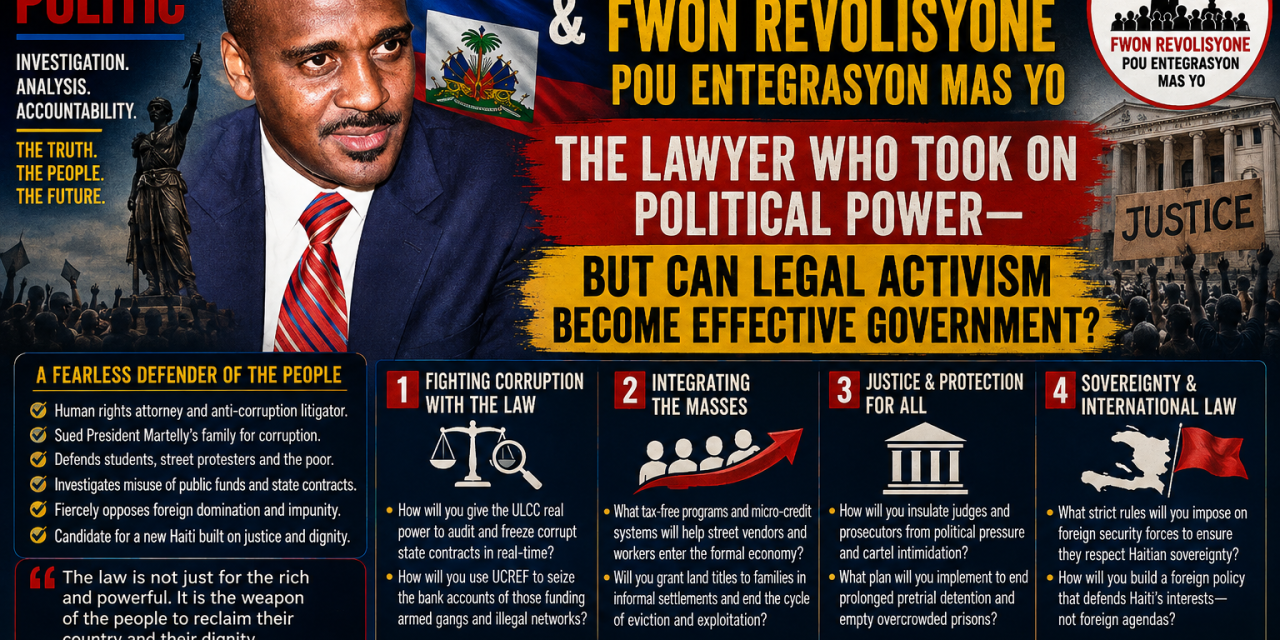
For years, Me Newton Louis St. Juste has occupied a combative corner of Haitian public life: lawyer, government critic, anti-corruption litigant and political activist.
His résumé is unusual for a presidential contender. He did not emerge primarily from Haiti’s business establishment, diplomatic corps or traditional governing bureaucracy. His public reputation was shaped substantially through legal confrontation with political power.
But Haiti’s crisis poses a harder test than opposition politics.
Can someone skilled at challenging the state also build and administer one?
Haiti Politic examined the available public record—and some of the claims commonly made about St. Juste deserve confirmation rather than repetition.
⚖️ WHAT THE RECORD ESTABLISHES
St. Juste is documented as a Haitian lawyer who became involved in politically sensitive cases concerning alleged corruption and economic and social rights.
In 2012, the International Federation for Human Rights (FIDH) and World Organisation Against Torture (OMCT) identified Newton Louis St. Juste, André Michel and Mario Joseph as lawyers working on cases involving economic and social rights. The organizations reported alleged intimidation and threats of arbitrary arrest against the attorneys.
Amnesty International likewise issued an urgent action concerning threats and intimidation involving the three lawyers and placed the controversy within broader concerns about judicial independence in Haiti.
Contemporary reporting also documents St. Juste’s involvement in corruption complaints targeting people around then-President Michel Martelly. A 2012 report by Jacqueline Charles said St. Juste and André Michel had brought corruption complaints involving the presidential family and members of the government.
In 2013, FIDH reported that André Michel, Newton Saint Juste and Mario Joseph were involved as lawyers for the civil party in a case concerning alleged corruption and manipulation of public funds involving people in the president’s entourage. Those allegations should be described as allegations—not findings of guilt.
When André Michel was detained in October 2013, St. Juste publicly denounced the detention as arbitrary and illegal.
That gives St. Juste a documented record of confronting political authority through the courts.
But confrontation is only one dimension of governing.
🏛️ FROM ACTIVIST LAWYER TO POLITICAL ACTOR
There is another important chapter.
Research compiled by Canada’s Immigration and Refugee Board identifies Newton Saint Juste as a founder of Plateforme Jistis, alongside André Michel, although the IRB noted limitations in corroborating some of the information available to it. The same research establishes that St. Juste left Plateforme Jistis in May 2015.
He subsequently contested the disputed 2015 presidential election under Fwon Revolisyone pou Entegrasyon Mas Yo.
Published election tables report 1,677 votes—approximately 0.11%—for St. Juste in that contest.
That result matters.
Not because vote totals determine whether someone’s ideas have merit.
They don’t.
But presidential government requires something litigation does not: a national political coalition capable of winning public legitimacy, electing legislators, administering ministries and maintaining alliances across Haiti’s departments.
So one of the first questions for St. Juste today must be:
What has changed since 2015?
🔎 INVESTIGATION 1 | CAN AN ANTI-CORRUPTION LAWYER BUILD AN ANTI-CORRUPTION STATE?
Filing corruption cases is one thing.
Preventing corruption across Customs, procurement, ministries, municipalities and state enterprises is considerably harder.
A St. Juste presidency should therefore be judged not simply on rhetoric about corruption, but on institutional architecture.
🎤 QUESTIONS FOR NEWTON ST. JUSTE
Would every major government contract be published online?
Would bidders, beneficial owners, contract amendments, payments and completion reports become searchable by citizens?
Would ULCC receive sufficient operational independence to investigate presidential appointees?
Would UCREF receive stronger legal and technological capacity to follow suspicious financial transactions?
And would those agencies remain independent if investigations implicated members of St. Juste’s own coalition?
That is the real anti-corruption test.
Not whether you can investigate your enemies.
Can you investigate your friends?
💰 INVESTIGATION 2 | FOLLOW THE MONEY BEHIND HAITI’S VIOLENCE
Haiti’s security crisis cannot be understood exclusively by looking at armed young men controlling neighborhoods.
Weapons cost money.
Ammunition costs money.
Vehicles cost money.
Political protection has value.
Financial networks therefore deserve as much scrutiny as street-level criminal organizations.
A St. Juste administration should explain exactly how it would connect financial intelligence, Customs enforcement, prosecutors and international anti-money-laundering cooperation.
Would assets connected to criminal financing be frozen only after conviction?
What judicial safeguards would prevent asset-seizure laws from becoming political weapons?
How would Haiti obtain banking information involving overseas transactions?
And would politically connected financiers receive exactly the same treatment as neighborhood gang commanders?
👩🏿🌾 INVESTIGATION 3 | WHAT DOES “INTEGRATION OF THE MASSES” ACTUALLY MEAN?
The name Fwon Revolisyone pou Entegrasyon Mas Yo makes an enormous political promise.
Integration.
But integration into what?
Millions of Haitians survive through commerce and work that exist partly or completely outside formal state structures.
A credible mass-integration agenda therefore needs policies, not merely revolutionary vocabulary.
Would street merchants receive simplified business registration?
Could a Madan Sara register a microenterprise from a telephone without hiring an attorney?
Would newly formalized microbusinesses receive a temporary tax holiday?
Could registration unlock bank accounts, insurance and credit?
Would municipalities—not another centralized Port-au-Prince bureaucracy—administer much of the system?
The question for St. Juste:
Can formalization give poor Haitians rights without simply giving the government another way to tax them?
🏘️ INVESTIGATION 4 | PROPERTY RIGHTS FOR HAITI’S URBAN POOR
One of the most consequential ideas raised by St. Juste’s political framing concerns economic inclusion.
Families can occupy property for decades without having clean, enforceable title.
That makes housing insecure and can prevent property from becoming usable collateral or transferable family wealth.
Would a St. Juste administration undertake a national cadastre?
Would long-term occupants receive pathways toward legal title?
How would legitimate owners contest fraudulent claims?
Would special land courts resolve disputes?
And how would the government prevent politically connected developers from exploiting land reform to acquire valuable urban property?
Land reform can democratize wealth.
Badly executed land reform can also produce another corruption industry.
⚖️ INVESTIGATION 5 | CAN HE MAKE THE COURTS INDEPENDENT—even from himself?
This may be the defining question for a lawyer seeking presidential power.
St. Juste’s own career unfolded against longstanding concerns about political pressure on Haiti’s justice system. Amnesty’s 2012 reporting specifically discussed instability surrounding prosecutors and concerns about judicial independence.
A President St. Juste would therefore face an extraordinary credibility test:
Would he accept judicial independence when judges rule against his government?
Would prosecutors have protected tenure?
Would judicial appointments become transparent?
Would disciplinary proceedings be insulated from presidential retaliation?
Would prosecutors be permitted to investigate cabinet ministers?
And would the presidency publish its contacts with prosecutors in politically sensitive cases?
Someone who spent years demanding an independent justice system from other presidents would eventually have to demonstrate that principle while possessing presidential power himself.
🔒 INVESTIGATION 6 | HAITI’S FORGOTTEN PRISONERS
A justice-centered presidential platform also cannot ignore prolonged pretrial detention.
The question shouldn’t stop at promising prison reform.
St. Juste should provide measurable targets.
How quickly would detainee files be digitized?
Would mobile courts review detention cases?
Would nonviolent defendants receive alternatives to incarceration?
How many judges and prosecutors would be added?
And what deadline would his government establish for reducing unlawful or excessive pretrial detention?
Justice delayed inside a prison cell is not an abstract constitutional problem.
It is state power exercised against an individual.
🌎 INVESTIGATION 7 | WHAT WOULD “SOVEREIGN FOREIGN POLICY” MEAN?
This is where St. Juste’s candidacy deserves particularly serious examination.
Haiti has experienced repeated foreign interventions, peacekeeping missions, donor programs and internationally influenced political settlements.
Yet criticizing foreign influence is easier than replacing dependency.
A nationalist government would still need international cooperation on weapons trafficking, sanctions, banking, migration, trade, intelligence, disaster response and development finance.
So what would St. Juste Doctrine actually be?
Would Haiti demand that foreign security assistance operate under Haitian-defined objectives?
Would international NGOs face stronger registration and financial-disclosure requirements?
Would Haiti diversify diplomacy beyond its traditional relationships with the United States, Canada and France?
What would relations look like with CARICOM, the Dominican Republic, African states and Latin America?
And perhaps most importantly:
How does Haiti become diplomatically independent without becoming diplomatically isolated?
🛡️ INVESTIGATION 8 | REVOLUTIONARY RHETORIC MEETS SECURITY REALITY
There is another unavoidable question.
A government cannot integrate marginalized citizens economically while armed organizations control neighborhoods, roads and commercial corridors.
What precisely would President St. Juste do?
Strengthen PNH?
Expand FAD’H?
Build financial-intelligence operations?
Seek international tactical assistance?
Pursue disarmament programs?
What happens to minors recruited into armed organizations?
What happens to commanders?
And what evidentiary standards would prosecutors need before the government freezes assets or imprisons alleged financial sponsors?
A human-rights lawyer faces a particularly difficult balance:
Can he restore coercive state authority without abandoning the civil liberties he built his career defending?
📊 HAITI POLITIC ASSESSMENT
| AREA | DOCUMENTED STRENGTH / EXPERIENCE | QUESTION STILL TO BE ANSWERED |
|---|---|---|
| Legal activism | Documented involvement in politically sensitive corruption and rights cases. | Can litigation skills translate into executive management? |
| Political opposition | Documented critic of the Martelly era and participant in opposition politics. | Can opposition politics become coalition governance? |
| Human-rights environment | International rights organizations documented alleged threats and intimidation involving St. Juste and fellow lawyers. | What institutional reforms would he enact as president? |
| Electoral experience | Contested the 2015 presidential election under Fwon Revolisyone pou Entegrasyon Mas Yo. | How would he expand a historically very small electoral base? |
| Foreign policy | His broader political posture provides grounds for questions about sovereignty and outside influence. | A detailed, current foreign-policy doctrine needs to be publicly demonstrated and scrutinized. |
| Executive management | The sources reviewed establish legal and political activism more clearly than large-scale executive administration. | Can he manage budgets, ministries, security institutions and a legislature? |
⚠️ WHAT OUR INVESTIGATION COULD NOT VERIFY
This distinction matters.
The available sources support describing Newton Louis St. Juste as a lawyer, political activist, critic of the Martelly administration, participant in corruption-related litigation and former presidential candidate.
But some stronger claims in political biographies circulating around him require better evidence.
I would not yet present as established fact that he has spent “decades” as a top-tier anti-corruption litigator, that he has personally documented broad networks linking Haiti’s business elite to armed groups, that he investigated reconstruction funds extensively, or that he has an established detailed foreign-policy doctrine opposing particular international institutions.
Likewise, saying he is “completely clean” of corruption goes beyond what a responsible investigation can establish merely because searches did not reveal evidence of wrongdoing.
Absence of evidence is not a certificate of innocence—and allegations are not proof of guilt.
That standard should apply to every candidate Haiti Politic investigates.
🇭🇹 THE QUESTION HAITIANS MUST ANSWER
Newton Louis St. Juste’s documented history gives voters something substantive to examine.
He challenged powerful political interests through legal action. International human-rights organizations documented threats and intimidation involving him and fellow attorneys. He entered organized politics and eventually sought the presidency.
But Haiti does not elect a chief opposition lawyer.
It elects a president.
And presidents must make Customs function, collect revenue, appoint competent administrators, negotiate internationally, secure territory, respect courts, build legislative coalitions and deliver public services.
So the question is bigger than whether Newton Louis St. Juste has demonstrated courage in confronting political power.
Can the lawyer who challenged the Haitian state design a state Haitians can finally trust?
Newton Louis St. Juste and Fwon Revolisyone pou Entegrasyon Mas Yo deserve the questions.
The evidence—and the Haitian people—should provide the verdict.
#HaitiPolitic #NewtonLouisStJuste #Haiti #PolitiqueHaitienne #Ayiti #ElectionsHaiti #Justice #Corruption #ForeignPolicy #RuleOfLaw #HaitiPolitics