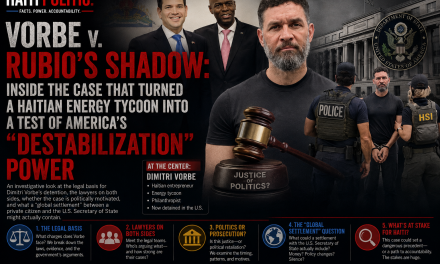

Miami, FL — A federal judge has ruled that Haitian businessman Dimitri Albert Edouard Vorbe was unlawfully held without any opportunity to seek bond, ordering U.S. immigration authorities to give him an individualized bond hearing by August 24, 2026 — or release him under supervision. The ruling, issued August 17, 2026 by U.S. District Judge Darrin P. Gayles of the Southern District of Florida, closes out nearly eleven months of detention that had drawn growing scrutiny from the court itself.
Background: An Arrest Rooted in U.S. Foreign Policy, Not a Criminal Charge
Vorbe, co-owner of the Haitian family power company Société Générale d’Énergie S.A. (SOGENER), was arrested by U.S. Immigration and Customs Enforcement (ICE) at his Miami-area home on September 23, 2025. He had lived in the United States since entering on a visitor’s visa in January 2020, and had been granted Temporary Protected Status (TPS) in 2023 after his U.S. citizen son sponsored a family-based immigration petition on his behalf.
Vorbe’s detention was not based on a criminal conviction. Instead, it stemmed from an undated memorandum by Secretary of State Marco Rubio, who determined under a rarely used provision of immigration law — 8 U.S.C. § 1227(a)(4)(C) — that Vorbe’s “presence or activities in the United States would have potentially serious adverse foreign policy consequences.” According to the memo, Rubio determined Vorbe had “engaged in a campaign of violence and gang support that contributed to Haiti’s destabilization.” The day after his arrest, the Department of Homeland Security withdrew his TPS status.
Vorbe’s family has publicly denied the allegations. His brother, Joel Vorbe, told Reuters the accusations were “inexplicable” and that Dimitri had never supported or financed gang activity.
His arrest fit a broader pattern: two months earlier, ICE had detained another prominent Haitian businessman and former presidential candidate, Pierre Réginald Boulos, on nearly identical grounds. Both cases arose amid a wider Trump administration effort — including a May 2025 State Department designation of Haiti’s Viv Ansanm and Gran Grif gangs as foreign terrorist organizations — to pursue Haitian nationals, including lawful permanent residents, accused of gang ties. Notably, Vorbe’s family had also drawn earlier political scrutiny in Haiti: in 2020, then-President Jovenel Moïse accused Vorbe and other business elites of corruption and moved to seize state control of SOGENER, part of a broader clash between Moïse’s government and Haiti’s business class.
The Legal Fight: Nearly a Year Without a Bond Hearing
Vorbe filed a habeas corpus petition on October 27, 2025, arguing that his continued detention without any chance to seek bond was unlawful. The core of his legal argument was narrow but significant: Congress, in the statute governing mandatory immigration detention (8 U.S.C. § 1226(c)), specifically listed the categories of noncitizens who must be held without bond — and people deportable under the “foreign policy consequences” provision Vorbe was charged under were not among them. Vorbe argued that a federal regulation extending mandatory detention to his category exceeded what Congress had actually authorized.
The case moved slowly. A brief detour arose in May 2026, when Vorbe and the government jointly sought to pause the case after Vorbe secured permission to be admitted to the Dominican Republic — an arrangement that collapsed a week later when the Dominican government reversed course and refused him entry. The case resumed, with a hearing held June 9, 2026.
By that hearing, Judge Gayles had already signaled concern about the length of Vorbe’s detention, reportedly telling the parties in court: “I am concerned about the whole idea that the petitioner can just be detained indefinitely. How long can the government just keep him in custody if it can’t effectuate his removal?”
The Ruling
In his August 17 order, Judge Gayles sided with Vorbe on the central legal question. The court held that the regulation the government relied on to deny Vorbe a bond hearing — 8 C.F.R. § 1003.19(h)(2)(i)(C) — went beyond the authority Congress granted in the underlying statute, because Congress’s detailed list of categories subject to mandatory detention conspicuously did not include people charged under the “foreign policy consequences” provision. Citing the Supreme Court’s 2024 decision in Loper Bright Enterprises v. Raimondo, which ended judicial deference to agency interpretations of ambiguous statutes, the court concluded it was not required to defer to the government’s broader reading of its own regulation.
The court rejected several jurisdictional arguments the government raised to try to keep the case out of federal court, and separately found that Vorbe was not required to first appeal through the Board of Immigration Appeals before bringing his case to federal court, because doing so would have been futile — an immigration appeals board, the court noted, lacks the authority to invalidate the regulation Vorbe was challenging.
Importantly, the court did not order Vorbe’s immediate release, and did not rule on the accusations against him. It found only that he is being held under a different, non-mandatory detention statute (8 U.S.C. § 1226(a)) than the government had argued — meaning he is now entitled to ask an immigration judge to set bond, rather than being categorically barred from doing so. The court also declined Vorbe’s request that it personally conduct the bond hearing rather than an immigration judge, though it noted Vorbe remains free to challenge the sufficiency of the government’s evidence — including the fact that Secretary Rubio’s letter “offers no factual findings, evidence, or documentation” supporting its claims — at that hearing, and to appeal any denial to the Board of Immigration Appeals.
What Happens Next
The court’s order requires:
- An individualized bond hearing for Vorbe on or before August 24, 2026, or his release under supervised conditions;
- A status report from the government by August 31, 2026, confirming whether the hearing occurred and its outcome.
The underlying habeas case has been administratively closed, though the court retains jurisdiction to reopen it if further disputes arise. Vorbe remains held at the Krome North Service Processing Center in Miami-Dade County, where he has now been detained for roughly eleven months — a period that included a temporary, court-scrutinized relocation of detainees out of South Florida in June 2026 due to a fire threat at the facility.
Whether an immigration judge ultimately grants Vorbe bond — and under what conditions — remains to be determined. The underlying removal proceedings against him, based on the Secretary of State’s foreign policy determination, continue separately and are unaffected by this ruling.
This summary is based on the court’s August 17, 2026 order in Vorbe v. Field Office Director, Miami Field Office, U.S. Immigration and Customs Enforcement, et al., Case No. 1:25-cv-24964-DPG (S.D. Fla.), and on public reporting. It is intended for general informational purposes and does not constitute legal advice.