🇭🇹 HAITI POLITIC | INVESTIGATIVE PROFILE
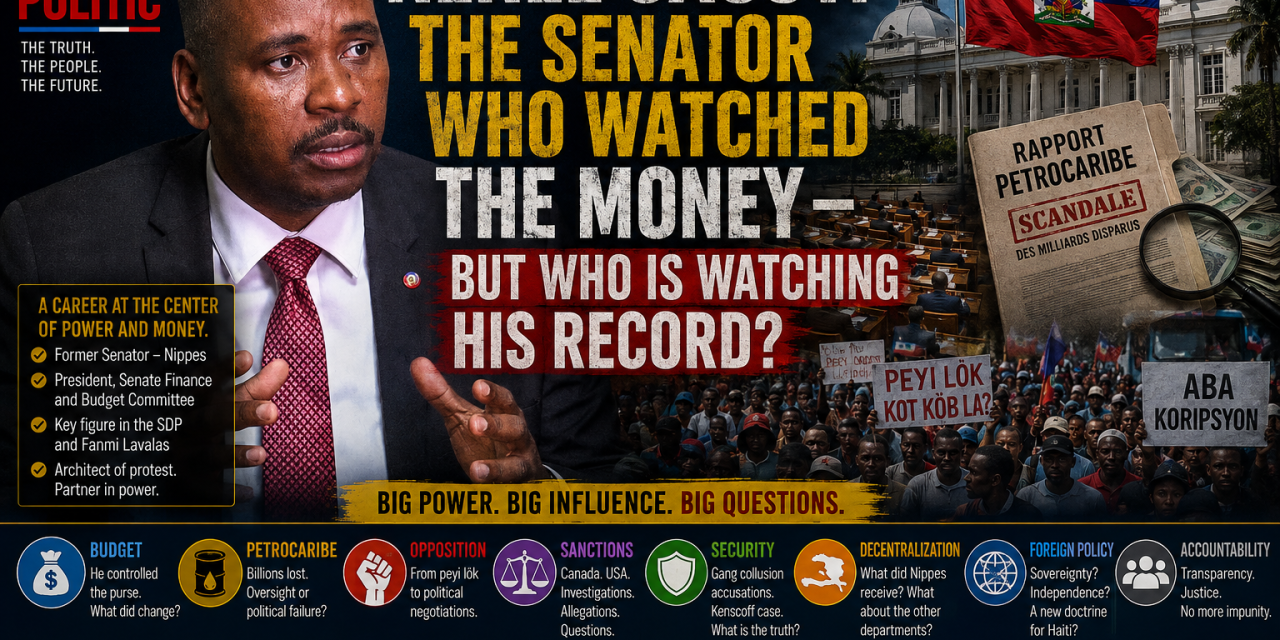
Budget. PetroCaribe. Opposition. Sanctions. Security. Decentralization. Foreign Policy. Accountability.
Editorial note: This is an investigative public-record profile, not an endorsement or recommendation. Some assertions in the proposed framing require correction or qualification. Most importantly, Cassy is now the subject of serious legal and sanctions-related matters that cannot responsibly be omitted. Allegations and government designations are identified as such; they should not be presented as criminal convictions.
🔎 WHO IS NENEL CASSY?
Nenel Cassy is a former senator from Nippes whose career places him at the intersection of three powerful currents in modern Haitian politics:
Fanmi Lavalas electoral politics. Senate budget oversight. Anti-government opposition mobilization.
Official electoral records confirm that Cassy was accepted as a Fanmi Lavalas candidate for senator from Nippes in the 2015 electoral process.
His most important institutional credential is substantial: Cassy repeatedly served as president of the Senate Finance Commission.
Reporting from 2009 shows him heading the commission during negotiations over Haiti’s national budget. In 2012, Le Nouvelliste reported that he had chaired the Finance Commission for four years during his first six-year Senate term. He later returned to the same powerful position; reporting from 2016 and 2017 again identifies him as president of the Senate Finance Commission.
That makes Cassy’s record particularly important.
He wasn’t merely protesting Haiti’s financial system from the streets. He spent years inside one of Parliament’s principal mechanisms for scrutinizing the public purse.
And that raises a much harder standard of accountability.
💰 THE SENATOR WHO WATCHED THE BUDGET
Cassy’s supporters can point to a genuine institutional résumé.
In 2009, his Finance Commission worked with ministers responsible for health, education, public works, agriculture, planning and finance before the Senate considered the budget. Cassy also criticized the extraordinary delay that resulted in the 2008–09 budget being approved months late.
In 2010, he warned that dysfunction in the Chamber of Deputies threatened the constitutional budget process.
In 2016, when the government submitted a proposed 121.9-billion-gourde budget, Cassy said his commission would call senior officials—including the prime minister and economic and planning ministers—to Parliament to examine the rectifying budget.
In 2017, he questioned ministers over allocations in the amended budget and expressed concern that the Ministry of Social Affairs was receiving inadequate treatment. He also urged greater fiscal discipline and support for domestic agricultural producers.
Those are legitimate pieces of a legislative record.
But they create an unavoidable question:
WHAT DID ALL THAT OVERSIGHT ACTUALLY CHANGE?
🛢️ PETROCARIBE: OVERSIGHT OR POLITICAL FAILURE?
The user-provided framing suggests that Cassy’s Finance Commission should be evaluated against the PetroCaribe scandal.
That’s fair—but the question needs precision.
Cassy was involved in the Senate’s PetroCaribe investigation, but Evalière Beauplan, not Cassy, chaired the Ethics and Anti-Corruption Commission associated with the major 2017 report. Contemporary reporting identified Cassy as Finance Commission president and a member of the special investigation commission.
That distinction matters.
The bigger issue remains.
Haiti produced parliamentary investigations, accusations and enormous political mobilization around PetroCaribe.
But accountability proved extraordinarily difficult.
🎯 QUESTIONS FOR NENEL CASSY
1. During the years you chaired the Senate Finance Commission, what permanent financial-control mechanisms did you introduce that remain operational today?
2. Why did parliamentary scrutiny fail to create a system capable of detecting questionable public expenditures before money disappeared rather than investigating afterward?
3. Would you support publishing every government contract, amendment, beneficial owner, payment and procurement decision through an online portal accessible to every Haitian citizen?
4. Would you give the CSCCA the ability to conduct continuous digital audits rather than primarily retrospective reviews?
And perhaps the hardest question:
If Parliament knew Haiti’s public-finance system was vulnerable, why wasn’t it fixed while experienced legislators like Cassy controlled its most important oversight committees?
⚠️ BUT THE INVESTIGATION CANNOT STOP WITH PETROCARIBE
There is now a much more serious issue surrounding Cassy’s own public record.
🇨🇦 CANADA SANCTIONED NENEL CASSY
In March 2023, Canada formally added Cassy to its Haiti sanctions regime.
The Canadian government’s regulatory statement said Haitian elites were using their positions, influence and resources, including associations with political figures, to protect or support criminal-gang activities and engage in significant corruption. Cassy’s name was added to the sanctions schedule.
That is a government sanctions determination—not a Haitian criminal conviction.
The distinction is essential.
🇺🇸 THE UNITED STATES ALSO ACTED
In December 2023, the United States publicly designated Cassy under Section 7031(c).
The stated basis was that he had abused his public position by participating in corrupt activity that undermined the integrity of Haiti’s government. The measure also covered immediate family members.
Again:
A foreign-government designation is not equivalent to a conviction in a Haitian court.
But for a former chairman of the Senate Finance Commission presenting himself as an authority on public money, it becomes impossible to discuss “accountability” without asking him to answer those findings directly.
🎯 QUESTIONS FOR CASSY
5. What specifically does he say Canada got wrong?
6. What specifically does he say the United States got wrong?
7. Has he formally challenged either designation, and if so, what documentary evidence has he submitted?
8. Would he voluntarily publish comprehensive asset declarations covering his years before, during and after public office?
9. Would he disclose companies, properties and significant financial interests in which he has held a beneficial interest?
This is where the standard becomes simple:
A politician demanding transparency from everyone else should be willing to practice radical transparency himself.
🚨 THEN CAME 2025
The public record became substantially more serious in 2025.
Haitian authorities issued a wanted notice naming Cassy amid investigations related to attacks on Kenscoff. The Associated Press reported in February 2025 that authorities had named Cassy among suspects accused of supporting gang members responsible for deadly attacks there.
On August 2, 2025, the DCPJ arrested Cassy in Pétion-Ville.
The Haitian National Police confirmed the arrest to Le Nouvelliste. Police statements and reporting listed allegations including conspiracy against the internal security of the state, financing criminal organizations, complicity in murder and criminal association.
The Associated Press likewise reported his arrest and described the accusations as including conspiring against the state and financing gangs.
These are extremely serious accusations.
They must also remain described as accusations unless and until adjudicated.
And the case apparently did not disappear.
A BINUH report covering October–December 2025 stated that there had been progress in investigations targeting Cassy and that the Port-au-Prince prosecutor had announced reconstruction of his judicial file after the original disappeared, in connection with allegations of collusion with armed gangs.
That development fundamentally changes the questions any serious political profile must ask.
⚖️ THE QUESTIONS CASSY MUST ANSWER NOW
10. THE GANG-COLLUSION CASE
What is his complete response to allegations that he supported or financed armed organizations?
Not a political slogan.
Not an attack on foreign powers.
Not a denunciation of his political opponents.
What evidence does he offer in his defense?
11. THE KENSCOFF INVESTIGATION
Authorities linked the investigation to deadly gang attacks in Kenscoff.
What contacts, if any, did Cassy or members of his political network maintain with individuals implicated in those attacks?
If he denies any relationship, would he consent to investigators examining relevant financial and communications records under lawful judicial supervision?
12. THE MISSING JUDICIAL FILE
BINUH reported that prosecutors said Cassy’s judicial file had to be reconstructed because the original had disappeared.
That raises a question extending beyond Cassy himself:
How can Haiti prosecute politically connected defendants when judicial evidence itself can disappear?
Would Cassy support digitizing criminal files, immutable audit logs and independent backup systems—even when those systems preserve evidence potentially damaging to him or his allies?
✊ FROM OPPOSITION TO GOVERNMENT AGREEMENT
Cassy was also a significant figure in the Secteur Démocratique et Populaire (SDP).
The movement became one of the principal opposition forces confronting the governments associated with Jovenel Moïse and PHTK.
After Moïse’s assassination, however, the SDP signed the September 11, 2021 agreement with Prime Minister Ariel Henry.
Contemporary reporting records Cassy defending the resulting political arrangement.
But the alliance fractured.
By August 2022, Cassy announced that his branch of the SDP was withdrawing from the agreement, arguing that Henry’s government had failed to implement it. Other prominent SDP figures rejected Cassy’s position and continued supporting the accord.
This is more nuanced than simply saying Cassy “became a primary architect and backer” of Henry indefinitely.
He supported the arrangement and then publicly broke with it.
That timeline matters.
🔥 THE PEYI LÒK QUESTION
Cassy’s opposition history also forces a difficult reckoning over Haiti’s politics of street mobilization.
Opposition movements saw mass demonstrations and shutdowns as pressure against governments they considered corrupt or illegitimate.
But ordinary Haitians paid enormous costs whenever transportation, schools, hospitals and commerce stopped functioning.
So the question shouldn’t simply be:
Was the opposition justified?
It should be:
Did the tactics strengthen Haitian democracy—or further weaken the state everyone claimed they wanted to save?
🎯 QUESTIONS
13. Does Cassy believe peyi lòk ultimately helped or harmed Haiti?
14. What responsibility should opposition leaders accept for economic damage caused by prolonged political shutdowns?
15. Should political movements ever block hospitals, food distribution, fuel deliveries or major commercial corridors?
16. When does legitimate civil disobedience become coercive political destabilization?
🌾 NIPPES: WHERE IS THE DECENTRALIZATION RECORD?
Cassy represented Nippes.
That makes decentralization more than an abstract campaign theme.
The relevant question is measurable:
What did Nippes receive because its senator became one of Haiti’s most influential budget overseers?
Roads?
Hospitals?
Schools?
Irrigation?
Electricity?
Municipal financing?
Disaster preparedness?
Ports?
Agricultural credit?
This investigation found substantial documentation of Cassy’s national budget activity, but not enough reliable evidence to substantiate the broader claim that he produced a transformative decentralization program for Nippes.
That gap itself should become an interview question.
🎯 QUESTION 17
Publish the numbers: During Cassy’s Senate terms, how much national capital investment went to Nippes, which projects did he personally champion, how much was appropriated, how much was actually disbursed, and which projects were completed?
💱 ECONOMIC POLICY: THERE IS A RECORD
There are useful glimpses of Cassy’s economic thinking.
In 2017, as Finance Commission president, he called for fiscal discipline and greater support for Haitian agricultural producers.
In 2016, Cassy argued against restrictions on certain Dominican imports, saying they contributed to higher living costs; he supported stronger border controls instead.
That’s significant because it reveals a genuine policy tension:
How does Haiti protect domestic production without making basic goods unaffordable?
A serious Cassy economic platform would need to explain tariffs, customs enforcement, competition policy, agricultural subsidies and consumer prices together—not separately.
🌎 FOREIGN POLICY: THE SANCTIONS QUESTION CHANGES EVERYTHING
For Cassy, foreign policy is no longer theoretical.
He has personally experienced the power that foreign governments can exercise over Haitian political actors through sanctions.
That creates potentially important questions about sovereignty—but also accountability.
A future Haitian foreign policy cannot simply alternate between:
“Washington must solve our problems”
and
“Washington must stay out of our affairs.”
Haiti needs a doctrine.
🎯 QUESTIONS FOR CASSY
18. Canada and the United States: Does he regard their sanctions against him as legitimate anti-corruption instruments, political interference, or something else—and what evidence supports his position?
19. Sovereignty: Should foreign governments be able to sanction Haitian officials when Haiti’s own justice system fails to prosecute alleged corruption?
20. Accountability: If he opposes unilateral foreign sanctions, what credible Haitian judicial mechanism should replace them?
21. Dominican Republic: How would he balance border enforcement, migration, trade and the fight against smuggling?
22. CARICOM: What permanent political and economic role should Haiti seek within Caribbean institutions?
23. Diaspora: Should Haitian dual nationals gain expanded constitutional political rights?
24. Foreign assistance: Should aid increasingly flow through Haitian government institutions—and what safeguards would prevent its diversion?
🛡️ THE MUSCADIN QUESTION
Nippes also presents one of Haiti’s sharpest security debates.
Jean Ernest Muscadin’s approach in Miragoâne has generated strong popular support while producing serious allegations of extrajudicial killings and parallel justice.
Cassy should be required to state a clear position:
Does security come through stronger institutions—or through officials acting outside them when institutions fail?
A politician cannot credibly demand rule of law from opponents while tolerating extralegal power among allies.
The same standard must apply to everyone.
📊 HAITI POLITIC | PUBLIC-RECORD MATRIX
| ISSUE | DOCUMENTED RECORD | QUESTION |
|---|---|---|
| Public finance | Repeatedly chaired the Senate Finance Commission and scrutinized national budgets. | What permanent reforms resulted? |
| PetroCaribe | Participated in the Senate investigation; Beauplan chaired the relevant Ethics/Anti-Corruption Commission. | Why didn’t investigations produce stronger institutional accountability? |
| Economic policy | Called for fiscal discipline, agricultural support and reconsideration of Dominican import restrictions. | What would his complete economic program be today? |
| SDP/Henry | Participated in the September 11 political arrangement, then broke with it in 2022. | What did that experiment teach him about transitional government? |
| Canadian sanctions | Canada added Cassy to its Haiti sanctions regime in 2023. | What is his evidence-based response? |
| U.S. designation | U.S. publicly designated him for significant corruption-related conduct in 2023. | Will he publicly disclose assets and challenge the allegations with documentation? |
| 2025 criminal investigation | PNH/DCPJ arrested him amid serious allegations involving state security and criminal organizations. | What is his defense, and what is the present judicial status? |
| Ongoing judicial issue | BINUH reported that his file was being reconstructed after the original disappeared. | Can Haiti guarantee an independent and credible adjudication? |
None of the allegations or foreign designations in this table should be represented as a Haitian criminal conviction unless a competent court has rendered such a judgment.
🧭 EXPERIENCE ISN’T THE QUESTION ANYMORE
Nenel Cassy clearly possesses political experience.
He understands Parliament.
He understands budgets.
He understands opposition politics.
He understands coalition negotiations.
He understands how political pressure works.
And he represented one of Haiti’s newer departments at the highest legislative level.
But in 2026, experience alone is an inadequate test.
The more difficult test is whether a veteran politician can explain what his years inside the system actually accomplished—and answer transparently when scrutiny turns toward him.
For Cassy, that standard is particularly demanding because of the contradiction at the center of his public profile:
A FORMER SENATE FINANCE WATCHDOG IS NOW HIMSELF THE SUBJECT OF INTERNATIONAL CORRUPTION DESIGNATIONS AND SERIOUS HAITIAN JUDICIAL ALLEGATIONS.
That doesn’t authorize the public to presume guilt.
It does authorize the public to demand answers.
🇭🇹 THE QUESTION FOR HAITI
Could Nenel Cassy’s knowledge of budgets, Parliament, regional politics and opposition organization contribute something useful to a future Haitian political system?
Or does his trajectory illustrate precisely why Haiti needs a deeper break from its established political class?
Can someone who spent years fighting governments become an effective institution-builder?
Can someone sanctioned abroad credibly lead a campaign for financial accountability?
Can Haiti investigate politically powerful figures fairly—without persecution, protection or foreign governments becoming substitutes for Haitian justice?
And if Cassy believes the accusations against him are false:
Will he put the evidence before the Haitian public?
Those are questions for Cassy to answer and for Haitian citizens to evaluate.
THE RECORD. THE QUESTIONS. THE ANSWERS. THE PEOPLE DECIDE.
#HaitiPolitic #NenelCassy #Haiti #Ayiti #Nippes #PetroCaribe #Parliament #SDP #ForeignPolicy #Security #Corruption #Accountability #Sovereignty