🇭🇹🌎 Haiti’s crisis is no longer only a domestic emergency.
It is a hemispheric security issue.
It is a migration issue.
It is a human-rights issue.
It is a democratic-governance issue.
And in Washington, one of the principal institutions where Haiti must transform regional concern into concrete action is the Organization of American States — OAS/OEA.
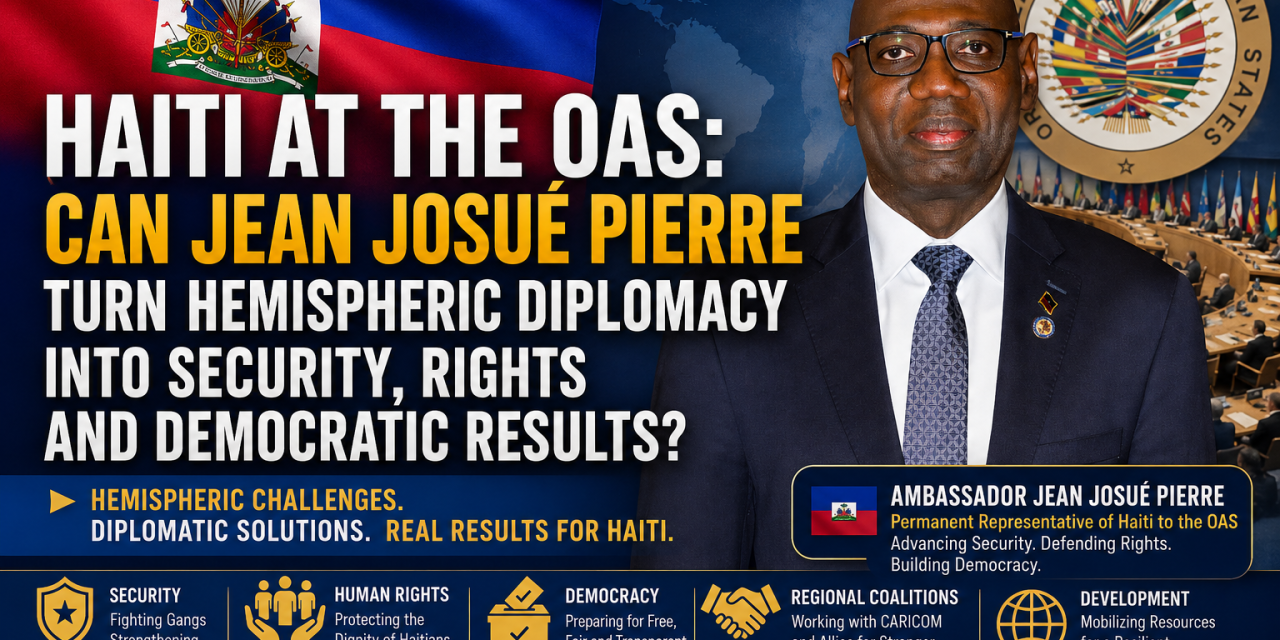
At the center of that mission today is Ambassador Jean Josué Pierre.
There is, however, an important discrepancy in Haiti’s own public records.
Haiti’s Ministry of Foreign Affairs website still identifies Pierre as “Représentant Permanent Adjoint” at the Mission permanente d’Haïti à l’OEA.
But the OAS itself records something more current:
Jean Josué Pierre has served as Haiti’s Ambassador and Permanent Representative to the OAS since January 21, 2026.
That distinction matters because he is no longer merely assisting Haiti’s representation.
He is now one of the officials directly responsible for defending Haiti’s interests before the inter-American system.
So the question is:
WHAT HAS HAITI ACTUALLY GAINED FROM HIS DIPLOMACY?
And can Pierre help introduce a more results-oriented foreign policy at a moment when Haitians increasingly question whether their diplomatic missions produce enough measurable benefits?
The evidence deserves examination.
👤 WHO IS JEAN JOSUÉ PIERRE?
Unlike a political newcomer suddenly placed into diplomacy, Pierre is described by the OAS as a career diplomat.
When he presented his credentials in January 2026, the OAS stated that he had served in France and Switzerland and had held senior positions within Haiti’s Ministry of Foreign Affairs.
His European diplomatic experience is independently documented.
The Embassy of Haiti in France lists Jean Josué Pierre Dahomey as Haiti’s ambassador in France from June 29, 2020 to June 24, 2024.
In September 2021, Switzerland’s Federal Department of Foreign Affairs confirmed that Pierre presented credentials to the Swiss Confederation as Haiti’s ambassador, while residing in Paris.
So his résumé establishes several relevant characteristics:
✔️ Long-term foreign-service experience
✔️ Ambassadorial experience
✔️ Bilateral diplomacy in Europe
✔️ Multilateral exposure
✔️ Senior-level experience inside Haiti’s foreign ministry
But diplomatic experience alone does not constitute diplomatic performance.
The real test begins with results.
🏛️ TAKING OVER AT A CRITICAL MOMENT
Pierre formally became Haiti’s Permanent Representative on January 21, 2026.
At his credential ceremony, he specifically identified four OAS principles as directly connected to Haiti’s national challenges:
democracy, human rights, integral development and multidimensional security.
That is significant because those four areas provide a measurable framework against which his mission can be evaluated.
Did Haiti’s representation obtain more security assistance?
Did it strengthen human-rights advocacy?
Did it accelerate election support?
Did it mobilize neighboring states?
Those are the questions that matter.
🛡️ SECURITY: SOME MOVEMENT, BUT WHO DELIVERED WHAT?
One of the clearest developments during Pierre’s current tenure concerns Haiti’s security relationship with the OAS.
In March 2026, Pierre participated in an OAS conference in Panama dedicated specifically to maritime and port security in Haiti.
The official program lists him alongside the OAS Secretary General, Canada and Panama at the opening of the two-day conference.
Then, on June 1, 2026, Pierre and his delegation held an official working meeting with the Inter-American Defense Board.
According to the Board, discussions focused on:
technical cooperation, defense and security advice, training, and specialized support for Haiti.
The Board subsequently reaffirmed its commitment to providing Haiti with technical advice, training and specialized assistance.
These are legitimate diplomatic activities.
But they raise the most important investigative question:
WHAT DID HAITI RECEIVE?
Training commitments are not the same as completed training.
Technical cooperation is not the same as equipment delivered.
Meetings are not the same as operational capacity.
The mission should therefore disclose:
How many Haitian police officers were trained?
What equipment was delivered?
What maritime-security systems were financed?
Which member states paid?
What was the dollar value?
Without those numbers, the public can verify engagement—but not yet fully measure impact.
🗺️ THE OAS HAITI ROADMAP: A MAJOR OPPORTUNITY
Pierre’s tenure also overlaps with one of the OAS’s largest recent attempts to coordinate international action on Haiti.
The organization currently operates a Haitian-led Roadmap for Stability and Peace with Regional and International Support.
The framework covers:
security
political consensus
democratic governance
elections
humanitarian assistance
economic resilience
human rights.
The Roadmap is explicitly designed to coordinate the OAS with CARICOM, the United Nations, the Inter-American Development Bank, PAHO, the Inter-American Defense Board and other partners.
Its scale is substantial.
For example, the published framework estimated approximately US$1.336 billion for security and more than US$104 million for electoral and institutional legitimacy initiatives.
By May 2026, OAS Secretary General Albert Ramdin reported progress in political facilitation, electoral preparation, security assistance and international coordination.
The OAS also stated in February that it was already providing technical and financial support to the Haitian National Police and the National Identification Office.
This creates an enormous performance question for Pierre.
How much of that assistance did Haiti’s Permanent Mission actively negotiate, accelerate or protect?
Because the Roadmap began in 2025—before Pierre formally became Permanent Representative—its existence cannot simply be attributed to him.
That distinction is essential.
The fair question is:
WHAT HAS HE DONE WITH THE ROADMAP SINCE TAKING OFFICE?
⚠️ DO NOT CONFUSE INSTITUTIONAL RESULTS WITH PERSONAL RESULTS
This distinction matters throughout any serious investigation.
The OAS Roadmap began in 2025.
Pierre became Permanent Representative in January 2026.
Likewise, several major OAS resolutions dealing with Haiti’s security, democratic transition, elections and human rights were adopted before his current mandate.
The Roadmap itself lists relevant OAS mandates dating from 2021 through 2025, including resolutions concerning security assistance, elections, democratic transition and a request for a UN peacekeeping operation.
Therefore:
Pierre should not receive automatic credit for initiatives created before his tenure.
But neither should his contribution to implementing them be ignored.
The legitimate measure is:
What changed after he took responsibility?
🗳️ DEMOCRACY AND ELECTIONS: THE OAS SAYS SUPPORT IS MOVING
The OAS has made electoral preparation one of its principal objectives in Haiti.
In February 2026, the organization announced that the transition period should focus on improved security and preparation for national elections.
It also confirmed technical and financial assistance involving the Haitian National Police and Haiti’s National Identification Office.
By May, the OAS Secretary General again reported progress on electoral preparation.
This could become one of the most consequential elements of Pierre’s mandate.
But once again, the public needs specifics.
What electoral technology has been secured?
What voter-registration assistance?
What cybersecurity support?
What training for election officials?
What funding?
What technical agreements?
What deadlines?
The difference between diplomatic activity and diplomatic accomplishment is implementation.
⚖️ HUMAN RIGHTS: A CORE OAS RESPONSIBILITY
Pierre himself identified human rights as one of the pillars connecting Haiti’s national crisis to the OAS mandate when presenting his credentials.
The OAS Roadmap also declares human-rights protection to be a cross-cutting priority.
That is important because the inter-American system gives Haiti access to institutions beyond conventional diplomacy—including the Inter-American Commission on Human Rights.
But the public record reviewed for this investigation does not clearly establish a comprehensive Pierre-era dashboard showing:
How many formal IACHR interventions Haiti’s mission initiated;
how many hearings it requested;
what monitoring mechanisms it negotiated for internally displaced Haitians;
or
what specific protections were secured for Haitian migrants abroad.
That does not establish inactivity.
It establishes an accountability gap.
And that gap should be filled with documentation.
🌎 HAITIAN MIGRANTS: WHERE IS THE HEMISPHERIC STRATEGY?
Perhaps one of the most politically sensitive tests for Haiti’s OAS mission concerns Haitian migrants across the Americas.
The OAS is composed of states receiving Haitian migrants throughout North America, the Caribbean, Central America and South America.
That should make the organization a logical platform for Haiti to raise concerns about:
due process
detention conditions
deportations
non-discrimination
family unity
documentation
and
regional migration coordination.
Yet the key performance question is not whether Haitian officials speak generally about migrant dignity.
It is whether the mission has built a diplomatic coalition capable of producing specific protections.
Which governments has Pierre approached?
Which OAS bodies have been activated?
What formal proposals have been submitted?
What protections have actually changed?
These are appropriate questions for public oversight.
🤝 CARICOM: HAITI SHOULD NOT FIGHT ALONE
One of the OAS Roadmap’s core features is direct coordination with the CARICOM Eminent Persons Group, alongside the United Nations and other inter-American institutions.
This makes Caribbean diplomacy particularly important.
Haiti is not merely another OAS member.
It is also a CARICOM state.
That gives its mission an opportunity to operate through regional voting alliances.
And OAS diplomacy often depends on exactly that kind of coalition.
The key question is therefore:
HOW EFFECTIVELY IS PIERRE USING THE CARIBBEAN BLOC?
Is Haiti coordinating draft language before Permanent Council meetings?
Does it hold regular strategy sessions with CARICOM ambassadors?
Are there unified voting positions on Haiti?
Do CARICOM states jointly lobby larger hemispheric powers?
Does Haiti maintain a written coalition strategy?
Those details should be publicly explainable without revealing confidential negotiations.
📊 WHAT CAN CURRENTLY BE VERIFIED?
From the public record reviewed for this investigation, several elements are documented.
✔️ Pierre is a career diplomat with prior ambassadorial service in France and Switzerland.
✔️ He became Haiti’s Permanent Representative to the OAS on January 21, 2026.
✔️ He has participated directly in OAS security initiatives concerning Haiti, including the March 2026 maritime-security conference.
✔️ He has engaged the Inter-American Defense Board regarding technical assistance, training and security cooperation.
✔️ His tenure overlaps with an OAS implementation phase involving police assistance, electoral preparation and broader Haiti Roadmap coordination.
But one major problem remains:
PUBLIC EVIDENCE OF DIPLOMATIC ACTIVITY IS EASIER TO FIND THAN A COMPLETE, QUANTIFIED RECORD OF WHAT THE MISSION ITSELF DELIVERED.
That is precisely why performance reporting matters.
📑 SEVEN QUESTIONS AMBASSADOR JEAN JOSUÉ PIERRE SHOULD ANSWER
I. SECURITY STABILIZATION
1️⃣ RESOLUTION DELIVERY
Which OAS Permanent Council resolutions, declarations or negotiated texts did Haiti’s mission directly draft, amend, co-sponsor or successfully lobby for under Pierre’s leadership?
Provide:
dates
member states involved
Haiti’s proposed language
final adopted language
and
what implementation resulted.
A resolution has value only if it changes conditions on the ground.
2️⃣ RESOURCE MOBILIZATION
Through the OAS Haiti Roadmap, security initiatives and cooperation with the Inter-American Defense Board:
How much financial assistance has been mobilized?
How many police officers were trained?
How much equipment was delivered?
What maritime or border-security assets were provided?
Which governments contributed?
What support reached Haiti after January 21, 2026?
The OAS says assistance is being provided.
Now Haiti’s mission should publish its contribution to obtaining it.
II. HUMAN RIGHTS AND MIGRANT ADVOCACY
3️⃣ IACHR COORDINATION
What direct actions has the mission undertaken with the Inter-American Commission on Human Rights regarding Haiti’s displacement and humanitarian emergency?
How many:
hearings?
formal submissions?
precautionary-measure requests?
monitoring missions?
technical consultations?
reports transmitted to Haitian authorities?
If the OAS is one of the hemisphere’s principal human-rights institutions, Haiti should be using every available mechanism.
4️⃣ REGIONAL MIGRANT PROTECTION
What has Haiti’s OAS mission done to defend Haitians facing migration enforcement across the hemisphere?
Has Pierre’s office proposed regional standards concerning:
due process before deportation,
protection of children and families,
detention conditions,
legal documentation,
anti-discrimination,
or
temporary humanitarian safeguards?
Which OAS member states supported those initiatives?
And what changed because of them?
III. DEMOCRATIC TRANSITION
5️⃣ ELECTORAL TECHNICAL ASSISTANCE
The OAS already confirms that electoral preparation is underway.
So publish the operational details.
What formal technical arrangements have been concluded between Haiti and OAS democracy institutions?
How much money has been committed?
What assistance has gone to:
the CEP?
voter registration?
electoral cybersecurity?
poll-worker training?
results transmission?
election observation?
Haiti does not need another statement supporting elections.
It needs an executable electoral system.
6️⃣ INSTITUTIONAL CAPACITY AND ANTI-CORRUPTION
Which OAS specialized agencies have been mobilized to strengthen Haitian institutions?
What training has been secured for:
judges?
prosecutors?
public administrators?
police investigators?
financial-crime units?
anti-corruption institutions?
How many beneficiaries?
How much funding?
What measurable institutional improvements?
IV. HEMISPHERIC COALITION BUILDING
7️⃣ CARICOM AND REGIONAL ALLIANCES
Finally:
How does Haiti coordinate its OAS diplomacy with CARICOM?
Does the mission maintain regular strategy meetings with Caribbean delegations?
Which Haiti-related resolutions have received coordinated CARICOM sponsorship?
Which Latin American states have joined those coalitions?
Which governments have made concrete security or financial commitments after Haitian lobbying?
And what mechanism ensures Haiti arrives at important OAS votes with a coalition already assembled?
Because diplomacy works differently when Haiti enters a room with 10 allies rather than one microphone.
⚠️ ONE MORE ACCOUNTABILITY QUESTION: HAITI’S OWN RECORDS
There is another issue that should not be overlooked.
As of the latest publicly indexed information reviewed here, Haiti’s Ministry of Foreign Affairs still describes Pierre as Deputy Permanent Representative, while the OAS identifies him as the Permanent Representative and Ambassador.
That may simply reflect an administrative update problem.
But diplomatic credibility also depends on accurate public records.
If Haiti wants modern foreign policy, even basic institutional information should be current.
🇭🇹 CAN JEAN JOSUÉ PIERRE BRING SOMETHING NEW?
The available evidence supports neither automatic praise nor automatic condemnation.
Pierre brings substantial diplomatic experience.
He has represented Haiti in major European capitals.
He entered the OAS at a moment when the organization is attempting a broad security, democratic and humanitarian response to Haiti’s crisis.
He has engaged directly in maritime-security and defense-cooperation discussions.
Those are relevant credentials and activities.
But the standard must be higher.
Haiti does not simply need diplomats who understand diplomacy.
It needs diplomats who can convert diplomacy into:
SECURITY ASSISTANCE.
POLICE CAPACITY.
ELECTORAL SUPPORT.
HUMAN-RIGHTS PROTECTION.
MIGRANT ADVOCACY.
REGIONAL COALITIONS.
MONEY.
EQUIPMENT.
TRAINING.
MEASURABLE RESULTS.
📢 THE NEW FOREIGN-POLICY TEST
Imagine if Haiti’s OAS mission published a quarterly dashboard showing:
💰 Funds mobilized
🚔 Police resources delivered
🎓 Officers and officials trained
⚖️ Human-rights interventions filed
🗳️ Electoral assistance secured
🤝 Member states committed
🌎 CARICOM initiatives coordinated
📜 Resolutions negotiated
👥 Haitian migrants assisted through regional mechanisms
That would allow citizens to evaluate diplomacy using evidence instead of personalities.
And that is the point of this investigation.
🔎 THE VERDICT BELONGS TO THE PEOPLE
Jean Josué Pierre has experience.
He holds a strategically important post.
He is operating at a moment when the OAS has placed Haiti near the center of its regional security and democratic agenda.
But Haiti’s foreign policy cannot be judged by diplomatic titles alone.
So instead of declaring his tenure a success or a failure:
PUBLISH THE PERFORMANCE REPORT.
Publish the commitments.
Publish the money.
Publish the assistance.
Publish the agreements.
Publish the outcomes.
Publish what existed before his mandate—and what he personally helped deliver after taking office.
Then—
🇭🇹 LET THE HAITIAN PEOPLE DECIDE.
Is Jean Josué Pierre helping transform Haiti’s OAS representation into a results-driven center of hemispheric diplomacy?
Or is Haiti still struggling to convert international solidarity into concrete national gains?
The evidence should decide.
#Haiti #JeanJosuePierre #OAS #OEA #HaitianDiplomacy #ForeignPolicy #Security #HumanRights #Migration #Elections #CARICOM #Accountability #Transparency #DiplomatieHaitienne #Investigation