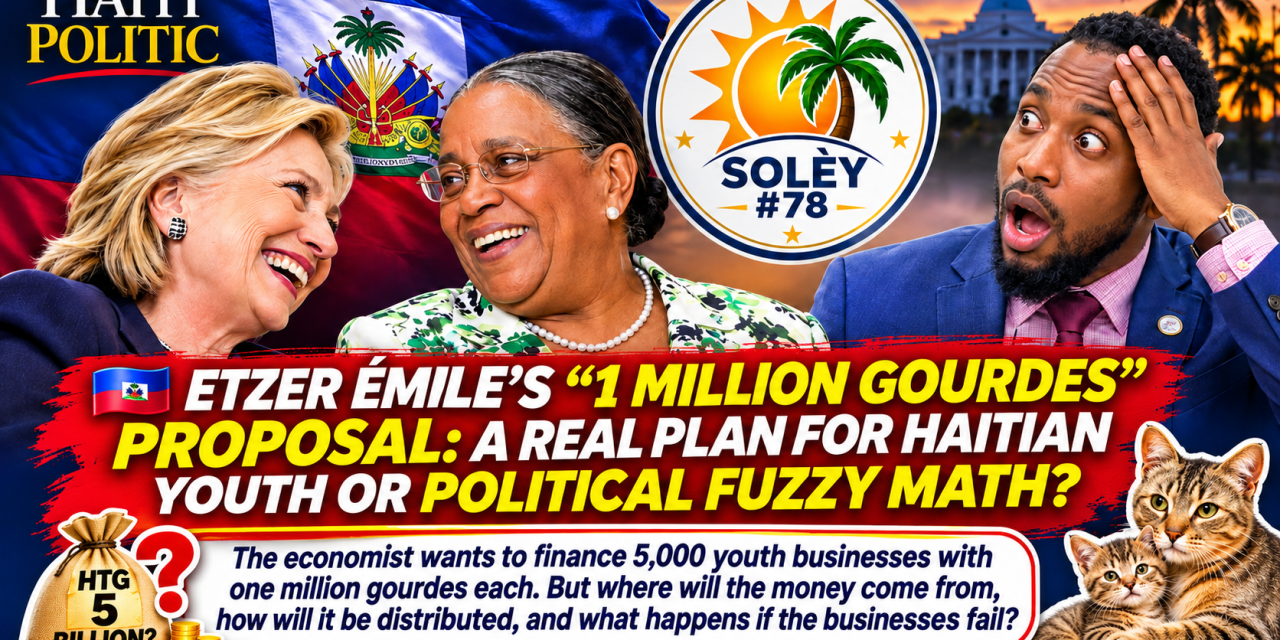
The economist wants to finance 5,000 youth businesses with one million gourdes each. But where will the money come from, how will it be distributed, and what happens if the businesses fail?
HAITI POLITIC — SPECIAL INVESTIGATION
Political & Economic Analysis | November 13, 2026
As economist and presidential applicant Etzer Émile promotes a proposal to finance thousands of young entrepreneurs, Haiti Politic examines the arithmetic, economic assumptions, political implications, and financial risks behind an initiative that could require billions of gourdes in public resources.
INTRODUCTION: FIVE THOUSAND DREAMS, FIVE BILLION GOURDES
Haiti’s young people have heard countless promises from politicians.
Promises of employment.
Promises of economic opportunity.
Promises of business financing.
Promises that the next government will finally recognize the country’s greatest untapped resource: its youth.
Now economist Etzer Émile, associated with the SOLÈY political platform and registered among Haiti’s presidential applicants, is presenting an idea that could attract considerable attention.
In a short video discussing employment and youth entrepreneurship, Émile proposes financing approximately 5,000 projects led by young Haitians, with each receiving one million Haitian gourdes.
His underlying argument is that investing public money in young entrepreneurs could stimulate economic activity, create opportunities, and eventually generate additional tax revenue.
It is an appealing proposition.
But it raises an immediate question.
Is Émile presenting a financially viable national entrepreneurship program, or an attractive political promise whose economic details remain unexplained?
The distinction matters.
Because 5,000 projects multiplied by one million gourdes does not produce a small government expenditure.
It produces a proposed investment of five billion Haitian gourdes.
And that is before administrative expenses, technical assistance, financial monitoring, and potential losses are considered.
Haiti Politic examined the proposal to determine what the numbers actually mean—and what Émile would need to explain before the idea could be evaluated as a serious national economic policy.
PART I — WHAT ETZER ÉMILE ACTUALLY SAID
1. A MESSAGE DIRECTED AT HAITI’S YOUNG PEOPLE
In the video, Émile discusses the importance of youth employment and entrepreneurship.
He proposes using public resources to finance thousands of projects.
He also argues that such investments could generate additional economic activity and tax revenue over the medium term.
His message contains three important ideas.
First, young people need access to capital.
Many aspiring entrepreneurs lack the financing necessary to establish a business.
Even when they have viable ideas, they may struggle to purchase equipment, acquire inventory, rent commercial space, or finance their initial operations.
Second, government spending should support productive economic activity.
Émile appears to be arguing that the state should invest in businesses capable of generating economic returns rather than focusing exclusively on short-term expenditures.
Third, youth entrepreneurship could help expand Haiti’s economy.
If new businesses survive and grow, they may create employment, generate household income, purchase goods from suppliers, and contribute to government revenue.
These are legitimate economic objectives.
However, the approximately 35-second excerpt does not establish that Émile has presented a complete financing plan.
It does not identify a funding source, beneficiary-selection process, repayment structure, projected business survival rate, or independently calculated economic return.
There is also an important limitation concerning the recording.
The accompanying automated transcript contains apparent recognition errors in the budget figures. It is therefore necessary to distinguish the clear numerical implication of the proposal from the exact words Émile used.
The arithmetic is clear: 5,000 projects receiving one million gourdes each would require five billion gourdes.
But the available transcript alone does not justify accusing Émile of making an elementary multiplication error.
The more important issue is whether the proposal has been subjected to a complete financial analysis.
PART II — THE FIVE-BILLION-GOURDE QUESTION
2. THE MATHEMATICS BEHIND THE PROMISE
Let us examine the proposal.
| Financial component | Amount |
|---|---|
| Proposed youth projects | 5,000 |
| Financing per project | HTG 1,000,000 |
| Total direct financing | HTG 5,000,000,000 |
| Total expressed in billions | HTG 5 billion |
The calculation is straightforward.
5,000 × 1,000,000 = 5,000,000,000 gourdes.
Five billion gourdes.
But this represents only the amount distributed to entrepreneurs.
A functioning national program would also require administrative infrastructure.
Applications would need to be reviewed.
Business plans would need to be evaluated.
Funds would need to be transferred securely.
Beneficiaries would need financial training.
Projects would need to be monitored.
Auditors would need to verify expenditures.
And the government would need mechanisms to detect fraud, political favoritism, and misuse of public funds.
Consider a hypothetical budget.
| Program component | Illustrative cost |
|---|---|
| Direct business financing | HTG 5 billion |
| Administration and financial monitoring | HTG 250 million |
| Entrepreneurship training and technical assistance | HTG 250 million |
| Total illustrative program cost | HTG 5.5 billion |
The additional costs are illustrative assumptions, not figures announced by Émile.
The actual amount would depend on the program’s design.
Nevertheless, the example demonstrates an important principle.
The cost of distributing money is not necessarily the full cost of operating a government-financed entrepreneurship program.
A serious proposal must account for both.
PART III — WHERE WILL THE MONEY COME FROM?
3. THE MISSING FINANCING STRATEGY
Émile proposes using resources from Haiti’s national budget.
But which resources?
Would five billion gourdes come from existing appropriations?
Would the government reduce other expenditures?
Would the program be financed through domestic borrowing?
Would international donors contribute?
Would the government establish a dedicated investment fund?
Or would new taxes be introduced?
These are not minor technical questions.
They determine whether the proposal is financially sustainable.
Option A: Reallocate existing public spending
The government could redirect resources from another budget category.
But this would require identifying which expenditures would be reduced.
Would the money come from public administration?
Infrastructure?
Agriculture?
Education?
Health?
Or existing economic-development programs?
Every reallocation involves trade-offs.
Option B: Borrow the money
The government could borrow to finance the initiative.
However, borrowing creates repayment obligations and may increase fiscal pressure.
The financing terms would matter.
Option C: Seek international assistance
Foreign development partners could potentially support entrepreneurship programs.
But donor financing may be temporary, conditional, or tied to specific implementation requirements.
A program dependent on external assistance could face sustainability problems if funding ends.
Option D: Establish a revolving investment fund
If beneficiaries receive repayable loans rather than grants, repayments could finance future entrepreneurs.
But such a model would require loan administration, collection procedures, default management, and safeguards against political interference.
Without a defined financing source, Émile’s five-billion-gourde proposal remains a policy concept rather than a funded government program.
PART IV — IS ONE MILLION GOURDES ENOUGH TO BUILD A SUCCESSFUL BUSINESS?
4. THE DIFFERENCE BETWEEN STARTUP CAPITAL AND BUSINESS VIABILITY
One million gourdes could help launch certain small businesses.
It might finance agricultural equipment, a small retail operation, food processing, transportation services, or other entrepreneurial activities.
But the amount required depends on the business.
A small agricultural project may face land, irrigation, storage, and transportation costs.
A manufacturing business may require machinery, electricity, imported materials, and technical expertise.
A retail operation may need inventory, security, storage, and reliable access to customers.
A technology business may require specialized equipment, connectivity, and skilled personnel.
Consequently, distributing exactly one million gourdes to every project may not be economically efficient.
Some businesses may need substantially less.
Others may need more.
The central question
Why one million gourdes per project?
Was the amount determined through market research?
Was it based on an assessment of startup costs in Haiti?
Was it derived from previous entrepreneurship programs?
Or was it selected because it is an attractive and memorable figure?
A credible program should explain how financing amounts would be matched to actual business needs.
PART V — WHAT HAPPENS WHEN BUSINESSES FAIL?
5. THE FINANCIAL RISK NOBODY SHOULD IGNORE
Entrepreneurship is inherently risky.
Businesses can fail even when their owners are hardworking, honest, and competent.
Market demand may be insufficient.
Operating costs may rise.
Suppliers may become unreliable.
Customers may lack purchasing power.
Security conditions may deteriorate.
Inflation may reduce the value of working capital.
And entrepreneurs may encounter circumstances beyond their control.
Suppose the government finances 5,000 businesses.
Consider three hypothetical scenarios.
| Scenario | Businesses remaining operational | Businesses closed |
|---|---|---|
| High survival | 4,000 | 1,000 |
| Moderate survival | 3,000 | 2,000 |
| Low survival | 2,000 | 3,000 |
These are illustrative scenarios, not predictions of actual business survival rates in Haiti.
The economic consequences would depend on the financing model.
If the money is distributed as grants, the government generally would not expect repayment.
If it is distributed as loans, defaults could create losses.
If the government takes equity stakes, the financial outcome would depend on the value and profitability of the businesses.
Even a failed business may have generated temporary employment or other economic benefits.
But the program still requires a method for measuring performance and managing risk.
Questions Émile must answer
Would beneficiaries repay the money?
Would there be interest?
Would collateral be required?
Would entrepreneurs receive technical assistance?
What happens if a business closes after six months?
Who determines whether funds were misused?
Would beneficiaries be personally liable for losses?
Would the government publish annual performance reports?
A government cannot responsibly commit billions of gourdes without defining what happens when financed projects do not succeed.
PART VI — THE TAX-REVENUE ARGUMENT
6. CAN FIVE BILLION GOURDES IN PUBLIC FINANCING GENERATE MORE THAN FIVE BILLION GOURDES IN TAXES?
Émile suggests that supporting youth businesses could produce additional tax revenue.
The principle is economically plausible.
Successful businesses may generate taxable profits, wages, transactions, and other economic activity.
But the relationship between investment and government revenue is not automatic.
A business receiving one million gourdes does not automatically generate one million gourdes in taxes.
Likewise, one million gourdes in annual sales is not equivalent to one million gourdes in profit.
And profit is not equivalent to tax revenue.
An illustrative calculation
Suppose the 5,000 financed businesses collectively generate an additional 250 million gourdes in government tax revenue each year.
At that rate, it would take 20 years for cumulative additional tax revenue to equal the original five-billion-gourde financing amount.
If annual additional tax revenue reached 500 million gourdes, the period would be 10 years.
If it reached one billion gourdes annually, it would be five years.
| Additional annual tax revenue | Simple period to equal HTG 5 billion |
|---|---|
| HTG 100 million | 50 years |
| HTG 250 million | 20 years |
| HTG 500 million | 10 years |
| HTG 1 billion | 5 years |
These figures are hypothetical.
They are not projections attributed to Émile.
They also exclude administrative costs, inflation, discounting, changing business performance, and other fiscal effects.
Moreover, a public investment does not necessarily need to repay its entire cost through taxes alone to generate social value.
Employment, skills development, reduced poverty, and increased domestic production may also matter.
Nevertheless, if Émile argues that the program could generate substantial tax returns, he should publish the assumptions supporting that claim.
How much new economic activity would the businesses produce?
What share would be taxable?
How much additional revenue would the government actually collect?
And over what period?
Without those answers, the tax-revenue argument remains a hypothesis.
PART VII — FIVE THOUSAND BUSINESSES DO NOT AUTOMATICALLY MEAN FIVE THOUSAND SUSTAINABLE JOBS
7. THE JOB-CREATION QUESTION
One of the most attractive features of Émile’s proposal is its potential to create employment.
But how many jobs would it actually create?
Suppose every financed business creates two additional paid positions.
That would produce a theoretical total of 10,000 jobs.
If each business creates four additional positions, the total would reach 20,000.
| Additional paid jobs per business | Potential jobs across 5,000 businesses |
|---|---|
| 1 | 5,000 |
| 2 | 10,000 |
| 3 | 15,000 |
| 4 | 20,000 |
These figures assume all 5,000 businesses become operational and maintain the specified employment levels.
They are not employment forecasts.
The government would also need to distinguish between newly created jobs and existing informal activities that simply receive financing.
For example, providing capital to an already operating business does not necessarily create a new job.
A proper evaluation would measure additional employment attributable to the program.
It would also examine wages, working conditions, business survival, and productivity.
Financing 5,000 projects is an output. Creating sustainable employment is an outcome.
The two should not be confused.
PART VIII — WHO GETS THE MONEY?
8. THE POLITICAL PATRONAGE RISK
Perhaps the most sensitive question concerns beneficiary selection.
Who would choose the 5,000 entrepreneurs?
Would the government establish an independent application process?
Would projects be evaluated by qualified business professionals?
Would financing be distributed geographically?
Would rural entrepreneurs have the same opportunities as applicants in Port-au-Prince?
Would women receive equitable access?
Would applicants need political connections?
Would members of the governing party receive preferential treatment?
These questions matter because a poorly designed public financing program could become vulnerable to favoritism.
Imagine a government distributing one million gourdes to thousands of applicants without transparent criteria.
Political intermediaries might attempt to influence the selection process.
Local officials might recommend supporters.
Applicants could feel pressured to demonstrate political loyalty.
And the public might have difficulty distinguishing legitimate business financing from political rewards.
This is a foreseeable governance risk, not evidence that Émile intends to create such a system.
A credible proposal would include independent selection committees, published eligibility criteria, conflict-of-interest rules, financial audits, and a transparent appeals process.
The government should also disclose aggregate information about where funds are distributed and what results are achieved.
PART IX — CAN HAITI’S BUSINESS ENVIRONMENT SUPPORT THE PROGRAM?
9. MONEY ALONE CANNOT SOLVE STRUCTURAL ECONOMIC PROBLEMS
Haiti’s economic difficulties extend beyond access to financing.
Businesses also depend on functioning markets and institutions.
Consider a young entrepreneur who receives one million gourdes to establish a food-distribution business.
The entrepreneur may purchase equipment and inventory.
But what happens if armed groups disrupt transportation routes?
What happens if merchandise cannot reach customers?
What happens if fuel prices increase sharply?
What happens if the business cannot obtain electricity?
What happens if suppliers close?
What happens if customers cannot afford the products?
These are real economic constraints.
A financing program that ignores them could place young entrepreneurs at considerable risk.
What should accompany youth financing?
A serious national strategy would need to address security, infrastructure, market access, business registration, financial services, technical training, and reliable supply chains.
It would also need to consider whether financing should be concentrated in sectors capable of increasing domestic production.
For example, agriculture and food processing could potentially strengthen local supply chains.
Manufacturing could support domestic production.
Technology services could create opportunities for skilled workers.
But sector selection should be based on evidence of demand and economic feasibility.
Haiti does not merely need more businesses registered on paper. It needs businesses capable of surviving and competing.
PART X — WHAT DOES THE PROPOSAL MEAN POLITICALLY?
10. ETZER ÉMILE, SOLÈY, AND THE YOUTH VOTE
Émile is not simply an economist discussing public policy in isolation.
He is also a presidential applicant associated with the SOLÈY political platform.
That political context matters.
Young Haitians face substantial barriers to employment, entrepreneurship, and financial independence.
A proposal offering one million gourdes in financing for thousands of youth projects is likely to attract attention.
It communicates a message of opportunity.
It suggests that government resources could be redirected toward young people rather than concentrated in traditional political and administrative structures.
And it allows Émile to present himself as a candidate with an economic response to youth unemployment.
But electoral appeal is not evidence of economic viability.
Is this a political promise?
The proposal has clear political relevance.
However, the short video does not establish whether it is part of a formally published campaign platform, an illustrative policy argument, or a detailed government program.
That distinction should be clarified by Émile himself.
Is it political fuzzy math?
The phrase fuzzy math is appropriate as a question about incomplete financial assumptions.
It should not be used to assert that Émile cannot multiply 5,000 by one million.
The available transcript is imperfect, and the proposal’s most significant weakness is not necessarily arithmetic.
It is the absence, in the excerpt, of a demonstrated financing structure, implementation plan, and measurable economic projections.
An economist seeking public office should be prepared to provide those details.
PART XI — WHAT WOULD A SERIOUS PROGRAM LOOK LIKE?
11. FROM POLITICAL PROMISE TO ECONOMIC POLICY
Émile’s idea could be developed into a more credible policy through several measures.
First: Establish a pilot program
Rather than immediately financing 5,000 businesses, the government could begin with a smaller group.
For example, a pilot involving 100 projects at one million gourdes each would require 100 million gourdes in direct financing.
The pilot could test application procedures, training methods, business survival, and monitoring systems.
Second: Match financing to business needs
Not every business requires the same amount of capital.
Financing could be determined through independently evaluated business plans.
Third: Establish clear financing categories
Some applicants might qualify for small grants.
Others might receive repayable loans.
More established businesses could potentially receive investment financing.
The terms should be transparent.
Fourth: Provide technical support
Entrepreneurs need more than money.
They may need accounting training, marketing assistance, legal guidance, procurement support, and help accessing markets.
Fifth: Publish measurable results
The government should report how many projects were financed, how many remain operational, how many jobs were created, and what economic activity resulted.
Sixth: Protect the program from political interference
Independent administration and external audits would help reduce the risk of favoritism.
These measures would not guarantee success.
But they would make the proposal more testable, transparent, and accountable.
PART XII — FIFTEEN QUESTIONS FOR ETZER ÉMILE
Haiti Politic believes the proposal deserves a direct public explanation from Émile.
1. THE TOTAL COST
Can you confirm that financing 5,000 projects at one million gourdes each would require five billion gourdes in direct funding?
2. THE NATIONAL BUDGET
Which specific budget allocations would finance the program?
3. THE FINANCING SOURCE
Would the money come from taxes, spending reductions, borrowing, international assistance, or another source?
4. GRANTS OR LOANS?
Would the one million gourdes be a grant, a repayable loan, or an investment?
5. BENEFICIARY SELECTION
Who would select the 5,000 young entrepreneurs?
6. POLITICAL INDEPENDENCE
How would you prevent political parties and government officials from influencing beneficiary selection?
7. BUSINESS FEASIBILITY
Would applicants need to submit independently evaluated business plans?
8. THE ONE-MILLION-GOURDE FIGURE
What economic research supports providing the same amount to every project?
9. BUSINESS FAILURE
What failure rate have you assumed in your calculations?
10. FINANCIAL LOSSES
Who would absorb the losses if financed businesses fail?
11. JOB CREATION
How many permanent jobs do you expect the program to create?
12. TAX REVENUE
How much additional annual tax revenue do you project, and what assumptions support that projection?
13. SECURITY
How would entrepreneurs operate in areas affected by armed groups and disrupted transportation routes?
14. INDEPENDENT AUDITS
Would you commit to publishing regular independent audits and performance evaluations?
15. THE PILOT TEST
Would you support launching a smaller pilot before committing five billion gourdes to a nationwide program?
These are not questions intended to dismiss youth entrepreneurship.
They are questions necessary to evaluate whether the proposal can achieve its stated objectives.
PART XIII — THE BIGGER QUESTION: WHAT DO HAITIAN YOUTH REALLY NEED?
Haitian youth need access to opportunity.
But opportunity requires more than an announcement of available financing.
Young people need security.
They need functioning schools and vocational training.
They need reliable infrastructure.
They need access to markets.
They need institutions capable of enforcing contracts and protecting property.
They need a financial system that can support productive investment.
And they need public programs that are administered fairly.
A government that finances entrepreneurship while failing to address these underlying conditions risks producing disappointing results.
At the same time, rejecting entrepreneurship financing altogether would ignore a genuine barrier faced by many young Haitians.
The appropriate response is not to dismiss the idea.
It is to demand a credible design.
The question is not whether Haiti should invest in young entrepreneurs.
The question is how to invest in them effectively, fairly, and sustainably.
CONCLUSION — FIVE BILLION GOURDES IS A NUMBER. ECONOMIC DEVELOPMENT REQUIRES A PLAN.
Etzer Émile’s proposal addresses a legitimate national priority.
Young Haitians need productive opportunities.
Entrepreneurship can contribute to job creation, household income, domestic production, and economic growth.
But financing 5,000 projects with one million gourdes each would require five billion gourdes in direct public financing.
A serious national program would also require administrative capacity, financial safeguards, technical assistance, and a strategy for managing business failures.
The proposal’s potential economic benefits should not be dismissed.
Nor should they be assumed.
Émile’s suggestion that entrepreneurship financing could generate additional tax revenue is plausible in principle.
But the video does not demonstrate how much revenue would be generated, how quickly it would materialize, or whether it would justify the program’s fiscal cost.
His political status makes these questions particularly important.
An economist seeking the presidency should be able to explain not only what a government ought to finance, but how the financing would work.
HAITI POLITIC’S CENTRAL QUESTION
Is Etzer Émile offering Haitian youth a carefully designed economic-development strategy—or a politically attractive financing proposal that has not yet been supported by a complete budget, risk assessment, and implementation plan?
The answer should come from a published policy document containing verifiable financial assumptions.
Until then, the proposal remains an idea worth examining rather than a demonstrated economic solution.
Haitian youth deserve more than promises of one million gourdes. They deserve functioning institutions, fair access to financing, and economic opportunities that can survive beyond an election campaign.
And taxpayers deserve to know how every gourde of public money would be spent.
Five thousand projects. One million gourdes each. Five billion gourdes in direct financing.
The arithmetic is straightforward. The economic challenge is much greater.
SOURCE AND EDITORIAL DISCLOSURE
Primary source: Video excerpt featuring Etzer Émile discussing youth employment, entrepreneurship, and financing 5,000 projects at one million gourdes each.
Financial calculations: Haiti Politic analysis based on the amounts described in the excerpt.
Illustrative scenarios: Administrative costs, business survival rates, employment projections, and tax-revenue calculations are hypothetical examples used to explain financial risks. They are not figures attributed to Émile.
Verification limitation: The accompanying automated transcript contains apparent recognition errors. The precise wording of Émile’s budget statement should be verified against the original audio before claiming he made a mathematical mistake.
Political context: Émile’s registration as a presidential applicant does not establish that the CEP has approved his candidacy.
Editorial position: This analysis does not allege fraud, corruption, intentional deception, or misuse of public funds. It examines the financial and administrative questions raised by a publicly discussed policy proposal.
© 2026 HAITI POLITIC — SPECIAL INVESTIGATION