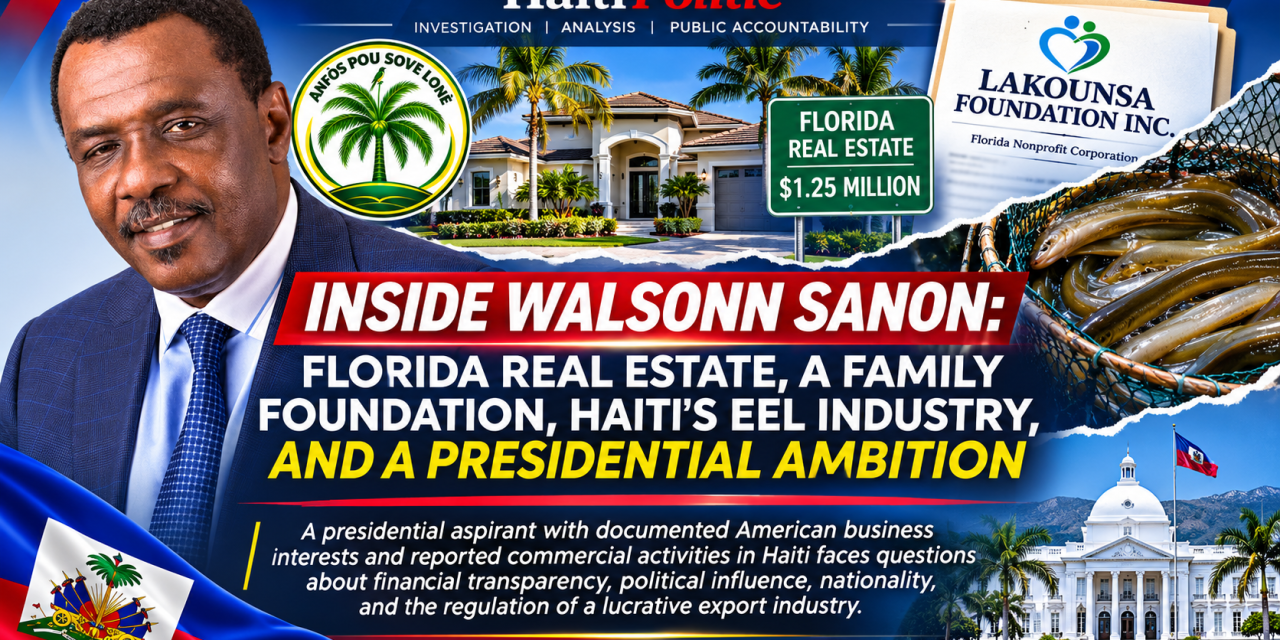
A presidential aspirant with documented American business interests and reported commercial activities in Haiti faces questions about financial transparency, political influence, nationality, and the regulation of a lucrative export industry.
HAITI POLITIC — SPECIAL INVESTIGATION
November 13, 2026
INTRODUCTION: WHO IS WALSONN SANON?
As Haiti prepares for another electoral process amid political instability, armed violence, economic hardship, and declining public confidence in government institutions, businessman and political organizer Walsonn Sanon is seeking a place in the country’s presidential contest.
Sanon has emerged under the banner of ANFÒS POU SOVE LONÈ, a political grouping that designated him as its presidential representative in September 2026.
According to a September 14 report by RL News Haiti, the political organization underwent a leadership restructuring following an August 31 assembly. Former government commissioner Bedford Claude assumed leadership, while Sanon received the grouping’s presidential nomination.
The report described an internal selection process in which Sanon prevailed over Serge Pierre Louis.
By November 7, 2026, his name appeared in publicly tracked presidential registration information associated with Haiti’s Provisional Electoral Council (CEP).
However, an important distinction remains: registration is not the same as final qualification.
The CEP must still determine which aspirants satisfy the applicable legal requirements.
Sanon’s emergence invites a broader examination of his background.
Who is the businessman seeking Haiti’s highest office?
What commercial activities connect him to Haiti’s agricultural sector?
What financial and corporate interests does his family maintain in the United States?
And what do the available records reveal—or fail to reveal—about his involvement in Haiti’s controversial eel-export industry?
Haiti Politic examined these questions using Florida corporate filings, previously reviewed real estate documents, public reporting, and statements from organizations seeking judicial investigations.
The findings establish several important connections.
They also expose substantial gaps in the public record.
PART I — THE POLITICAL NETWORK: ANFÒS AND THE PRESIDENTIAL CAMPAIGN
Walsonn Sanon is not entering politics as a complete newcomer.
Public reporting has associated him with political organizing and opposition movements over several years.
His latest political vehicle, ANFÒS POU SOVE LONÈ, has presented him as a presidential aspirant for Haiti’s forthcoming elections.
The September 2026 leadership reorganization is significant.
According to RL News Haiti, Bedford Claude became the organization’s leader while Sanon secured its presidential nomination.
This creates a political partnership worth examining through official records.
What responsibilities does Bedford Claude exercise within ANFÒS?
Who finances the organization’s political activities?
Which political parties constitute the grouping?
And what financial disclosures, if any, have been submitted concerning the campaign?
These are ordinary accountability questions for any organization seeking control of the Haitian presidency.
The electoral authorities must ultimately determine whether Sanon meets the constitutional and statutory requirements for presidential office.
Until then, his status should be described as a presidential aspirant or registered applicant, rather than an officially approved candidate.
PART II — THE FLORIDA PROPERTY: A $1.25 MILLION REAL ESTATE TRANSACTION
One of the clearest financial findings concerns real estate in South Florida.
A previously examined Florida property transaction report identifies Walsonn Sanon and Betty Andresol as purchasers of a residential property in Miramar, Broward County, in March 2022.
The transaction information identifies the buyers as husband and wife.
The reported purchase price was approximately:
$1,250,000
The original mortgage was approximately:
$908,800
The difference between the purchase price and mortgage principal was approximately $341,200.
That difference does not necessarily represent the purchasers’ exact cash contribution because closing costs, credits, other financing, and transaction adjustments may affect the final amount.
Nevertheless, the transaction establishes a substantial American real estate acquisition.
What the property record proves
The record establishes that the named purchasers acquired the property in 2022.
It does not establish their citizenship, immigration status, current ownership, net worth, or source of funds.
Nor does it establish that the transaction involved any improper activity.
The purchase nevertheless raises legitimate financial-disclosure questions for a presidential aspirant.
Did Sanon purchase the property using personal business earnings?
Was the property financed through income generated in Haiti, the United States, or elsewhere?
Does he continue to own the property?
And will he disclose his foreign assets as part of the applicable electoral process?
These questions require updated property records, mortgage documents, and disclosures—not speculation.
PART III — LAKOUNSA FOUNDATION: THE FLORIDA NONPROFIT
The Florida investigation also identified a nonprofit corporation connected to Sanon and members of his family.
LAKOUNSA FOUNDATION INC.
According to the Florida Department of State’s Division of Corporations, the organization was incorporated on June 19, 2023.
Its official corporate registration number is:
N23000007374
The Florida corporate record lists the following officers:
| Position | Individual |
|---|---|
| President | Walsonn Sanon |
| Vice President | Betty Lamy Sanon |
| Secretary | Widginie O. Sanon |
| Registered agent | Walsonn Sanon |
The organization is listed as active in the Florida corporate registry.
Its federal employer identification number is recorded as 39-4336420.
A corporate compliance interruption
The foundation’s filing history includes an administrative dissolution in September 2024, followed by reinstatement on July 26, 2025.
Its annual-report history includes filings for 2024, 2025, and 2026.
An administrative dissolution for failure to submit an annual report is a corporate compliance matter. It is not, by itself, evidence of fraud, misuse of charitable funds, or criminal wrongdoing.
The reinstatement restored the organization’s active corporate status.
What does Lakounsa Foundation actually do?
This is where the public record becomes less informative.
Florida’s corporate registration establishes the foundation’s legal existence and officers.
It does not explain its complete operational history.
The records examined do not establish:
-
Whether the foundation has received IRS recognition under Section 501(c)(3).
-
Its annual revenue or expenditures.
-
Whether it has received charitable donations or government grants.
-
Whether it operates programs in Haiti.
-
Whether it has funded agricultural, educational, or humanitarian initiatives.
-
Whether it has any financial relationship with Sanon’s Haitian commercial activities.
These questions require IRS records, organizational financial statements, grant disclosures, and information from the foundation itself.
A Florida nonprofit registration is not proof that an organization is federally recognized as a tax-exempt charity.
The IRS reporting question
Haiti Politic has not independently verified a publicly available federal Form 990-series filing or IRS determination letter for Lakounsa Foundation.
That finding should not be interpreted as proof that the organization failed to comply with federal tax requirements.
Different filing obligations apply depending on an organization’s tax classification, revenue, assets, and exemption status.
A definitive investigation would require an exact EIN search through the IRS and, where appropriate, a request for publicly disclosable organizational returns.
For an organization led by a presidential aspirant, voluntary disclosure of its activities and funding would help answer questions about its mission and financial operations.
PART IV — BETTY LAMY SANON: THE BUSINESSWOMAN CONNECTED TO HAITI’S EEL INDUSTRY
Betty Lamy Sanon is an important figure in this investigation.
Her name appears in Florida corporate records as Lakounsa Foundation’s vice president.
She is also associated with commercial activities in Haiti’s eel industry.
In November 2025, RL News Haiti reported that Betty Lamy publicly described approximately 13 years of involvement in eel-related commercial operations.
She maintained that her activities complied with the regulatory requirements of Haiti’s Ministry of Agriculture.
That statement provides a basis for investigating the businesses and permits associated with her commercial operations.
However, the precise legal name of her Haitian enterprise, its ownership structure, and the licenses it holds have not been independently established through original government documents.
The New York business connection
A previously examined commercial people-search report also associated Betty Lamy with a business identified as GR Multiple Services, reportedly connected to Baldwin, New York, beginning around July 2009.
This remains an unconfirmed business association.
No corresponding official New York corporate registration or county business certificate has been independently verified.
The report does not establish that she currently owns the business.
Nor does it demonstrate a financial relationship between GR Multiple Services, Lakounsa Foundation, and any Haitian company.
The next investigative step would be to obtain the relevant New York business-registration records.
PART V — HAITI’S EEL INDUSTRY: WHY THE BUSINESS MATTERS
Haiti’s eel industry has become a significant subject of public controversy because of the international value of juvenile eels, commonly called glass eels or elvers.
These young eels are collected and sold into international supply chains serving aquaculture markets.
Their commercial value can increase dramatically between the point of collection and the international market.
A 2026 United Nations Panel of Experts report examined smuggling methods, licensing problems, and regional trading networks involving Haitian elvers.
The report described situations in which traders operating across Caribbean waters offered Haitian fishermen higher prices than local buyers.
It also examined attempts to move eels through neighboring jurisdictions when exporters lacked authorization.
These findings establish that Haiti’s eel sector faces documented regulatory and trafficking vulnerabilities.
They do not establish that every participant in the industry is involved in illicit activity.
Nor do they establish that Walsonn Sanon or Betty Lamy committed any offense.
Who controls the licenses?
For Haiti Politic, the central administrative questions concern the issuance and oversight of export authorizations.
Which companies have been authorized to exploit or export eels?
Who owns those companies?
What fees do they pay?
How are export quantities recorded?
Which government officials approve the licenses?
And how are regulatory decisions protected from political interference?
Those questions should be answered through original records from the Ministry of Agriculture, Ministry of Commerce, customs authorities, and other responsible agencies.
PART VI — THE ALLEGATIONS: WHAT RHAJAC CLAIMS AND WHAT REMAINS UNPROVEN
On November 12, 2025, the Réseau Haïtien des Journalistes Anti-Corruption (RHAJAC) issued a statement calling for the suspension of eel exploitation and export licenses associated with Betty Lamy, Walsonn Sanon, and Fritz Richardson while an investigation proceeded.
On November 9, 2026, the organization issued another statement alleging possible corruption and other criminal conduct involving individuals connected to the sector.
The organization also alleged that payments had been promised in connection with efforts to influence control of Haiti’s eel industry.
These are serious accusations.
They are not established judicial findings.
Haiti Politic has not obtained authenticated bank records, export documents, criminal judgments, or final judicial findings proving the allegations against Sanon or Lamy.
The organization’s statements must therefore be understood as allegations and requests for investigation.
Sanon and Lamy have challenged accusations against them
Their response is an essential part of the public record.
On November 11, 2025, RL News Haiti reported that Walsonn Sanon and Betty Lamy pursued a defamation complaint against attorney Caleb Jean Baptiste.
According to that report, they rejected accusations involving illicit organ-related activities and characterized the allegations as damaging and unfounded.
Betty Lamy maintained that her eel-related commercial activities complied with Haitian regulations.
The existence of competing accusations and denials underscores the importance of obtaining the underlying judicial records.
The public deserves to know whether an investigating judge has issued a ruling, whether charges have been filed, and what evidence supports any official action.
Until such records are established, allegations must not be presented as proven criminal conduct.
PART VII — THE MINISTRY OF AGRICULTURE AND THE QUESTION OF POLITICAL INFLUENCE
Sanon’s reported agricultural interests and his family’s commercial association with the eel industry make Haiti’s Ministry of Agriculture particularly relevant to this investigation.
The ministry plays an important role in regulating agricultural production, fisheries, and associated commercial activities.
Public allegations have raised questions about political influence over licensing decisions.
Separate political claims have also suggested that Sanon played a role in recommending individuals for government positions.
However, Haiti Politic has not obtained official appointment correspondence, government memoranda, or other documentary evidence establishing that Sanon determined or controlled a ministerial appointment.
That distinction matters.
Political advocacy is not automatically improper.
Business ownership is not automatically a conflict of interest.
But conflicts can arise when a public official or political intermediary participates in decisions affecting enterprises in which that person has a financial interest.
A credible investigation would therefore examine the chronology of government appointments, license approvals, ownership records, and any documented communications between applicants and decision-makers.
The rice-production controversy
Sanon has also been associated with public claims concerning international agreements and Haiti’s rice production.
One reported assertion suggested that Haiti had entered agreements restricting domestic rice production.
Haiti Politic has not identified an authenticated agreement requiring Haiti to stop producing rice.
The long-term effects of trade liberalization, agricultural imports, and foreign economic policy on Haitian rice farmers are legitimate subjects for investigation.
But those broader economic concerns should not be confused with proof of a specific agreement prohibiting rice cultivation.
Any such claim requires the original agreement, its signatories, and its operative provisions.
PART VIII — DOES WALSONN SANON OWN PROPERTY OR BUSINESSES IN HAITI?
Sanon has been publicly associated with agricultural operations in northern Haiti, including the Milot area.
Betty Lamy has publicly described longstanding commercial activity involving eels.
These connections warrant further examination.
However, the records reviewed do not establish the precise ownership of Haitian agricultural land, commercial buildings, export facilities, or other properties.
No authenticated Haitian land deed has been obtained establishing the acreage or ownership of a particular agricultural operation.
Similarly, the investigation has not obtained complete Haitian corporate records identifying every enterprise owned or controlled by Sanon and Lamy.
The distinction between operating and owning
An individual may cultivate agricultural land without owning it.
A businessperson may manage an enterprise without holding all of its shares.
An exporter may operate under a license issued to a company rather than personally.
For that reason, the existence of commercial activity should not be treated as proof of legal ownership.
The relevant records would include land deeds, leases, company registrations, shareholder information, and export authorizations.
PART IX — THE CITIZENSHIP QUESTION: DOES SANON HOLD U.S. NATIONALITY?
Sanon’s documented Florida property and corporate interests raise a separate question concerning nationality and presidential eligibility.
Florida records establish his involvement in a real estate transaction and a nonprofit corporation.
They do not establish that he is a United States citizen.
Foreign nationals may legally purchase property and participate in Florida corporations.
Likewise, the investigation has not obtained an official Florida voter-registration record confirming that Sanon or Betty Lamy Sanon is registered to vote.
Their citizenship status therefore remains unverified.
Why nationality matters
Haiti’s Constitution contains nationality requirements for presidential candidates.
Article 135 and the applicable electoral framework must be examined to determine the precise eligibility standards governing the forthcoming election.
A candidate’s foreign property holdings do not establish that the candidate possesses another nationality.
Nor do they establish ineligibility.
The appropriate question is whether Sanon can provide the nationality documentation required by Haiti’s electoral authorities.
That determination belongs to the competent institutions applying Haitian law.
PART X — FOLLOW THE MONEY: THE UNANSWERED FINANCIAL QUESTIONS
The available information establishes several distinct areas of financial activity:
First: A substantial residential real estate purchase in Florida.
Second: Leadership of an active Florida nonprofit corporation.
Third: Reported family commercial activity in Haiti’s eel sector.
Fourth: Public association with agricultural entrepreneurship in Haiti.
Fifth: A political organization supporting Sanon’s presidential aspirations.
What has not been established is whether money moves between these activities.
There is no verified financial trail demonstrating that eel-export revenue financed the Florida property.
There is no verified evidence that Lakounsa Foundation received proceeds from Haitian commercial operations.
There is no verified evidence that charitable donations were diverted into political activities.
And there is no verified evidence that the Florida property was acquired with unlawful funds.
Those distinctions are essential.
A serious financial investigation should seek bankable evidence, not construct conclusions from coincidental associations.
What records would clarify the picture?
The relevant records include corporate ownership filings, financial disclosures, available nonprofit tax returns, public procurement records, property transaction documents, and legally accessible export-license information.
If public authorities have opened formal proceedings, authenticated court records would also be important.
The objective should be to determine what can be established—not to presume wrongdoing.
FIFTEEN QUESTIONS WALSONN SANON SHOULD ANSWER BEFORE SEEKING HAITI’S PRESIDENCY
PERSONAL FINANCES AND FOREIGN PROPERTY
1. Do you still own the Florida property purchased in March 2022 for approximately $1.25 million?
2. What were the principal sources of income used to finance that transaction?
3. Do you own additional real estate in Haiti, the United States, or other countries?
BUSINESS INTERESTS
4. What companies do you currently own or control in Haiti?
5. What is the legal ownership structure of the agricultural operations publicly associated with you?
6. Do you hold a direct or indirect financial interest in any company involved in eel exploitation or exportation?
BETTY LAMY AND THE EEL INDUSTRY
7. What is the registered name of Betty Lamy’s eel-related business, and who are its shareholders?
8. Which exploitation and export licenses have been issued to companies associated with either of you?
9. Have any of those businesses received government concessions, preferential authorizations, or public subsidies?
GOVERNMENT RELATIONSHIPS
10. What role, if any, have you played in recommending or supporting appointments within Haiti’s Ministry of Agriculture?
11. Have you or your businesses participated in meetings with officials responsible for approving eel-export licenses?
LAKOUNSA FOUNDATION
12. What programs has Lakounsa Foundation conducted since its incorporation in 2023?
13. Has the foundation received IRS tax-exempt recognition, and will its leadership disclose applicable financial reports?
NATIONALITY AND PRESIDENTIAL ELIGIBILITY
14. What official documents establish your nationality and eligibility under Haiti’s Constitution and electoral law?
POLITICAL TRANSPARENCY
15. Will you publicly disclose your business interests, relevant assets, campaign financing, and potential conflicts of interest before the CEP completes its candidate qualification process?
CONCLUSION — THE DOCUMENTS MATTER MORE THAN THE POLITICAL PROMISES
Walsonn Sanon’s presidential ambition places his public record under greater scrutiny.
The Florida evidence establishes a significant real estate transaction and leadership of a nonprofit corporation.
Public reporting connects his family to commercial activities in Haiti’s eel industry.
Political records identify him as a presidential aspirant associated with ANFÒS POU SOVE LONÈ.
At the same time, allegations surrounding the eel sector remain contested, and important questions about Haitian business ownership, financial relationships, and nationality have not been resolved through authenticated documents.
None of the verified facts establishes criminal wrongdoing.
But the unanswered questions are relevant to public accountability.
Haiti’s voters deserve accurate information about the financial interests, political relationships, and legal qualifications of those seeking national office.
Candidates should have an opportunity to explain their records, respond to allegations, and provide documentation.
Investigators and journalists, in turn, must distinguish legitimate questions from unsupported accusations.
The central question is not whether Walsonn Sanon owns property in Florida or participates in business activities in Haiti.
It is whether the public can obtain a clear, documented account of his financial interests, political relationships, and eligibility to exercise the presidency.
That standard should apply to every presidential aspirant, regardless of political affiliation.
HAITI POLITIC — FOLLOW THE RECORDS. EXAMINE THE CLAIMS. DEMAND ACCOUNTABILITY.
Editor’s note: This investigation distinguishes corporate and property records from press reporting, allegations, and unresolved questions. Walsonn Sanon, Betty Lamy Sanon, and other individuals mentioned should be afforded an opportunity to respond to factual questions or allegations before publication. Any responses and supporting documents should be incorporated into the final report.
© 2026 Haiti Politic — Independent Political Reporting and Analysis