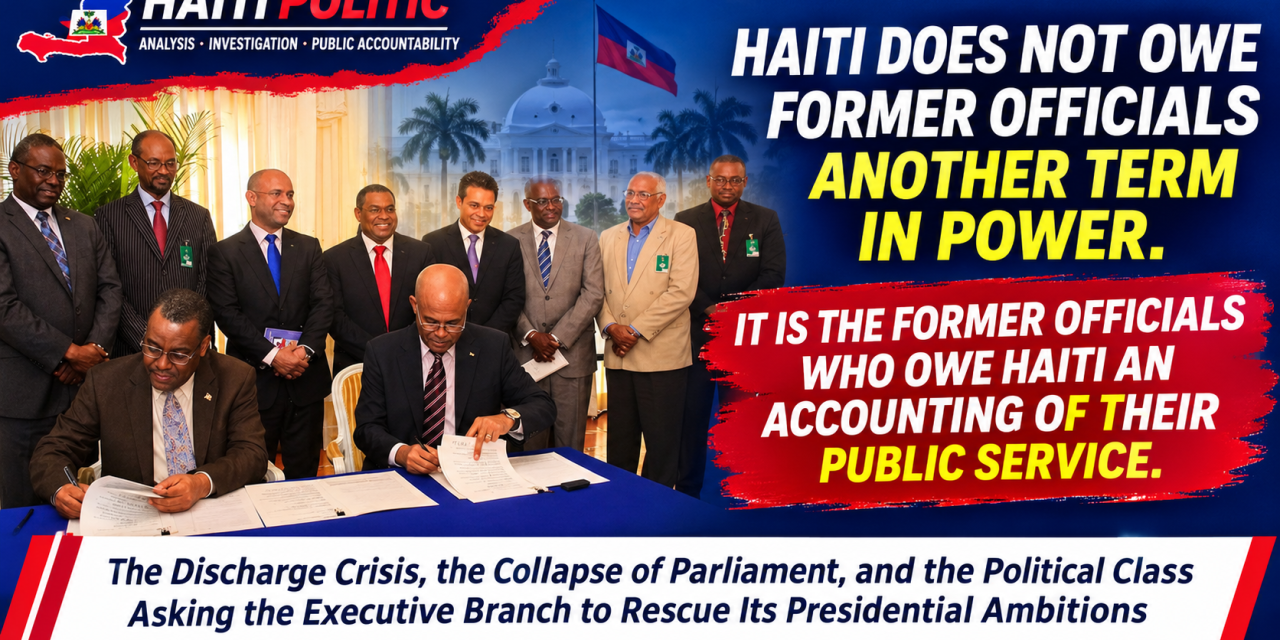
The Discharge Crisis, the Collapse of Parliament, and the Political Class Asking the Executive Branch to Rescue Its Presidential Ambitions
A person does not need to work for the government to help Haiti. Former presidents, prime ministers, ministers, senators, and deputies have other ways to serve their country. Public office is not a lifetime profession, and political experience does not create an entitlement to return to power.
HAITI POLITIC — NOVEMBER 13, 2026
INTRODUCTION: BEFORE ASKING TO GOVERN HAITI AGAIN, EXPLAIN WHAT HAPPENED THE FIRST TIME.
Haiti is approaching another electoral cycle with a constitutional crisis that reveals something deeply troubling about the country’s political system.
Former ministers and prime ministers are seeking a return to public office.
Some are confronting a legal requirement involving parliamentary discharge.
The Superior Court of Auditors and Administrative Disputes (CSCCA) has reminded them that it cannot grant the parliamentary discharge required under the constitutional framework.
The institution responsible for that process—Parliament—does not function.
Now, political figures are discussing whether the executive branch should intervene through a decree.
But there is a question that deserves more attention than the presidential ambitions of former government officials:
WHO IS RESPONSIBLE FOR ALLOWING HAITI’S PARLIAMENT TO DISAPPEAR?
And an equally important question:
WHY SHOULD THE HAITIAN PEOPLE BE EXPECTED TO KEEP RETURNING THE SAME POLITICAL CLASS TO GOVERNMENT WITHOUT FIRST RECEIVING AN ACCOUNTING OF ITS PREVIOUS PUBLIC SERVICE?
This is not an argument that every former official committed corruption.
It is not an argument that every former minister or parliamentarian personally caused the collapse of the state.
It is an argument that previous public service must be examined before it is presented as a qualification for renewed political authority.
Haiti’s political class cannot reasonably expect voters to consider its experience while refusing to examine the consequences of its decisions.
The discharge controversy offers an opportunity to ask questions that should have been answered years ago.
1. HAITI’S PARLIAMENT DID NOT DISAPPEAR OVERNIGHT.
The current constitutional crisis did not begin with Dominique Dupuy’s presidential ambitions.
It did not begin with Laurent Lamothe’s proposals concerning discharge.
And it did not begin with the CSCCA’s November 12, 2026 advisory.
Its roots extend through years of delayed elections, institutional conflict, and failures of constitutional continuity.
In January 2015, during Michel Martelly’s presidency, the expiration of parliamentary mandates left Haiti without a functioning legislature.
Martelly subsequently governed by decree for more than a year.
Legislative elections eventually took place, allowing Parliament to resume its functions.
But the underlying institutional weaknesses remained.
Years later, the country confronted another legislative breakdown.
Parliamentary elections scheduled for October 2019 did not take place.
The International Monetary Fund documented several immediate obstacles: failure to approve a new electoral law, the absence of an approved budget, and disagreement over the composition of the Provisional Electoral Council.
The U.S. Congressional Research Service also documented legislative obstruction, disputes over government formation, and political instability during that period.
These were not problems that emerged without warning.
They developed while Haiti still had elected officials occupying positions of constitutional responsibility.
THE QUESTION:
What did the president, prime ministers, ministers, senators, deputies, and electoral authorities do to prevent the approaching institutional collapse?
Which proposals did they advance?
Which legislation did they support?
Which decisions did they oppose?
Who obstructed negotiations?
Who attempted to resolve the impasse?
Those questions require individual examination.
But the collective failure to maintain constitutional continuity is documented.
2. JANUARY 13, 2020: THE DAY HAITI LOST ITS FUNCTIONING PARLIAMENT.
On January 13, 2020, the mandates of all deputies and two-thirds of Haiti’s senators expired without elected replacements.
President Jovenel Moïse subsequently governed by decree.
Ten senators remained in office, but they could not constitute a functioning bicameral legislature.
Their mandates eventually expired in January 2023.
Haiti was left without any elected national legislators.
This was a major constitutional breakdown.
Parliament was not merely a place where politicians debated legislation.
It was an institution responsible for making laws, exercising oversight, examining government decisions, and participating in the constitutional control of public expenditure.
Its absence weakened those mechanisms.
Yet the executive branch continued functioning.
Ministers continued to be appointed.
Government budgets continued to be administered.
Public contracts continued to be signed.
Political appointments continued.
The state continued exercising authority while a central institution responsible for checking that authority was absent.
That is the contradiction at the center of today’s discharge crisis.
3. THE POLITICAL CLASS HAD YEARS TO ADDRESS THE PROBLEM.
The collapse of Parliament cannot be attributed automatically to every person who previously served in government.
But responsibility cannot be avoided simply by pointing to the complexity of Haiti’s political crisis.
Former presidents and prime ministers should be examined according to the powers they exercised.
Former parliamentarians should be examined according to their legislative and oversight responsibilities.
Former ministers should be examined according to the decisions and public resources under their authority.
The electoral authorities should be examined according to their legal responsibilities.
Haiti’s political crises also involved insecurity, protests, disputes over electoral legitimacy, institutional weaknesses, and competing political interests.
Those factors matter.
But they do not eliminate the obligation to explain government decisions.
A SIMPLE QUESTION FOR FORMER OFFICIALS:
If you knew Parliament’s mandates were approaching expiration, what did you do to prevent the country from losing its legislature?
For officials who served after Parliament became nonfunctional, the question changes:
What did you do to restore constitutional institutions, and why did those efforts fail?
These are questions about public records, not personal popularity.
And the answers should be supported by documents.
4. NOVEMBER 12, 2026: THE COURT OF AUDITORS EXPOSES THE CONSEQUENCES.
On November 12, 2026, the CSCCA issued an advisory concerning the discharge of former prime ministers and ministers.
The Court reaffirmed that it cannot substitute itself for Parliament.
Article 233 of Haiti’s Constitution establishes a parliamentary commission composed of nine deputies and six senators to examine ministerial management and report to both legislative chambers for discharge.
The CSCCA may perform financial oversight and other functions within its legal jurisdiction.
But parliamentary discharge is a separate constitutional responsibility.
The Court also identified a specific exception concerning former officials declared de facto public accountants, whose accounts may fall within its judicial jurisdiction.
That exception does not amount to a general power to grant parliamentary discharge.
The problem is obvious.
The constitutional system assigns responsibility for discharge to an institution that no longer functions.
And former government officials now seeking elected office are confronting the consequences.
The situation creates a genuine legal dilemma.
It does not establish that every former official is ineligible.
Nor does it establish that the executive branch can lawfully replace Parliament.
Those questions require interpretation of the applicable constitutional and electoral provisions.
But the political accountability question remains unavoidable.
Why was this institutional failure allowed to continue for so long?
5. DOMINIQUE DUPUY: THE RIGHT TO RUN DOES NOT ERASE THE DUTY TO ACCOUNT.
Former Foreign Affairs Minister Dominique Dupuy has argued that the state cannot reasonably require a document that no functioning institution can issue.
In her November 2026 video, she also stated that she requested an audit of her ministerial management in a March 30, 2026 letter.
That claim deserves examination.
A request for an audit is relevant.
But a request is not a completed audit.
And a completed audit is not automatically parliamentary discharge.
Haiti Politic has not independently verified the March 30 correspondence, any acknowledgment of receipt, or a completed audit of her ministerial management.
That does not establish wrongdoing.
It means the documentary record remains incomplete.
Dupuy has the right to explain her interpretation of the constitutional crisis.
But the public also has the right to ask about her previous service.
Did she submit the financial and administrative records legally required of her?
Did she comply with applicable asset-declaration obligations?
What documentary evidence supports her statements?
What legal mechanism does she propose to resolve the discharge problem?
And would that mechanism apply equally to other former ministers?
These questions are not an attempt to prevent her from participating in politics.
They are part of evaluating her public record.
The title of former minister can be presented as political experience. But the responsibilities associated with that title cannot simply disappear when a presidential campaign begins.
6. LAURENT LAMOTHE: CAN AN EXECUTIVE DECREE REPLACE A MISSING PARLIAMENT?
Former Prime Minister Laurent Lamothe has discussed historical executive measures adopted during periods without a functioning Parliament.
He has also publicly claimed that favorable audits supported a discharge measure concerning his own administration.
Those claims should be evaluated against the relevant original documents.
But his broader proposal raises a significant constitutional question.
Can the executive branch resolve the discharge crisis through another decree?
Supporters of such an approach may argue that candidates should not be excluded because the state failed to preserve the institution responsible for granting discharge.
That concern is legitimate.
However, critics can reasonably question whether a decree would improperly assume powers assigned to Parliament.
A decree cannot be treated as constitutionally valid merely because previous governments adopted similar measures.
The legal basis matters.
The scope of executive authority matters.
The distinction between electoral eligibility and financial discharge matters.
And the consequences for future accountability matter.
THE POLITICAL QUESTION:
Why is the political discussion focused so heavily on finding a decree that would permit former officials to seek office, rather than on determining how Haiti will prevent another parliamentary collapse?
An emergency solution might address an immediate electoral obstacle.
It cannot, by itself, rebuild the constitutional system.
7. JOSUÉ PIERRE-LOUIS AND THE QUESTION OF EQUAL TREATMENT.
Former Justice Minister Josué Pierre-Louis has also been associated with the argument that candidates should not be penalized for the absence of Parliament.
The position attributed to him emphasizes the possibility of legal remedies when candidates encounter an institutional obstacle they did not create.
That argument raises important questions concerning electoral rights and equal treatment.
Pierre-Louis himself previously occupied senior positions in the Haitian state.
He served as justice minister during Michel Martelly’s presidency.
In September 2021, Prime Minister Ariel Henry appointed him secretary general of the Council of Ministers, with ministerial rank.
His public-service experience makes the broader issue relevant to his own political history.
But experience in government does not determine whether a legal argument is correct.
The legal merits must be evaluated independently.
The same principle should apply to Dominique Dupuy, Laurent Lamothe, Claude Joseph, and other former officials.
The law should not change depending on which former official is seeking office.
8. THE BIGGER PROBLEM: GOVERNMENT OFFICE HAS BECOME A RECURRING POLITICAL DESTINATION.
Haiti’s political system has repeatedly seen former ministers, legislators, prime ministers, and other senior officials return to electoral politics.
There is nothing inherently unlawful about that.
A former official may possess valuable experience.
Some may have records of public service worth examining positively.
Others may have unresolved questions concerning their performance.
But previous government employment should never be treated as a permanent claim on political authority.
A person who has served as a minister is not automatically entitled to become president.
A former senator is not entitled to another legislative mandate.
A former prime minister is not entitled to return to the executive branch.
Public office belongs to the institutions of the republic.
It is not personal property.
It is not an inheritance.
It is not a guaranteed career.
AND MOST IMPORTANTLY:
HAITI DOES NOT OWE ANY FORMER OFFICIAL ANOTHER GOVERNMENT JOB.
The right to seek office, where legally available, is different from the right to obtain office.
Only the voters, acting through a credible electoral process, can confer an electoral mandate.
9. FORMER OFFICIALS: FIND ANOTHER JOB. HAITI NEEDS YOUR CONTRIBUTION, NOT NECESSARILY YOUR RETURN TO GOVERNMENT.
There is an assumption in political life that deserves to be challenged.
Why must every person who claims to love Haiti seek a government position?
Why must public service always mean becoming a minister, senator, deputy, prime minister, or president?
Why is the presidency so often presented as the ultimate expression of patriotism?
A PERSON DOES NOT NEED TO WORK FOR THE GOVERNMENT TO HELP HAITI.
Haiti needs entrepreneurs.
It needs farmers.
It needs engineers.
It needs teachers.
It needs doctors and nurses.
It needs accountants and auditors.
It needs construction professionals.
It needs people who can develop businesses, create employment, train young workers, strengthen schools, and improve local communities.
Former government officials can contribute to these efforts without occupying another political office.
A former minister with expertise in international relations could teach diplomacy or support independent educational initiatives.
A former finance official could help develop financial-literacy programs or support legitimate private-sector investment.
A former parliamentarian could participate in civic education and explain how legislation works.
A former prime minister could write, teach, conduct research, or participate in lawful nonprofit initiatives.
Former officials could support agricultural development, vocational training, and community organizations.
Their experience does not become worthless when they leave government.
But neither does their experience require taxpayers to employ them again.
HAITI POLITIC’S MESSAGE:
IF YOU TRULY WANT TO HELP HAITI, YOU DO NOT HAVE TO WAIT FOR AN APPOINTMENT, A MINISTRY, A PARLIAMENTARY SEAT, OR A PRESIDENTIAL ELECTION.
There are other ways to serve.
And those contributions can be evaluated through tangible results.
How many people received training?
How many jobs were created?
How many students benefited?
What infrastructure was built?
What community problem was addressed?
What measurable improvement occurred?
Political speeches are not the only form of public service.
10. HAITI NEEDS TO EXAMINE RESULTS, NOT JUST POLITICAL TITLES.
The debate over discharge should encourage a broader examination of previous administrations.
For every former minister seeking higher office, voters can ask:
What was the ministry’s budget during that official’s tenure?
What programs were implemented?
What results were documented?
What contracts were approved?
What financial reports were submitted?
What independent audits were completed?
For former parliamentarians, the questions are different.
Which laws did they introduce or support?
What oversight hearings did they conduct?
How did they vote on major legislation?
What actions did they take concerning electoral continuity?
Did they attempt to resolve the institutional disputes that contributed to Parliament’s collapse?
For former presidents and prime ministers:
What actions did their administrations take to maintain constitutional institutions?
What decisions contributed to electoral delays?
What measurable progress occurred in security, public finance, education, and government administration?
What reforms survived after they left office?
These questions allow voters to evaluate public service through evidence rather than campaign slogans.
A title establishes that someone held a position. It does not establish what that person accomplished.
11. BAD GOVERNANCE IS NOT AUTOMATICALLY A CRIME. BUT PROVEN WRONGDOING MUST HAVE CONSEQUENCES.
Haiti Politic’s call for accountability must distinguish political failure from criminal conduct.
A government can perform poorly without every official committing a crime.
A parliamentarian can make an unsuccessful policy decision without violating the law.
A minister can preside over a program that fails to achieve its goals without necessarily engaging in corruption.
But when evidence establishes embezzlement, fraud, unlawful expenditure, or another offense, the appropriate legal institutions must act.
That may include prosecution, financial penalties, restitution, or other consequences authorized by law.
Political responsibility operates differently.
Voters can reject a former official’s request for another mandate.
Political parties can examine candidates’ records.
Civil society can demand documentation.
Journalists can investigate decisions and expenditures.
The two forms of accountability should reinforce each other.
But neither should replace the other.
Poor governance deserves public scrutiny. Proven illegal conduct deserves legal consequences.
12. HAITI’S ASSET-DECLARATION LAW MUST NOT BE FORGOTTEN.
The discharge controversy should not obscure other financial-accountability requirements.
Haiti’s law of February 12, 2008 establishes asset-declaration obligations for designated public officials.
These obligations are distinct from parliamentary discharge.
That distinction is particularly important today.
Even if Parliament cannot grant discharge, other legal obligations may remain applicable.
The public should be able to seek confirmation, through lawful procedures, that officials complied with those requirements.
Confidentiality protections must also be respected.
Not every personal financial detail is automatically available for public disclosure.
But the existence of confidentiality protections should not be confused with the absence of legal accountability.
The question is whether the responsible institutions can verify compliance and act when violations are established.
13. AN EXECUTIVE DECREE SHOULD NOT BECOME A POLITICAL RECYCLING MACHINE.
The debate over an executive decree presents two competing constitutional concerns.
On one side is the risk of excluding candidates because of a document that the state cannot currently issue.
On the other is the risk of weakening financial oversight by allowing the executive to substitute itself for Parliament.
A legally defensible solution must address both concerns.
If an electoral accommodation is adopted, its legal basis should be clearly explained.
It should apply consistently.
It should preserve outstanding financial obligations.
It should remain subject to appropriate judicial review.
And it should not be represented as a completed parliamentary discharge unless the law validly provides for that result.
MOST IMPORTANTLY:
A TEMPORARY ELECTORAL SOLUTION MUST NOT BE CONFUSED WITH A POLITICAL ENDORSEMENT OF FORMER OFFICIALS.
The executive branch does not decide whether a former minister deserves another opportunity to govern.
The electorate decides whether to grant an eligible candidate a new mandate.
And voters are entitled to evaluate the candidate’s previous record.
14. FIFTEEN QUESTIONS HAITI’S FORMER POLITICAL LEADERS SHOULD ANSWER.
1. TO FORMER PRESIDENTS: What actions did your administration take to ensure legislative elections occurred before parliamentary mandates expired?
2. TO FORMER PRIME MINISTERS: What responsibility did your government exercise in preparing electoral legislation, budgets, and administrative arrangements?
3. TO FORMER SENATORS: What did you do to address legislative and electoral deadlock while Parliament still functioned?
4. TO FORMER DEPUTIES: Which laws, votes, and oversight actions demonstrate your efforts to preserve constitutional continuity?
5. TO FORMER MINISTERS: What financial and administrative reports document your management of public resources?
6. TO FORMER OFFICIALS SEEKING DISCHARGE: Have you submitted every legally required document that remains possible to submit without Parliament?
7. TO THOSE REQUESTING A DECREE: What constitutional or statutory authority would permit the executive branch to adopt the proposed measure?
8. TO THOSE CITING PREVIOUS DECREES: What were the legal bases of those measures, and have their effects been independently verified?
9. TO FORMER OFFICIALS WHO CLAIM FAVORABLE AUDITS: Will you provide the relevant reports and explain their scope?
10. TO FORMER MINISTERS SEEKING THE PRESIDENCY: What measurable results from your previous service should voters examine?
11. TO FORMER PARLIAMENTARIANS SEEKING ANOTHER MANDATE: Why should voters trust your commitment to legislative oversight?
12. TO FORMER GOVERNMENT LEADERS: What actions did you take to restore Parliament after January 2020?
13. TO ALL FORMER OFFICIALS: How have you contributed to Haiti since leaving public office?
14. TO ALL PRESIDENTIAL ASPIRANTS: What institutional reforms would prevent a future government from operating for years without legislative oversight?
15. TO HAITI’S POLITICAL CLASS: If you are not elected or appointed again, what will you do to serve Haiti outside government?
The final question deserves particular attention.
Because public service should not begin and end with access to political power.
15. HAITI DOES NOT NEED TO CHOOSE BETWEEN CONSTITUTIONAL RIGHTS AND POLITICAL RENEWAL.
Former officials who satisfy applicable legal requirements may seek elected office.
That right should not be arbitrarily denied.
At the same time, the electorate is under no obligation to return them to power.
Voters can examine their records, consider new candidates, and decide what kind of leadership they want.
Political renewal does not require automatically excluding every former official.
Nor does respect for political rights require treating every former official as indispensable.
The more important principle is that public office must remain open to lawful competition and meaningful scrutiny.
Haiti’s future should not depend on the assumption that only people who have already governed are qualified to govern again.
The country has educators, business owners, professionals, community organizers, and citizens with experience outside national politics.
Their contributions deserve consideration within the same constitutional framework.
16. THE DISCHARGE CRISIS IS A WARNING ABOUT HAITI’S FUTURE.
Consider what the current controversy reveals.
In 2015, Haiti experienced a legislative breakdown.
In 2019, overdue legislative elections were not held.
In January 2020, Parliament became nonfunctional.
In January 2023, the remaining senators’ mandates expired.
In November 2026, the CSCCA reminded former ministers and prime ministers that Parliament holds the constitutional responsibility for granting discharge.
And now, during preparations for the next electoral cycle, some former officials are proposing executive action to address the resulting problem.
This sequence illustrates the long-term consequences of failing to preserve constitutional institutions.
The issue is larger than any individual candidate.
It concerns the relationship between political power, financial accountability, electoral rights, and the separation of powers.
If Haiti addresses only the immediate eligibility controversy, the deeper institutional weakness may remain.
The next administration could inherit the same unresolved problems.
And future candidates could confront similar disputes.
That is why the discussion must extend beyond the political ambitions of former officials.
HAITI POLITIC | FINAL EDITORIAL
FORMER OFFICIALS, HAITI DOES NOT OWE YOU ANOTHER GOVERNMENT JOB.
Haiti has experienced years of electoral delays, institutional breakdown, political conflict, and weakened constitutional oversight.
Former presidents, prime ministers, ministers, senators, and deputies have different levels of responsibility for those events.
Their individual records must be examined fairly.
But none of them is entitled to another mandate simply because they previously held office.
The constitutional discharge controversy presents a legitimate legal problem.
It should be resolved through lawful procedures that protect electoral rights and preserve financial accountability.
Yet solving that legal problem will not answer the larger political question:
What did Haiti receive in return for the years these officials spent exercising public authority?
Former parliamentarians should explain their legislative records.
Former ministers should explain their management of public resources.
Former prime ministers and presidents should explain the decisions taken under their administrations.
Those seeking another mandate should be prepared to discuss both achievements and failures.
And those who do not return to government still have opportunities to contribute to the country.
They can teach.
They can build businesses.
They can create employment.
They can support agriculture.
They can invest in education.
They can organize community initiatives.
They can participate in civic life.
They can help strengthen the institutions that Haiti needs.
No government appointment is required to demonstrate patriotism.
No presidential campaign is required to serve the Haitian people.
And no former official possesses a permanent claim on public power.
THE MESSAGE IS SIMPLE:
HAITI DOES NOT OWE FORMER OFFICIALS ANOTHER TERM IN POWER.
IT IS THE FORMER OFFICIALS WHO OWE HAITI AN ACCOUNTING OF THEIR PUBLIC SERVICE.
IF YOU WANT TO HELP HAITI, YOU DO NOT NEED ANOTHER GOVERNMENT JOB.
AND IF YOU WANT TO GOVERN AGAIN, THE HAITIAN PEOPLE HAVE EVERY RIGHT TO EXAMINE WHAT YOU DID WHEN YOU GOVERNED BEFORE.
The next election is an opportunity to debate the country’s future.
But it is also an opportunity to examine its political past.
Because democratic accountability does not end when a government official leaves office.
And political experience should never become a substitute for documented public service.
SOURCES AND DOCUMENTARY REFERENCES
1. Haiti’s Constitution, Article 233. Establishes the parliamentary mechanism for examining ministerial management and granting discharge.
2. CSCCA, Advisory to Former Prime Ministers and Ministers, November 12, 2026. Confirms that the Court cannot substitute itself for Parliament in granting parliamentary discharge.
3. International Monetary Fund, Haiti: 2019 Article IV Consultation, Country Report No. 20/121. Documents the failure to hold legislative elections in 2019 and the institutional consequences in January 2020.
4. Congressional Research Service, Haiti’s Political and Economic Conditions. Documents electoral delays, legislative disputes, and periods of executive rule by decree.
5. Associated Press, January 2023. Reports the expiration of the remaining senators’ mandates and the absence of elected national legislators.
6. Freedom House, Haiti: Freedom in the World 2023. Reviews the political and institutional developments surrounding Parliament’s collapse and subsequent governance.
7. Haiti’s Law of February 12, 2008 on Asset Declarations. Establishes asset-declaration obligations for designated public officials.
8. Public statements attributed to Dominique Dupuy, Laurent Lamothe, and Josué Pierre-Louis, November 2026. Used to describe their respective positions in the discharge controversy. Their individual claims concerning audits, correspondence, or legal entitlements require verification against original records.
EDITORIAL NOTE
This article is an opinion-based political and institutional analysis grounded in documented historical events and constitutional provisions.
It does not allege that every former official committed corruption or personally caused Parliament’s collapse. Individual legal responsibility requires evidence and appropriate legal proceedings.
The argument for political renewal is an editorial position, not a claim that former officials are legally prohibited from seeking office.
HAITI POLITIC — INDEPENDENT POLITICAL ANALYSIS | CONSTITUTIONAL ACCOUNTABILITY | PUBLIC FINANCE | ELECTIONS 2027