
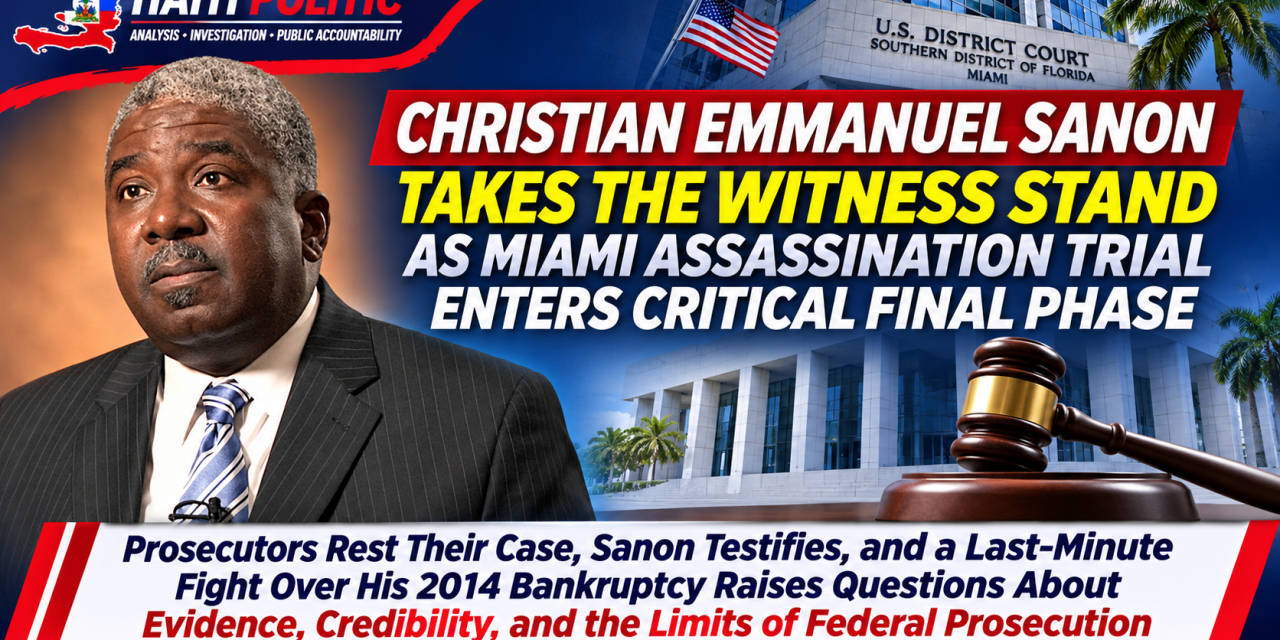
Prosecutors Rest Their Case, Sanon Testifies, and a Last-Minute Fight Over His 2014 Bankruptcy Raises Questions About Evidence, Credibility, and the Limits of Federal Prosecution
HAITI POLITIC | SPECIAL LEGAL INVESTIGATION
Miami, Florida | November 13, 2026
An examination of the federal court docket, trial proceedings, and newly filed motions in United States v. Christian Emmanuel Sanon, Case No. 1:22-cr-20104-JB, before U.S. District Judge Jacqueline Becerra.
1. A Major Turning Point in the Trial of Christian Emmanuel Sanon
The federal criminal trial of Christian Emmanuel Sanon, one of the defendants charged in connection with the July 7, 2021 assassination of Haitian President Jovenel Moïse, has reached a decisive stage in Miami.
After weeks of testimony involving former Haitian officials, alleged conspirators, law enforcement agents, and other witnesses, federal prosecutors rested their case on November 10, 2026.
Two days later, Sanon took the witness stand in his own defense.
That development is especially significant because Sanon is no longer merely challenging the prosecution through his attorneys. By testifying, he has placed his own account before the jury and opened himself to cross-examination.
Meanwhile, a separate evidentiary dispute erupted on November 13, when prosecutors sought to introduce documents from a 2014 bankruptcy proceeding involving Sanon and his wife.
His attorneys immediately objected.
The dispute presents an important question: Can the government use an old civil bankruptcy judgment to undermine a defendant’s credibility during a criminal trial involving an entirely different set of allegations?
The answer will depend on the purpose for which the evidence is offered, the applicable Federal Rules of Evidence, and Judge Becerra’s ruling.
As of the November 13 docket reviewed by Haiti Politic, the jury had not returned a verdict.
2. What the Federal Court Docket Confirms
The case is pending in the United States District Court for the Southern District of Florida, Miami Division.
Case: United States v. Christian Emmanuel Sanon
Case number: 1:22-cr-20104-JB
Presiding judge: Jacqueline Becerra
Trial began: September 28, 2026
Latest docket reviewed: November 13, 2026, approximately 1:09 p.m. Eastern Time
Sanon is represented by attorneys Zeljka Bozanic and Humberto Rolando Dominguez.
The prosecution team includes Assistant United States Attorneys Sean McLaughlin, Jason Wu, and Altanese Phenelus.
The court docket establishes the following recent developments:
| Date | Development |
|---|---|
| September 28, 2026 | Sanon’s jury trial begins in Miami. |
| October 23, 2026 | Court records identify testimony from Jean Roger Noelcius and Joseph Joel John. |
| November 2, 2026 | Mario Antonio Palacios Palacios and Jacob Israel appear in the government’s case. |
| November 3, 2026 | The docket records testimony involving Jacob Israel and Frederick Bergmann Jr. |
| November 6, 2026 | German Alejandro Rivera Garcia continues testifying. |
| November 9, 2026 | Rivera Garcia, Manuel Garcia, and Special Agent George Nunez testify. |
| November 10, 2026 | Prosecutors rest their case; defense expert Thomas Pullen testifies. |
| November 12, 2026 | Thomas Pullen continues; Christian Emmanuel Sanon takes the witness stand. |
| November 13, 2026 | Prosecutors file notice concerning 2014 bankruptcy records; defense moves to exclude them. |
These developments are documented in the federal docket, including entries 2276, 2286, 2292, 2294, and 2295.
The central fact is that the government has finished presenting its principal case, while the defense has begun presenting evidence directly to the jury.
That does not necessarily mean the trial is about to conclude immediately. Additional defense testimony, rebuttal evidence, evidentiary rulings, closing arguments, jury instructions, and deliberations may still be required.
3. Sanon Testifies: Why His Decision Matters
According to docket entry 2292, the 29th day of Sanon’s jury trial took place on November 12, 2026.
The official minute entry identifies two developments:
-
Defense expert Thomas Pullen continued testifying.
-
Christian Emmanuel Sanon was sworn and testified.
The court scheduled proceedings to continue on November 13 at 9:00 a.m.
Sanon’s decision to testify represents a consequential strategic choice.
Under the Fifth Amendment, a criminal defendant has the constitutional right not to testify. A jury cannot treat the defendant’s decision to remain silent as evidence of guilt.
But when a defendant voluntarily testifies, the prosecution may cross-examine him within the boundaries established by the rules of evidence.
That creates both opportunities and risks.
For the defense, Sanon’s testimony provides an opportunity to explain his conduct, relationships, intentions, and understanding of the events preceding President Moïse’s assassination.
For prosecutors, it creates an opportunity to challenge inconsistencies, confront him with admissible documents, and test his credibility.
The key distinction is that the docket confirms Sanon testified, but it does not establish what he said.
The actual November 12 trial transcript was not among the documents provided for this analysis.
Consequently, it would be irresponsible to claim that Sanon admitted particular facts, contradicted specific witnesses, or identified additional participants without reviewing his testimony.
Nevertheless, the decision to testify could become one of the defining moments of the trial.
4. What Is Sanon Actually Accused Of?
The federal prosecution arises from the events surrounding the assassination of President Jovenel Moïse at his private residence in Pétion-Ville on July 7, 2021.
The broader investigation has involved allegations of a conspiracy that included political ambitions, security operations, financing arrangements, and the movement of personnel and equipment.
Sanon’s case has evolved through multiple superseding indictments.
The docket identifies charges and statutory provisions involving:
Conspiracy to provide material support or resources for a conspiracy to kill or kidnap outside the United States — 18 U.S.C. § 2339A.
This statute can apply when prosecutors prove that a defendant knowingly provided, or conspired to provide, material support intended for use in carrying out certain specified federal offenses.
Conspiracy to kill or kidnap a person outside the United States — 18 U.S.C. § 956(a)(1).
This provision addresses certain conspiracies formed within U.S. jurisdiction to commit murder or kidnapping abroad.
Conspiracy to commit offenses against the United States — 18 U.S.C. § 371.
The docket also identifies charges involving an expedition against a friendly nation, smuggling, and false or misleading export information.
The docket’s summary contains historical counts from successive indictments. Therefore, it should not be read as a substitute for the operative indictment and the final instructions defining the precise counts submitted to Sanon’s jury.
A crucial legal distinction must also be maintained.
Being accused of participating in a conspiracy connected to an assassination is not the same as being proved to have personally committed the killing.
The government must establish the elements of each charged offense beyond a reasonable doubt.
Sanon remains presumed innocent unless and until a jury finds him guilty.
5. The Government Rests Its Case on November 10
Docket entry 2286 records a major procedural milestone.
On November 10, the government presented testimony involving:
-
Special Agent George Nunez;
-
Daniel Gonzalez; and
-
Nestor Mascarell.
The entry then states that the government rested.
Defense expert Thomas Pullen subsequently testified.
The court also held a charge conference, during which the parties and judge addressed proposed jury instructions.
Sanon waived his appearance at that conference.
A charge conference is an important stage because it helps determine how jurors will be instructed to evaluate the evidence and apply the law.
In a complex conspiracy prosecution, disputes over jury instructions can be consequential.
Questions may include what prosecutors must prove regarding intent, knowledge, participation in an agreement, material support, and the relationship between alleged conduct and the charged crimes.
The November 10 minute entry confirms that the conference occurred, but it does not reproduce the court’s complete instructions or resolve every disputed legal issue.
The government’s decision to rest also does not prevent it from seeking permission to introduce proper rebuttal evidence after the defense case.
6. The Witnesses: What the Court Records Show — and What They Do Not
The trial has included testimony from individuals whose names have appeared throughout the investigation into President Moïse’s assassination.
Among those identified in the supplied docket are:
Martine Moïse and Jomarlie Moïse
The September 30 court entry identifies testimony involving the former first lady and Jomarlie Moïse, along with other witnesses.
Their appearance is important because of their connection to the events surrounding the assassination.
However, the docket does not provide a complete account of their testimony or cross-examination.
Joseph Joël John
The October 23 docket entry identifies continued videotaped testimony involving Joseph Joël John.
His participation is significant because he has been implicated in the broader federal investigation.
But the docket summary does not establish precisely what he said about Sanon.
Mario Antonio Palacios Palacios
The November 2 entry records continued testimony from Palacios.
His testimony is potentially important because of his connection to the group of Colombian personnel associated with the operation.
Again, the docket identifies the witness without reproducing his substantive answers.
German Alejandro Rivera Garcia
Rivera Garcia’s testimony continued into November.
The docket records his participation on November 6 and November 9.
His testimony may be important to the prosecution’s reconstruction of the operation, but its exact evidentiary significance cannot be assessed without the transcripts.
Frederick Bergmann Jr.
The November 3 docket identifies Bergmann as a government witness.
His appearance may be relevant to the logistical and material-support aspects of the prosecution.
However, a witness’s appearance on the docket does not establish that the witness corroborated every allegation against Sanon.
The central evidentiary question
For each cooperating or previously charged witness, the jury must evaluate credibility.
Relevant considerations can include firsthand knowledge, inconsistencies, prior statements, incentives to cooperate, and any promises or benefits received from prosecutors.
A guilty plea by another participant does not automatically establish Sanon’s guilt.
The jury must decide Sanon’s individual criminal responsibility based on admissible evidence presented against him.
7. November 13: Prosecutors Introduce a New Controversy Involving Sanon’s Bankruptcy
The most recent legal dispute concerns documents from a federal bankruptcy case dating back to 2014.
On November 13, prosecutors filed docket entry 2294, a notice seeking to use records from an earlier proceeding involving Sanon.
The proposed evidence is identified as Government Exhibit GX 4I.
The documents concern:
United States Trustee v. Christian Sanon, Adversary Proceeding No. 8:14-ap-00702-MGW, in the U.S. Bankruptcy Court for the Middle District of Florida.
According to the defense’s November 13 motion, prosecutors want to introduce the bankruptcy docket, complaint, and final judgment without accompanying testimony from a witness or records custodian.
The defense objects to the proposed admission.
The timing is notable.
The motion describes the trial as being in its seventh week.
It also argues that the government has not adequately explained why these old civil records should be admitted in a prosecution concerning events in Haiti years later.
The legal issue is not simply whether the bankruptcy documents are authentic. It is whether they are admissible for the particular purpose prosecutors intend.
8. What Happened in the 2014 Bankruptcy Proceeding?
According to Sanon’s defense filing, the United States Trustee filed a complaint on August 14, 2014, seeking revocation of bankruptcy discharges involving Christian Sanon and his wife, Louise Marie Sanon.
The proceeding was brought under provisions of 11 U.S.C. § 727.
The complaint contained allegations relating to fraud, including allegations that the defense says were pleaded on information and belief.
The Sanons did not file an answer contesting the complaint.
Instead, on October 14, 2014, they consented to entry of a judgment revoking their bankruptcy discharges.
A final judgment was entered on December 19, 2014.
The defense emphasizes that the judgment resulted from consent rather than a contested trial.
According to the motion, the judgment did not contain independently adjudicated findings resolving the underlying fraud allegations.
That distinction is legally important.
A consent judgment is not automatically proof of every allegation
A civil judgment entered by agreement can have significant legal consequences.
In this instance, the reported consequence was revocation of the bankruptcy discharges.
But that does not necessarily mean a court conducted a trial and independently determined that every allegation in the complaint was true.
The defense argues that Sanon’s agreement not to contest the proceeding should not be transformed into proof of criminal misconduct.
This is a legitimate evidentiary issue.
However, the fact that a judgment was entered by consent does not automatically make every fact associated with it inadmissible in a later case.
The judge must examine the specific documents, the purpose for which they are offered, the applicable evidence rules, and any relevant constitutional objections.
9. The Defense’s Five Major Legal Arguments
Sanon’s attorneys filed docket entry 2295 on November 13.
The seven-page motion asks Judge Becerra to exclude GX 4I in its entirety.
It advances several arguments.
A. The bankruptcy judgment did not adjudicate the fraud allegations
The defense relies on Eleventh Circuit precedent, including Balbirer v. Austin, 790 F.2d 1524 (11th Cir. 1986).
The motion argues that a consent judgment ordinarily does not conclusively establish a disputed issue unless the parties intended that result.
This argument concerns the distinction between a settlement or consent disposition and an actual adjudication.
Its strength will depend partly on how prosecutors propose to use the judgment.
B. The government cannot automatically use the public-records exception to prove the allegations
The defense challenges reliance on Federal Rule of Evidence 803(8).
That rule permits certain public records to be admitted despite the hearsay rule.
But it contains limitations, particularly concerning factual findings offered against a criminal defendant.
The defense argues that the 2014 bankruptcy judgment contains no qualifying factual findings.
An important distinction exists between proving that a court document was filed and proving that every allegation inside the document is true.
A certified copy of a complaint may establish that the complaint exists. It does not, by itself, prove the complaint’s allegations.
C. The records may contain inadmissible hearsay
The defense argues that the bankruptcy complaint contains assertions that were never tested through testimony or cross-examination.
If prosecutors offer those assertions for their truth, the court must determine whether a hearsay exception or exclusion applies.
The analysis may differ if the documents are offered for another legitimate purpose.
D. The proposed evidence may violate Rule 404(b)
Federal Rule of Evidence 404(b) generally prohibits using evidence of other acts simply to show that a person has a bad character and therefore probably committed the charged offense.
Such evidence can sometimes be admitted for other purposes, including intent, knowledge, motive, or absence of mistake.
But the prosecution must satisfy applicable notice and admissibility requirements.
Sanon’s attorneys argue that the bankruptcy documents are being introduced too late and without an adequately identified permissible purpose.
The defense specifically objects that prosecutors sought to introduce the material during the seventh week of trial.
Whether the court agrees will depend on the government’s explanation, any good cause for late notice, and the relationship between the records and disputed issues in the case.
E. The evidence may create unfair prejudice under Rule 403
Rule 403 permits a court to exclude otherwise relevant evidence when its probative value is substantially outweighed by dangers such as unfair prejudice, confusing the issues, or misleading the jury.
The defense argues that jurors could improperly treat old bankruptcy allegations as proof that Sanon is generally dishonest.
That would be particularly concerning if the jury were shown allegations of fraud without understanding that they were not adjudicated after a contested evidentiary hearing.
The defense also argues that introducing the records could create a distracting dispute about a bankruptcy proceeding from more than a decade earlier.
What the defense wants
Sanon’s attorneys ask the court to strike the relevant portion of the government’s notice and exclude GX 4I under multiple provisions of the Federal Rules of Evidence.
They also reserve further constitutional objections, including under the Confrontation Clause.
As of the documents reviewed, the defense has requested exclusion. There is no accompanying court order establishing that Judge Becerra has granted or denied this motion.
10. Why the Bankruptcy Dispute Could Matter to Sanon’s Testimony
The timing of the government’s bankruptcy filing is potentially important.
Sanon testified on November 12.
The government filed its notice concerning the 2014 records on November 13.
That sequence raises a legitimate question: Is the government seeking to use the bankruptcy material to challenge Sanon’s credibility, to rebut a particular factual claim, or to establish another legally permissible issue?
The supplied notice summary and defense motion do not conclusively establish the prosecution’s intended theory.
It would therefore be premature to assert that prosecutors introduced the documents specifically because Sanon testified.
Nevertheless, his decision to take the witness stand changes the evidentiary context.
A defendant who testifies may be questioned about certain matters affecting credibility, subject to the rules governing impeachment, extrinsic evidence, relevance, and unfair prejudice.
But testifying does not eliminate all evidentiary protections.
Nor does it give prosecutors unlimited permission to introduce unrelated accusations.
Judge Becerra must decide whether the proposed evidence is admissible and, if so, for what purpose.
This could become a significant issue for appellate review if the evidence is admitted, the defendant is convicted, and the ruling is properly preserved for appeal.
11. A Separate Development: The Defense’s Expert Witness
The court records identify Thomas Pullen as a defense expert.
On November 10, Judge Becerra granted a request allowing Pullen to bring his laptop and cellular phone into the courthouse.
Pullen testified on November 10 and continued on November 12.
The government had previously filed motions seeking to exclude certain defense expert testimony, including testimony associated with Pullen.
The defense opposed those requests.
The November 12 docket confirms that Pullen testified, but the supplied materials do not provide the complete substance of his expert opinions.
It would therefore be speculative to describe his conclusions as having disproved the government’s evidence.
The significance of his testimony will depend on the actual questions, answers, qualifications, methodology, and cross-examination.
The court’s willingness to hear expert testimony does not mean it has endorsed the expert’s conclusions.
12. The Government’s Discovery Filing Reveals the Enormous Scale of the Investigation
Another document filed November 12 deserves attention.
In docket entry 2290, prosecutors describe the discovery made available to newly added defendants in the broader assassination prosecution.
The government states that the material includes:
-
Thousands of financial records, interview reports, and photographs;
-
More than 150 digital forensic reports involving seized electronic devices;
-
Banking and business records;
-
Cellphone and computer extraction reports;
-
Transcripts and translations in French, Spanish, and Haitian Creole;
-
Evidence obtained through mutual legal assistance procedures;
-
Domestic search warrant results;
-
Ballistics testing;
-
Medical records and autopsy evidence; and
-
Video and photographic material.
The government also identifies a report of President Jovenel Moïse’s autopsy conducted by Haitian authorities.
In addition, prosecutors reference FBI firearms-toolmark testing involving recovered projectiles and firearms.
The discovery filing indicates that the prosecution has accumulated a substantial body of investigative material.
But there is an important limitation.
The existence of thousands of records does not establish that every document is admissible, reliable, or incriminating against every defendant.
The government must still connect admissible evidence to the elements of the charged offenses.
The November 12 filing also concerns discovery access for several defendants in the broader case, including Joseph Félix Badio, Byron Sherrod Rainer, and others.
It should not be mistaken for an announcement that all those defendants are being tried together with Sanon in the current jury proceeding.
13. What About Joseph Félix Badio and the Other Defendants?
The broader federal case continues to involve multiple defendants.
The November 12 government discovery response specifically identifies Joseph Félix Badio among defendants receiving access to previously produced materials.
The filing also describes the use of a coordinating discovery attorney appointed by the court on October 13, 2026.
That attorney’s role is to help manage the extensive evidence accumulated over several years.
The government reports that access to earlier discovery productions was facilitated on November 5, 2026.
This development demonstrates that the federal prosecution extends beyond Sanon’s individual trial.
However, the discovery response does not establish the outcome of Badio’s case, the precise date of his future trial, or the substance of his anticipated defense.
Those questions require examination of his individual docket and applicable scheduling orders.
The presence of his name in a discovery filing should not be interpreted as proof of guilt.
14. Could Sanon Face Life Imprisonment?
Sanon faces serious federal charges, including offenses carrying potentially severe penalties.
Under 18 U.S.C. § 2339A, certain material-support offenses involving a death-resulting allegation can carry a maximum sentence of life imprisonment.
The actual sentencing exposure depends on the specific count of conviction, the statutory elements proved, any required jury findings, and applicable sentencing law.
Other charges carry different statutory penalties.
A conviction on one count would not automatically establish guilt on every other count.
Similarly, a sentence cannot be predicted solely from the indictment.
The prosecution must first obtain a conviction.
The court would then conduct a separate sentencing process.
At this stage, Sanon has not been convicted by the jury in the trial covered by the November 13 docket.
15. The Most Important Question: What Did Sanon Tell the Jury?
Sanon’s November 12 testimony creates a new investigative priority.
The public needs to know precisely what he said under oath.
Several questions are particularly important.
First: Did Sanon acknowledge that he intended to become Haiti’s president?
Second: How did he explain his relationships with individuals who later became defendants or witnesses in the assassination investigation?
Third: What did he say about the purpose of the security operation allegedly organized before July 7, 2021?
Fourth: Did he distinguish between a plan to replace President Moïse politically and any plan involving kidnapping or killing?
Fifth: What did he say about financing, contracts, or promises allegedly made to individuals involved in the operation?
Sixth: Did prosecutors confront him with communications, financial records, or statements from cooperating witnesses?
Seventh: Did his testimony contradict any earlier statements attributed to him?
Eighth: How did he respond to testimony from Mario Antonio Palacios Palacios, German Alejandro Rivera Garcia, and Joseph Joël John?
Ninth: Did he identify anyone he believed had greater knowledge of the assassination plot?
Tenth: Did he describe contacts with Haitian political figures, security officials, or foreign nationals before the assassination?
These are questions for examination of the actual transcript.
They are not assertions about what Sanon said.
The distinction matters because the most sensational version of a trial is not necessarily the version supported by the sworn testimony.
16. What Happens Next?
Based on the November 13 court records, several developments should be monitored.
The continuation of Sanon’s testimony
The November 12 minute entry scheduled proceedings to continue on November 13 at 9:00 a.m.
The docket reviewed at approximately 1:09 p.m. does not contain a completed November 13 trial-day minute entry.
Therefore, the precise status of that day’s testimony cannot be confirmed from the supplied record.
The bankruptcy evidence ruling
Judge Becerra must address the government’s proposed GX 4I evidence and Sanon’s motion to exclude it.
The court could exclude the evidence, admit some or all of it, limit its permitted use, or require further argument.
No outcome should be assumed before the ruling.
Possible rebuttal witnesses
The docket includes a November 12 defense demand concerning summaries of proposed rebuttal expert Bryan Jordan.
This suggests that expert rebuttal issues remain under consideration.
It does not establish that Jordan has testified or that his testimony will necessarily be admitted.
Final jury instructions
The parties have filed proposed instructions and participated in a charge conference.
The final instructions will determine how jurors are directed to apply federal law to the evidence.
Closing arguments and deliberations
Once the evidence closes, the court may proceed to final instructions, closing arguments, and jury deliberations.
The supplied docket does not establish a definitive date for a verdict.
17. Haiti Politic Legal Analysis: The Difference Between Political Ambition and Criminal Responsibility
The prosecution of Christian Emmanuel Sanon raises questions extending beyond the individual defendant.
The assassination of President Jovenel Moïse remains one of the most consequential crimes in Haiti’s recent political history.
But a federal criminal trial must answer narrower legal questions than a broad political investigation.
A jury is not being asked to determine who would have governed Haiti best, whether the country’s political system was legitimate, or whether Sanon’s ambitions were realistic.
The jury must determine whether prosecutors have proved the specific federal crimes charged against him.
That requires attention to evidence of knowledge, intent, agreement, and conduct.
Political ambition alone is not a federal crime.
Seeking political power is not, by itself, proof of participation in an assassination conspiracy.
Conversely, presenting a political project or claiming peaceful intentions does not automatically defeat a criminal charge if prosecutors prove the required elements through admissible evidence.
The legal distinction is fundamental.
The government must prove more than association with individuals who committed crimes.
It must establish Sanon’s own criminal responsibility under the statutes charged.
And the defense is entitled to challenge witnesses, contest documents, present its own evidence, and require the government to meet its burden.
The jury must evaluate both sides without assuming that the seriousness of President Moïse’s assassination establishes the guilt of every person accused in connection with it.
18. The Larger Accountability Problem: Will the Miami Trial Reveal the Full Story?
Even a comprehensive federal trial may not answer every question surrounding the assassination.
The Miami prosecution focuses on violations of U.S. federal law.
It is not a substitute for a complete Haitian judicial accounting of every political, institutional, security, and financial failure surrounding July 7, 2021.
The evidence may illuminate relationships and events beyond those necessary to establish Sanon’s individual guilt.
But the jury’s verdict will address the charges submitted to it.
That distinction should shape how the public interprets the proceedings.
A conviction would establish criminal liability for the offenses proved beyond a reasonable doubt.
An acquittal would mean the government failed to establish guilt beyond a reasonable doubt on the relevant counts.
Neither result would automatically resolve every unanswered question about the assassination.
For Haiti, the pursuit of accountability must remain broader than any one defendant.
19. Twelve Questions Haiti Politic Believes Must Be Answered
-
What exactly did Christian Emmanuel Sanon tell the jury on November 12, 2026, about his political ambitions and the events preceding President Moïse’s assassination?
-
Did Sanon acknowledge knowing about any plan to kidnap or kill President Moïse, or did he deny such knowledge?
-
What documents, communications, and financial records did prosecutors use to challenge his testimony?
-
How did Sanon’s account compare with testimony from Joseph Joël John, Mario Antonio Palacios Palacios, and German Alejandro Rivera Garcia?
-
What benefits, if any, did cooperating witnesses receive or expect in exchange for their testimony?
-
What was the precise purpose of the security operation allegedly organized around Sanon’s political ambitions?
-
Who financed the personnel, equipment, transportation, and other logistical arrangements described in the prosecution?
-
What did the defense expert Thomas Pullen tell the jury, and how did prosecutors challenge his conclusions?
-
Why did prosecutors seek to introduce Sanon’s 2014 bankruptcy records during the seventh week of trial?
-
Will Judge Becerra permit the bankruptcy documents to be used, and what restrictions will govern their presentation to the jury?
-
What additional evidence will emerge in the proceedings involving Joseph Félix Badio and other defendants?
-
Will the federal prosecution clarify the distinction between the people who planned the operation, those who financed it, those who carried it out, and those who may have been unaware of its ultimate purpose?
These questions are central to a serious examination of the assassination.
They should be answered through court records and sworn testimony, not political speculation.
CONCLUSION: SANON’S TESTIMONY COULD DEFINE THE FINAL PHASE OF HIS TRIAL
The latest developments in Miami establish that Christian Emmanuel Sanon’s trial has entered an important new phase.
The government rested on November 10.
Sanon testified on November 12.
On November 13, prosecutors sought to introduce records from a 2014 bankruptcy proceeding, and the defense immediately challenged their admissibility.
The court must now resolve disputed evidentiary questions while the jury continues evaluating the prosecution and defense cases.
For Haiti Politic, three principles should guide coverage.
First, the testimony matters more than the accusations surrounding it. The actual trial transcripts are essential to understanding what witnesses said and whether their accounts withstand scrutiny.
Second, a defendant’s past financial or civil litigation history cannot automatically substitute for proof of the crimes charged. Evidence must satisfy the rules governing relevance, admissibility, and fairness.
Third, the assassination of President Jovenel Moïse demands accountability based on evidence rather than political convenience.
Sanon’s testimony may provide important answers.
It may also raise new questions.
But the final determination of his criminal responsibility belongs to the jury, applying the law as instructed by the court.
Until a verdict is reached, Christian Emmanuel Sanon remains presumed innocent.
DOCUMENTARY SOURCES
Source 1 — Federal Criminal Docket
United States v. Christian Emmanuel Sanon, Case No. 1:22-cr-20104-JB, U.S. District Court, Southern District of Florida. PACER docket report retrieved November 13, 2026, approximately 1:09 p.m. Eastern Time.
Relevant entries include:
-
DE 2276 — November 9 trial proceedings.
-
DE 2277 — November 10 order concerning defense expert Thomas Pullen.
-
DE 2286 — November 10 trial proceedings and conclusion of the government’s case.
-
DE 2292 — November 12 trial proceedings and Sanon’s testimony.
-
DE 2293 — Defense demand concerning rebuttal expert Bryan Jordan.
-
DE 2294 — Government notice concerning 2014 bankruptcy records.
-
DE 2295 — Defense motion to exclude bankruptcy evidence.
Source 2 — Government Discovery Filing
Government’s Second Response to the Standing Discovery Orders, DE 2290, filed November 12, 2026, seven pages.
Source 3 — Sanon’s Evidentiary Objection
Defendant’s Objection to the Government’s Tenth Supplemental Notice [DE 2294] and Motion to Exclude GX 4I, the 2014 Bankruptcy Consent Judgment and Pleadings, DE 2295, filed November 13, 2026, seven pages.
Legal authorities discussed: 18 U.S.C. §§ 371, 956, 960, and 2339A; Federal Rules of Evidence 403, 404(b), 803, and 902; Balbirer v. Austin, 790 F.2d 1524 (11th Cir. 1986); and applicable constitutional protections.
Editorial note: This report distinguishes court-confirmed procedural developments from allegations and arguments made by prosecutors or defense counsel. It does not treat an indictment, a motion, or an attorney’s characterization of evidence as a judicial finding. The underlying trial transcripts and the government’s complete November 13 exhibit submission were not supplied for independent examination.
© 2026 HAITI POLITIC — SPECIAL LEGAL INVESTIGATION