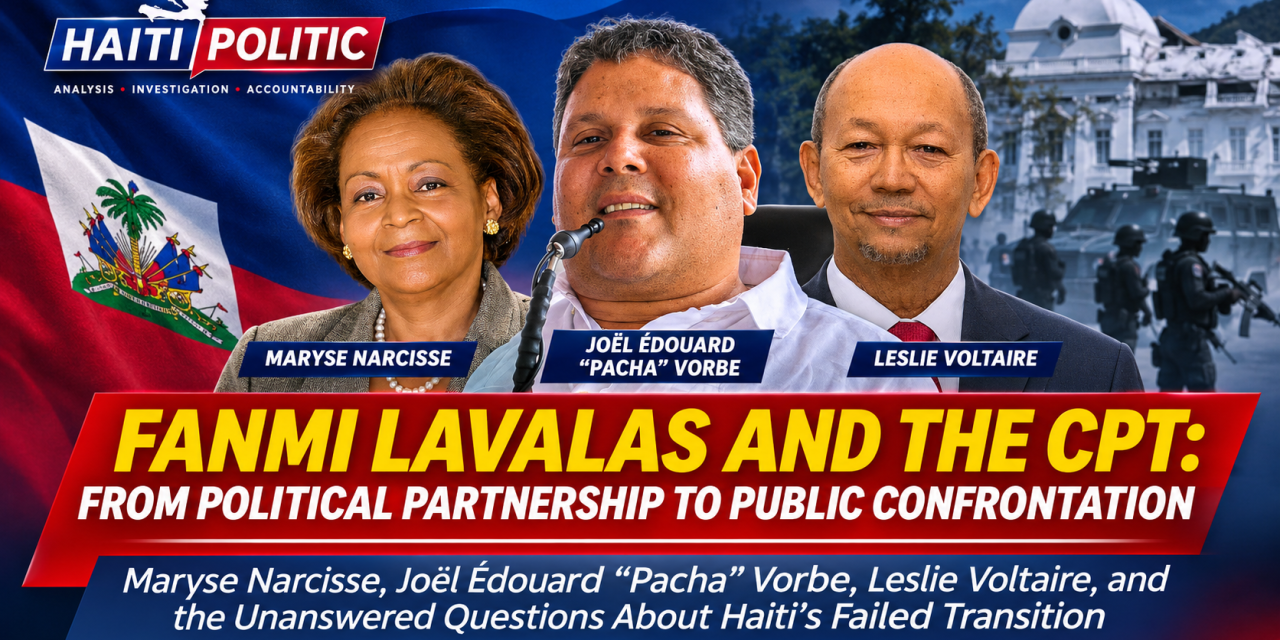
Maryse Narcisse, Joël Édouard “Pacha” Vorbe, Leslie Voltaire, and the Unanswered Questions About Haiti’s Failed Transition
HAITI POLITIC | SPECIAL POLITICAL INVESTIGATION
November 13, 2026
Fanmi Lavalas helped establish Haiti’s Presidential Transitional Council and selected Leslie Voltaire to represent it. Months later, the party publicly challenged the council, rejected its representative’s electoral strategy, and demanded a different political arrangement. Is this a political reversal, a legitimate response to a failed transition, or evidence of deeper disagreements over accountability? A review of Haiti’s electoral history reveals a complicated relationship between participation, protest, and political responsibility.
INTRODUCTION: WHEN A PARTY OPPOSES THE GOVERNMENT IT HELPED CREATE
Haiti’s political crisis has produced another difficult question for the country’s established political organizations: Can a party help establish a transitional government, appoint a representative to its leadership, and subsequently distance itself from that government’s failures?
That question now surrounds Fanmi Lavalas, the political organization founded by former President Jean-Bertrand Aristide.
In a recent video reviewed by Haiti Politic, Dr. Maryse Narcisse and Joël Édouard “Pacha” Vorbe discuss the conditions necessary for Haiti to organize credible elections.
Their central argument is that elections require an acceptable security environment, political dialogue, and renewed public confidence.
The speaker whose remarks are captured in the accompanying transcript argues that Haitians must be able to live, attend school, and vote in peace. The recording also emphasizes dialogue among political stakeholders. Because the automated transcript does not reliably distinguish between the two speakers, individual quotations cannot be assigned with certainty.
These positions deserve serious consideration. Haiti’s security crisis presents genuine obstacles to electoral participation.
But the statements also invite scrutiny of Fanmi Lavalas’s political history.
The party was excluded from the disputed electoral process surrounding the 2010–2011 presidential election. It participated in the 2015 and 2016 presidential contests. It subsequently helped establish the CPT in 2024, only to become one of the council’s most vocal critics.
The resulting controversy is about more than elections.
It concerns the relationship between political participation, institutional responsibility, and the right to oppose a government after helping establish it.
I. THE 2010–2011 ELECTION: WHY FANMI LAVALAS WAS ABSENT
To understand the present controversy, it is necessary to revisit the election that followed Haiti’s devastating January 12, 2010 earthquake.
Fanmi Lavalas did not officially participate in the presidential election that ultimately brought Michel Martelly to power.
However, describing that absence as a voluntary boycott would misrepresent the historical record.
The party had already encountered major registration problems before the earthquake.
An internal leadership dispute
In 2009, different factions within Fanmi Lavalas submitted competing candidate lists for legislative elections.
Jean-Bertrand Aristide, the party’s founder and recognized leader, was living in exile in South Africa.
According to the Organization of American States’ electoral observation report, one faction submitted an authorization naming Maryse Narcisse as coordinator of the party’s executive committee.
The document was submitted after the legal deadline, and another faction challenged its validity.
The CEP requested an authenticated authorization that the party did not provide in an acceptable form.
The electoral authorities consequently rejected Fanmi Lavalas’s registration.
The OAS documented these administrative problems, while independent electoral monitors questioned whether the exclusion was legally justified.
This history reveals two distinct issues.
First, Fanmi Lavalas faced an internal dispute over who could legally represent the organization.
Second, the electoral authorities’ decision generated serious concerns about political exclusion.
Neither issue should be erased.
The election after the earthquake
The November 28, 2010 presidential election proceeded amid extraordinary national circumstances.
Haiti was recovering from the earthquake, large numbers of citizens had been displaced, and public institutions were severely weakened.
The preliminary presidential results placed Mirlande Manigat first, Jude Célestin second, and Michel Martelly third.
Following allegations of electoral irregularities, an OAS expert review recommended changes that resulted in Martelly advancing to the runoff against Manigat.
The United States supported the review process, and Secretary of State Hillary Clinton visited Haiti in January 2011 during the electoral dispute.
The historical record documents international involvement and pressure surrounding the electoral review. It does not establish that Clinton personally selected Martelly as president.
Martelly subsequently defeated Manigat in the March 2011 runoff.
Fanmi Lavalas remained outside the official contest.
The party’s exclusion became part of a broader debate about electoral legitimacy, political representation, and foreign influence.
The lesson from 2010–2011 is not simply that Fanmi Lavalas refused to participate. It is that internal party disputes, electoral administration, and political exclusion combined to prevent its official participation.
II. 2015 AND 2016: FANMI LAVALAS RETURNS TO THE BALLOT
The next presidential election cycle presents a different picture.
In October 2015, Fanmi Lavalas participated with Maryse Narcisse as its presidential candidate.
The election was marked by allegations of fraud and irregularities, and its presidential results were eventually annulled.
A new presidential election was organized in November 2016.
Fanmi Lavalas again participated with Narcisse as its candidate.
She received approximately 9% of valid votes, while Jovenel Moïse won the presidency.
The Congressional Research Service confirms the controversial 2015 election and the subsequent organization of a new presidential contest in 2016.
These elections matter because they establish that Fanmi Lavalas has not consistently refused to participate during periods of political instability.
The party contested two presidential elections despite serious disagreements over electoral credibility.
That history raises a question for its present leadership:
What conditions were considered sufficient for participation in 2015 and 2016, and how do those conditions compare with the standards Fanmi Lavalas demands today?
The answer cannot depend on a superficial comparison.
Haiti’s security situation has changed significantly since 2016. Armed groups have expanded their territorial influence, displaced communities, and disrupted essential institutions.
Nevertheless, political parties should be able to explain how they determine when electoral participation is possible.
Without clear criteria, the public cannot distinguish a consistent electoral principle from a position adopted in response to changing political circumstances.
III. APRIL 2024: FANMI LAVALAS HELPS ESTABLISH THE CPT
The controversy takes a new direction in April 2024.
Following the collapse of Prime Minister Ariel Henry’s governing arrangement and negotiations facilitated by CARICOM, Haiti established the Presidential Transitional Council.
The CPT was installed on April 25, 2024.
Its responsibilities included exercising transitional presidential authority, appointing a government, improving security conditions, and preparing elections.
Fanmi Lavalas participated in the political arrangement and designated Leslie Voltaire as its representative.
The council consisted of seven voting members and two observers.
The arrangement was intended to provide a pathway from political crisis to elected government.
The council’s establishment and mandate were documented by the Associated Press and subsequent U.S. congressional reporting.
The question of political responsibility
Fanmi Lavalas did not control the CPT.
Voltaire was one member of a collective governing institution.
He could not independently determine every decision concerning security, government appointments, or elections.
That distinction is essential.
But Fanmi Lavalas was also not an outside observer.
It participated in establishing the political arrangement and selected one of the individuals entrusted with implementing it.
Consequently, the party’s role raises legitimate accountability questions.
What commitments did Voltaire make to Fanmi Lavalas before joining the council?
What instructions, if any, did the party provide?
What mechanism existed to address disagreements between the party and its representative?
And what responsibility did the party accept for the transitional arrangement itself?
These questions became increasingly important as relations deteriorated.
IV. THE BNC CORRUPTION CONTROVERSY AND THE BREAKDOWN OF CONFIDENCE
By late 2024, the CPT was facing serious political criticism.
Among the most damaging controversies were corruption allegations involving three presidential advisers:
Louis Gérald Gilles, Smith Augustin, and Emmanuel Vertilaire.
The allegations concerned an alleged bribery scheme connected to the leadership of Haiti’s state-owned National Bank of Credit.
The individuals concerned disputed the accusations.
The allegations should not be confused with final judicial findings of guilt.
Nevertheless, the controversy damaged public confidence in the council and intensified disagreements over its leadership.
Fanmi Lavalas criticized the CPT’s performance and questioned its handling of the allegations.
The dispute also placed Leslie Voltaire in a difficult position.
As the party’s representative and a rotating president of the CPT, Voltaire was expected to participate in governing an institution that Fanmi Lavalas increasingly criticized.
A political dilemma
If Fanmi Lavalas believed the council had lost credibility, it could publicly demand corrective action.
But the party also needed to address its relationship with the representative it had selected.
Did it formally instruct Voltaire to pursue specific institutional reforms?
Did it request his resignation?
Did it withdraw its political mandate?
Or did it conclude that he remained useful as a representative despite disagreements with the council?
The public record establishes significant tensions, but the full internal communications between the party and Voltaire have not been independently established.
The controversy therefore raises questions about political accountability without proving that Fanmi Lavalas directed or approved the actions of the advisers accused in the BNC affair.
V. FEBRUARY 2025: FANMI LAVALAS PUBLICLY CONTRADICTS LESLIE VOLTAIRE
The disagreement became unmistakable in February 2025.
Leslie Voltaire advocated continuing electoral preparations and suggested that voting could take place in departments where security conditions permitted.
His position reflected an attempt to move the transition toward its electoral objectives despite the country’s security crisis.
Fanmi Lavalas rejected that approach.
In a statement published in early February 2025, the party opposed organizing elections and a constitutional referendum before restoring acceptable security conditions.
The statement was signed by four members of its executive leadership:
Maryse Narcisse, Joël Édouard Vorbe, Jean Myrtho Julien, and Antoine Dessources.
The party specifically challenged Voltaire’s approach and called for security to be restored before proceeding with electoral preparations.
The disagreement was substantive
Voltaire’s position suggested that elections might be organized in accessible areas while security operations continued elsewhere.
Fanmi Lavalas argued that elections excluding insecure communities would undermine democratic participation.
The dispute raised an important question about the meaning of universal suffrage.
If citizens in gang-controlled areas cannot vote, can the election be considered sufficiently inclusive?
On the other hand, if elections must wait until every community is secure, what prevents indefinite postponement?
These are difficult questions.
There is no simple solution that eliminates every competing concern.
The central problem is that Haiti needs both credible electoral participation and a realistic pathway toward restoring elected government.
The contradiction within Fanmi Lavalas
The immediate political difficulty was that the party was publicly rejecting the electoral strategy advanced by its own representative.
Voltaire had been selected by Fanmi Lavalas.
Yet his approach to the transition differed from the position expressed by the party’s executive committee.
This did not necessarily mean that either side had abandoned its principles.
A representative serving in a collective governing institution may develop positions different from those of the organization that nominated him.
But the disagreement exposed an institutional weakness.
What happens when a political party’s representative exercises governmental authority in ways that the party publicly opposes?
The controversy suggests that the relationship between political nomination and governmental accountability was not sufficiently defined.
VI. PACHA VORBE’S ACKNOWLEDGMENT: PARTICIPATING WHILE OPPOSING
One of the most revealing episodes occurred in February 2025.
Joël Édouard “Pacha” Vorbe publicly discussed the difficult position of Fanmi Lavalas within the transition.
In an interview reported by Karibinfo, Vorbe acknowledged that the party was effectively operating on two fronts: it had a representative within the CPT while opposing the council’s direction.
He also acknowledged that the political sectors involved in establishing the CPT had not created adequate safeguards to prevent representatives from exercising authority independently of those who selected them.
Vorbe argued that elections should follow the restoration of security rather than precede it.
This acknowledgment is central to the controversy.
It suggests that the disagreement was not merely the product of a sudden change in political opinion.
It also reflected a structural problem in the design of the transitional arrangement.
The parties and organizations that selected CPT members did not necessarily retain effective control over those representatives once they assumed office.
Two interpretations
Critics can reasonably argue that Fanmi Lavalas participated in creating a governing institution and therefore bears some responsibility for the political arrangement.
Fanmi Lavalas can reasonably respond that participation in a collective institution does not mean endorsing every decision made by that institution.
Both interpretations address different aspects of accountability.
The first concerns responsibility for creating and supporting a political framework.
The second concerns responsibility for specific governmental decisions.
The evidence does not establish that Fanmi Lavalas controlled the CPT.
But it does establish that the party participated in its creation and later opposed important decisions made within it.
VII. MAY 2025: FROM CRITICISM TO CALLS FOR RESIGNATION
By May 2025, the disagreement had escalated.
Vorbe publicly called for the departure of CPT members, including Leslie Voltaire, as dissatisfaction with the transition increased.
The demand reflected a broader argument that the council had failed to achieve its central objectives.
The question, however, was how Fanmi Lavalas intended to translate its opposition into institutional action.
A call for the resignation of the entire council is not necessarily the same as formally withdrawing the mandate of an individual representative.
For that reason, the distinction matters.
If Fanmi Lavalas concluded that the CPT had failed, did it formally request that Voltaire leave?
If he remained, did the party continue to recognize him as its representative?
What internal decision authorized that continued relationship?
These questions require documentary answers.
Public statements alone cannot establish whether the party took every available step to end its participation in the council.
Political opposition and institutional participation
A party may legitimately withdraw confidence from a transitional government when it believes the government has failed.
But political accountability also requires explaining what the party did after reaching that conclusion.
That is particularly important when the party retains a connection to the institution it is criticizing.
The public has an interest in understanding whether the disagreement produced formal consequences or remained principally a matter of public statements.
VIII. NOVEMBER 2025 TO FEBRUARY 2026: THE TRANSITION APPROACHES ITS END
The controversy continued as the CPT approached the expiration of its mandate.
A January 2026 United Nations report documented growing disagreement among Haitian political actors over the future of transitional governance.
The report noted that, on November 4, 2025, several groups originally represented in the CPT, including Fanmi Lavalas, criticized the lack of progress on security, constitutional reforms, and elections.
They called for new governance arrangements beyond the agreed deadline.
The United Nations also reported that the electoral calendar had shifted the anticipated installation of elected national authorities into 2027.
The CPT’s mandate expired on February 7, 2026.
The council left office without having organized the elections originally expected during its mandate.
Executive authority subsequently passed to Prime Minister Alix Didier Fils-Aimé.
Reuters documented the expiration of the council’s mandate amid continued insecurity, political disputes, and the absence of an agreed succession arrangement.
The CPT’s departure did not resolve the broader electoral crisis.
The country still faced major challenges involving security, electoral preparations, political legitimacy, and institutional continuity.
What did the transition accomplish?
An assessment of the CPT must distinguish between its stated objectives and its actual record.
The council established or maintained elements of the transitional governing structure and advanced some electoral preparations.
But it did not complete the transition to elected government within its mandate.
Security conditions remained a major obstacle.
Political disagreements also complicated the council’s operations.
Those outcomes provide the context for Fanmi Lavalas’s subsequent criticism.
However, responsibility for the transition’s shortcomings cannot be attributed automatically to every political organization represented in the council.
A complete assessment would need to examine voting records, decisions, appointments, and the actual authority exercised by individual council members.
IX. THE ELECTION QUESTION: WHY 2015, 2016, AND 2026 MUST BE COMPARED
Fanmi Lavalas’s position on elections should be evaluated against its historical record.
The comparison reveals both continuity and change.
| Election period | Fanmi Lavalas’s position | Historical significance |
|---|---|---|
| 2010–2011 | No official participation following registration disputes and exclusion | Raised questions about political inclusion and electoral administration |
| 2015 | Participated with Maryse Narcisse | Election later annulled amid controversy |
| 2016 | Participated again with Maryse Narcisse | Party competed in the election won by Jovenel Moïse |
| 2024–2025 | Participated in establishing the CPT but opposed parts of its electoral strategy | Revealed disagreement between the party and Leslie Voltaire |
| 2026 | Continued emphasizing security and dialogue before credible elections | Raised questions about the standards and timetable for participation |
This chronology does not establish that Fanmi Lavalas refuses elections whenever leadership changes are at stake.
The party participated in two presidential contests and was excluded from the earlier post-earthquake process.
Nevertheless, the comparison raises a legitimate question about consistency.
What electoral conditions does Fanmi Lavalas consider indispensable, and how has it applied those standards across different political periods?
The answer should include a clear explanation of what the party means by acceptable security.
It should also identify the conditions under which dialogue would be considered successful.
Otherwise, the party’s position risks remaining difficult for the public to evaluate.
X. IS FANMI LAVALAS FLIP-FLOPPING?
The term flip-flop suggests that a political organization has reversed its position.
The documented history supports a narrower conclusion.
Fanmi Lavalas changed its relationship with the CPT over time, moving from participation in establishing the council to public opposition to its performance and electoral strategy.
That is an observable political development.
Whether it constitutes an inconsistent reversal depends on additional evidence.
The case for political inconsistency
Critics can point to several facts.
Fanmi Lavalas participated in the arrangement that established the CPT.
It designated Leslie Voltaire as its representative.
It subsequently challenged the council’s performance and rejected Voltaire’s electoral approach.
It later supported demands for a different governing arrangement.
From this perspective, the party should explain what responsibility it accepts for the institution it helped establish.
The case for a consistent political principle
Fanmi Lavalas can point to its repeated emphasis on security and political legitimacy.
Its February 2025 statement opposing elections under insecure conditions is consistent with the security concerns expressed in the recent video.
The party can also argue that it was entitled to withdraw support when the CPT failed to meet its commitments.
From this perspective, criticizing the council does not necessarily mean abandoning the principles that motivated participation in the transition.
What remains unresolved
The decisive evidence would include the original political commitments made by Fanmi Lavalas, instructions given to Voltaire, internal decisions regarding his continued representation, and the party’s formal proposals for replacing the CPT.
Without those records, the public can identify political contradictions but cannot conclusively determine the motives behind them.
XI. THE BIGGER ISSUE: WHO ACCEPTS RESPONSIBILITY FOR HAITI’S TRANSITIONS?
The controversy extends beyond Fanmi Lavalas.
Haiti’s transitional governments have repeatedly involved political parties, civil society organizations, private-sector representatives, and international mediators.
These arrangements often distribute authority among multiple actors.
But shared authority can make responsibility difficult to establish.
When a transition fails, participating organizations may argue that they lacked sufficient power to determine the outcome.
That argument may be accurate in individual cases.
Nevertheless, democratic accountability requires transparency about participation in collective decisions.
The public should know which organizations supported a governing arrangement, which representatives they selected, which decisions those representatives endorsed, and when political support was withdrawn.
Dialogue must produce measurable commitments
Maryse Narcisse and Pacha Vorbe emphasize dialogue as a necessary condition for resolving Haiti’s crisis.
Dialogue can be an important mechanism for reaching agreements.
But its effectiveness depends on what participants agree to accomplish.
A credible process should clarify the security objectives, electoral timetable, institutional responsibilities, and mechanisms for verifying progress.
Otherwise, negotiations can continue without producing a transition to elected government.
The essential issue is not whether political leaders support dialogue. It is what their dialogue is intended to achieve and how the public can measure the results.
XII. FIFTEEN QUESTIONS FOR MARYSE NARCISSE, PACHA VORBE, AND FANMI LAVALAS
Haiti Politic believes the following questions would help clarify the party’s position and its role in the transition.
1. Why did Fanmi Lavalas agree to participate in establishing the CPT in April 2024? What commitments did it expect the council to fulfill?
2. Why was Leslie Voltaire selected as the party’s representative? What criteria guided his selection?
3. Did Voltaire agree to follow formal instructions from Fanmi Lavalas? If so, what were those instructions?
4. When did Fanmi Lavalas first conclude that the CPT was failing to meet its responsibilities?
5. What specific actions did the party take after the BNC corruption allegations emerged?
6. Why did Fanmi Lavalas publicly oppose Voltaire’s proposal to organize elections in relatively secure departments?
7. Did the party formally request Voltaire’s resignation or withdraw its political mandate from him?
8. What responsibility does Fanmi Lavalas accept for participating in the political arrangement that established the CPT?
9. Did Fanmi Lavalas recommend or support any ministerial, diplomatic, or administrative appointments during the transition?
10. Why did Fanmi Lavalas participate in the 2015 and 2016 presidential elections despite serious controversies surrounding electoral administration?
11. What specific security conditions does Fanmi Lavalas now require before supporting another election?
12. Would the party accept elections if some areas remain insecure but displaced voters can participate through credible alternative arrangements?
13. What political agreement does Fanmi Lavalas seek through national dialogue?
14. What deadline would the party consider reasonable for completing that dialogue and proceeding with elections?
15. If the proposed dialogue fails to produce an agreement, what alternative does Fanmi Lavalas propose to prevent another prolonged transition?
These questions are not accusations of wrongdoing.
They concern decisions, commitments, and institutional responsibilities that political organizations should be able to explain publicly.
CONCLUSION: THE DIFFERENCE BETWEEN OPPOSITION AND ACCOUNTABILITY
The controversy between Fanmi Lavalas and the CPT cannot be understood through a single political label.
The party participated in establishing the transitional council and designated Leslie Voltaire as its representative.
It subsequently criticized the council’s performance, rejected Voltaire’s electoral strategy, and supported demands for a different political arrangement.
Those developments are documented.
What remains less clear is the extent of the party’s influence over the council and the formal steps it took when disagreements emerged.
Fanmi Lavalas’s position on security also deserves a serious hearing.
Haiti cannot ignore the electoral rights of citizens living under armed-group control.
At the same time, the country cannot resolve its legitimacy crisis through indefinite postponement.
Political parties advocating dialogue should explain the conditions they seek, the timetable they support, and the institutional responsibilities they are prepared to accept.
The central question for Maryse Narcisse, Joël Édouard “Pacha” Vorbe, and Fanmi Lavalas is therefore not simply whether the party supported or opposed the CPT.
It is how the party accounts for both decisions—and what concrete plan it now proposes to move Haiti from transitional governance to elected leadership.
For Haiti’s citizens, that explanation matters more than the political label attached to the controversy.
HAITI POLITIC — INDEPENDENT POLITICAL ANALYSIS
Elections | Fanmi Lavalas | CPT | Political Accountability | National Dialogue
Sources and documentation
This investigation draws on the Organization of American States’ 2010–2011 electoral observation report; the Institute for Justice and Democracy in Haiti’s independent electoral monitoring report; the Congressional Research Service’s historical and 2026 assessments; the United Nations Secretary-General’s January 2026 report on Haiti; Associated Press and Reuters reporting on the CPT; and February 2025 reporting by Port-au-Prince Post, Gazette Haïti, and Karibinfo.
The video supplied to Haiti Politic provides the immediate context for the discussion of security and dialogue. Its automated transcript contains errors and does not reliably identify individual speakers.
Allegations concerning corruption are attributed to the relevant investigations and reporting. They are not presented as findings of criminal guilt.