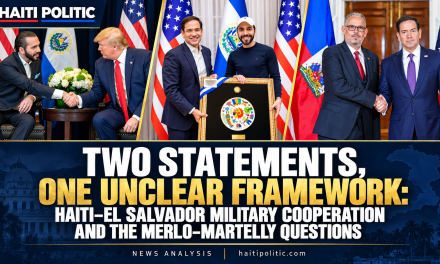
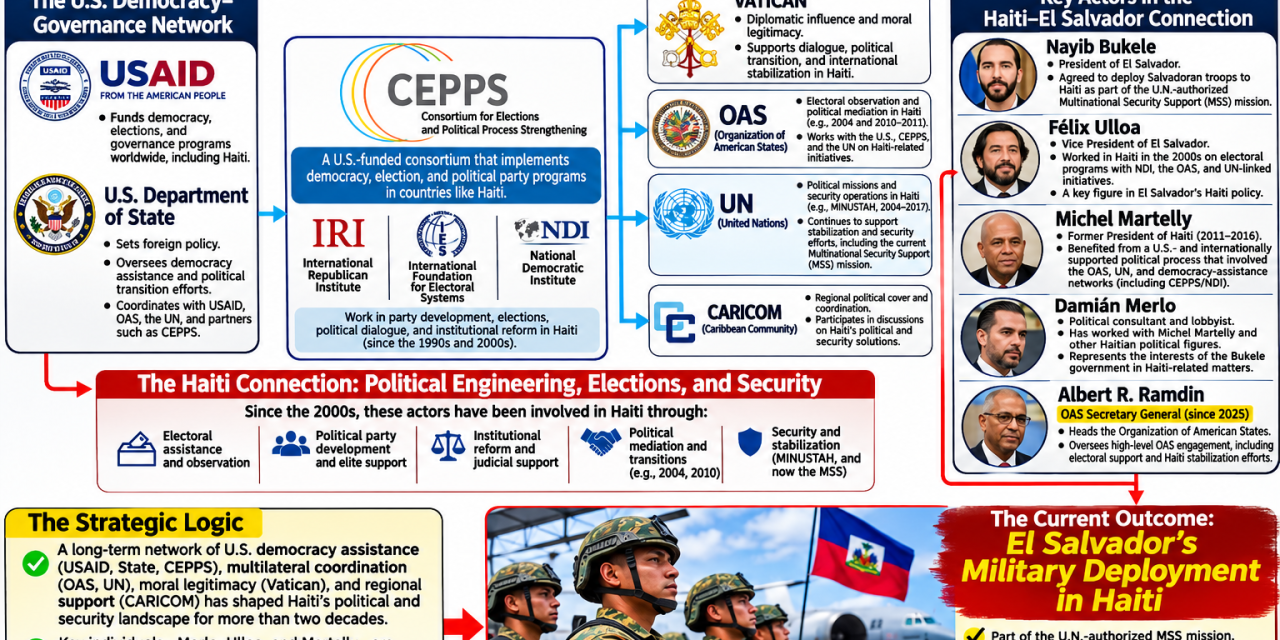
Inside the connections linking USAID, the U.S. State Department, CEPPS, IRI, IFES, NDI, the OAS, the United Nations, CARICOM, the Vatican, Albert Ramdin, Damián Merlo, Félix Ulloa, Nayib Bukele, and Michel Martelly.
HAITI POLITIC — Political Investigation & Analysis
Updated: November 7, 2026
From Hillary Clinton’s intervention in Haiti’s disputed 2010–2011 presidential election to the reported deployment of Salvadoran troops in 2026, Haiti’s political history reveals a recurring question: Where does international assistance end, and foreign influence over national decisions begin?
INTRODUCTION: A NETWORK THAT DESERVES EXAMINATION
For more than two decades, Haiti has been the focus of international programs intended to strengthen democracy, support elections, stabilize political institutions, and improve national security.
The United States has financed electoral assistance through USAID and organizations operating under the Consortium for Elections and Political Process Strengthening (CEPPS).
The Organization of American States (OAS) has participated in electoral observation, political mediation, and institutional assistance.
The United Nations has deployed peacekeeping and security missions.
CARICOM has participated in political negotiations and regional diplomatic initiatives.
The Vatican has maintained diplomatic relationships with successive Haitian governments.
More recently, El Salvador, under President Nayib Bukele, has become involved in Haiti’s international security arrangements.
These developments raise important questions about how international institutions interact, how political relationships evolve, and whether Haiti has developed sufficient safeguards to protect its sovereignty.
The relationships are real in several important respects. However, their existence does not establish that all these institutions participate in a single coordinated political operation.
To understand the situation, Haiti Politic examines the historical record, the individuals involved, and the questions that remain unanswered.
PART I — THE AMERICAN DEMOCRACY-ASSISTANCE NETWORK
1. USAID AND THE U.S. DEPARTMENT OF STATE
The United States has been one of Haiti’s most important international partners in electoral assistance and democratic governance.
USAID has supported programs involving electoral administration, civic education, political participation, institutional development, and governance.
The U.S. Department of State establishes American foreign-policy priorities and maintains diplomatic relationships with Haitian governments.
Although the two institutions perform different functions, their activities can intersect during major political crises.
That relationship became particularly significant during Haiti’s disputed 2010–2011 presidential election.
American financing of Haiti’s 2010 election
According to a January 2011 State Department statement, USAID contributed approximately $14.5 million to support Haiti’s electoral process.
That assistance included funding for electoral administration, training, materials, and other election-related activities.
Approximately $5 million supported an electoral fund administered through the United Nations Development Programme.
American assistance also supported international election observation activities.
This establishes an important historical fact:
Washington was not simply observing Haiti’s electoral crisis from a distance. It was a significant financial and diplomatic participant in the electoral environment.
However, financing an election does not automatically establish control over its results.
That distinction is essential.
2. CEPPS, IRI, IFES, AND NDI: HOW THE NETWORK OPERATES
CEPPS stands for the Consortium for Elections and Political Process Strengthening.
It brings together three organizations:
The International Republican Institute (IRI) works on democratic governance, political institutions, and political participation.
The International Foundation for Electoral Systems (IFES) provides technical assistance involving election administration, electoral institutions, and electoral systems.
The National Democratic Institute (NDI) supports democratic institutions, political parties, civic organizations, and political participation.
These organizations have received American government funding for democracy-assistance programs internationally.
In 2022, the U.S. Department of State reported that USAID had provided more than $3 million for CEPPS activities in Haiti.
Those activities included assistance to Haiti’s Provisional Electoral Council, training, strategic planning, and electoral information systems.
Why does this matter?
International electoral assistance can strengthen institutions that lack adequate resources.
But it also creates important questions about transparency and institutional independence.
Who determines the priorities of technical assistance?
Who selects the consultants?
Who controls electoral databases and information systems?
Can Haitian authorities independently audit the systems installed or supported by international partners?
And what safeguards prevent donor preferences from influencing electoral decisions?
These are legitimate governance questions.
They should not be confused with proof that CEPPS, IRI, IFES, or NDI manipulated Haitian elections.
PART II — THE 2010–2011 ELECTION: WHEN INTERNATIONAL PRESSURE CHANGED HAITI’S POLITICAL LANDSCAPE
3. MIRLANDE MANIGAT, JUDE CÉLESTIN, AND MICHEL MARTELLY
On November 28, 2010, Haiti held presidential and legislative elections under extraordinarily difficult circumstances.
The country was still recovering from the devastating January earthquake.
Government institutions were weakened, large numbers of citizens were displaced, and international assistance played an important role in the country’s recovery.
On December 7, 2010, Haiti’s Provisional Electoral Council announced preliminary first-round presidential results:
| Candidate | Preliminary vote share |
|---|---|
| Mirlande Manigat | 31.37% |
| Jude Célestin | 22.48% |
| Michel Martelly | 21.84% |
Under those results, Manigat and Célestin would advance to the runoff.
Martelly finished third.
However, the announcement triggered demonstrations, accusations of electoral fraud, and a political crisis.
Martelly’s supporters challenged the results, alleging irregularities that benefited Célestin, the candidate associated with President René Préval’s political movement.
An OAS expert mission subsequently examined the results.
After reviewing electoral irregularities and recommending adjustments, the mission concluded that Martelly should move into second place.
The proposed revision would eliminate Célestin from the runoff.
The methodology and authority of the OAS review became subjects of controversy.
Nevertheless, its recommendations had major political consequences.
4. HILLARY CLINTON’S JANUARY 2011 INTERVENTION
On January 30, 2011, U.S. Secretary of State Hillary Clinton traveled to Haiti.
She met with President René Préval and political leaders during the electoral crisis.
According to the Congressional Research Service, the United States and other international partners pressured the Haitian government to accept the OAS recommendations.
Washington also revoked visas belonging to certain Haitian officials and warned that American assistance could be reconsidered.
On February 3, 2011, Haiti’s electoral authorities published final first-round results.
Michel Martelly qualified for the runoff against Mirlande Manigat.
Jude Célestin was eliminated.
Martelly subsequently won the second round and became president.
Did Hillary Clinton select Michel Martelly?
The historical record supports a more precise conclusion.
Washington exerted diplomatic pressure in favor of accepting an electoral review that enabled Martelly to participate in the runoff.
That is documented.
However, the available evidence does not establish that Clinton personally selected Martelly as president or controlled the final vote count.
The distinction matters because it identifies the actual political issue.
A foreign government exercised substantial influence during a Haitian electoral dispute.
Whether that intervention was justified as a response to irregularities or represented excessive foreign interference remains a legitimate subject of historical and political debate.
Haiti Politic asks:
If the United States could exert diplomatic pressure over a decision affecting Haiti’s presidential runoff in 2011, what institutional protections exist to prevent similar pressure during future elections?
PART III — FÉLIX ULLOA: FROM ELECTORAL ASSISTANCE TO EL SALVADOR’S VICE PRESIDENCY
5. A LONG HISTORY WITH HAITI
Félix Augusto Antonio Ulloa Garay is currently vice president of El Salvador.
Long before assuming that position, Ulloa worked in international electoral assistance.
Biographical information from the ACE Electoral Knowledge Network identifies him as a senior resident director for NDI in Haiti beginning in 2000.
His professional background includes electoral administration and international democracy-related activities.
Historical records also associate him with OAS electoral assistance initiatives concerning Haiti.
This establishes that Ulloa developed professional experience with Haiti’s electoral and institutional environment more than two decades ago.
It does not establish that he commanded a United Nations mission or participated in military operations during that period.
Why is Ulloa relevant today?
Ulloa now serves in the administration of Nayib Bukele, whose government has become involved in Haiti’s international security efforts.
The historical connection is therefore noteworthy.
An individual who previously worked on Haiti’s electoral institutions now occupies a senior political position in a government participating in Haiti’s security arrangements.
But continuity in a person’s professional experience does not prove continuity in a political plan.
Questions for Félix Ulloa
What relationships does Ulloa maintain with Haitian political figures from his earlier work?
Did he participate in negotiations concerning Salvadoran security assistance?
What role does he play in shaping El Salvador’s Haiti policy?
And what lessons from his earlier experience with Haitian institutions influence his current recommendations?
PART IV — DAMIÁN MERLO: POLITICAL CONSULTING, LOBBYING, AND HAITI’S SECURITY DEBATE
6. WHO IS DAMIÁN MERLO?
Damián Merlo is a political consultant and lobbyist whose professional activities have intersected with Haitian and Salvadoran politics.
Public reporting and lobbying disclosures have associated him with former Haitian President Michel Martelly and political activities involving the Bukele administration.
He has also publicly discussed Haiti’s security crisis and international intervention.
These relationships make him relevant to an investigation of political consulting, lobbying, and foreign-policy influence.
However, his professional connections should not be mistaken for proof that he exercises official military command or controls the decisions of international organizations.
A necessary correction
An earlier Haiti Politic infographic incorrectly identified an individual named Christian Merlo as the head of an OAS mission in Haiti.
That identification could not be substantiated.
The revised investigation removes Christian Merlo entirely.
Damián Merlo is the political consultant under examination.
No verified evidence establishes a family relationship between Damián Merlo and the previously identified Christian Merlo.
7. THE MERLO–MARTELLY CONNECTION
Merlo’s reported professional relationship with Michel Martelly deserves particular examination because Martelly remains an important figure in Haiti’s recent political history.
Martelly became president following the controversial 2010–2011 election.
He served from 2011 to 2016.
In August 2024, the U.S. Treasury Department imposed sanctions on Martelly under authorities addressing international drug trafficking.
The Treasury accused him of abusing his influence to facilitate drug trafficking, laundering illicit proceeds, and supporting gang activity.
These were administrative sanctions, not a criminal conviction.
The historical sequence raises questions about the political relationships surrounding Martelly and the evolution of American policy toward him.
It does not establish that Merlo participated in the conduct alleged by the Treasury Department.
Nor does it establish that Merlo influenced the 2011 electoral review.
Questions requiring investigation
What consulting or lobbying agreements existed between Merlo and Martelly?
What services were provided?
Which agreements were registered under the Foreign Agents Registration Act?
Did the relationship continue after Martelly left office?
And does any documented professional relationship exist between Martelly, Merlo, and the Salvadoran government’s current Haiti policy?
The answers require contracts, registration records, financial disclosures, and direct testimony.
8. THE MERLO–BUKELE CONNECTION
Merlo has also been associated with the Salvadoran government under President Nayib Bukele.
His involvement in political consulting and lobbying makes him a relevant figure when examining El Salvador’s international relationships.
In reporting concerning Haiti’s security situation, Merlo has discussed coordination involving Salvadoran personnel and Haitian authorities.
But several distinctions are necessary.
A lobbyist may represent a government’s interests without holding an official government position.
A consultant may advocate a policy without controlling its implementation.
And a professional relationship with a president does not automatically confer authority over military operations.
Haiti Politic’s questions for Damián Merlo
What is the precise scope of his professional relationship with the Bukele administration?
Has he participated in discussions concerning Salvadoran security operations in Haiti?
Has he received compensation for Haiti-related lobbying or consulting?
Has he communicated with Haitian officials about military deployment, security contracts, or operational financing?
And has he maintained contact with Michel Martelly concerning Haiti’s current political or security situation?
These questions should be answered through documentary evidence rather than assumptions based on overlapping political relationships.
PART V — ALBERT R. RAMDIN: THE OAS SECRETARY GENERAL AND HAITI’S REGIONAL DIPLOMACY
9. WHO IS ALBERT RAMDIN?
Albert R. Ramdin is a Surinamese diplomat who became Secretary General of the Organization of American States in 2025.
Before assuming that position, Ramdin held senior diplomatic responsibilities, including serving as Suriname’s foreign minister.
He also previously served as OAS Assistant Secretary General.
His experience places him within the institutional history of regional diplomacy in the Americas.
As Secretary General, Ramdin leads the OAS and participates in high-level diplomatic discussions involving member states.
His responsibilities are fundamentally different from those of Damián Merlo.
Ramdin is the head of a multilateral organization. Merlo is a private political consultant and lobbyist.
They should not be presented as holding equivalent positions.
10. RAMDIN AND THE OAS’S ROLE IN HAITI
The OAS has a long history of involvement in Haiti.
Its activities have included election observation, institutional assistance, political mediation, and diplomatic coordination.
The organization’s role during the 2010–2011 electoral crisis remains particularly significant.
In 2025, the OAS presented a stabilization roadmap addressing Haiti’s security, governance, humanitarian needs, and institutional recovery.
The plan envisioned cooperation with the United Nations, CARICOM, and other partners.
Under Ramdin’s leadership, the OAS has continued to address Haiti’s political and security challenges.
This creates an important question about institutional continuity.
The OAS participated in a controversial electoral review in 2011.
Today, it continues to participate in international discussions concerning Haiti’s stabilization and future elections.
Questions for Albert Ramdin
What lessons has the OAS drawn from its controversial role in the 2010–2011 election?
What safeguards prevent international electoral assistance from becoming political interference?
How does the OAS distinguish between supporting Haitian institutions and influencing their decisions?
What role does the organization play in discussions concerning foreign military participation in Haiti?
And will the OAS publish detailed information about its Haiti-related programs, budgets, agreements, and institutional partners?
Is Ramdin connected to Merlo?
Both individuals operate within the broader political and diplomatic environment surrounding Haiti.
However, their participation in discussions about the same country does not establish a personal, financial, or coordinated political relationship.
No such relationship should be asserted without documentary evidence.
PART VI — THE UNITED NATIONS, CARICOM, AND THE VATICAN
11. THE UNITED NATIONS: FROM MINUSTAH TO NEW SECURITY ARRANGEMENTS
The United Nations has played a major role in Haiti’s international security environment.
MINUSTAH operated from 2004 to 2017.
Subsequent UN activities included political assistance and institutional support.
In October 2023, the UN Security Council authorized the Multinational Security Support Mission to assist Haiti’s security institutions.
The mission was intended to support efforts against armed gangs and improve security conditions.
However, authorization of an international mission does not mean that every foreign soldier operating in Haiti automatically falls under the same command structure.
Different deployments may involve distinct legal agreements, mandates, and operational arrangements.
That distinction is particularly important when examining Salvadoran military participation.
12. CARICOM: REGIONAL DIPLOMACY AND POLITICAL TRANSITION
CARICOM has participated in diplomatic efforts concerning Haiti’s political transition.
Its activities have included facilitating discussions among Haitian political actors and supporting regional coordination.
CARICOM’s involvement illustrates how regional institutions can influence political negotiations without necessarily exercising formal authority over Haitian government decisions.
Nevertheless, the organization should be accountable for the recommendations and agreements it supports.
What political arrangements has CARICOM facilitated?
Which Haitian organizations participated?
How were representatives selected?
And how does CARICOM evaluate whether the agreements it supports have achieved their stated objectives?
13. THE VATICAN: DIPLOMATIC INFLUENCE AND MORAL AUTHORITY
The Vatican maintains diplomatic relations with Haiti and has repeatedly expressed concern about the country’s humanitarian and political situation.
Papal meetings with Haitian officials demonstrate the Vatican’s continued diplomatic interest.
However, diplomatic engagement is not evidence of military command, electoral manipulation, or participation in a coordinated political operation.
No verified evidence presented in this investigation establishes that the Vatican directed the 2011 electoral intervention or El Salvador’s military activities.
Its role should therefore be understood primarily through diplomacy, humanitarian concerns, and moral advocacy unless additional evidence demonstrates otherwise.
PART VII — NAYIB BUKELE AND EL SALVADOR’S MILITARY ROLE IN HAITI
14. FROM ELECTORAL COOPERATION TO SECURITY OPERATIONS
El Salvador’s relationship with Haiti has developed through different institutional channels.
Félix Ulloa’s earlier work involved electoral assistance.
More recently, the Salvadoran government has participated in international security arrangements concerning Haiti.
In October 2024, El Salvador adopted legislation enabling its armed forces to participate in the Multinational Security Support Mission.
That decision established a legal basis under Salvadoran law for participation in international security operations.
Reports from late 2026 have described a significant expansion of Salvadoran military involvement following an attack involving Salvadoran aviation personnel.
However, the precise number of troops, their operational assignments, and their relationship to existing international security structures require verification through official deployment records.
The central question
Does El Salvador’s military participation represent a limited security contribution, or is it becoming a longer-term foreign military presence requiring additional political and legal oversight?
Answering that question requires more than public statements.
It requires examining the agreements governing the deployment.
15. WHO COMMANDS SALVADORAN FORCES IN HAITI?
Military operations require clear legal authority.
When foreign troops operate on another country’s territory, several questions become essential.
Who authorizes their missions?
Who establishes the rules of engagement?
Who exercises operational command?
What responsibilities belong to the Haitian government?
What authority belongs to the Salvadoran government?
What responsibilities, if any, belong to the international mission coordinating the operation?
And what happens when a military action causes civilian casualties?
Without clear answers, it becomes difficult to determine responsibility.
A foreign military presence cannot be evaluated solely by the number of gang members arrested or killed.
It must also be evaluated by legality, accountability, civilian protection, and measurable improvements in public security.
PART VIII — WHO FINANCES THE OPERATION?
16. THE FINANCIAL QUESTIONS BEHIND FOREIGN SECURITY ASSISTANCE
International security missions require substantial resources.
Costs may include transportation, aircraft, equipment, fuel, communications, medical services, accommodation, and personnel support.
When several governments and international institutions participate, financial accountability becomes especially important.
Haiti Politic believes the following information should be publicly available:
-
The legal agreements governing Salvadoran military participation.
-
The official deployment budget.
-
The institutions responsible for financing the operation.
-
Any contracts involving private security, transportation, or logistical companies.
-
The procedures used to investigate civilian casualties.
-
The duration of the deployment and conditions for withdrawal.
The existence of international financing does not itself establish corruption or improper influence.
But the absence of transparent financial reporting makes independent oversight more difficult.
PART IX — MIRLANDE MANIGAT, ETZER ÉMILE, AND HAITI’S POLITICAL FUTURE
17. WHAT HAS HAITI’S POLITICAL CLASS LEARNED?
Mirlande Manigat experienced the 2010–2011 electoral controversy as a presidential candidate.
She participated in the runoff against Michel Martelly after the OAS review and Washington’s diplomatic intervention.
Her political experience makes her an important figure to question about the historical consequences of that election.
Etzer Émile, an economist associated with a newer generation of Haitian political figures, represents a different political background.
Their involvement in contemporary political discussions raises questions about whether established and emerging political actors are prepared to reform the institutions that have repeatedly failed Haiti.
Questions for Mirlande Manigat
Does she believe the 2011 electoral process respected Haiti’s sovereignty?
What is her assessment of Hillary Clinton’s intervention?
What institutional reforms would she support to prevent similar controversies?
Questions for Etzer Émile
How would he reduce Haiti’s dependence on foreign financing?
What reforms would protect the CEP’s independence?
Would he support public disclosure of all international electoral assistance contracts?
What economic strategy would enable Haiti to finance more of its own democratic institutions?
Political renewal requires more than new personalities. It requires institutions capable of functioning independently of political pressure, whether domestic or foreign.
PART X — THE DOCUMENTED CONNECTIONS AND THE UNANSWERED QUESTIONS
18. WHAT THE EVIDENCE ESTABLISHES
The available historical record supports several important conclusions.
First, the United States has financed democratic assistance and electoral programs in Haiti through USAID and other institutional partners.
Second, CEPPS, IRI, IFES, and NDI have participated in international programs supporting democratic institutions and electoral processes.
Third, the OAS participated in the 2010–2011 electoral review that recommended changing the candidates advancing to the presidential runoff.
Fourth, the United States exerted diplomatic pressure on Haiti’s government to accept the OAS recommendations.
Fifth, Félix Ulloa worked in electoral assistance involving Haiti before becoming vice president of El Salvador.
Sixth, Damián Merlo has professional connections to political actors associated with Haiti and El Salvador.
Seventh, Albert Ramdin became OAS Secretary General in 2025 and leads an organization with a long history of involvement in Haiti.
Eighth, El Salvador has participated in international security arrangements concerning Haiti.
Together, these facts demonstrate overlapping institutional histories and political relationships.
They do not establish that all the individuals and organizations are members of a single coordinated network controlling Haiti’s political future.
19. WHAT REMAINS UNPROVEN
Several allegations require additional evidence.
There is no established basis in the material reviewed to conclude that CEPPS, NDI, IRI, or IFES directed Haiti’s 2011 election results.
There is no demonstrated connection establishing that the Vatican directed the Salvadoran military deployment.
There is no verified evidence that Albert Ramdin and Damián Merlo jointly organized a political or military operation in Haiti.
There is no established evidence that Félix Ulloa’s earlier electoral work in Haiti formed part of a long-term plan to deploy Salvadoran troops.
And the existence of professional relationships involving Merlo, Martelly, and the Bukele administration does not establish that those individuals jointly control Haiti’s security policy.
These distinctions are essential.
An investigation becomes stronger when it identifies what is documented, what is plausible, and what remains unproven.
PART XI — FIFTEEN QUESTIONS THAT DESERVE PUBLIC ANSWERS
To the U.S. Department of State
1. What diplomatic objectives guided Washington’s intervention in Haiti’s 2010–2011 electoral crisis?
2. What safeguards currently prevent American diplomatic or financial pressure from influencing Haiti’s electoral decisions?
To USAID and CEPPS
3. How much funding has been allocated to Haitian electoral assistance since 2010?
4. Which contracts, technical assistance agreements, and performance evaluations are publicly available?
To the OAS and Albert Ramdin
5. What institutional lessons did the OAS draw from its controversial 2011 electoral review?
6. What is the OAS’s precise role in current discussions involving Haiti’s security and electoral transition?
To Félix Ulloa
7. What relationships from your earlier electoral work in Haiti remain relevant to your current responsibilities?
8. What role have you played in discussions concerning Salvadoran security assistance to Haiti?
To Damián Merlo
9. What consulting or lobbying agreements have you maintained with Haitian and Salvadoran political actors?
10. Have you participated in negotiations concerning Salvadoran military activities in Haiti?
To Nayib Bukele
11. What legal agreements govern the presence and operational authority of Salvadoran military personnel in Haiti?
12. What are the financial costs, operational objectives, and withdrawal conditions of the deployment?
To Michel Martelly
13. What professional or political relationships do you currently maintain with individuals involved in international security discussions concerning Haiti?
To Haiti’s Government
14. Will the government publish the agreements governing foreign military operations and international electoral assistance?
15. What concrete plan exists to strengthen the Haitian National Police, the justice system, and national institutions so that foreign security assistance becomes less necessary?
CONCLUSION — FROM HILLARY CLINTON TO NAYIB BUKELE: WHO HAS THE FINAL SAY OVER HAITI?
Haiti’s modern political history demonstrates the enduring importance of international financing, diplomacy, electoral assistance, and security cooperation.
In 2011, the United States exerted diplomatic pressure during a disputed presidential election.
The OAS recommended revisions to the first-round results.
Michel Martelly advanced to the runoff and ultimately became president.
Years later, the United States imposed sanctions on Martelly.
Meanwhile, Haiti continued to experience political instability, institutional weakness, and armed violence.
Today, new international actors have entered the security debate.
El Salvador’s President Nayib Bukele has become a prominent figure in discussions concerning foreign military assistance.
Vice President Félix Ulloa brings a history of involvement in Haiti’s electoral assistance environment.
Damián Merlo represents another dimension of the story through political consulting and lobbying.
Albert Ramdin leads the OAS, an institution that has participated in Haitian political and electoral affairs for decades.
The United Nations, CARICOM, the United States, and other international partners continue to influence the diplomatic environment surrounding Haiti.
But an important distinction must remain clear.
Overlapping political relationships do not automatically establish a coordinated conspiracy.
What they establish is the need for transparency.
Haiti’s citizens deserve to know who finances their elections, who advises their political leaders, who negotiates security agreements, and who commands foreign military personnel operating on Haitian territory.
The central issue is not whether Haiti should reject every form of international assistance.
It is whether international assistance strengthens Haitian institutions or perpetuates dependence on foreign decision-making.
A sustainable solution requires a properly equipped Haitian National Police, an independent justice system, credible elections, accountable political leadership, and institutions capable of defending national sovereignty.
HAITI POLITIC’S FINAL QUESTION
If Washington could exert diplomatic pressure over Haiti’s electoral process in 2011, what guarantees exist today to ensure that Haitians retain the final authority over their elections, their security, and their political future?
Haiti does not need another generation of international promises without measurable results.
It needs institutions that work, leaders who answer to the people, and a political system in which sovereignty is exercised rather than merely proclaimed.
HAITI POLITIC — THE QUESTIONS MUST BE ASKED. THE DOCUMENTS MUST SPEAK. THE PEOPLE DESERVE ANSWERS.