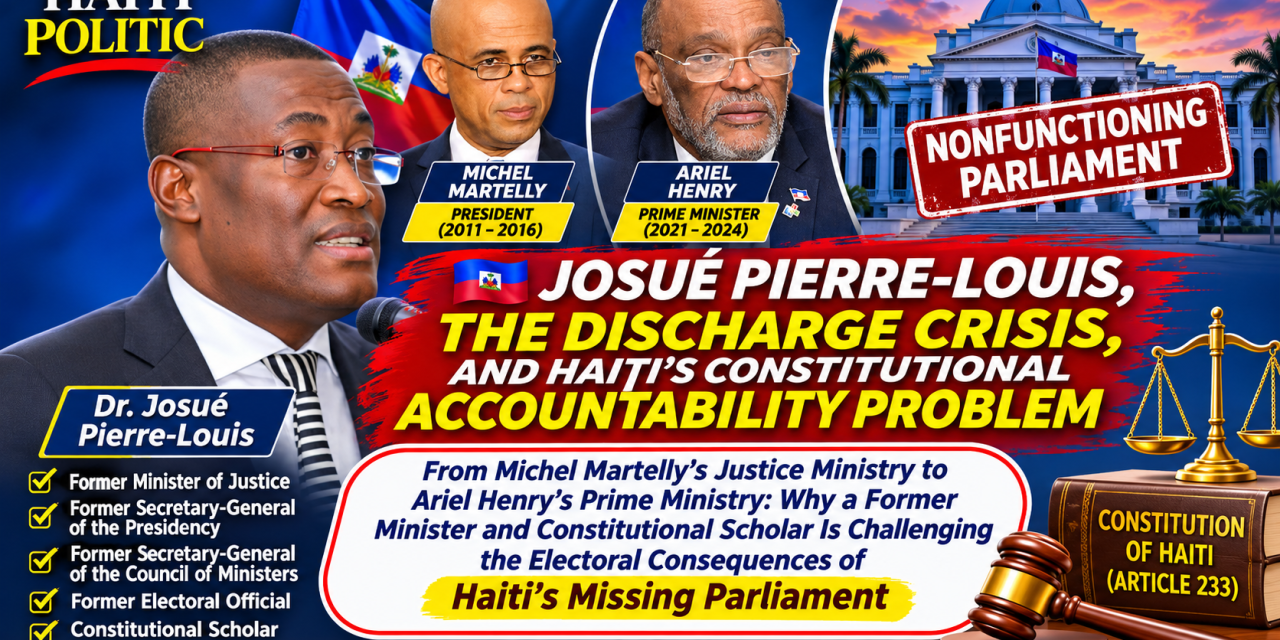
From Michel Martelly’s Justice Ministry to Ariel Henry’s Presidency: Why a Former Minister and Constitutional Scholar Is Challenging the Electoral Consequences of Haiti’s Missing Parliament
HAITI POLITIC — SPECIAL INVESTIGATION
Constitutional Law | Political Accountability | Elections 2027
November 13, 2026
As Haiti’s Superior Court of Auditors reaffirms that only Parliament can grant financial discharge to former ministers, constitutional scholar Dr. Josué Pierre-Louis argues that candidates should not be penalized for an institutional vacuum they did not create. But his extensive career inside Haiti’s executive branch raises another important question: How should former public officials demonstrate financial accountability when the institutions responsible for reviewing their management no longer function?
INTRODUCTION: A CONSTITUTIONAL EXPERT WHO HAS ALSO BEEN PART OF THE GOVERNMENT
Haiti is confronting a constitutional contradiction with potentially significant consequences for its next elections.
Former presidents, prime ministers, ministers, senators, deputies, and other public officials are seeking to return to political office.
Many previously occupied positions carrying legal obligations concerning public financial management, asset declarations, or both.
Yet the institution constitutionally responsible for granting parliamentary discharge to former ministers is not functioning.
On November 12, 2026, Haiti’s Cour Supérieure des Comptes et du Contentieux Administratif (CSCCA) issued an advisory reaffirming that it cannot replace Parliament in granting financial discharge to former prime ministers and ministers.
The advisory immediately raised questions about the eligibility of former government officials seeking elected office.
Among those addressing the controversy is Dr. Josué Pierre-Louis, a Haitian constitutional scholar and former minister of justice.
According to a statement attributed to him, candidates cannot reasonably be penalized for failing to obtain a document that only a currently absent institution is authorized to issue.
His argument raises a legitimate legal problem.
But Pierre-Louis’s intervention deserves particular attention for another reason.
He is not simply a constitutional scholar commenting on Haiti’s political system from the outside. He has spent decades working inside that system.
His career includes service as minister of justice, secretary-general of the Presidency, secretary-general of the Prime Minister’s Office, senior electoral official, diplomat, and secretary-general of the Council of Ministers.
He served in senior positions during the administrations of Michel Martelly, Jovenel Moïse, and Ariel Henry.
That history provides important context for understanding his interpretation of the discharge controversy.
It also raises questions about the financial-accountability obligations applicable to officials who have held multiple senior government appointments.
The central question is not whether Pierre-Louis has the right to interpret Haiti’s Constitution. He does.
The question is whether the solution he advocates can protect electoral rights without weakening the constitutional obligation to account for public resources.
PART I — WHO IS DR. JOSUÉ PIERRE-LOUIS?
1. FROM THE JUDICIARY TO THE HIGHEST LEVELS OF GOVERNMENT
Josué Pierre-Louis was born on June 16, 1970, in Petit-Goâve, Haiti.
His professional background includes legal education, judicial administration, constitutional studies, and senior public administration.
According to a curriculum vitae preserved in European parliamentary records, Pierre-Louis earned a law degree from the State University of Haiti and a doctorate in law from Université Paul Cézanne Aix-Marseille III in France.
His doctoral research examined the modernization of Haitian law.
He also pursued studies at France’s École nationale d’administration and École nationale de la magistrature.
His professional experience includes service as a government prosecutor, appellate judge, senior justice official, and university professor.
His career eventually brought him into the executive branch, where he held several positions involving national administration and institutional decision-making.
His government experience is therefore substantial, extending well beyond academic constitutional interpretation.
Source: European parliamentary archive — Josué Pierre-Louis curriculum vitae.
2. A CAREER ACROSS SEVERAL HAITIAN ADMINISTRATIONS
Pierre-Louis’s professional history illustrates how senior public administrators can remain influential across successive governments.
His documented positions include:
| Period | Government position |
|---|---|
| 1995 | Deputy government commissioner, Petit-Goâve |
| 1999 | Deputy government commissioner, Port-au-Prince |
| 2001 | Government commissioner, Port-au-Prince |
| 2005 | Judge at the Court of Appeal |
| 2006 | Director general, Ministry of Justice |
| 2011 | Minister of Justice and Public Security |
| 2012 | Secretary-general of the Presidency |
| 2012 | Senior leadership of Haiti’s Electoral Council |
| Subsequent years | Haitian diplomatic representative to European institutions |
| 2015–2016 | Secretary-general of the Prime Minister’s Office |
| 2017 | General coordinator, Office of Management and Human Resources |
| September 2021 | Secretary-general of the Council of Ministers |
| November 2021 | Secretary-general of the Presidency |
The Haitian government’s September 16, 2021 announcement confirms many of these appointments.
It also confirms that Pierre-Louis received ministerial rank when appointed secretary-general of the Council of Ministers.
This career history matters because different public offices carry different legal responsibilities.
Some involve direct management of public funds.
Others involve administrative supervision, policy coordination, or institutional representation.
Those distinctions must be examined before determining which financial-accountability requirements applied to a particular official.
Source: Haitian government — Installation of Josué Pierre-Louis, September 16, 2021.
PART II — THE MICHEL MARTELLY CONNECTION
3. PIERRE-LOUIS SERVED AS MINISTER OF JUSTICE IN 2011
One of the most important periods in Pierre-Louis’s political career occurred during Michel Martelly’s presidency.
In October 2011, Pierre-Louis became Haiti’s minister of justice and public security.
He subsequently occupied senior positions within the presidential administration.
By 2012, he had served as secretary-general of the Presidency and held a leadership position within Haiti’s electoral administration.
These appointments placed him within institutions responsible for administering justice, supporting executive decision-making, and overseeing electoral processes.
His service during the Martelly administration is a documented part of his career.
However, holding those positions does not, by itself, establish involvement in any alleged misconduct associated with that administration.
Why this history matters today
Pierre-Louis now offers a legal interpretation that could be relevant to former ministers seeking to return to elected office.
Former President Michel Martelly and other former government officials have also been part of the broader public debate over electoral eligibility and financial discharge.
That makes Pierre-Louis’s earlier government service relevant context.
But it would be inaccurate to conclude, without evidence, that his constitutional position is intended to benefit Martelly or any particular political group.
The appropriate question is whether Pierre-Louis’s interpretation applies consistently to every former official, regardless of political affiliation.
A constitutional principle cannot depend on whether the person invoking it belongs to a favored administration.
PART III — HIS RETURN TO POWER UNDER ARIEL HENRY
4. SEPTEMBER 2021: SECRETARY-GENERAL OF THE COUNCIL OF MINISTERS
Following President Jovenel Moïse’s assassination on July 7, 2021, Haiti entered another period of political uncertainty.
Prime Minister Ariel Henry assumed leadership of the government.
On September 16, 2021, Henry appointed Pierre-Louis secretary-general of the Council of Ministers, with ministerial rank.
The Haitian government’s official announcement confirmed the appointment and summarized Pierre-Louis’s previous government responsibilities.
The position placed him within the administrative structure supporting the Council of Ministers.
It also renewed his direct involvement in executive-branch administration.
This appointment is significant because Pierre-Louis returned to senior government service during a period when Haiti’s Parliament was already nonfunctional.
That institutional reality is now central to his argument about financial discharge.
Source: Haitian government announcement, September 16, 2021.
5. NOVEMBER 2021: A CONTROVERSIAL APPOINTMENT AT THE NATIONAL PALACE
Approximately two months later, Pierre-Louis received another important appointment.
In November 2021, Prime Minister Ariel Henry appointed him secretary-general of the Presidency, with ministerial rank.
He replaced Lyonel Valbrun.
The appointment generated an institutional dispute.
Valbrun challenged the circumstances surrounding his removal, and Pierre-Louis’s installation reportedly encountered resistance at the National Palace.
The ceremony eventually proceeded under the authority of Justice Minister Berto Dorcé.
This episode raises an institutional question separate from the current discharge controversy.
What legal authority governs appointments to the Presidency’s administrative leadership when the country has no sitting president?
That question is particularly relevant to Haiti’s experience after July 2021.
The dispute over Pierre-Louis’s appointment illustrates the broader constitutional uncertainty surrounding executive power during periods of institutional breakdown.
However, the reported confrontation does not establish that his appointment was ultimately declared unlawful.
A definitive legal assessment would require examining the appointment order, the relevant statutory provisions, and any judicial decisions concerning the dispute.
PART IV — THE NOVEMBER 12, 2026 DISCHARGE CONTROVERSY
6. WHAT DID HAITI’S SUPERIOR COURT OF AUDITORS ACTUALLY SAY?
On November 12, 2026, the CSCCA published an advisory addressed to former prime ministers and ministers.
The Court reaffirmed that it does not possess constitutional authority to replace Parliament in granting discharge for ministerial management.
The advisory relies on several legal provisions.
Article 233 of Haiti’s Constitution
Article 233 establishes a parliamentary mechanism for reviewing ministerial management.
It provides for a commission composed of:
Nine deputies and six senators.
The commission examines ministerial management and reports to both parliamentary chambers so that they can decide whether to grant discharge.
The constitutional provision assigns this responsibility to the legislative branch.
Article 89 of the May 4, 2016 law
The CSCCA also refers to legislation governing the preparation and execution of public finances.
The cited provision addresses Parliament’s continuing oversight of public expenditures.
Article 205 of the Senate’s internal regulations
The advisory further references the Senate’s procedures concerning the parliamentary commission responsible for examining financial-management reports.
Together, these provisions reinforce the constitutional distinction between financial auditing and parliamentary discharge.
What the Court did not say
The CSCCA did not announce that it could assume Parliament’s responsibilities because Parliament was absent.
It did not create a new discharge procedure for former ministers.
It did not automatically exempt former officials from financial accountability.
And it did not establish that every former minister was eligible to participate in the next elections.
Instead, the Court reaffirmed the limits of its own authority.
Its position is that constitutional powers cannot simply be transferred from one institution to another because the institution originally responsible is not functioning.
The Court also distinguished its jurisdiction over individuals legally classified as comptables de fait—persons who may be held accountable for handling public funds without the corresponding formal accounting authority.
That is a separate jurisdictional issue and should not be confused with ordinary parliamentary discharge.
Sources:
PART V — WHAT IS JOSUÉ PIERRE-LOUIS ARGUING?
7. CAN A CANDIDATE BE PENALIZED FOR THE ABSENCE OF PARLIAMENT?
According to the statement attributed to Pierre-Louis, the CSCCA advisory changes the legal debate surrounding former ministers seeking elected office.
His reported argument is straightforward.
If Parliament is the only institution authorized to grant discharge, and Parliament is not functioning, former officials cannot obtain the required document through the ordinary constitutional procedure.
He argues that they should not be penalized for an institutional vacuum they did not create.
The statement further suggests that candidates rejected because they cannot produce discharge documentation could challenge those decisions before the competent electoral courts.
This position raises a serious constitutional issue.
Can the state require a person to produce a document that no functioning institution is legally authorized to issue?
In legal terms, Pierre-Louis’s reasoning resembles an argument based on impossibility of compliance.
It also raises questions about proportionality, equality before the law, and political participation.
However, an important distinction must be maintained.
The inability to obtain a parliamentary discharge does not automatically establish that an official’s management was satisfactory.
Nor does it automatically establish that the electoral authority must disregard every documentary requirement.
The precise legal outcome depends on the Constitution, electoral legislation, applicable procedures, and decisions of competent courts.
An important verification limitation
The statement attributed to Pierre-Louis has been reproduced in public commentary, but Haiti Politic has not independently obtained his complete original legal opinion.
Consequently, this article analyzes the position attributed to him without claiming that every aspect of his reasoning has been independently verified.
PART VI — THE DIFFERENCE BETWEEN PIERRE-LOUIS AND LAURENT LAMOTHE
8. TWO ARGUMENTS, TWO POSSIBLE LEGAL SOLUTIONS
Former Prime Minister Laurent Lamothe has also publicly addressed the discharge controversy.
Lamothe argues that Parliament is responsible for granting discharge and that the absence of Parliament creates an obstacle for former ministers seeking elected office.
He has referred to executive decrees issued during previous periods without a functioning Parliament.
He also claims that he benefited from a 2021 discharge measure following favorable audit reports.
Lamothe proposes that the government consider another decree for former officials who possess favorable audit reports.
Pierre-Louis’s reported position emphasizes a different mechanism.
He argues that candidates who cannot produce discharge because Parliament is absent may seek judicial protection if their applications are rejected.
The distinction is important.
Laurent Lamothe’s approach
Use an executive decree to address the discharge problem, drawing on earlier precedents.
Josué Pierre-Louis’s reported approach
Allow affected candidates to challenge electoral decisions through the competent judicial process.
These approaches are not legally equivalent.
An executive decree purporting to grant discharge raises questions about the separation of powers.
An electoral court reviewing a candidate’s eligibility raises questions about interpretation and application of electoral law.
A court might determine that a particular documentary requirement cannot be enforced in a specific circumstance without necessarily granting financial discharge.
Protecting a candidate’s electoral rights is not the same thing as certifying that the candidate properly managed public money.
That distinction must remain central to the debate.
PART VII — THE QUESTION PIERRE-LOUIS’S CAREER RAISES
9. WHAT FINANCIAL-ACCOUNTABILITY OBLIGATIONS APPLIED TO HIS OWN GOVERNMENT SERVICE?
Pierre-Louis’s extensive career makes this an appropriate subject for examination.
He served as minister of justice.
He held senior positions in the Presidency and Prime Minister’s Office.
He occupied an important position in electoral administration.
He served as a diplomat.
He coordinated a government human-resources institution.
And he later returned to executive administration under Ariel Henry.
Different offices may involve different financial obligations.
Some may require asset declarations.
Some may involve responsibility for public expenditures.
Some may fall within the parliamentary discharge framework.
Others may be subject to different accounting or administrative procedures.
What should be examined?
For each relevant appointment, Haiti Politic should seek to establish:
-
The exact legal authority creating the position.
-
The appointment and departure dates.
-
Whether the office was covered by Haiti’s asset-declaration law.
-
Whether Pierre-Louis exercised authority over public funds.
-
Whether financial-management reports were required.
-
Whether the relevant reports were submitted.
-
Whether any discharge requirement applied.
-
Whether any applicable financial review was completed.
These are questions about compliance, not allegations of wrongdoing.
No evidence examined for this article establishes that Pierre-Louis failed to submit a required declaration, improperly managed public funds, or violated a discharge obligation.
But his public participation in the constitutional debate makes it reasonable to ask him to clarify which rules applied to his own offices.
The same questions should be asked of other former senior officials.
PART VIII — ASSET DECLARATIONS AND FINANCIAL DISCHARGE ARE NOT THE SAME THING
10. TWO DIFFERENT SYSTEMS OF PUBLIC ACCOUNTABILITY
One of the most important problems in Haiti’s public debate is the tendency to treat asset declarations and financial discharge as interchangeable.
They are not.
Asset declarations
Haiti’s law of February 12, 2008 requires specified categories of public officials to declare their assets.
The law covers senior executive officials, legislators, judicial officers, and other designated public servants.
Its purpose includes helping institutions detect unexplained changes in wealth and potential conflicts of interest.
An asset declaration concerns the official’s personal financial situation.
Financial discharge
Parliamentary discharge concerns the review of ministerial management of public resources.
The process is intended to provide institutional accountability for the exercise of public financial responsibilities.
Why the distinction matters
A former minister could have complied with an asset-declaration requirement without obtaining parliamentary discharge.
Likewise, an official’s receipt of a discharge would not automatically prove compliance with every separate asset-declaration obligation.
The two systems address different questions.
Asset declarations ask what an official owns and reports.
Financial discharge concerns the review of the official’s management of public resources.
The applicable legal rules also distinguish between public disclosure of compliance information and access to the full contents of personal financial declarations.
The existence of a legal duty to declare assets does not automatically mean every member of the public has unrestricted access to every detail of the declaration.
Haiti Politic should therefore seek both compliance records and legally accessible financial documents without assuming that all personal information is public.
Source:
PART IX — DOES HOLDING MINISTERIAL RANK AUTOMATICALLY REQUIRE PARLIAMENTARY DISCHARGE?
11. A LEGAL QUESTION THAT CANNOT BE IGNORED
Pierre-Louis’s career raises a particularly important distinction.
Several of his appointments carried the rank of minister.
But holding ministerial rank is not necessarily identical to serving as a minister responsible for a government department.
For example, the secretary-general of the Presidency may exercise administrative responsibilities without occupying the same constitutional position as the minister of justice.
The legal classification of the office matters.
So does the individual’s actual financial authority.
A person may have ministerial rank without automatically being subject to every rule applicable to a cabinet minister.
Conversely, certain officials without ministerial rank may still have substantial responsibilities concerning public funds.
The correct legal analysis must examine the position, the applicable statute, and the person’s financial-management responsibilities.
This distinction is relevant not only to Pierre-Louis but also to numerous former government officials who served in advisory, administrative, or coordinating positions.
A blanket assumption that every official with ministerial rank requires parliamentary discharge would be legally insufficient without examining the governing provisions.
PART X — THE PROBLEM WITH AUTOMATIC DISCHARGE
12. SHOULD EVERY FORMER MINISTER RECEIVE DISCHARGE BECAUSE PARLIAMENT IS ABSENT?
One proposed response to Haiti’s institutional vacuum is to create an alternative procedure for former officials.
But that raises another question.
If the executive branch grants discharge without the parliamentary process established by Article 233, what prevents the executive from assuming powers assigned to the legislature?
Supporters of an alternative procedure may argue that extraordinary circumstances require a practical solution.
Critics may respond that constitutional responsibilities cannot be reassigned through executive convenience.
Both positions raise questions requiring legal analysis.
A previous decree may provide a historical precedent.
But precedent alone does not establish constitutional validity.
The relevant questions include whether the executive possessed lawful authority, whether the measure was challenged, and whether competent courts upheld it.
An executive act does not become constitutional merely because a previous government issued a similar act.
Equally, the absence of Parliament cannot be ignored when electoral rules require documents that Parliament alone can issue.
This is why the dispute requires more than a political agreement among former officials.
It requires a legally defensible solution.
PART XI — WHAT COULD THE ELECTORAL COURTS ACTUALLY DO?
13. THE LIMITS OF JUDICIAL RELIEF
Pierre-Louis’s reported suggestion that rejected candidates could seek relief before electoral courts raises several possibilities.
A candidate might argue that enforcing a documentary requirement is impossible under existing institutional conditions.
The electoral authority might argue that it is required to apply the electoral rules as written.
A competent tribunal would then need to examine the applicable legal framework.
The tribunal could be asked to determine whether the document is mandatory for that particular candidate, whether a lawful alternative exists, and what remedy is available.
But an electoral tribunal’s authority is not unlimited.
A court reviewing electoral eligibility cannot automatically assume Parliament’s separate constitutional responsibility to grant financial discharge.
It must act within its own jurisdiction.
The distinction is crucial.
A ruling allowing a candidate to proceed despite the absence of a discharge document would not necessarily mean the candidate had been financially discharged.
The candidate could remain subject to any applicable financial-accountability procedures.
That separation may be important in designing a solution that protects political participation without erasing past financial obligations.
PART XII — WHAT IS THE REAL CONSTITUTIONAL SOLUTION?
14. PROTECT ELECTORAL RIGHTS WITHOUT ERASING FINANCIAL ACCOUNTABILITY
Haiti’s institutional crisis requires a response that distinguishes three separate questions.
First: Is the former official legally eligible to seek elected office?
Second: Has the former official complied with applicable financial-reporting obligations?
Third: Has the former official received the parliamentary discharge required for the management of public resources?
These questions overlap, but they are not identical.
A possible legal approach would involve several stages.
Stage 1 — Determine the precise legal requirements
The CEP and competent legal authorities should identify which offices and categories of candidates are actually subject to discharge requirements.
Not every former public official necessarily falls within the same legal category.
Stage 2 — Verify existing financial records
Relevant institutions should determine whether former officials submitted the reports, declarations, and supporting documents required by law.
The absence of Parliament should not prevent the preservation or examination of existing records.
Stage 3 — Provide lawful electoral review
Where candidates cannot obtain a document because the competent institution is absent, the applicable electoral procedures should permit a reasoned determination and any legally available judicial challenge.
Such review should not be confused with granting discharge.
Stage 4 — Preserve future financial accountability
Any temporary electoral accommodation should explicitly preserve the authority of competent institutions to examine financial management when the necessary procedures become available.
Stage 5 — Restore functioning constitutional institutions
The long-term solution requires restoring the institutions responsible for exercising constitutional oversight.
No temporary measure can fully replace a functioning Parliament.
The objective should be to avoid two opposite outcomes: excluding candidates solely because an institution is absent, and granting automatic financial immunity because that institution is absent.
Whether a particular temporary mechanism is legally permissible must be determined under the applicable constitutional and electoral framework.
PART XIII — FIFTEEN QUESTIONS FOR DR. JOSUÉ PIERRE-LOUIS
Haiti Politic believes Pierre-Louis’s intervention deserves a detailed public explanation.
1. THE CONSTITUTION
Article 233 assigns the parliamentary discharge process to Parliament.
What specific constitutional or statutory provision supports your proposed treatment of candidates who cannot obtain discharge?
2. LEGAL IMPOSSIBILITY
Does the absence of Parliament justify an exception to an electoral documentary requirement, or does it require a formal change in the applicable law?
3. THE CSCCA ADVISORY
Do you agree that the CSCCA lacks authority to grant parliamentary discharge?
4. ELECTORAL COURTS
What precise remedy should a former minister request if the CEP rejects an application for lack of discharge?
5. JUDICIAL AUTHORITY
Can an electoral tribunal permit a candidacy without granting discharge, and what legal provision would authorize that distinction?
6. THE LAMOTHE PROPOSAL
Do you support Laurent Lamothe’s suggestion that the executive branch issue a decree granting discharge to former officials with favorable audit reports?
7. SEPARATION OF POWERS
If the executive grants discharge while Parliament is absent, how would that arrangement comply with Article 233?
8. YOUR SERVICE AS JUSTICE MINISTER
Which financial-accountability obligations applied to your service as minister of justice in 2011?
9. YOUR SERVICE AT THE PRESIDENCY
What asset-declaration and financial-reporting requirements applied to your appointments as secretary-general of the Presidency?
10. YOUR APPOINTMENTS WITH MINISTERIAL RANK
Does holding ministerial rank automatically create a parliamentary discharge obligation, or must the legal responsibilities of the office be examined individually?
11. YOUR SERVICE UNDER ARIEL HENRY
What legal framework governed your November 2021 appointment as secretary-general of the Presidency during the absence of a sitting president?
12. THE LYONEL VALBRUN DISPUTE
How was the legal disagreement surrounding your appointment and Valbrun’s removal resolved?
13. ASSET DECLARATIONS
Would you support publication of legally disclosable records showing whether senior officials complied with their asset-declaration obligations?
14. EQUAL TREATMENT
Should the same legal principles apply to former officials from the Martelly, Moïse, Henry, and other administrations, regardless of political affiliation?
15. PERMANENT REFORM
What constitutional or legislative reform would prevent Haiti from facing the same discharge controversy during future periods of parliamentary dysfunction?
These questions concern public law, institutional responsibility, and government transparency.
They do not presume misconduct.
PART XIV — THE QUESTION HAITI’S POLITICAL CLASS CANNOT AVOID
15. WHO IS ACCOUNTABLE WHEN THE INSTITUTIONS OF ACCOUNTABILITY DISAPPEAR?
The discharge controversy exposes a structural problem.
Haiti’s Constitution establishes responsibilities for institutions that are not always functioning.
Former officials may therefore face legal requirements that cannot be completed through ordinary procedures.
At the same time, public resources continue to be managed.
Government contracts continue to be awarded.
Public expenditures continue.
Senior officials continue to enter and leave office.
And the obligation to account for public money remains.
This creates a fundamental problem of institutional continuity.
If Parliament is absent, who ensures that financial records are preserved and available for future review?
If ministers cannot obtain parliamentary discharge, how can electoral authorities distinguish between an official who complied with every available financial procedure and one who failed to submit required records?
If the executive creates its own discharge mechanism, who protects the constitutional independence of legislative oversight?
These questions go beyond Josué Pierre-Louis or Laurent Lamothe.
They concern the design and survival of Haiti’s accountability institutions.
The problem cannot be resolved simply by declaring that all former officials are innocent.
Nor can it be resolved by assuming that every former official who lacks discharge has committed wrongdoing.
The absence of discharge is not automatically proof of corruption.
But the absence of Parliament is not proof of proper financial management either.
CONCLUSION — JOSUÉ PIERRE-LOUIS AND THE CONSTITUTIONAL QUESTION HAITI MUST ANSWER
Dr. Josué Pierre-Louis occupies an unusual position in Haiti’s current constitutional debate.
He is a legal scholar with extensive experience in the judiciary and public administration.
He is also a former minister of justice and senior executive official who served across several Haitian administrations.
His reported argument concerning the discharge crisis raises a genuine issue of legal impossibility.
If Parliament alone can grant discharge, and Parliament does not function, former officials may be unable to obtain the document required under the ordinary procedure.
That problem deserves a lawful solution.
But the solution must distinguish electoral eligibility from financial accountability.
It must also respect the constitutional separation of powers.
Pierre-Louis’s own career makes this debate particularly relevant because he has firsthand experience with the institutions whose responsibilities are now being questioned.
His service under Michel Martelly and Ariel Henry is documented.
His appointments to positions carrying ministerial rank are documented.
His experience within Haiti’s electoral and judicial institutions is documented.
What has not been established is that he personally failed to comply with any applicable financial-reporting or discharge obligation.
That distinction is essential.
Haiti Politic’s investigation therefore raises questions about institutional accountability rather than making allegations of personal misconduct.
THE THREE QUESTIONS THAT MATTER MOST
FIRST: CAN HAITI REQUIRE A FORMER MINISTER TO PRODUCE A DOCUMENT THAT ONLY A NONFUNCTIONING PARLIAMENT CAN ISSUE?
SECOND: CAN THE EXECUTIVE BRANCH OR AN ELECTORAL COURT CREATE A LAWFUL SOLUTION WITHOUT ASSUMING PARLIAMENT’S CONSTITUTIONAL POWERS?
THIRD: HOW CAN HAITI ENSURE THAT FORMER PUBLIC OFFICIALS REMAIN ACCOUNTABLE FOR THEIR FINANCIAL MANAGEMENT EVEN WHEN THE INSTITUTIONS RESPONSIBLE FOR GRANTING DISCHARGE ARE ABSENT?
These are the questions that should guide the debate.
Not personal loyalties.
Not political alliances.
Not selective interpretations of the Constitution.
And not the assumption that an official’s previous government service automatically establishes wrongdoing.
The same constitutional standards must apply to every former official.
HAITI POLITIC — FINAL QUESTION
If Haiti’s political leaders cannot produce parliamentary discharge because Parliament no longer functions, should the solution be to suspend electoral participation, create a lawful temporary accommodation, or restore the institutions necessary to complete the constitutional process?
The answer requires a legal framework that protects both political rights and public accountability.
Because the purpose of constitutional government is not simply to determine who may return to office.
It is also to ensure that those who previously exercised public authority remain answerable for how they used it.
SOURCES AND DOCUMENTARY REFERENCES
1. Constitution of Haiti, Article 233. Establishes the parliamentary commission responsible for examining ministerial management and reporting to the two legislative chambers.
World Intellectual Property Organization — WIPO Lex.
https://www.wipo.int/wipolex/fr/legislation/details/7837
2. CSCCA advisory, November 12, 2026. Official notice to former prime ministers and ministers reaffirming that the Court cannot replace Parliament in granting discharge.
Cour Supérieure des Comptes et du Contentieux Administratif.
https://webdisk.cscca.gouv.ht/
3. Haitian government announcement, September 16, 2021. Confirms Pierre-Louis’s appointment as secretary-general of the Council of Ministers and summarizes his previous government career.
4. European parliamentary records. Curriculum vitae documenting Pierre-Louis’s academic qualifications, judicial service, and senior government appointments.
https://www.parlament.gv.at/dokument/XXIV/EU/123045/imfname_10413326.pdf
5. Law of February 12, 2008, concerning asset declarations. Establishes asset-declaration requirements for specified categories of public officials.
Organization of American States legal archive.
https://www.oas.org/en/sla/dlc/mesicic/docs/mesicic4_hti_loi_pat.pdf
6. RHINEWS, November 12, 2026. Reports the CSCCA’s interpretation of its constitutional responsibilities concerning parliamentary discharge.
EDITORIAL DISCLOSURE
This article distinguishes documented government appointments, constitutional provisions, and the CSCCA’s official position from legal interpretations attributed to Dr. Josué Pierre-Louis.
Pierre-Louis’s complete original November 2026 legal opinion has not been independently obtained. The article therefore does not present the reported interpretation as a judicial ruling.
Questions concerning Pierre-Louis’s personal financial declarations, public-fund management, or discharge obligations require examination of the applicable laws and official records. No finding of financial misconduct is made.
The article does not conclude that any proposed executive or judicial remedy is constitutional. That determination depends on the relevant legal framework and decisions of competent authorities.
© 2026 HAITI POLITIC — SPECIAL INVESTIGATION