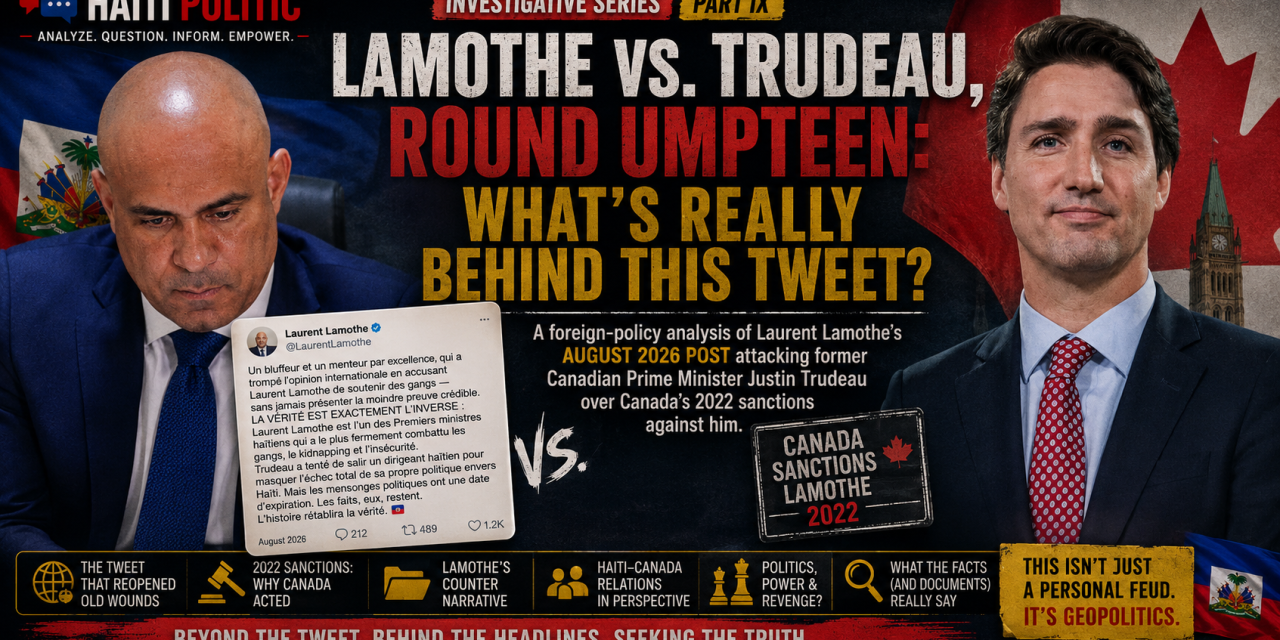
A foreign-policy analysis of Laurent Lamothe’s August 2026 post attacking former Canadian Prime Minister Justin Trudeau over Canada’s 2022 sanctions against him.
The Background the Tweet Assumes You Already Know
To understand what Laurent Lamothe is doing in this post, you need the underlying episode it refers to. On November 17, 2022, Canada’s government — under Foreign Affairs Minister Mélanie Joly, with Justin Trudeau as prime minister — added Lamothe, Haiti’s prime minister from May 2012 to December 2014, to its sanctions list under the Special Economic Measures (Haiti) Regulations. The government’s stated justification was that Lamothe had used “his status as a current or previous public office holder to protect and enable the illegal activities of armed criminal gangs, including through money laundering and other acts of corruption.” The sanctions froze any Canadian assets in his name and barred him from financial dealings and entry into Canada. He was one of what eventually grew to roughly 17 sanctioned members of Haiti’s political and business elite, part of a broader Canadian effort — publicly championed by Trudeau — to pressure Haiti’s political class over its alleged role in enabling the gang violence that has since engulfed much of the country.
Lamothe has denied the allegation from day one, and has done so consistently and loudly for nearly four years. He says he learned of his sanctioning from social media, not from any Canadian government contact. He filed for judicial review in Federal Court in December 2022, arguing the process violated principles of natural justice because he was never given a chance to respond before being listed. He has said that when he pressed Global Affairs Canada for the evidence behind the designation, he was pointed to two online articles that did not even mention his name. As of late 2025, reporting indicated Lamothe was still fighting the sanctions nearly three years on, amid broader criticism — including from parliamentarians and lawyers — that Canada’s sanctions regime is under-resourced, slow, and lacking in transparency for those contesting their listing.
What’s New in This Particular Tweet
The August 2026 post is not Lamothe’s first public rebuttal, but it is notably more personal and combative than his earlier, largely legalistic responses. Rather than simply asserting his innocence or citing his court challenge, he goes on the offensive: calling Trudeau “a master bluffer and liar,” asserting flatly that “the truth is exactly the opposite” of the sanctions’ premise, and attaching a mocking video labeled “Le petit rigolo Justin Trudeau” (“Little joker Justin Trudeau”). He also reframes the entire episode as an attempt by Trudeau to “cover up the total failure of his own policy toward Haiti” — shifting the conversation from his own conduct to an indictment of Canada’s broader Haiti strategy under Trudeau’s government.
One detail is worth flagging on its own: Justin Trudeau resigned as Canadian prime minister in early 2025 and was succeeded by Mark Carney. Lamothe is, in other words, attacking a private citizen — a former head of government with no remaining authority over Canada’s sanctions policy — rather than a sitting official who could plausibly reverse the designation. That timing matters for understanding the tweet’s real purpose.
What Lamothe Is Trying to Prove
Several distinct objectives appear to be layered into this single post:
1. Reputational rehabilitation ahead of Haiti’s electoral calendar. With Haiti’s Transitional Presidential Council dissolved in February 2026 and general elections planned for August and December 2026, Lamothe — a former prime minister with lingering political ambitions and an active public profile — has an obvious incentive to clear his name of gang-linked corruption allegations before any potential return to public life. A sanctions designation citing gang enablement is a serious reputational liability in a country where gang violence is now the dominant political issue.
2. Attacking the messenger now that he can’t be politically threatened. Trudeau’s resignation removed any diplomatic cost to Lamothe from directly and personally attacking him. Where an active head of government might have warranted a more measured legal response, a former one — one now widely unpopular even within Canada by the end of his tenure — is a safer, lower-risk target for pointed personal insults, mockery, and blame-shifting.
3. Reframing the narrative from “was Lamothe sanctioned fairly” to “did Trudeau’s Haiti policy fail.” This is a classic redirection tactic in political communication: rather than re-litigating the specific evidence (or absence of evidence) behind his own sanctioning, Lamothe broadens the frame to Canada’s entire Haiti policy under Trudeau — which by most measures did fail to stabilize the country, with gang control expanding, the capital’s airport shut down by armed groups in 2024, and successive interim governments unable to hold elections. This is rhetorically effective because it’s harder to dispute (Canada’s Haiti policy genuinely did not achieve its stated goals) even though it doesn’t actually address whether the specific sanctions allegation against Lamothe was accurate.
4. Positioning himself as one of Haiti’s more credible anti-gang, pro-security figures. Lamothe’s post explicitly claims he is “one of the Haitian Prime Ministers who has most firmly fought against gangs, kidnapping, and insecurity” — a claim consistent with his public self-description during his 2012–2014 tenure as a “nightmare” for gangs and a reform-minded, private-sector-oriented prime minister, as some contemporaneous profiles have also characterized him. Whether or not this framing is complete, it serves his current interest in distinguishing himself from the corruption and gang-linkage narratives that have engulfed much of Haiti’s post-2016 political class.
The Bottom Line
Lamothe’s tweet is best understood as a piece of strategic political communication rather than a straightforward factual rebuttal. Its core empirical claims about the sanctions process — that he was designated without prior notice, without being shown specific evidence, and that he has formally contested the decision — are consistent with the public record as reported by multiple Canadian outlets. But the tweet’s more sweeping assertions — that the truth is “exactly the opposite” of Ottawa’s allegation, and that Trudeau is a deliberate “liar” rather than someone who acted, rightly or wrongly, on the information his government had — go well beyond what the public record can currently confirm either way. The underlying question of whether Lamothe did or did not enable gang activity during or after his tenure remains legally and factually unresolved in the open record; what is clear is that Lamothe has a strong, escalating political incentive to settle that question in the court of public opinion now, on his own terms, at a moment when his primary accuser has left office and Haiti itself is heading toward an electoral cycle in which his own reputation carries direct political stakes.
This analysis is based on public reporting from CBC, Global News, CTV News, The Globe and Mail, Radio-Canada, and legal commentary on Canada’s sanctions regime. It is offered for informational purposes and does not constitute a determination of guilt or innocence in the underlying dispute.