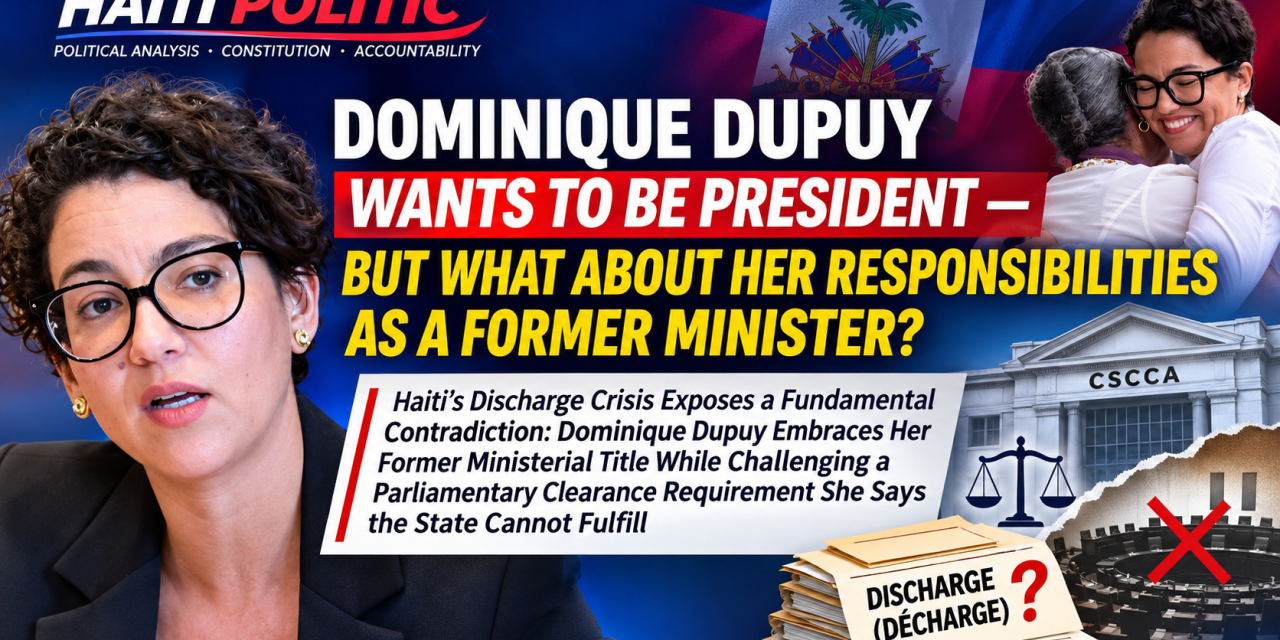
Haiti’s Discharge Crisis Exposes a Fundamental Contradiction: Dominique Dupuy Embraces Her Former Ministerial Title While Challenging a Parliamentary Clearance Requirement She Says the State Cannot Fulfill
HAITI POLITIC — SPECIAL INVESTIGATION
November 13, 2026
The former foreign affairs minister says she requested an audit months before announcing her presidential candidacy. Now she intends to submit her electoral application without parliamentary discharge. Her argument raises legitimate constitutional questions — but also demands a closer examination of the financial-accountability obligations that accompany public office.
1. A FORMER MINISTER, A PRESIDENTIAL CANDIDATE, AND A CONSTITUTIONAL CONTROVERSY
Dominique Dupuy has entered Haiti’s presidential debate with a message that combines constitutional criticism, institutional reform, and a defense of her right to seek the country’s highest office.
On November 11, 2026, Dupuy announced her presidential candidacy.
Approximately one day later, Haiti’s Superior Court of Auditors and Administrative Disputes (Cour Supérieure des Comptes et du Contentieux Administratif, or CSCCA) issued an advisory addressing the parliamentary discharge process for former prime ministers and ministers.
The Court’s position revived a longstanding institutional problem: Haiti does not have a functioning Parliament capable of exercising the constitutional authority associated with parliamentary discharge.
For former government officials seeking elected office, that absence creates a potentially significant legal obstacle.
Dupuy responded through a video published on her social media platform.
She urged supporters not to panic.
She argued that the Haitian state cannot demand a document that its own institutions are unable to issue.
And she announced that she intends to submit her presidential application without parliamentary discharge.
Her message raises an important question:
Can a former minister invoke the absence of Parliament to overcome an electoral requirement without undermining the principle that public officials must account for their management of public resources?
There is another dimension.
Dupuy’s public political profile prominently identifies her as a former minister of foreign affairs and religious affairs, as well as a former minister responsible for Haitians living abroad.
Her government experience is therefore an acknowledged part of her public identity.
That creates a legitimate accountability question.
If holding ministerial office is part of a candidate’s public credentials, what evidence should voters expect concerning the legal and financial responsibilities attached to that office?
The answer requires separating political rhetoric from constitutional law.
2. WHAT DOMINIQUE DUPUY ACTUALLY SAID
In her approximately seven-minute video, Dupuy addresses the discharge controversy directly.
She begins by thanking supporters for their encouragement following her candidacy announcement.
She then turns to the CSCCA advisory.
Dupuy acknowledges that she is not a constitutional-law specialist but says she has consulted experts.
Her central argument is that the Haitian state has created an administrative contradiction.
According to her explanation, the electoral framework requires former ministers to produce parliamentary discharge.
However, the institution constitutionally responsible for granting that discharge is not functioning.
She argues that the state cannot reasonably impose a requirement that its own institutional failures make impossible to satisfy.
One of her most important statements concerns her previous efforts to obtain financial scrutiny.
Dupuy claims she requested an audit on March 30, 2026.
In the video, she says that after leaving ministerial office, she wrote to the CSCCA and the parliamentary secretariat requesting an audit of her management.
This claim deserves particular attention.
It means her position is not simply that former ministers should never be audited.
Rather, she says she attempted to initiate an accountability procedure but encountered an institutional system unable to provide the parliamentary discharge required for electoral purposes.
However, Haiti Politic has not independently examined the March 30 correspondence, any acknowledgment of receipt, or an official response to her request.
Until those records are produced, the public can verify what Dupuy claims but cannot independently establish the complete administrative history of her request.
That distinction is essential.
3. DOMINIQUE DUPUY’S POLITICAL ARGUMENT: THE STATE CANNOT DEMAND THE IMPOSSIBLE
Dupuy’s argument rests on a recognizable legal principle: a person should not ordinarily be penalized for failing to perform an obligation that is legally or practically impossible to fulfill.
Applied to Haiti’s situation, her reasoning is straightforward.
If parliamentary discharge can only be granted through a functioning Parliament, and Parliament is absent, how can the state require a former minister to produce that document?
This is a serious constitutional question.
But the answer is not necessarily as simple as eliminating the requirement.
A constitutional obligation does not automatically disappear because the institution responsible for implementing it has stopped functioning.
Nor does the absence of Parliament automatically authorize the executive branch, the CSCCA, or an electoral tribunal to exercise powers constitutionally assigned to another institution.
The legal challenge is to reconcile three principles:
First: Citizens have political rights, including the right to seek public office subject to lawful eligibility requirements.
Second: Former public officials remain accountable for their management of public resources.
Third: Public institutions must exercise only the powers granted to them by the Constitution and applicable laws.
Dupuy emphasizes the first principle.
The CSCCA advisory emphasizes the third.
The second principle — financial accountability — must not disappear from the debate.
4. ARTICLE 233: WHAT THE CONSTITUTION ACTUALLY REQUIRES
Article 233 of Haiti’s Constitution establishes a parliamentary mechanism for examining ministerial management.
It provides for a commission composed of nine deputies and six senators.
That commission examines ministerial management and reports to the two chambers of Parliament for the discharge process.
The constitutional structure therefore distinguishes between financial examination and parliamentary decision-making.
The CSCCA has auditing and public-finance oversight functions.
Parliament exercises the constitutional authority associated with granting parliamentary discharge under Article 233.
These responsibilities are related but not interchangeable.
An audit is not automatically a discharge.
An audit may examine whether public funds were properly administered.
It may identify accounting irregularities, unsupported expenditures, or compliance with applicable financial rules.
A favorable audit may support a former minister’s position.
But it does not necessarily constitute the parliamentary decision required by Article 233.
Likewise, the absence of parliamentary discharge does not automatically establish financial misconduct.
A former minister may lack discharge because Parliament has been unable to perform its constitutional functions.
This is the distinction that must guide the debate.
The absence of discharge is not proof of corruption. But the impossibility of obtaining discharge is not proof of proper financial management either.
5. THE NOVEMBER 12 CSCCA ADVISORY: AN INSTITUTION REFUSING TO REPLACE PARLIAMENT
The CSCCA advisory issued on November 12, 2026, addresses the institutional responsibilities involved in parliamentary discharge.
The Court emphasizes the separation of powers and the limits of its constitutional authority.
Its position, as reflected in the advisory presented for this investigation, is that the Court cannot simply assume the constitutional functions of Parliament.
This creates an important distinction.
The Court may possess authority to examine certain public accounts and financial-management matters.
But that does not mean it can grant parliamentary discharge in the absence of the legislative institution constitutionally responsible for that decision.
Dupuy interprets the advisory as confirmation that the state cannot currently provide the document required by the electoral framework.
That interpretation identifies a real institutional problem.
However, the advisory does not, by itself, establish that every former minister is automatically exempt from the applicable electoral requirements.
Nor does it establish that the executive branch can constitutionally replace Parliament.
Those questions require separate legal analysis.
6. THE MARCH 30, 2026 AUDIT REQUEST: THE MOST IMPORTANT DOCUMENT DUPUY SHOULD RELEASE
Perhaps the most consequential moment in Dupuy’s video occurs when she says she requested an audit of her ministerial management before announcing her presidential candidacy.
If documented, that request would establish that she sought a form of financial review before the immediate electoral controversy.
But several questions remain unanswered.
What exactly did she request?
Did she ask for an administrative audit, an examination of public accounts, or a procedure specifically connected to parliamentary discharge?
Did she submit financial statements or supporting documents?
Did the CSCCA acknowledge receipt?
Did the Court provide a written explanation of its authority or inability to proceed?
Was the parliamentary secretariat contacted through an official channel?
And did Dupuy complete all financial reporting obligations independently required of her former office?
These questions are not accusations.
They are ordinary verification questions concerning a former public official seeking the presidency.
Haiti Politic calls for publication of the relevant correspondence.
Dupuy could help clarify the controversy by releasing the March 30 letter and any official responses, subject to legitimate confidentiality restrictions.
Such disclosure would allow the public to distinguish between an unsuccessful attempt to obtain a parliamentary document and any unresolved obligation to submit financial records.
A request for an audit demonstrates an intention to seek review. It does not, by itself, establish that an audit was completed or that every financial obligation was satisfied.
7. THE FORMER MINISTER TITLE: POLITICAL EXPERIENCE AND PUBLIC RESPONSIBILITY
Dominique Dupuy’s public profile identifies her former ministerial positions.
That is a factual description of her government service.
Former officials are entitled to describe positions they previously held.
But government experience has two dimensions.
One is professional and political.
The other is institutional and legal.
Ministerial office carries responsibilities that do not disappear merely because an individual leaves government.
Depending on the position and applicable legal provisions, those responsibilities may include financial reporting, asset declarations, preservation of administrative records, and cooperation with authorized oversight institutions.
A candidate’s former title does not establish that these obligations were fulfilled.
It also does not establish that they were violated.
The relevant question is whether compliance can be documented.
Haiti Politic’s central question to Dupuy is therefore:
You identify yourself publicly as a former minister. Can you also demonstrate that you fulfilled the financial-accountability obligations that accompanied that office, including those that remain possible to satisfy despite the absence of Parliament?
This is a question that should be asked of every former minister seeking public office.
Not just Dominique Dupuy.
8. DECLARATIONS OF ASSETS: A SEPARATE LEGAL OBLIGATION
The discharge controversy should not obscure another important aspect of Haitian public law.
Haiti adopted legislation on February 12, 2008, concerning declarations of assets by designated public officials.
The law establishes asset-declaration obligations for categories of officials identified in its provisions.
These declarations are intended to support transparency and the detection of unexplained changes in personal wealth.
Their legal purpose differs from parliamentary discharge.
Asset declaration
An asset declaration concerns a public official’s personal financial interests and assets, according to the categories and procedures established by law.
Financial audit
A financial audit concerns the examination of accounts, transactions, or public-resource management.
Parliamentary discharge
Parliamentary discharge concerns the constitutional process through which the competent legislative authorities examine and decide on ministerial management.
These three mechanisms should not be confused.
A former minister might face an institutional obstacle to obtaining parliamentary discharge while still having separate obligations concerning asset declarations or administrative records.
That is why Dupuy’s argument must be evaluated carefully.
The absence of Parliament does not necessarily make every form of financial accountability impossible.
For Haiti Politic, the relevant question is whether Dupuy filed the declarations required for her particular offices and whether the legally authorized institutions can confirm compliance.
The same question applies to other former officials.
Public access to the contents of individual declarations must be assessed under the applicable confidentiality and disclosure provisions. The existence of a filing obligation does not automatically mean every detail of a declaration is available for unrestricted public inspection.
9. DUPUY’S ARGUMENT ABOUT AN EXTRA-CONSTITUTIONAL GOVERNMENT
Another significant part of Dupuy’s video concerns Haiti’s current political arrangements.
She argues that the country has operated outside its normal constitutional framework for years.
She points to the absence of Parliament and questions the constitutional consistency of the electoral decree.
Her criticism is that the authorities rely on exceptional arrangements to govern but invoke ordinary constitutional requirements when evaluating former ministers’ eligibility.
This is a challenge to the consistency of institutional practice.
It deserves examination.
However, an important legal distinction remains.
A government operating through exceptional arrangements does not necessarily acquire unlimited authority to disregard constitutional requirements.
Nor does the existence of extraordinary governance arrangements automatically establish that a particular electoral rule is invalid.
The relevant questions include the legal authority under which the electoral decree was issued, the hierarchy of applicable norms, and the jurisdiction of electoral courts to resolve disputes.
Dupuy’s criticism highlights a contradiction.
But identifying a contradiction is not the same as establishing the legal remedy.
10. CAN THE EXECUTIVE BRANCH SOLVE THE DISCHARGE CRISIS?
Dupuy argues that the executive branch must address the institutional problem.
Her position raises a difficult constitutional question.
Can an executive authority create an alternative to parliamentary discharge when Parliament is absent?
Former Prime Minister Laurent Lamothe has raised a related proposal.
Lamothe has referred to previous executive measures adopted during periods when Haiti lacked a functioning Parliament.
He argues that a new mechanism should be considered for former officials who possess favorable audit reports.
But historical precedent is not sufficient by itself to establish constitutional validity.
A decree issued by a previous administration may be relevant to understanding political practice.
It does not automatically prove that the same measure would withstand constitutional scrutiny today.
The central question is whether an executive measure would merely address electoral documentation or improperly substitute itself for Parliament’s constitutional authority.
Those are different legal acts.
An electoral accommodation might allow a candidate to pursue judicial review of an impossible documentation requirement.
A parliamentary discharge, by contrast, concerns the constitutional examination and approval of ministerial management.
An executive decision allowing participation in an election should not automatically be treated as financial discharge or immunity from subsequent scrutiny.
That distinction would help protect both political rights and financial accountability.
11. DOMINIQUE DUPUY, LAURENT LAMOTHE, AND JOSUÉ PIERRE-LOUIS: THREE APPROACHES TO THE SAME PROBLEM
The discharge controversy now involves several former officials and legal commentators.
Their positions overlap, but they are not identical.
Dominique Dupuy
Dupuy emphasizes the impossibility of obtaining a document from a nonfunctioning institution.
She says she previously requested an audit.
She intends to submit her candidacy without parliamentary discharge and calls for an executive response to the institutional contradiction.
Laurent Lamothe
Lamothe emphasizes historical precedents for executive intervention during periods without Parliament.
He has described receiving discharge through a previous executive measure and has advocated a solution for former officials with favorable audit reports.
His position places particular emphasis on an executive mechanism.
Josué Pierre-Louis
Pierre-Louis, a former justice minister and constitutional-law scholar, has been quoted arguing that former officials should not be penalized for the absence of an institution they do not control.
His reported position also highlights the possibility of electoral litigation if candidates are rejected because they cannot produce parliamentary discharge.
Pierre-Louis’s perspective is notable because he has held important public positions himself.
He served as justice minister during President Michel Martelly’s administration.
In September 2021, Prime Minister Ariel Henry appointed him secretary-general of the Council of Ministers with ministerial rank.
These backgrounds do not invalidate the arguments of any of the three individuals.
But they underscore why the legal solution should apply consistently.
The rules should not depend on which former official is seeking office or which administration that person previously served.
A legal interpretation favorable to Dominique Dupuy must be evaluated under the same standards as one invoked by Laurent Lamothe, Josué Pierre-Louis, or another former minister.
12. THE TIMING OF THE COURT’S ADVISORY: POLITICAL TARGETING OR INSTITUTIONAL COINCIDENCE?
Dupuy raises another issue in her video.
She observes that the CSCCA advisory appeared approximately 24 hours after her candidacy announcement.
She suggests that the timing was not accidental.
This is a political claim that requires evidence.
The chronology alone cannot establish the Court’s motive.
The advisory concerns former ministers and prime ministers generally.
Its implications extend beyond Dupuy.
Other former officials may face similar questions concerning parliamentary discharge.
To establish that the advisory was designed specifically to target Dupuy, investigators would need evidence concerning the Court’s internal decision-making, the origin of the advisory, or communications demonstrating such an intention.
No such evidence has been established in the materials examined for this article.
The timing may be politically significant.
But political significance and proof of institutional targeting are not the same thing.
13. WHAT KIND OF POLITICAL APPROACH DOES DUPUY’S VIDEO REVEAL?
Dupuy’s presentation offers insight into how she is framing her presidential campaign.
Three features stand out.
Institutional reform as a campaign theme
She presents the discharge controversy as an example of broader administrative dysfunction.
Rather than limiting her remarks to her own candidacy, she discusses citizens struggling to obtain identification documents, passports, and other government services.
She connects her personal electoral dispute with the public’s experience of state bureaucracy.
A rights-based defense of her candidacy
Dupuy emphasizes that she intends to exercise her political rights despite the institutional obstacles she identifies.
Her argument is that an individual should not lose those rights because the state cannot fulfill its own administrative responsibilities.
A challenge to selective constitutional enforcement
She questions why constitutional requirements are invoked against candidates while the institutions responsible for enforcing those requirements operate under exceptional arrangements.
This argument invites scrutiny of consistency and equality before the law.
But the video provides less detail about the precise legal mechanism she believes should replace the unavailable parliamentary process.
It also does not provide the underlying documents necessary to independently verify her reported audit request.
Her video therefore establishes a political and legal position, but it does not resolve the financial-accountability questions associated with her former ministerial service.
That is the distinction voters should understand.
14. TWELVE QUESTIONS HAITI POLITIC HAS FOR DOMINIQUE DUPUY
1. THE MARCH 30 LETTER
Will you publish the letter you say you sent to the CSCCA on March 30, 2026, requesting an audit of your management?
2. OFFICIAL ACKNOWLEDGMENT
Did the CSCCA acknowledge receiving your correspondence, and what response did it provide?
3. FINANCIAL MANAGEMENT
Did you submit every financial-management report required by law during and after your service as minister?
4. DECLARATION OF ASSETS
Did you file the asset declarations legally required when entering and leaving the public offices you held?
5. DOCUMENTARY TRANSPARENCY
Would you support independent verification of your compliance with those obligations, subject to the confidentiality protections established by law?
6. CONSTITUTIONAL AUTHORITY
What specific constitutional or statutory provision supports your position that the CEP should accept your candidacy without parliamentary discharge?
7. THE EXECUTIVE BRANCH
What precise executive action do you propose to resolve the discharge crisis?
8. ARTICLE 233
How would your proposed solution respect the constitutional authority assigned to Parliament?
9. THE CSCCA
Do you agree that the CSCCA cannot simply assume Parliament’s constitutional power to grant discharge?
10. EQUAL TREATMENT
Should the same electoral accommodation apply to Laurent Lamothe, Michel Martelly’s former ministers, Ariel Henry’s former ministers, and every other former official covered by the same rules?
11. FINANCIAL ACCOUNTABILITY
Would you support a system in which candidates facing an unavailable parliamentary discharge process remain subject to all other lawful audits, reporting obligations, and financial investigations?
12. INSTITUTIONAL REFORM
If elected president, what concrete reforms would you propose to prevent future governments from operating for years without a functioning Parliament capable of exercising its constitutional oversight responsibilities?
These questions are not allegations of misconduct.
They are questions about legal compliance, public accountability, and the institutional reforms Dupuy says she supports.
15. THE BROADER PROBLEM: HAITI CANNOT CONTINUE GOVERNING WITHOUT ACCOUNTABILITY
The controversy extends far beyond one presidential applicant.
For years, Haiti has struggled with the absence of functioning constitutional institutions.
Governments have continued to appoint ministers, administer public programs, authorize expenditures, and manage national resources.
Yet the ordinary parliamentary oversight mechanisms have remained unavailable.
That creates a structural problem.
A minister may enter office, exercise executive authority, supervise public resources, and leave office without the country possessing the functioning parliamentary institutions necessary to complete the ordinary discharge process.
But the failure of one accountability mechanism should not become a reason to abandon the others.
Asset declarations remain a separate legal issue.
Financial-management records remain relevant.
Public accounting obligations remain relevant.
The jurisdiction of competent oversight and judicial institutions remains relevant.
And the public retains a legitimate interest in understanding how officials administered government resources.
This applies equally to presidents, prime ministers, ministers, legislators, and other officials, subject to the specific laws governing their positions.
Not every office carries the same discharge requirement.
Not every official exercises the same financial authority.
And not every form of public service is subject to the same documentation procedures.
That is why individualized legal analysis is necessary.
Accountability should be determined by the law governing each office, not by political affiliation or public popularity.
16. A CONSTITUTIONAL SOLUTION MUST PROTECT TWO RIGHTS AT ONCE
Haiti needs a solution that respects both electoral participation and financial accountability.
Those objectives are not inherently contradictory.
A legally sound approach would begin by identifying which former officials are actually subject to parliamentary discharge requirements.
It would then distinguish between documents that can still be obtained and those that cannot be issued because Parliament is absent.
Where the law permits, competent electoral courts could examine disputes involving impossible documentation requirements.
At the same time, former officials should remain responsible for all independently applicable financial and administrative obligations.
An electoral ruling should not automatically be treated as parliamentary discharge.
An executive accommodation should not automatically erase outstanding financial responsibilities.
And a favorable audit should not automatically be confused with a constitutional discharge decision.
Ultimately, restoring a functioning Parliament remains essential.
Without Parliament, Haiti cannot fully restore the constitutional oversight system contemplated by Article 233.
The country needs a legal solution to the electoral problem without creating a permanent exemption from financial accountability.
HAITI POLITIC | FINAL ANALYSIS
DOMINIQUE DUPUY’S RIGHT TO SEEK THE PRESIDENCY AND HER DUTY TO ACCOUNT FOR PUBLIC OFFICE ARE TWO SEPARATE QUESTIONS
Dominique Dupuy’s argument identifies a genuine constitutional dilemma.
She says the Haitian state requires former ministers to obtain a document that no functioning institution can currently issue.
She says she requested an audit on March 30, 2026.
She intends to submit her presidential candidacy without parliamentary discharge.
Those statements deserve serious examination.
But the public also has a legitimate interest in the financial-accountability record of anyone who previously exercised ministerial authority.
The fact that Dupuy identifies herself as a former minister does not establish that she failed to fulfill her obligations.
The fact that she requested an audit does not establish that an audit was completed.
The fact that Parliament cannot issue discharge does not automatically eliminate other legally applicable financial obligations.
And the fact that an electoral requirement may be impossible to satisfy does not automatically determine the legal remedy.
The central issue is therefore broader than Dominique Dupuy.
It concerns the relationship between political rights, public accountability, and constitutional government.
A former minister should not automatically lose political rights because an institution has ceased functioning.
But neither should an institutional crisis automatically prevent the public from examining that official’s financial-management record.
HAITI POLITIC’S CENTRAL QUESTIONS
If Dominique Dupuy requested an audit, where is the official correspondence?
If she fulfilled her asset-declaration obligations, can the competent institutions verify compliance?
If Parliament cannot issue discharge, what lawful electoral remedy is available?
And if an accommodation is adopted, will the same rules apply to every former official?
These questions should be answered through documentary evidence and constitutional analysis.
Not political speculation.
Not selective enforcement.
And not assumptions of guilt.
THE PRINCIPLE IS SIMPLE:
THE RIGHT TO RUN FOR OFFICE DOES NOT ELIMINATE THE DUTY TO ACCOUNT FOR PUBLIC RESOURCES.
THE ABSENCE OF PARLIAMENT DOES NOT AUTOMATICALLY ESTABLISH FINANCIAL MISCONDUCT.
AND AN ELECTORAL ACCOMMODATION MUST NOT BE CONFUSED WITH PARLIAMENTARY DISCHARGE.
Haiti’s challenge is to protect political participation while rebuilding institutions capable of enforcing accountability.
Because the country needs more than another election.
It needs a constitutional system in which those who exercise public power can be required to explain how they used it.
DOCUMENTARY REFERENCES AND VERIFICATION NOTES
Primary source: Dominique Dupuy’s November 2026 video discussing the CSCCA advisory, her reported March 30 audit request, and her intention to submit her candidacy without parliamentary discharge.
Constitutional reference: Article 233 of Haiti’s Constitution, concerning the parliamentary examination of ministerial management.
Institutional reference: CSCCA advisory of November 12, 2026, concerning the Court’s constitutional authority and parliamentary discharge.
Financial-transparency reference: Haitian legislation of February 12, 2008, concerning asset declarations by designated public officials.
Related public statements: Laurent Lamothe’s November 2026 position on executive discharge measures and the reported constitutional analysis of Josué Pierre-Louis.
Verification limitations: Haiti Politic has not independently examined Dupuy’s March 30, 2026 correspondence, her individual asset declarations, a completed audit of her ministerial management, or a final electoral-court decision concerning her candidacy. Her statements about those matters are attributed to her and should not be treated as independently verified findings.
Editorial clarification: This investigation does not accuse Dominique Dupuy of corruption, misappropriation, or failure to file legally required documents. It examines her public arguments, the constitutional framework, and the documentary questions that remain unanswered.
🇭🇹 HAITI POLITIC — POLITICAL ANALYSIS, CONSTITUTIONAL ACCOUNTABILITY & PUBLIC TRANSPARENCY
Question for readers: Should former ministers be permitted to seek elected office when Parliament cannot issue discharge, provided that they remain subject to all other applicable financial-accountability requirements?
#HaitiPolitic #DominiqueDupuy #HaitiElections2027 #Decharge #CSCCA #HaitiConstitution #PoliticalAccountability #AssetDeclarations #LaurentLamothe #JosuePierreLouis #HaitiPolitics