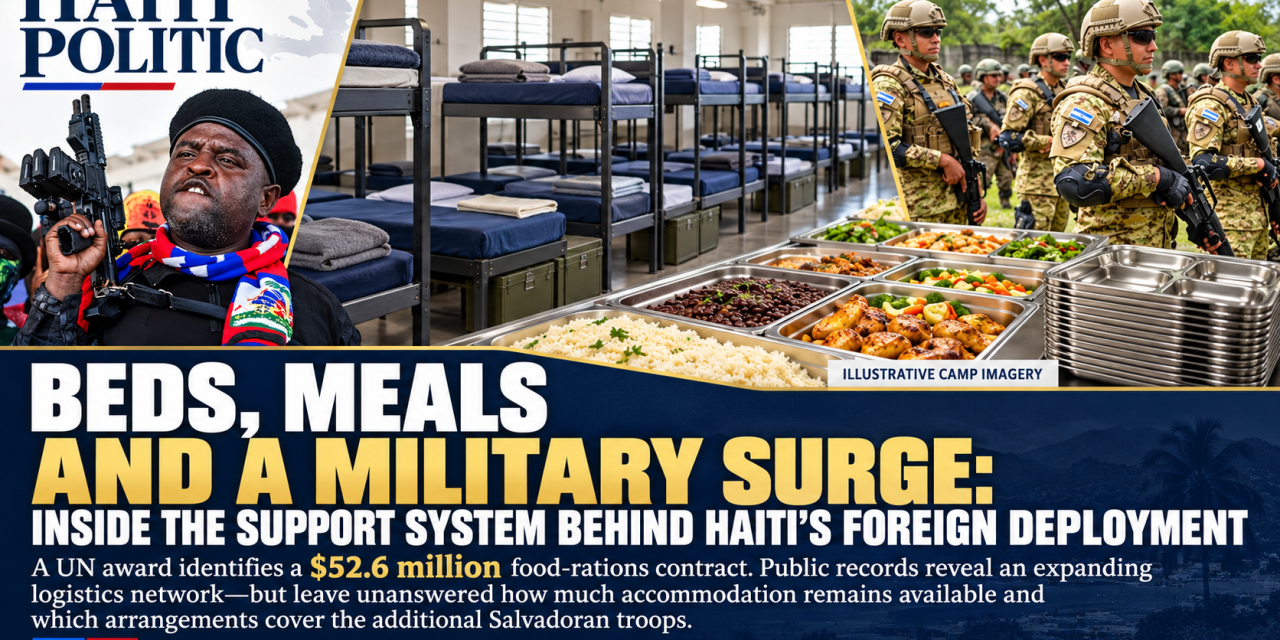
A UN award identifies a $52.6 million food-rations contract. Public records reveal an expanding logistics network—but do not establish how much spare accommodation exists or which arrangements cover the additional Salvadoran troops.
Haiti Politic | Public-records investigation and analysis
October 29, 2026
A rapid military deployment creates demands that continue long after the transport aircraft land: sleeping space, drinking water, toilets, meals, refrigeration, electricity and medical support.
El Salvador’s October 28 communiqué announces an operational deployment of more than 2,000 soldiers. Haiti’s parallel statement places bilateral security cooperation within the Gang Suppression Force framework. Neither supplied statement explains where the reinforcements are staying or how their daily support is being financed. [1]
Public procurement and operational records identify part of the system behind the deployment, including a named UN food-rations contractor. They also expose the limits of what can currently be established: neither a current camp-by-camp accommodation inventory nor a complete catering allocation for the Salvadoran reinforcement was located.
The evidence supports concern about potential pressure from rapid arrivals. It does not establish overcrowding, food shortages or a breakdown in support.
THE COMPANY NAMED IN THE FOOD CONTRACT
The UN Procurement Division’s award register identifies Gulf Catering Company for General Trade and Contracting, WLL as the vendor for “UNSOH FOOD RATIONS,” contract 4700032373. The register lists United Arab Emirates in its country field. [2]
The recorded contract period runs from February 20, 2026, to April 9, 2029, with a potential end date of April 9, 2031. Its not-to-exceed amount is $52,613,821.32. That is a ceiling, not evidence that the entire amount has been spent, paid to the supplier or earned as profit. The possible extension is not proof it has been exercised.
This is the clearest publicly documented answer to the supplier question: Gulf Catering is a named UNSOH food-rations contractor. The summary does not identify every kitchen operator, Haitian subcontractor, delivered meal or beneficiary contingent. It therefore cannot establish that this firm directly cooks and serves every meal eaten by the additional Salvadoran soldiers.
WHO SUPPLIES FOOD IS NOT ALWAYS WHO COOKS IT
The UN describes its general rations model as a contracted supply chain involving sourcing, warehousing, reserves and delivery to contingents. Catering can be included, but is not automatically identical to food supply. Local transport can also be subcontracted. [3]
That distinction matters. The food-rations vendor, the mess-hall operator and the personnel preparing meals need not be the same entity. A complete answer requires the applicable contract schedules and subcontractor records.
No verified list of Haitian catering businesses serving the new Salvadoran reinforcement was located in the records reviewed. Naming local restaurants or caterers without documentation would create a false impression of certainty.
A CAFETERIA EXISTS—BUT ITS OPENING FIGURE IS NOT TODAY’S CAPACITY
The UN Department of Operational Support reports that a new cafeteria opened on April 1, 2026, serving a mission workforce then described as 500 people. More than 150 Guatemalan military police were its first hot-meal customers. The facility offered three daily buffet meals and additional refreshments. [4]
The same account describes a transition from U.S. government contracts to UN-owned fuel and rations contracts. It does not name the cafeteria operator.
The 500-person workforce figure is not a published seating capacity, an October ceiling or proof that the entire force depends on one dining room. It is a dated operational snapshot.
THE EARLIER SUPPORT CONTRACTOR
Amentum provides another identifiable company name, with an important time qualification. In a corporate account of its Haiti project, the company says its sites supported an average daily headcount of approximately 1,000 deployed personnel, with 30 modular living quarters, a field hospital and a dining facility capable of serving more than 800 meals per session, four times daily. [5]
Amentum says its mission concluded in May 2026 after transfer to the UN. This documents an earlier infrastructure and support role, not proof that Amentum remains the current caterer.
Nor can those figures be converted into today’s accommodation inventory. Thirty living quarters does not disclose their individual bed counts. Dining throughput does not establish residential capacity. The Amentum and UN cafeteria descriptions should not be added together without determining whether the facilities overlap.
WHERE THE FORCE IS BEING SUPPORTED
UNSOH’s public reporting identifies Camp Vertières in Port-au-Prince as the GSF’s principal headquarters and logistics hub. Other reporting describes supported facilities at the airport, near the port and in Gonaïves, Artibonite. [6–7]
On October 19, UNSOH head Daniela Kroslak said the office was developing and sustaining eight operational and logistical bases. She stressed coordination of deployment schedules and contingent requirements as the force expanded. [8]
Eight bases does not mean eight completed residential camps. The public accounts reviewed do not provide certified bed counts, occupancy, spare sanitation capacity or the distribution of Salvadoran personnel.
The record establishes an expanding support network, not the remaining capacity available at each location.
HOW A SURGE COULD CREATE PRESSURE
As an illustrative calculation—not a verified additional headcount—2,000 extra personnel receiving three meals each would require 6,000 additional meal portions every day.
That demand would be accompanied by food deliveries, storage, kitchen labor, washing facilities and waste disposal. Accommodation would require more than placing extra beds in an existing building: water, sanitation, power and medical services must also keep pace.
These are potential constraints, not documented failures. A contractor may have reserve capacity, expandable services or advance orders that are not visible in the public summaries.
The October 2025 UN procurement notice anticipated food and catering support for up to 5,550 personnel, alongside accommodation and utilities. It sought cold-chain capability, kitchen services and food reserves. But a procurement requirement is not a completion certificate or evidence that every service is available immediately at every base. [9]
DO THE SALVADORAN REINFORCEMENTS FALL UNDER THESE CONTRACTS?
That question remains unresolved in the public documents reviewed.
Haiti’s communiqué invokes the GSF, while El Salvador emphasizes its national rescue operation and continued security support. Neither identifies the support orders, contract amendments or reimbursement arrangements covering the reinforcement. [1]
The existence of a UN rations agreement does not establish eligibility for every newly arriving soldier. Conversely, the absence of a published amendment does not prove that troops are receiving unauthorized support or paying their own way.
The necessary evidence includes the authorized beneficiary headcount, effective dates, approved quantities and payer for any services outside existing arrangements.
THE HAITIAN ECONOMIC STAKE
In February, the UN organized a procurement webinar attended by more than 140 participants from Haiti’s business community. Food, accommodation, construction and other mission requirements were among the opportunities discussed. [10]
Participation in an outreach event does not establish that Haitian firms received contracts. The next accountability question is how much spending reaches Haitian suppliers and workers, through which subcontractors, and on what payment terms.
WHAT THE PUBLIC SHOULD BE TOLD
A useful disclosure would identify:
• Certified accommodation capacity and occupancy in aggregate;
• The rations supplier, catering operators and material subcontractors;
• Which personnel are covered by existing support arrangements;
• Contract ceilings, actual expenditure and approved expansion costs;
• Food-safety, water and sanitation inspection results.
These disclosures can explain capacity and spending without publishing sensitive operational layouts or movements.
The available evidence shows that Haiti’s foreign deployment rests on an established, expanding support system and a substantial food-rations contract. It does not demonstrate that sufficient spare capacity exists for every reinforcement.
The central test is whether arrivals, accommodation, meals and funding have been coordinated. Until the responsible authorities disclose those arrangements, a support-capacity squeeze remains a credible risk—not a confirmed crisis.