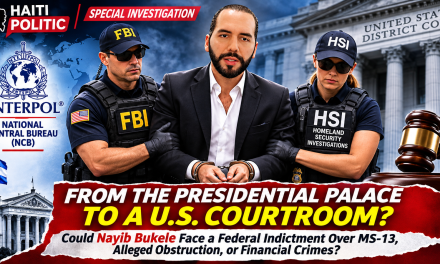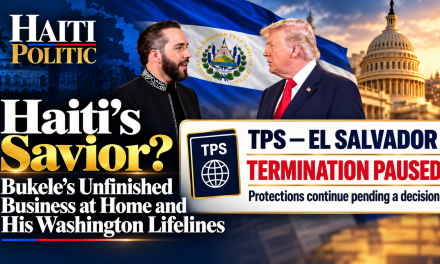
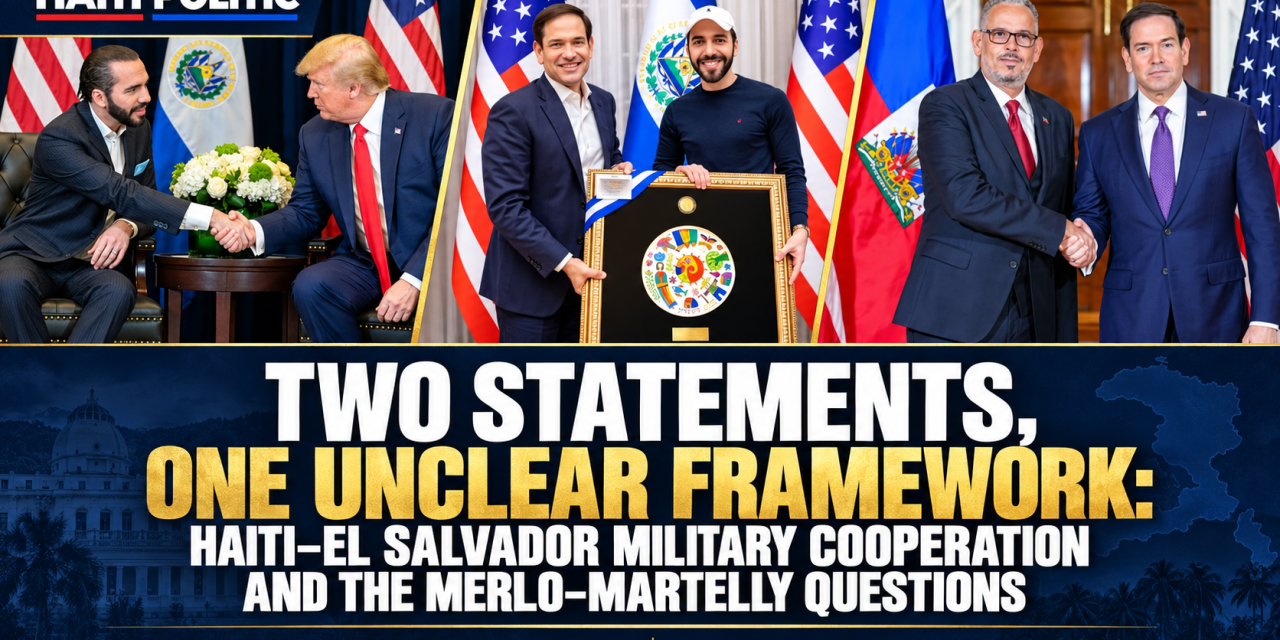
Haiti places the operation within the GSF. El Salvador announces a deployment of more than 2,000 soldiers and discusses its mission’s continued presence. Neither government publishes the terms governing the reinforcements. A shared political intermediary and Martelly’s proposed electoral return add questions that require evidence.
Haiti Politic — News Analysis
October 29, 2026
The statements issued by Haiti and El Salvador on October 28 confirm cooperation over a major Salvadoran military operation in Haiti. They also leave unresolved the questions that matter most: which troops belong to the UN-authorized Gang Suppression Force, who commands the additional personnel, what legal instrument governs them, and who will finance their continued presence.
Both communiqués describe a telephone conversation between Haitian Prime Minister Alix Didier Fils-Aimé and Salvadoran President Nayib Bukele concerning the search for four missing Salvadoran military personnel. But they frame the broader deployment differently.
Haiti explicitly situates bilateral coordination and operational cooperation within the FRG/GSF framework. El Salvador’s statement does not name the GSF. It instead emphasizes its own security operation, a deployment exceeding 2,000 soldiers, and discussions about the mission’s continued presence in Haiti.
Those differences warrant scrutiny. They do not, on their own, prove that a new bilateral status-of-forces agreement has been signed, that every announced soldier has already arrived, or that an indefinite deployment has been legally authorized. [1–2]
WHAT THE TWO GOVERNMENTS ACTUALLY SAY
The Haitian statement, headed “Haïti–El Salvador : renforcement de la coopération sécuritaire,” presents the call as coordination over the deployment and the search for four missing servicemembers. It says the leaders reaffirmed bilateral coordination and operational cooperation “dans le cadre de la FRG/GSF.”
It also insists that cooperation should respect the authority of the Haitian state and contribute to lasting national security. It provides no troop figure, deployment timetable, funding commitment or explanation of the command structure. [1]
The Salvadoran Foreign Ministry’s statement says the leaders discussed both the rescue operation and “la permanencia de la misión” maintained by El Salvador in Haiti. In context, permanencia concerns the mission’s continued presence or stay; it is not, by itself, a declaration of a permanent base or unlimited deployment.
The statement also says Bukele reaffirmed willingness to continue supporting anti-gang security work. Its closing paragraph announces that El Salvador will continue an operational deployment of more than 2,000 soldiers, supported by various countries and international organizations. Those supporters are not identified. [2]
WHAT CAN BE ESTABLISHED — AND WHAT CANNOT
Issue | Evidence in the statements | Unresolved question
Troop strength | El Salvador announces an operation involving more than 2,000 soldiers | How many are physically deployed, when they arrived and which framework covers each contingent
GSF relationship | Haiti expressly invokes the GSF; El Salvador’s communiqué omits it | Whether the reinforcement is integrated, separately commanded or divided between arrangements
Bilateral cooperation | Both governments acknowledge direct coordination | Whether any new agreement was signed and when
Mission duration | El Salvador discusses continued presence and anti-gang support | Withdrawal date, extension procedure and conditions for remaining after the search
Financing | Unnamed international support is asserted | Donors, amounts, eligible expenses and reimbursement obligations
Accountability | Haiti invokes state authority | Applicable jurisdiction, civilian complaints and investigation procedures
The Salvadoran communiqué is official evidence of the government’s announced scale. It is not a deployment manifest. Its wording does not allow a precise, independently verified count of personnel physically present on October 28. [1–2]
A BILATERAL ARRANGEMENT IS NOT AUTOMATICALLY OUTSIDE THE GSF
The word bilateral does not settle the legal question. Governments can coordinate directly while contributing to a multinational operation. Indeed, Haiti explicitly combines bilateral coordination with the GSF framework in its own communiqué.
Resolution 2793 places GSF operational command and daily decisions with its Force Commander. It also authorizes participating states to conduct certain counter-gang operations independently or alongside Haitian forces, subject to the mandate’s conditions. That wording should not be confused with unrestricted authority to conduct a separate national campaign. [3]
The discrepancy between the statements may reflect different political messaging, an incompletely explained operational arrangement, or a division between existing GSF personnel and additional national reinforcements. These are possibilities, not established findings.
A factual correction is also necessary: El Salvador’s omission of the GSF in this communiqué does not mean its government has never recognized that force. On September 29, its Legislative Assembly approved legislation specifically authorizing participation in the GSF. [4]
WHERE IS THE AGREEMENT?
Neither October 28 statement identifies or publishes a newly signed Haiti–El Salvador status-of-forces agreement.
There are earlier legal instruments. Salvadoran legislative records document ratification in October 2024 of an agreement concerning protections for the predecessor Multinational Security Support mission, signed by El Salvador on October 3 that year. That establishes a prior status-protection framework, not automatic coverage of every later operation. [5]
Separately, Security Council Report describes an agreement signed between Haiti and the GSF on July 27, 2026, concerning the force’s legal personality, privileges and immunities. Its September analysis said the agreement had not been made public. That Haiti–GSF agreement is distinct from proof of a new Haiti–El Salvador bilateral agreement. [6]
A host-state invitation, a mission-status instrument, a troop-contribution arrangement and an operational order answer different questions. The documents reviewed do not establish which combination governs the additional Salvadoran troops.
Publication of the applicable terms would clarify authorization, jurisdiction, detention powers, claims for civilian harm and the conditions under which Haiti can request withdrawal. The absence of a disclosed new SOFA proves neither that one exists nor that all personnel lack legal arrangements.
THE RESCUE IS NOT THE ONLY PURPOSE DESCRIBED
The Salvadoran text goes beyond reporting a search. It discusses the mission’s continued presence and willingness to keep supporting anti-gang security work. That supports a broader reading of the political commitment than a narrowly defined recovery operation.
However, it gives no end date and does not explicitly say that the additional 2,000-plus force will remain after the missing personnel are found.
The longer-term context predates the disappearance. The September 29 Salvadoran legislation authorized an initial twelve months of GSF participation beginning October 2, with provision for extension. That law concerns GSF participation; it cannot simply be assumed to authorize every separately organized reinforcement on identical terms. [4]
The issue is therefore whether the search has accelerated or expanded a security commitment, and whether that expansion has been properly defined. The statements justify that question without establishing a secret permanent deployment.
WHO PAYS FOR A CONTINUING PRESENCE?
Neither communiqué identifies a reimbursement agreement, troop-payment rate or division of costs between Haiti, El Salvador and outside supporters.
The GSF framework separates personnel costs, funded through voluntary contributions, from UNSOH’s authorized logistical support. It provides for accommodation, supplies and other services, as well as reimbursement of eligible contingent-owned equipment under agreed arrangements. [3]
Those provisions do not establish that every expense of a separate Salvadoran operation qualifies for UN support. Conversely, the existence of external support does not prove that El Salvador is earning a profit.
Governments should disclose the applicable funding commitments and identify who is paying for transport, housing, rations, fuel, equipment and personnel. Haiti’s obligations, if any, should be stated explicitly.
THE MERLO CONNECTION AND MARTELLY’S ELECTORAL COMEBACK
The political context also deserves examination. Damián Merlo has documented connections to both Bukele and former Haitian president Michel Martelly. Reporting describes Merlo’s past work for Martelly, including as a special assistant, and his lobbying for Bukele. U.S. Foreign Agents Registration Act records list Merlo’s firm, Latin America Advisory Group, and filings for the Office of the President of El Salvador, including a March 2026 filing. These establish an overlapping political network; they do not establish Merlo’s involvement in negotiating the October deployment. [7–8]
The electoral timing makes that network relevant. Le Nouvelliste reported that Martelly submitted presidential candidacy documents under the Debloke banner on October 23, five days before the government statements. Filing documents is not the same as a final determination of eligibility or an approved candidacy. [9]
Could support for Martelly’s return form part of a broader political understanding around security cooperation? That is a legitimate investigative question. Neither communiqué, nor the other records reviewed here, establishes such an exchange. Neither statement mentions Merlo, Martelly, Debloke or an electoral undertaking.
The potential political effects are nevertheless substantial. As analysis, a foreign-backed security improvement could strengthen incumbent authorities, benefit politicians claiming credit for it or give foreign-connected intermediaries greater influence. The GSF mandate itself includes support for security conditions conducive to free and fair elections. That objective requires impartiality; it is not a mandate to favor a particular candidate. [3]
The next evidence to seek is concrete: any official or informal negotiating role held by Merlo; meetings involving representatives of Martelly or Debloke; lobbying mandates covering Haitian security or elections; relevant contracts and payments; and any commitments concerning campaign support, electoral access or political appointments.
Shared advisers and closely timed events justify scrutiny. They do not prove a military-for-electoral-support bargain. Until records connect the two, Martelly’s comeback must be treated as a possible political dimension to investigate, rather than an established term of the arrangement.
COOPERATION NEEDS TERMS THE PUBLIC CAN EXAMINE
The Haitian government’s reference to state authority is a political assurance. The agreements and operational arrangements must show how that authority works in practice: who approves missions, who can stop them, how detainees enter Haitian custody and how civilians can seek investigation or remedy.
The immediate public record supports a clear finding: the governments are endorsing continued cooperation around an expanded Salvadoran deployment, but have not explained its terms sufficiently to distinguish the GSF contribution from any separate operation.
El Salvador emphasizes national military action. Haiti invokes a multinational framework. The public needs a shared account of the force’s status, command, funding and exit conditions.
The search for four missing personnel is urgent. It does not remove the obligation to explain a foreign military presence to the population living alongside it.