Haiti Politic | Political analysis and editorial commentary | October 24, 2026
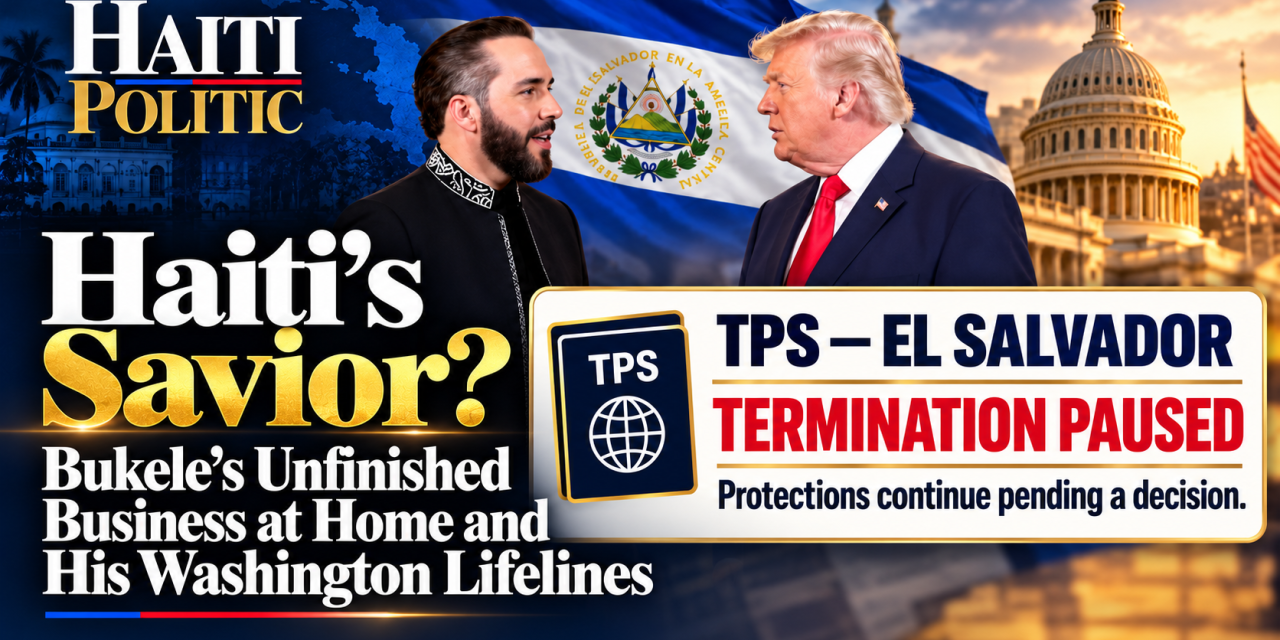
El Salvador’s dependence on diaspora earnings, unresolved fiscal pressures and uncertain TPS protections complicate the image of Bukele as an answer to Haiti’s insecurity. His Washington connections and the financing of Salvadoran troops deserve scrutiny alongside his security record.
Nayib Bukele’s political rise began in municipal government: Nuevo Cuscatlán in 2012, San Salvador in 2015, and election to the presidency on February 3, 2019. He took office that June and won reelection on February 4, 2024. His presidency has become internationally associated with its crackdown on gangs, ambitious communications strategy and Bitcoin experiment. [1–2]
The economic foundations of that presidency receive less attention. El Salvador uses the U.S. dollar, depends heavily on its diaspora, maintains deep commercial ties with the United States and continues to seek multilateral financing. A favorable relationship with Washington matters across all those channels. It cannot, by itself, deliver fiscal independence or widespread prosperity.
For Haitians assessing the Salvadoran model, the distinction is important. Bukele’s security policies operate within an economic system sustained by migrant labor, inherited monetary arrangements, international lenders and public institutions. A serious evaluation must examine that system alongside the headline achievements.
Haiti Politic’s editorial position is that Bukele should prioritize his country’s unresolved needs before encouraging expectations that his leadership can deliver Haiti’s salvation. The word “savior” here describes the political image under examination; it is not presented as a verified quotation from Bukele. International assistance should be judged by its results, financing and accountability to Haitians.
His Washington connection extends beyond presidential friendship
U.S.–Salvadoran relations long predate Bukele. The countries are connected through migration, security cooperation, investment and CAFTA-DR, the trade agreement that entered into force for El Salvador in 2006. Congress, immigration agencies, financial institutions, employers and Salvadoran communities each have interests that cannot be reduced to the relationship between two presidents. [2]
The relationship has also changed across administrations. The Congressional Research Service (CRS) describes Biden-era concerns over corruption, judicial independence and human rights, followed by the second Trump administration’s effort to deepen cooperation with Bukele, particularly on migration and detention. The White House documented their Oval Office meeting on April 14, 2025. [2–3]
CRS reported that Bukele agreed during Secretary of State Marco Rubio’s February 2025 visit to incarcerate people removed from the United States and alleged to belong to gangs. It also documented congressional scrutiny of detention arrangements and legal challenges to some removals. Allegations of gang membership should not be presented as convictions established for every person transferred. [2]
These arrangements give Bukele a prominent role in a U.S. political priority. But diplomatic access, immigration protection, appropriated aid and multilateral lending involve different authorities and legal processes. Success in one negotiation does not guarantee a favorable outcome in all the others.
The documented lobbying channel
Washington access is also supported by professional representation. A March 3, 2026 filing under the U.S. Foreign Agents Registration Act identifies Latin America Advisory Group and the Office of the President of El Salvador. Its attached agreement, signed by Damián Merlo for the firm, provides for US$780,000 over calendar year 2026, payable in twelve monthly installments of US$65,000. [4]
The agreement describes executive-branch and congressional outreach, official visits and international media work. The contracting party is Companía de Luz Eléctrica de Ahuachapán, or CLEA. This is a contract value, not proof that every scheduled payment was made or that the firm secured a particular policy decision. [4]
The record establishes an organized effort to maintain political relationships and shape international messaging. Evaluating its public value requires disclosure of expenditure and results, alongside scrutiny of the policies it promotes.
Currency and policy changes
Dollarization came before Bukele
El Salvador adopted the U.S. dollar as legal tender in January 2001, almost two decades before Bukele became president. That decision reduced currency-conversion risk in a country closely connected to the United States. It also meant relinquishing an independent national monetary policy of the kind available to a country issuing its own currency. [5]
The practical consequence remains significant: El Salvador cannot respond to a domestic downturn simply by devaluing a freely floating national currency or issuing U.S. dollars. Dollar liquidity must be supported by external receipts, financial-sector resources and credible public finances. U.S. monetary conditions therefore matter even when relations between the governments are cordial.
Bitcoin changed the international brand more than the remittance system
In September 2021, Bukele’s government introduced Bitcoin as legal tender alongside the dollar. The initiative promised investment and broader financial access, including cheaper remittances. An IMF assessment published in 2025 found little evidence that the experiment had improved financial inclusion or digital remittances, while identifying fiscal, governance and consumer-protection risks. [2, 6]
The subsequent policy adjustment was substantial. When the IMF approved a 40-month, approximately US$1.4 billion Extended Fund Facility in February 2025, the program included voluntary private acceptance of Bitcoin, tax payments only in U.S. dollars and restrictions on public-sector Bitcoin activity. The financing is a lending arrangement with conditions and staged reviews, not a U.S. government grant. [7]
By its October 2026 review, the IMF reported the transfer of majority ownership and control of the state-backed Chivo wallet to a private operator and called for remaining public exposure to be unwound. It also granted waivers concerning certain unmet Bitcoin-accumulation criteria following corrective measures and renewed commitments. [8]
The policy lesson is that attracting attention through a currency experiment is different from creating a widely used, affordable payment system. The durability of household finances still depends on earnings, transaction costs and dependable financial services.
The remittance lifeline
The US$8.2 billion figure is useful, but it needs a date. CRS identifies US$8.2 billion in remittances from the United States in 2023. It should not be presented as a timeless annual amount or as government aid. [2]
Newer figures show an even larger overall flow. EFE, citing El Salvador’s Banco Central de Reserva (BCR), reported US$9.98791 billion in total family remittances in 2025, up from US$8.47970 billion in 2024. These are receipts from all origins, predominantly the United States; the entire total should not be relabeled as exclusively U.S.-origin money. [9]
The World Bank’s personal-remittances indicator lists 27.5% of GDP for 2025. That is a more current benchmark than a general 24%–26% range. Its indicator and the BCR’s family-remittance series have different statistical definitions, and ratios also depend on the GDP estimate and data vintage used. [10]
A comparison that preserves the accounting distinctions
| Flow | Dated figure | What it represents |
|---|---|---|
| Remittances from the United States | US$8.2 billion, 2023 | Private transfers, as reported by CRS |
| State Department and USAID bilateral aid allocation | Approximately US$87.1 million, FY2023 | Estimated allocation covering development, global health and military education/training categories identified by CRS |
| Additional Central America Regional Security Initiative allocation for El Salvador | US$39.5 million, FY2023 | Security and rule-of-law programming identified by CRS |
| Total family remittances from all origins | US$9.98791 billion, 2025 | BCR figure reported by EFE |
| Personal remittances relative to GDP | 27.5%, 2025 | World Bank indicator |
| IMF program envelope | Approximately US$1.4 billion over 40 months, approved February 2025 | Multilateral lending, not annual bilateral aid |
Sources: CRS, EFE/BCR, World Bank and IMF. [2, 7, 9–10]
The two FY2023 assistance categories total approximately US$126.6 million. The US$8.2 billion remittance figure is roughly 65 times that amount. This is a scale comparison between a calendar-year private flow and fiscal-year assistance allocations; it is not a comprehensive accounting of every form of U.S. support or a comparison of identical cash-disbursement measures.
The conclusion nevertheless holds: migrant families transfer far more money directly into Salvadoran household finances than those aid categories represent. Their earnings support food, housing, education, medical expenses and commerce. That contribution belongs to the diaspora and its families, rather than being counted as a presidential development achievement.
TPS continues amid uncertainty
As of this article’s review, El Salvador’s Temporary Protected Status should not be described as having definitively ended on September 9, 2026. That was the endpoint of the previously announced extension. A later USCIS alert stated that Salvadorans already under TPS retain protection, including work authorization, pending a further announcement. The American Immigration Lawyers Association’s October 21 update records that continuing position. [11–12]
This is continued temporary protection with an unresolved future, rather than permanent residence or an indefinite guarantee. Older expiration tables and earlier agency messages must be read alongside the subsequent alert. Individual eligibility and employment-document requirements remain separate questions.
TPS uncertainty matters economically because it can affect workers’ ability to plan their employment, housing and family support. The potential effect on remittances is a risk, not a quantified loss established here. Salvadoran remittance senders include citizens, permanent residents and people in other immigration categories; their transfers must not all be attributed to TPS beneficiaries.
A sound Washington strategy would seek clear, durable treatment of the diaspora, rather than treating a temporary reprieve as proof that the country’s economic exposure has disappeared.
Haiti lost TPS while Salvadorans received a reprieve
The comparison with Haiti makes this more than a technical immigration question. USCIS announced Haiti’s TPS termination effective July 27, 2026; on August 5, the district court lifted the order that had blocked the termination following appellate proceedings. Contemporary reporting commonly puts the affected population at roughly 350,000 Haitians, rather than treating 300,000 as an exact administrative count. [18–19, 25]
By contrast, roughly 200,000 Salvadorans retained protection while Washington postponed a decision. These are rounded estimates from different reports, not counts of people necessarily deported or still enrolled on the publication date. The human stakes include employment, family unity and the ability to support relatives abroad.
Haiti’s danger also remains visible in Washington’s own guidance: the State Department’s July 10, 2026 advisory places the country at Level 4: Do Not Travel. A travel advisory and a TPS determination apply different legal standards, but the juxtaposition demands an explanation of how country conditions are assessed. [26]
Why did the White House intervene for El Salvador?
Politico’s September 29 reporting, summarized by the Immigration Policy Tracking Project, says DHS and USCIS had cleared a Salvadoran termination notice before the White House stopped its publication. It identifies pressure from Bukele, employers and business leaders with donor connections, including in Texas. These are reported influences on the decision, rather than an official account of the White House’s reasoning. [20]
The New Yorker separately reported construction-industry lobbying and warnings about labor disruption, particularly in Washington. Its account also says the administration had not publicly explained the delay. Taken together, the reporting supports an explanation involving diplomatic access and employer pressure; it does not establish one definitive motive. [21]
The documented Merlo lobbying contract belongs in this context, but the filing alone does not establish that he personally secured the TPS pause. Nor does the evidence reviewed establish that TPS protection was exchanged for Salvadoran troops in Haiti or cooperation over detention. [4]
For Haiti Politic, the accountability question is direct: why did the administration proceed against Haitian TPS holders while pausing action against Salvadorans, and what weight did humanitarian conditions, employers, donors and foreign-government access carry? Salvadoran families deserve protection and clarity. Haitian families deserve a transparent explanation of the different outcome.
Transfer costs are another U.S. policy channel
The IRS states that a 1% tax on certain remittance transfers took effect January 1, 2026, including transfers funded with cash, money orders, cashier’s checks or similar physical instruments. It is not a universal 1% charge on every cross-border payment. [13]
For a taxable US$500 transfer, the tax alone is US$5, before ordinary provider charges. Whether the sender absorbs that cost or adjusts the amount sent depends on the household. That small example illustrates how U.S. domestic policy can affect Salvadoran families independently of presidential diplomacy.
Remaining fiscal and structural challenges
Security improvements have created economic opportunities, but public debt, fiscal capacity and productivity still constrain development.
The IMF’s October 2026 review projected 4.5% real GDP growth in 2026 and nonfinancial public-sector gross debt, including the specified pension bonds, at 85% of GDP. These are projections, not completed-year results. It urged continued fiscal consolidation and protection of priority social spending. [8]
This creates a difficult policy balance. Lower financing pressures can support investment, but expenditure restraint must be assessed against access to schools, health care and essential services. A primary surplus measures the balance before interest payments; it does not demonstrate that debt-service costs or pension obligations have disappeared.
The World Bank’s October 2026 overview identifies persistent problems including low productivity, limited human capital, poor-quality jobs, infrastructure needs and climate vulnerability. It also recognizes stronger security and investor confidence. Together, these findings support a more demanding test than a choice between declaring total success or total failure: can improved conditions generate productive, accessible employment and sustained public services? [14]
Institutional safeguards matter to that test. CRS documented concerns over judicial independence and civil liberties under Bukele, alongside the popularity and security gains of his administration. Reliable courts, transparent contracts and scrutiny of public spending affect ordinary citizens as well as investors. [2]
Ripple effects on local development
The effect of security and external financing is felt locally: a shop’s opening hours, a worker’s journey, access to a clinic, a school meal or a construction job. The World Bank identifies construction and tourism as important recent growth drivers, but national expansion does not establish that benefits reach every municipality or household. [14]
Remittances can reinforce those gains. When recipients buy goods, repair homes or pay for services, local businesses receive income. Some spending also purchases imported products, so a dollar received does not automatically become a dollar of domestic production.
The distribution matters. A household with reliable overseas support faces different opportunities from one without it. A tourist district may attract investment while another community still lacks dependable water, transport or training. These are reasons to assess development through service coverage, wages, business survival and access to opportunities, rather than visitor numbers or construction alone.
Local resilience also requires institutions capable of planning and maintaining investment. The World Bank’s Local Economic Resilience Project provides a concrete example of externally financed work directed at municipal economic resilience. Its project and procurement records offer a basis for examining what is funded and delivered. [15]
The relevant political questions are who selects projects, whether contracts are competitive, whether communities participate, and who pays operating and maintenance costs after construction. External money can finance an asset; competent institutions must sustain its public value.
Ongoing critical aid and development segments
Remittances are much larger than many aid flows, but family money does not replace a public-health network, a water system or a school-feeding program. Several distinct forms of external support therefore remain relevant.
| Segment | Evidence and current relevance | Accounting distinction |
|---|---|---|
| School meals and nutrition | Counterpart International has published a USDA McGovern-Dole program evaluation plan for El Salvador; USDA’s freight records list a related October 8, 2026 award | A program plan or shipment award does not establish that every planned meal or activity has been delivered |
| Primary health care | The World Bank approved the US$120 million, five-year PROMAS project in March 2025, covering facilities, equipment, care and institutional capacity | This is IBRD loan financing, not a bilateral U.S. grant |
| Local services and resilience | World Bank project documentation covers local economic resilience; the country portfolio also identifies water, transport and related investments | Multilateral projects must be evaluated through their individual financing and implementation records |
| Security and rule of law | CRS documents historical U.S. assistance and the conditions and waivers governing selected cooperation | Security cooperation is distinct from household transfers and social-development expenditure |
Sources: USDA, Counterpart International, World Bank and CRS. [2, 14–17]
The continued existence of selected programs should not be interpreted as proof that all earlier aid survived U.S. restructuring unchanged. Nor should announcements of aid reductions be treated as proof that every health, education or nutrition channel has stopped. Appropriations, commitments, disbursements and delivery require separate verification.
Who pays for Salvadoran soldiers deployed to Haiti?
El Salvador’s legislature authorized continued participation in the Gang Suppression Force (GSF), including military and civilian personnel, aircraft and other resources, for an initial twelve months starting October 2, 2026. After four Salvadoran personnel disappeared in an October ambush, El Salvador sent additional special forces to assist rescue operations. The standing mission and the emergency reinforcement should be accounted for separately. [23, 27]
The available public record supports a divided funding structure, rather than a single answer that Bukele or one foreign government pays every bill. A March 2026 State Department report to Congress distinguishes UN-assessed funding for UNSOH logistics and sustainment from voluntary financing for GSF personnel salaries and predeployment training, including through the Haiti trust fund. [22]
| Cost or contribution | Publicly documented financing framework | What remains to be disclosed |
|---|---|---|
| Mission logistics and sustainment through the UN Support Office in Haiti (UNSOH) | Assessed contributions from UN member states | Amounts actually spent supporting the Salvadoran contingent |
| GSF personnel salaries and predeployment training | Voluntary funding, including through the UN trust fund | Who pays Salvadoran personnel, applicable allowances and any reimbursement arrangements |
| Salvadoran personnel, aircraft and equipment | Resources authorized by El Salvador’s legislature | National expenditure, third-party support and any costs recovered |
| October rescue reinforcement | Additional deployment reported after the ambush | Separate authorization, transport and operating costs, and the final allocation among national, bilateral and mission budgets |
Sources: State Department, Salvadoran Legislative Assembly and AP. [22–23, 27]
The UN’s public trust-fund dataset records donor pledges and cash receipts. Those figures can help identify contributors, but a pledge is not a payment, and a contribution to a pooled fund is not proof that the donor directly paid a particular Salvadoran soldier. [24]
The precise payer-by-payer breakdown for the Salvadoran contingent, including its October reinforcement, was not established by the documents reviewed. A credible answer requires the contingent’s financing agreement, Salvadoran budget execution, donor disbursements and relevant UN expenditure or reimbursement records. The record reviewed also does not establish a direct Haitian-government payment for that contingent.
This creates a concrete transparency test. El Salvador, Haiti, donor governments and the mission should disclose the applicable agreements, costs, reimbursement rules and oversight arrangements. Haitians should be able to examine who finances operations on their territory, who controls the funds and how civilian complaints are investigated.
The TPS contrast and the military deployment both illustrate the political value of Washington access. They warrant scrutiny together, while any claim of a negotiated exchange between them still requires evidence.
Bukele’s first responsibility remains at home
Bukele’s security record does not settle the wider question of his government’s performance. The evidence discussed here shows continuing fiscal constraints, dependence on remittances, uncertainty for Salvadoran TPS holders and concerns about institutional safeguards. These issues belong at the center of any assessment of his leadership. [2, 8–12, 14]
Our editorial judgment is that he should give those responsibilities priority over cultivating an international reputation as the leader who can solve another country’s insecurity. That judgment does not require El Salvador to resolve every domestic problem before assisting Haiti. It requires a clear account of what the assistance costs, what it can realistically accomplish and how it serves the public in both countries.
Salvadoran families working abroad sustain an economic lifeline that presidential messaging should acknowledge. Their uncertain immigration future warrants sustained diplomatic attention. At home, the measures of success include productive jobs, dependable services, responsible debt management and institutions that citizens can question without fear.
For Haiti, outside military assistance should strengthen Haitian capacity and operate under transparent agreements with enforceable civilian protections. A foreign leader’s popularity cannot substitute for competent Haitian institutions, legitimate political leadership or accountability for abuses.
The contrast between the two countries’ TPS outcomes adds urgency to that demand. Washington should explain its decisions, and Haitian leaders should explain how they are defending their diaspora’s interests while negotiating foreign security assistance. The available evidence does not establish that these policies were exchanged in a bargain.
Bukele can contribute to Haiti’s security efforts. The political credit he receives should follow independently verifiable results. Haiti’s future must remain in Haitian hands, and El Salvador’s unfinished business must remain a priority for its president.
Sources and measurement notes
Reviewed October 24, 2026. Dollar amounts are U.S. dollars. Historical and forecast dates are identified in the text. The 65-times comparison is calculated as US$8.2 billion divided by US$126.6 million, using the specific categories in CRS’s May 30, 2025 report. It is not an estimate of total aid currently disbursed. Loans, grants, private transfers, program envelopes and procurement records are not treated as interchangeable.
-
El Salvador presidency biography. Official account of Bukele’s municipal career and 2019 election; read as the government’s biography, not an independent assessment of its political claims.
-
Congressional Research Service, El Salvador Current Issues and U.S. Relations, May 30, 2025. Historical relations, political and security context, U.S.-origin 2023 remittances and FY2023 assistance categories. Later developments are sourced separately.
-
DOJ FARA filing received March 3, 2026. Registrant, foreign principal, Merlo-signed agreement, services and calendar-year contract value. A filed agreement does not by itself verify performance or all payments.
-
IMF, Official Dollarization as a Monetary Regime, 2011 and 2004 Article IV staff report. Dollarization history and monetary-policy implications.
-
IMF, El Salvador Selected Issues, published March 19, 2025. Assessment of Bitcoin adoption and financial inclusion.
-
IMF EFF approval, February 26, 2025. Financing terms and policy commitments.
-
IMF combined second and third reviews, October 1, 2026. Macroeconomic projections, fiscal priorities and Bitcoin/Chivo developments.
-
EFE report of BCR remittance figures, January 28, 2026. Family-remittance totals for 2024 and 2025. The GDP ratio in that news report is not substituted for the separately identified World Bank indicator.
-
World Bank personal remittances received as a percentage of GDP. Most recent displayed figure at review: 2025, 27.5%.
-
September 2026 USCIS page capture preserved by the Immigration Policy Tracking Project. Agency alert preserving protection pending a further announcement. Official USCIS country page.
-
AILA TPS status chart updated October 21, 2026. Corroborates continued Salvadoran TPS and discusses employment-document uncertainty. This article does not determine any individual’s immigration eligibility or documentation requirements.
-
IRS, remittance-transfer tax guidance, April 10, 2026. Effective date, rate and covered payment instruments; distinguishes the existing tax from proposed implementing regulations.
-
World Bank El Salvador overview, updated October 6, 2026. Structural constraints, growth sectors and development portfolio.
-
World Bank Local Economic Resilience Project procurement plan, August 15, 2025. Published project procurement documentation.
-
Counterpart International, El Salvador USDA McGovern-Dole evaluation plan and USDA freight tenders and awards. Country-specific program documentation and the October 8, 2026 entry for El Salvador Award 24-036P.
-
World Bank PROMAS health project announcement, March 19, 2025. US$120 million, five-year project and IBRD loan terms.
-
USCIS/E-Verify, Haiti TPS termination update, July 29, 2026. Agency notice identifying July 27 as the effective termination date; subsequent court developments are identified separately.
-
Miot v. Trump, district court order filed August 5, 2026, preserved by Massachusetts, and AILA’s October 21 status chart. Court-order chronology and current status summary.
-
Immigration Policy Tracking Project, Salvadoran TPS timeline, summarizing Politico’s September 29 report. The original Politico page was inaccessible during review; its account is attributed through the accessible tracking project, rather than presented as independently verified internal deliberations.
-
Jonathan Blitzer, The New Yorker, September 30, 2026. Reporting on construction-industry lobbying and the absence of a public explanation.
-
State Department, Report to Congress on Options to Counter Destabilization in Haiti, March 2026. Indexed agency text distinguishes assessed logistics funding from voluntary salaries and training support; it is not a contingent-level expenditure ledger.
-
Legislative Assembly of El Salvador, authorization of continued participation in Haiti. Indexed official account identifies resources and the initial twelve-month period beginning October 2, 2026.
-
UN Peace & Security Data Hub, Haiti MSS/GSF trust fund. Dataset description identifies voluntary contributions, pledges and cash receipts; those categories do not establish payments to individual contingents.
-
El País, August 5, 2026, on Haiti’s TPS termination. Reporting estimates approximately 350,000 affected people and describes the lifting of the court block.
-
State Department Haiti travel advisory. July 10, 2026 Level 4 advisory; a travel warning is not itself a TPS adjudication.
-
AP, October 22, 2026, Salvadoran special-forces deployment. Emergency reinforcement following the disappearance of four Salvadoran personnel; not a financing disclosure.