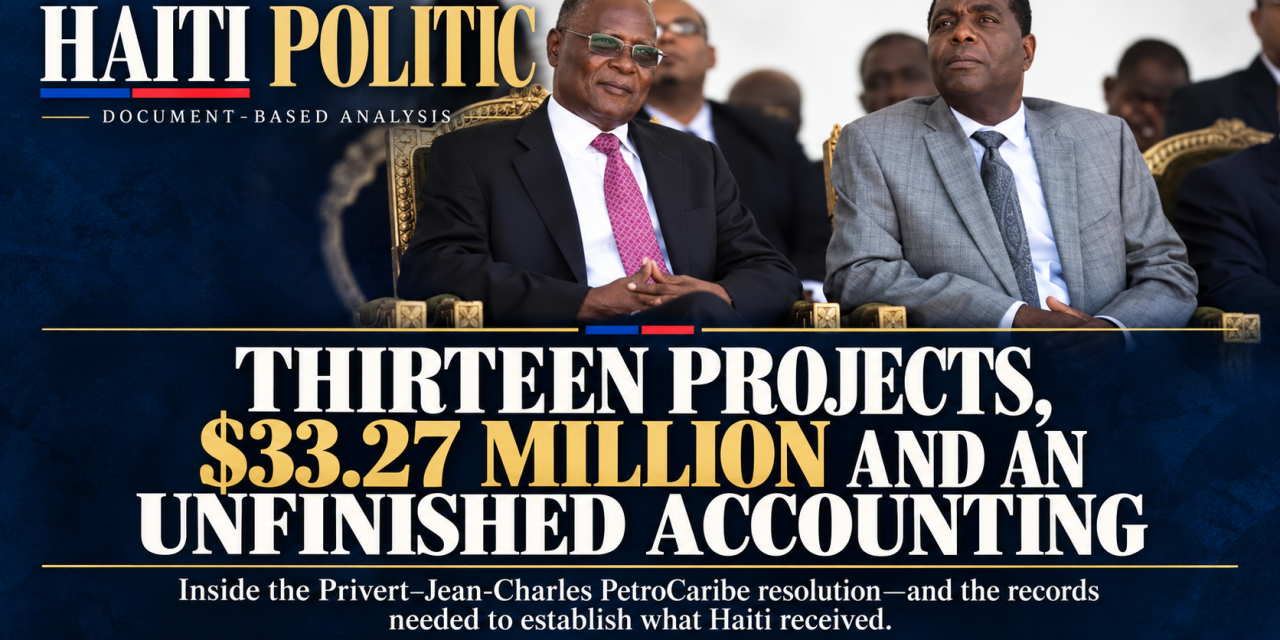
Inside the Privert–Jean-Charles PetroCaribe resolution—and the records needed to establish what Haiti received.
A Cabinet decision can authorize money. It cannot, by itself, demonstrate that a road was finished, a school delivered or a contractor paid for verified work.
That distinction sits at the center of the September 28, 2016 resolution adopted under provisional President Jocelerme Privert and Prime Minister Enex Jean-Charles. It authorized withdrawals of up to US$33,268,729 from PetroCaribe funds to continue 13 projects already underway. Contemporary reporting identified its publication in Le Moniteur No. 179 on October 10, 2016. [1]
The amount was approximately $33.27 million. It was a spending authorization, not proof that the entire amount left government accounts. Nor was this particular envelope an allocation to the Ede Pèp social programs: its schedule concerned infrastructure and a school.
The accountability question therefore requires several answers: What was authorized? What was transferred? What reached contractors? What work was inspected and accepted?
WHAT THE CABINET FUNDED
The CSC/CA’s first audit reproduces the following schedule in Annex 17. These are allocations under this resolution, not the lifetime costs of the projects. [2]
Project | Allocation, US$
Cayes–Jérémie road | 5,835,867
Petite-Rivière-de-Nippes–Petit-Trou-de-Nippes road | 5,000,000
Colladère–Cerca-Carvajal emergency road rehabilitation | 5,375,702
Chansolme urban renewal | 1,000,000
Meyotte–Frères road | 2,000,000
Grande-Rivière-du-Nord public market | 800,000
François Capois national lycée, Chansolme | 1,000,000
RN1/Freycineau–Saint-Marc–Bigot and associated road works | 1,250,000
Route de Frères | 766,722
Delmas–Nazon viaduct | 541,255
Cap-Haïtien waterfront | 2,619,183
Villa d’Accueil rehabilitation | 1,080,000
Jacmel–La Vallée road | 6,000,000
TOTAL | 33,268,729
The table matters because it allows citizens to ask about identifiable works rather than an undifferentiated multimillion-dollar envelope. Each line needs its own payment history and evidence of delivery.
AUTHORIZATION WAS LARGER THAN RECORDED TRANSFERS
The first audit lists $15,984,874.63 in BMPAD transfers against this resolution—approximately 48 percent of the authorized ceiling. The arithmetic difference is $17,283,854.37. That difference alone does not establish missing money: an authorization can remain partly unused, and institutional transfers are not identical to final contractor payments. [2]
In January 2017, Finance Minister Yves Romain Bastien had already told Le Nouvelliste that the full envelope had not been disbursed. Radio Vision 2000 reproduced that reporting. [1]
A complete reconciliation would connect every transfer to the receiving institution, its bank records, contractor invoices and certified work. Without it, treating the authorization as money entirely spent—or entirely stolen—would outrun the evidence.
PRIVERT’S EXPLANATION NEEDS SUPPORTING RECORDS
An October 28, 2026 report by Lakay Info 509 attributes to Privert an explanation that his administration inherited about $34 million in available resources against approximately $192 million in commitments, disbursed around $15 million and left roughly $19 million. Those are his reported figures, not independently reconciled balances established by this article. [4]
They concern the administration’s account of available resources and obligations. They should not automatically be equated with the execution of this single resolution. Comparing them responsibly requires matching dates, accounts and definitions.
His explanation also raises a legitimate policy issue: a government inheriting unfinished projects may face pressure to honor commitments. But inherited obligations still require verification. The essential question is what evidence supported the decision to continue funding each project.
WHAT THE AUDIT FOUND ABOUT DELIVERY
For complementary Jacmel–La Vallée works, the May 2019 audit records a November 25, 2016 contract of $8,964,568.45 against a $6 million allocation. It identifies Planning Minister Aviol Fleurant as contracting authority and SECOSA as contractor. Inspectors found contractual activities incompletely executed and no supervision report. [3]
The $2,964,568.45 difference calls for the financing justification and approval records. The finding concerns the complementary contract; it should not be presented as proof that the entire road was never built.
For the Grande-Rivière-du-Nord market, auditors reported missing supervision reports and provisional and final acceptance certificates. [3] Missing certificates prevent a clean documentary confirmation of acceptance; they do not, alone, prove that no structure existed.
These findings do not support saying all 13 projects had been fully delivered when audited. They also do not establish the current condition of every project. This review has not verified a complete, updated inventory of completion, acceptance and public use.
WHO MUST EXPLAIN WHAT
Privert and Jean-Charles should explain the Cabinet’s priorities and the controls required before further funding. Bastien should explain the financial execution and reconciliation. BMPAD and the implementing ministries should produce the transfer and project files.
For the Jacmel complementary contract, the audit’s identification of Fleurant and SECOSA provides a specific starting point for questions about financing, execution and supervision. Holding an office or appearing in an audit does not itself establish criminal guilt.
The available record supports a demand for documented accountability. It does not justify assigning every historical problem on these inherited projects to the administration that approved this continuation envelope.
FIVE QUESTIONS FOR JOCELERME PRIVERT
1. Will you publish the signed September 28, 2016 resolution, its annex and the technical assessments explaining why these 13 projects were selected for further funding?
2. How do you reconcile the $33,268,729 authorization with the audit’s $15,984,874.63 in BMPAD transfers and your reported figures for money available, disbursed and remaining? Will you release dated bank statements and a project-by-project reconciliation?
3. What verified completion levels, unpaid obligations and contractor performance reports did your Cabinet review before authorizing additional funding?
4. What financing and approval records explain the Jacmel–La Vallée complementary contract exceeding its allocation, and what action followed the auditors’ findings of incomplete activities and missing supervision?
5. Will you identify which of the 13 projects were formally accepted before your administration left office, publish the acceptance certificates and handover report, and specify which unfinished obligations passed to your successors?
Haitians need a public record that connects the Cabinet’s decision to money actually paid and infrastructure actually delivered. Publishing that record would give Privert and his former officials a concrete way to answer the questions that the resolution still raises.
Reporting note: This analysis draws on published reporting and CSC/CA audit documents. No new interviews were conducted. Audit observations describe conditions and documentation reviewed at the time; this article does not certify present-day project status or make findings of criminal liability.