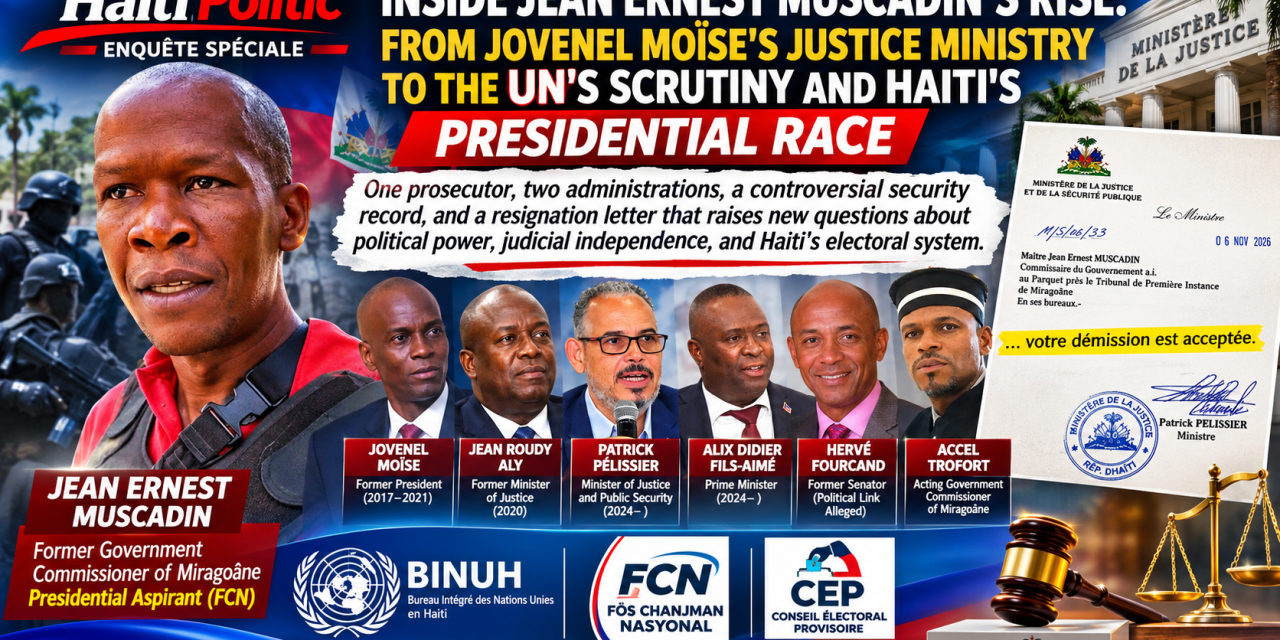
One prosecutor, two administrations, a controversial security record, and a resignation letter that raises new questions about political power, judicial independence, and Haiti’s electoral system.
HAITI POLITIC | SPECIAL INVESTIGATION
November 7, 2026
THE LETTER THAT OPENS A BIGGER POLITICAL STORY
On November 6, 2026, Haiti’s Minister of Justice and Public Security, Patrick Pélissier, signed a letter formally accepting the resignation of Jean Ernest Muscadin, the controversial Government Commissioner of Miragoâne.
At first glance, the document appears to be an ordinary administrative communication.
But its political significance extends far beyond the departure of one prosecutor.
Muscadin rose to prominence under President Jovenel Moïse’s administration. He remained in office through successive governments, became a nationally recognized figure in Haiti’s struggle against armed gangs, attracted scrutiny from United Nations human rights mechanisms, and eventually entered the presidential race under the banner of Fòs Chanjman Nasyonal (FCN).
His resignation now connects several chapters of Haiti’s recent political history.
The central questions are unavoidable:
Who helped Muscadin rise? Who protected his position? Why did successive governments retain him despite serious allegations? And can the prosecutor who became famous for fighting gangs convince Haitians that he is qualified to govern an entire country?
The answers require examining the institutions and political actors surrounding his career.
1. JOVENEL MOÏSE, JEAN ROUDY ALY, AND MUSCADIN’S APPOINTMENT
The first important date is January 31, 2020.
That is when Jean Ernest Muscadin was installed as acting Government Commissioner at the Court of First Instance of Miragoâne.
At the time, Haiti was governed by President Jovenel Moïse, and Jean Roudy Aly headed the Ministry of Justice and Public Security.
Muscadin’s appointment therefore occurred within the Moïse administration’s justice system.
This institutional relationship is documented.
However, the original appointment instrument has not been obtained for this investigation. Consequently, the available evidence does not establish whether President Moïse personally selected Muscadin, whether Justice Minister Aly recommended him, or whether another official initiated the appointment.
That distinction matters.
A government appointment establishes administrative responsibility, but it does not automatically establish a personal political alliance.
The questions surrounding his appointment
Why was Muscadin selected to lead the Miragoâne prosecutor’s office?
What professional qualifications were considered?
Who recommended him?
Was the appointment based entirely on his judicial experience, or did political relationships influence the decision?
These questions are particularly relevant because Muscadin’s arrival was controversial from the beginning.
Reports published shortly after his installation described opposition from lawyers in Miragoâne who criticized his inaugural remarks and questioned his suitability for the position.
His career at the head of the prosecutor’s office therefore began amid disagreement—not universal acceptance.
2. HERVÉ FOURCAND: THE POLITICAL CONNECTION THAT DESERVES INVESTIGATION
Another name appears in discussions surrounding Muscadin’s earlier political relationships: former Senator Hervé Fourcand.
Investigative reporting has examined allegations that Muscadin supported Fourcand’s 2016 senatorial campaign.
One account suggested that political support might have influenced Muscadin’s subsequent professional advancement.
Other testimony disputed the suggestion that Fourcand intervened to secure his appointment.
These competing accounts do not prove political favoritism.
Nevertheless, they establish an important subject for further investigation.
Did Muscadin maintain political relationships before becoming a nationally prominent prosecutor?
If so, what was the nature of those relationships?
Haiti Politic should seek the original appointment letter, relevant correspondence, and testimony from officials involved in the 2020 decision.
Without that evidence, it would be premature to describe Muscadin’s appointment as a political reward.
3. MIRAGOÂNE: HOW A PROSECUTOR BECAME A NATIONAL SECURITY SYMBOL
Miragoâne occupies a strategically important position along National Route 2.
The city connects the Port-au-Prince region with Haiti’s southern peninsula.
As armed gangs expanded their influence, maintaining access to this transportation corridor became increasingly important for commerce, transportation, and civilian movement.
Muscadin built his reputation around confronting suspected gang members and preventing armed groups from establishing control in his jurisdiction.
Unlike prosecutors who operate primarily through courtroom proceedings, Muscadin became known for his direct presence during security operations.
His approach generated considerable public support.
To many residents frustrated by the Haitian state’s inability to provide security, he represented an official willing to confront armed criminals.
But his growing popularity also produced a fundamental contradiction.
Was Muscadin demonstrating effective law enforcement, or was he replacing judicial procedures with personal authority?
Those two possibilities must be examined separately.
A region’s relative security cannot automatically be attributed to one official. Police operations, geography, community cooperation, transportation routes, and the activities of armed groups must also be considered.
The public deserves measurable evidence: arrests, prosecutions, convictions, crime statistics, and documented operational results.
4. THE UNITED NATIONS CONNECTION: EMPLOYMENT OR INVESTIGATION?
The relationship between Jean Ernest Muscadin and the United Nations is one of the most important aspects of this investigation.
Haiti has experienced successive UN missions, including MINUSTAH, MINUJUSTH, and BINUH.
These institutions have participated in security assistance, judicial reform, human rights monitoring, and institutional support.
Muscadin worked within Haiti’s justice system during periods when UN institutions were active.
However, no verified evidence obtained for this investigation establishes that Muscadin was personally employed, appointed, financed, or trained by a UN mission.
That question remains open pending examination of his complete professional history.
What is documented is considerably different.
The UN’s allegations against Muscadin
United Nations human rights reporting has repeatedly raised allegations concerning killings attributed to Muscadin.
A 2024 report by the UN’s designated expert on human rights in Haiti referred to at least 26 alleged criminals and gang members reportedly killed by the prosecutor.
Subsequent UN reporting documented additional allegations.
Reporting in 2026 cited BINUH’s account of at least 76 alleged summary executions associated with Muscadin between 2022 and 2025.
These figures come from different reporting periods and should not simply be added together.
They are allegations documented by international human rights mechanisms, not findings of guilt by a criminal court.
Nevertheless, they raise a serious question about Haiti’s judicial institutions.
How could a prosecutor remain in office for years while international human rights monitors repeatedly reported allegations of unlawful killings?
The answer requires examining the responsibilities of the Ministry of Justice, the police, and the judicial authorities.
It also requires giving Muscadin an opportunity to respond to the specific allegations.
5. THE JUSTICE MINISTRY HAD PREVIOUSLY QUESTIONED HIS CONDUCT
The controversy did not begin in 2026.
In December 2023, Haiti’s Ministry of Justice publicly reprimanded Muscadin over aspects of his conduct.
At the time, Emmelie Prophète Milcé headed the ministry.
The reprimand demonstrates that concerns about Muscadin’s professional methods had reached the national government.
Yet Muscadin remained in office.
This creates an institutional accountability question extending beyond the prosecutor himself.
What follow-up measures were taken after the reprimand?
Did the ministry initiate an administrative investigation?
Were any allegations referred to competent judicial authorities?
Did the ministry establish corrective procedures?
And why did successive administrations retain him?
These questions do not establish that ministers approved unlawful conduct.
They concern the effectiveness of the state’s supervisory mechanisms.
6. PATRICK PÉLISSIER: THE MINISTER WHO ACCEPTED HIS RESIGNATION
Patrick Pélissier became Minister of Justice and Public Security in November 2024 under Prime Minister Alix Didier Fils-Aimé.
His professional background includes legal training and reported experience connected to international human rights institutions.
That background is significant because the Ministry of Justice is responsible for important aspects of Haiti’s prosecutorial administration.
Pélissier inherited a justice system facing severe institutional weaknesses.
He also inherited the controversy surrounding Muscadin.
By November 2026, Muscadin was no longer simply a regional prosecutor.
He was a presidential aspirant.
What the November 6 letter establishes
The document supplied to Haiti Politic bears the heading of Haiti’s Ministry of Justice and Public Security.
It is addressed to Jean Ernest Muscadin in his capacity as acting Government Commissioner at the Miragoâne prosecutor’s office.
The letter is dated November 6, 2026.
It acknowledges a resignation letter dated October 29, 2026.
Most importantly, the minister states:
« Votre démission est acceptée. »
The document bears the printed name and apparent signature of Patrick Pélissier, together with a ministry seal.
Its contents are consistent with contemporary reporting on Muscadin’s departure.
However, the photograph alone does not independently authenticate the original document or establish the date on which the ministry physically received Muscadin’s resignation.
What the letter does not establish
The letter does not explain why Muscadin resigned.
It does not provide a legal opinion concerning his presidential eligibility.
It does not establish that his candidacy has been approved by the CEP.
It does not address the allegations previously documented by UN human rights mechanisms.
And it does not establish whether Pélissier had any political agreement with Muscadin.
The document confirms an administrative decision. Its broader political implications require additional evidence.
7. ALIX DIDIER FILS-AIMÉ AND THE QUESTION OF GOVERNMENT RESPONSIBILITY
Prime Minister Alix Didier Fils-Aimé heads the administration under which Pélissier accepted Muscadin’s resignation.
This places the decision within the government’s broader responsibility for justice and public security.
But an important distinction must be maintained.
There is no evidence in the resignation letter that Fils-Aimé personally ordered Muscadin’s departure or intervened in his presidential ambitions.
The prime minister’s relevance is institutional.
His government is responsible for maintaining the functioning of the justice system while Haiti prepares for elections and confronts armed violence.
The Muscadin case therefore raises questions about the administration’s approach to judicial accountability.
Why did the government retain Muscadin despite continuing controversy?
What procedures existed for reviewing allegations against prosecutors?
And how will the administration ensure that his successor operates within the law?
8. ACCEL TROFORT: THE MAN WHO INHERITS MUSCADIN’S OFFICE
Following Muscadin’s departure, Accel Trofort was designated acting Government Commissioner of Miragoâne.
Trofort previously served within the prosecutor’s office.
His appointment represents administrative continuity, but it also creates a test for Haiti’s justice system.
Will Trofort continue Muscadin’s operational approach?
Will the ministry introduce different procedures?
Will the prosecutor’s office publish statistics concerning arrests, prosecutions, and convictions?
Will there be greater transparency concerning cooperation with the Haitian National Police?
These questions are especially important because Miragoâne’s strategic importance has not disappeared with Muscadin’s resignation.
The region still requires effective security.
But security policy must also operate within Haiti’s constitutional and judicial framework.
9. FÒS CHANJMAN NASYONAL: FROM PROSECUTOR TO PRESIDENTIAL CANDIDATE
Muscadin’s presidential ambitions connect him to Fòs Chanjman Nasyonal, or FCN.
The political organization has supported his attempt to enter the presidential race.
This represents a significant transformation.
Muscadin built his public reputation through law enforcement.
A presidential campaign requires something broader.
It requires positions on economic development, education, agriculture, public finance, infrastructure, diplomacy, and constitutional governance.
The political recruitment question
Who first approached Muscadin about becoming a presidential candidate?
What role did FCN leaders play?
What agreements govern his relationship with the party?
Who finances his political activities?
And what political experience does Muscadin bring beyond his years as a prosecutor?
These questions should be answered through party records, financial disclosures, and direct interviews.
There is currently insufficient evidence to establish an undisclosed arrangement between FCN and any former or current government official.
10. THE CEP: WHY ACCEPTING A RESIGNATION IS NOT THE SAME AS APPROVING A CANDIDACY
The October 29–November 6 timeline is especially important.
Muscadin’s resignation letter is dated October 29.
Minister Pélissier accepted it on November 6.
But Haiti’s electoral decree contains requirements governing the resignation of certain public officials seeking elected office.
Article 153 has been cited in reporting concerning the requirement that covered public prosecutors resign before the opening of the candidate-registration period.
This creates a potentially significant legal problem for Muscadin.
The date on which a minister accepts a resignation does not necessarily resolve whether a candidate complied with the electoral deadline.
The CEP must examine the applicable law and supporting documents.
Reports have also raised questions about missing documents in Muscadin’s application, including evidence concerning his resignation and tax obligations.
The complete administrative record is necessary to determine whether those deficiencies were subsequently corrected.
Three separate decisions
The public should distinguish between three matters.
First, the Ministry of Justice accepted Muscadin’s resignation.
Second, the electoral authorities must determine whether his application satisfies the legal requirements.
Third, any available electoral appeal process may review a disputed decision.
These are not interchangeable procedures.
The resignation letter is therefore important evidence, but it is not proof that Muscadin has been accepted as a presidential candidate.
11. THE POLITICAL PARADOX: A PROSECUTOR CRITICIZED BY THE UN NOW SEEKS TO LEAD HAITI
Muscadin’s political rise presents a paradox.
For years, the United Nations and other human rights monitors have criticized aspects of his security record.
Yet some Haitians view him as an effective response to the insecurity that international missions and successive Haitian governments have struggled to contain.
His supporters see a determined official.
His critics see a dangerous departure from the rule of law.
Both positions reflect a deeper crisis of confidence in Haiti’s institutions.
The important question is not simply whether Muscadin is popular.
It is whether his approach can be evaluated through independently verifiable evidence and reconciled with the responsibilities of constitutional government.
The Bukele comparison
Muscadin has sometimes been compared with Salvadoran President Nayib Bukele because of their public reputations for aggressive anti-gang policies.
But the comparison has limits.
Bukele governs a sovereign state and exercises national executive authority.
Muscadin served as a regional prosecutor.
Their powers, institutional responsibilities, and political circumstances differ substantially.
Furthermore, a comparison of security outcomes must include judicial safeguards, civilian protection, detention conditions, and accountability.
Popularity alone cannot answer those questions.
12. THE ACTORS AND THEIR DOCUMENTED CONNECTIONS
| Actor | Relationship to Muscadin | What remains unresolved |
|---|---|---|
| Jovenel Moïse | President when Muscadin was installed in Miragoâne in 2020 | Whether he personally influenced the selection |
| Jean Roudy Aly | Justice minister during the appointment | Whether he signed or initiated the appointment |
| Hervé Fourcand | Subject of reporting about earlier political relationships with Muscadin | Whether he influenced Muscadin’s career advancement |
| Emmelie Prophète Milcé | Justice minister whose ministry reprimanded Muscadin in 2023 | What disciplinary follow-up occurred |
| Patrick Pélissier | Justice minister who accepted Muscadin’s resignation | Whether additional administrative or legal reviews occurred |
| Alix Didier Fils-Aimé | Prime minister under whom the resignation was accepted | Whether the prime minister had any direct involvement |
| Accel Trofort | Successor at the Miragoâne prosecutor’s office | Whether he will change the office’s security practices |
| United Nations / BINUH | Documented allegations concerning Muscadin’s conduct | Whether any direct professional relationship existed earlier in his career |
| FCN | Political organization supporting his presidential ambitions | Recruitment process, political commitments, and campaign financing |
| CEP | Institution responsible for evaluating electoral eligibility | Final determination concerning his application |
These relationships are not all equivalent.
Some are documented administrative relationships.
Others involve allegations, institutional oversight, or unresolved questions.
No evidence presented here establishes that these actors participated in a coordinated political operation to advance Muscadin’s presidential ambitions.
13. TEN QUESTIONS HAITI POLITIC WANTS ANSWERED
1. To Jean Roudy Aly: Who recommended Jean Ernest Muscadin for appointment as Government Commissioner of Miragoâne in January 2020?
2. To Hervé Fourcand: Did you recommend, support, or intervene in any appointment involving Muscadin?
3. To Patrick Pélissier: On what exact date did your ministry receive Muscadin’s October 29 resignation letter?
4. To Patrick Pélissier: Did your ministry issue any legal opinion concerning Muscadin’s compliance with the electoral decree?
5. To Alix Didier Fils-Aimé: What measures has your administration taken to ensure accountability for allegations involving public prosecutors?
6. To Accel Trofort: Will your office continue Muscadin’s security practices, and what judicial safeguards will govern future operations?
7. To BINUH: What evidence supports the allegations involving Muscadin, and what responses have Haitian authorities provided?
8. To FCN: Who recruited Muscadin, and who is financing his presidential campaign?
9. To the CEP: Has Muscadin submitted every required document, and has a final decision been issued concerning his eligibility?
10. To Jean Ernest Muscadin: Will you publish your complete professional history, presidential application, resignation correspondence, and a detailed response to the allegations documented by UN human rights mechanisms?
CONCLUSION: WHO CREATED MUSCADIN’S POLITICAL OPPORTUNITY?
Jean Ernest Muscadin did not emerge from nowhere.
His rise occurred within Haiti’s judicial system.
He was installed under Jovenel Moïse’s administration, remained in office through subsequent governments, developed a national reputation for confronting armed gangs, faced serious human rights allegations, and eventually entered presidential politics.
Now Patrick Pélissier’s November 6 letter formally closes one chapter of that career.
But it opens another.
The letter does not explain who first promoted Muscadin, why successive governments retained him, or whether his presidential application satisfies every electoral requirement.
Those questions must be answered through documentary evidence—not political assumptions.
Haiti Politic’s central finding is that Muscadin’s career reveals a larger institutional problem: Haiti has struggled to reconcile public demands for security with the legal accountability expected of those entrusted with enforcing the law.
His supporters are entitled to demand effective protection from armed gangs.
His critics are entitled to demand accountability for alleged abuses.
And every Haitian citizen is entitled to know whether a presidential candidate meets the constitutional and electoral requirements for office.
The next chapter belongs to the CEP, the Ministry of Justice, Muscadin himself, and ultimately the Haitian electorate.
The question is no longer simply whether Jean Ernest Muscadin can fight gangs.
It is whether he can demonstrate the qualifications, judgment, transparency, and respect for constitutional institutions required to govern Haiti.
HAITI POLITIC — Independent Political Investigation
Editorial note: This investigation distinguishes documented administrative actions from reported allegations and unresolved political questions. Allegations of unlawful conduct are not criminal convictions. Individuals named in this report should be given an opportunity to respond before publication of any additional allegations.