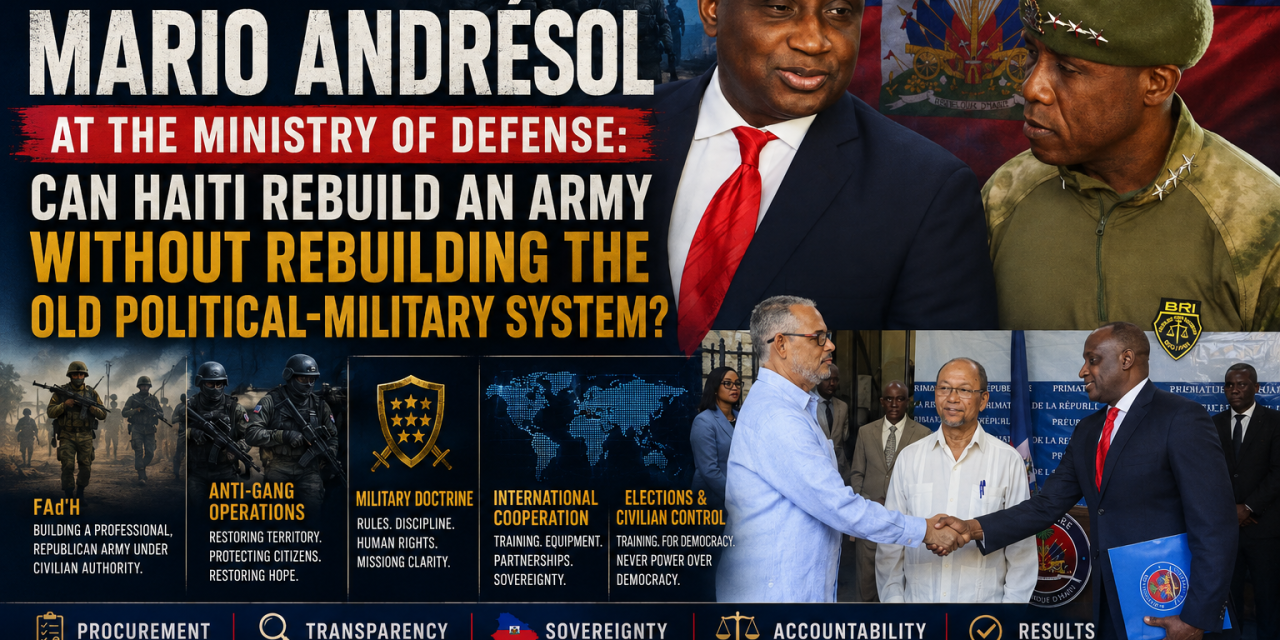
FAd’H. Anti-gang operations. Military doctrine. International cooperation. Elections. Civilian control. Procurement. Sovereignty. Accountability.
Haiti Politic Investigative Profile | August 2026
This investigation does not endorse or oppose Mario Andrésol or any political faction. It examines the publicly documented record, the constitutional role of the defense establishment, the government’s stated objectives and the questions Haitians should be able to ask of whoever controls the Ministry of Defense. The people can judge the results.
Haiti’s security crisis has transformed the Ministry of Defense from what was once a comparatively marginal government portfolio into a potentially consequential center of state power.
And the man currently occupying that office is no stranger to Haiti’s security establishment.
Mario Andrésol was installed as Minister of Defense on March 4, 2026, after previously serving as a military officer, Director General of the Haitian National Police (PNH), and, more recently, Secretary of State for Public Security. The government’s stated objective when installing him was the continued development, professionalization and modernization of the Armed Forces of Haiti.
That résumé gives Andrésol something unusual:
experience on both sides of Haiti’s police-military security architecture.
But experience is not the same thing as results.
The question Haiti Politic asks is larger:
Can the Ministry of Defense help rebuild sovereign security institutions—or will Haiti simply create another armed institution without the accountability, money, doctrine and civilian controls necessary to make it work?
🪖 FIRST: WHAT SHOULD A HAITIAN MINISTER OF DEFENSE ACTUALLY DO?
The defense minister should not be understood as Haiti’s battlefield commander.
There is an important distinction between political/civilian oversight and military command.
The ministry’s strategic role includes translating government policy into defense priorities, developing the country’s defense architecture, overseeing resources and institutional development, coordinating with the FAd’H leadership and representing Haiti in defense relationships with foreign governments.
That makes the minister a bridge:
Cabinet → Defense Ministry → FAd’H → international partners.
The minister therefore faces a fundamental democratic test:
Can Haiti build a stronger army while keeping that army subordinate to civilian constitutional authority?
This matters enormously given Haiti’s history.
A successful reconstruction cannot merely produce more soldiers.
It must produce a professional republican institution.
And Andrésol himself has publicly framed his objective in those terms, calling for a modern and professional force under civilian authority and respectful of human rights.
That promise should become measurable.
📊 WHAT HAS ANDRÉSOL’S MINISTRY ACTUALLY DONE?
The Ministry of Defense published a review covering Andrésol’s first 100 days, from March 4 through June 12.
According to that ministry-generated assessment, the period included:
339 soldiers integrated from the “Capois la Mort” promotion.
A national recruitment campaign generating 17,722 applications, including 4,331 women.
Six military-site assessment missions.
Rehabilitation initiatives at Vertières, Anacaona and Clercine.
Work toward a new military doctrine.
Expanded military relationships with countries including France, Brazil, Argentina, Mexico and the United States.
And six military-training scholarships offered by Argentina.
These are tangible institutional activities.
But because the 100-day assessment comes from the ministry itself, it should be treated as the government’s account of its performance, not an independent audit of operational effectiveness.
That distinction is critical.
🔥 THE BIG PROMISE: EXPANDING THE FAd’H
Andrésol has articulated an ambitious vision.
He has described rebuilding the FAd’H as a long-term response to Haiti’s security crisis and argued that the country’s dependence on external forces is connected to the security vacuum created after the dissolution of the former armed forces in 1995.
His publicly stated ambition has included increasing military strength from roughly 2,000 toward 5,000 personnel, alongside infrastructure rehabilitation and nationwide recruitment.
This raises the first major accountability question:
5,000 soldiers—with what money?
Recruiting soldiers is relatively easy compared with maintaining an army.
Every additional soldier requires:
salary;
food;
housing;
uniforms;
weapons;
ammunition;
vehicles;
communications;
medical care;
training;
insurance and benefits;
command infrastructure;
maintenance;
and eventually pensions.
A military that Haiti cannot sustainably finance could become another institutional liability.
So before celebrating recruitment numbers, Parliament, auditors, journalists and citizens should demand something much less glamorous:
the long-term bill.
⚔️ FAd’H VS. THE GANGS: WHAT IS THE ACTUAL DOCTRINE?
Andrésol has described a future division of labor in which the armed forces develop greater territorial-defense capacity while the PNH remains centered on public-order and policing responsibilities.
His ministry’s 2026–2027 Action Plan goes further.
According to the published description, one priority is improving FAd’H capacity against armed gangs in order to help create conditions for safe and credible elections. Another is expanding foreign defense partnerships, while a third involves improving the ministry’s strategic-analysis capability.
This deserves serious scrutiny.
Because gang warfare inside cities is not conventional warfare.
Soldiers trained to defeat an enemy military are not automatically trained to conduct operations in neighborhoods filled with civilians.
That raises questions about:
rules of engagement;
arrest authority;
intelligence sharing with the PNH;
civilian casualties;
detention procedures;
evidence preservation;
and command responsibility.
A stronger army without clearly defined rules could create new problems while attempting to solve existing ones.
🎯 A SPECIAL-FORCES UNIT IS NOW ON THE TABLE
On August 5, Andrésol met the FAd’H high command to discuss modernization and coordination.
Among the projects discussed was the creation of a special-forces unit at Base Vertières, alongside recruitment, logistical support, international partnerships and improved institutional coordination.
That could substantially expand military capability.
It also demands substantially greater oversight.
Haiti Politic would ask:
Who selects these soldiers?
Who trains them?
Who vets them?
What is their mission?
Under whose operational command will they deploy?
What rules govern lethal force?
Can they arrest civilians?
What human-rights training will they receive?
What mechanism investigates misconduct?
And who outside the military audits their operations?
Elite military capability must be accompanied by elite accountability.
🇲🇽 THE MEXICO CONNECTION
One of the more concrete bilateral initiatives involves Mexico.
Andrésol met Mexican Ambassador José de Jesús Cisneros Chávez in July to discuss strengthening the FAd’H.
Le Nouvelliste reported that 114 Haitian military personnel were expected to travel to Mexico for basic training, alongside discussions about expanding bilateral cooperation.
The ministry’s 100-day report likewise identifies Mexico as part of its expanded international cooperation program.
This represents something potentially important:
using diplomacy to build Haitian capability rather than permanently substituting foreign personnel for Haitian institutions.
But the public should eventually know what the training produces.
How many return?
What specialties do they acquire?
Where are they assigned?
How long do they remain in service?
And what does Haiti contribute financially?
🇧🇷 BRAZIL: URBAN SECURITY EXPERIENCE?
Brazil represents another potentially consequential relationship.
In July, Andrésol met Brazilian Ambassador Luís Guilherme Nascentes da Silva.
According to Le Nouvelliste’s account of the ministry’s description, discussions concerned defense, security, logistical assistance, training and Brazilian experience relevant to securing urban environments.
That last point deserves attention.
Haiti’s immediate security problem is overwhelmingly urban and irregular.
But importing tactics from another country’s security environment must be handled carefully.
Port-au-Prince is not Rio de Janeiro.
Haitian institutions need doctrine designed for Haitian law, Haitian communities and Haitian conditions.
🇺🇸 THE UNITED STATES: A POTENTIALLY MAJOR SHIFT
One of the more significant developments involves Washington.
In July, Andrésol met the U.S. Embassy’s military attaché following developments concerning longstanding restrictions on U.S. cooperation with the FAd’H.
Discussions reportedly included military education, training and possible scholarships.
This could eventually matter far more than diplomatic photographs.
U.S. cooperation could potentially affect:
training;
communications;
logistics;
professional military education;
institutional standards;
and interoperability.
But Haiti should approach every foreign military partnership with the same principle:
Cooperation should build Haitian capacity—not permanent Haitian dependency.
💰 FOLLOW THE DEFENSE MONEY
This may eventually become the most important investigation of all.
Rebuilding an army requires substantial procurement.
Vehicles.
Weapons.
Ammunition.
Communications systems.
Drones.
Body armor.
Engineering equipment.
Barracks.
Fuel.
Maritime assets.
Maintenance contracts.
And construction.
Every one of those categories creates opportunities for legitimate modernization.
Every one also creates opportunities for corruption.
Therefore, the reconstruction of the FAd’H should be accompanied by an unusually aggressive procurement-transparency regime.
The public should be able to determine, subject to legitimate national-security redactions:
Who received contracts?
How were vendors selected?
What was purchased?
How much did it cost?
Was competitive bidding used?
Who inspected delivery?
Did the government actually receive what it purchased?
National security cannot become a blanket justification for hiding public money.
⚖️ CAN ANDRÉSOL BUILD AN ACCOUNTABILITY CULTURE?
There is at least one recent case worth examining.
In June, two FAd’H soldiers were dismissed following an administrative investigation concerning theft and intimidation allegations.
Andrésol publicly presented the disciplinary action as evidence that corruption, abuse of authority and illegal conduct would not be tolerated inside the institution.
One disciplinary action does not establish an institutional culture.
But it establishes a standard against which future cases can be measured.
The harder tests will involve allegations concerning:
excessive force;
civilian deaths;
procurement corruption;
political interference;
weapons diversion;
and senior officers.
Accountability becomes meaningful when it reaches powerful people, not merely junior soldiers.
🗳️ THE MOST SENSITIVE QUESTION: THE MILITARY AND ELECTIONS
The Defense Ministry’s own action-plan description explicitly connects improving FAd’H anti-gang capacity with creating conditions for safe and credible elections.
That makes institutional boundaries exceptionally important.
There is a legitimate security function:
protecting territory;
helping secure transportation corridors;
protecting critical infrastructure;
and supporting conditions in which civilian institutions can function.
But military involvement in electoral politics is something entirely different.
The firewall must be unmistakable:
Secure the democratic process. Never determine its political outcome.
Soldiers should not become campaign operatives.
Military resources should not favor candidates.
Commanders should not pressure voters.
Security deployment should not become selective political protection.
And defense institutions should not become instruments for incumbents.
Haiti’s history makes these safeguards especially important.
🏛️ CABINET POWER VS. MILITARY POWER
A defense minister sits in Cabinet.
That means Andrésol’s responsibility extends beyond barracks.
He participates in a government that must integrate:
defense + police + justice + border control + customs + diplomacy + intelligence + economic policy + elections.
No military strategy can succeed if courts cannot process detainees.
No territorial operation succeeds permanently if police cannot remain afterward.
No border strategy works if customs officials are corrupt.
No counter-gang strategy survives if weapons continue entering the country.
And no security strategy is sustainable if unemployed young Haitians remain an unlimited recruitment pool for armed organizations.
Defense policy must therefore become national policy integration—not merely military expansion.
📋 HAITI POLITIC | DEFENSE ACCOUNTABILITY DASHBOARD
| Question | What government activity currently shows | What remains to be demonstrated |
|---|---|---|
| Recruitment | Large recruitment campaign reported | Vetting, retention and sustainable financing |
| Infrastructure | Base rehabilitation underway | Completion, cost and independent audit |
| Doctrine | New doctrine under development | Publication/implementation and legal boundaries |
| Anti-gang capability | FAd’H expansion planned | Measurable territorial/security outcomes |
| Special Forces | Unit proposed at Vertières | Mission, training, oversight and rules |
| Mexico | Training program developing | Long-term operational impact |
| Brazil | Cooperation discussions | Concrete programs and results |
| United States | New cooperation possibilities | Formal implementation |
| Military discipline | Two soldiers dismissed after investigation | Independent and durable accountability system |
| Elections | Security identified as enabling credible elections | Strict political neutrality |
These entries describe publicly reported activities and unresolved verification questions; they are not a ranking or assessment of Andrésol against any candidate, party, or political alternative.
🔎 15 QUESTIONS MARIO ANDRÉSOL SHOULD ANSWER
- What exactly is the constitutional mission of the reconstructed FAd’H?
- What functions belong exclusively to the PNH?
- Who commands joint PNH-FAd’H anti-gang operations?
- What rules of engagement govern soldiers operating among civilians?
- What is the projected annual cost of expanding toward 5,000 troops?
- How will Haiti finance that force without creating unsustainable foreign dependency?
- Will major defense contracts be publicly disclosed where national security permits?
- Who independently audits military procurement?
- How will weapons and ammunition inventories be tracked to prevent diversion?
- What precisely will the proposed Vertières special-forces unit do?
- What measurable results should Haitians expect from cooperation with Mexico, Brazil, Argentina, France and the United States?
- What human-rights investigation mechanism will examine allegations against soldiers?
- Will civilians have an independent channel for filing complaints against FAd’H personnel?
- What formal safeguards prevent military resources from being used to influence elections?
- What numerical indicators should the public use in 2027 to determine whether the Defense Ministry’s strategy actually worked?
🇭🇹 THE ANDRÉSOL TEST
Mario Andrésol’s return to the center of Haiti’s security establishment creates an unusual experiment.
A former military officer.
A former PNH Director General.
A former Secretary of State for Public Security.
Now Minister of Defense.
His ministry has announced recruitment, military-base rehabilitation, doctrinal reform, international training relationships and a proposed special-forces capability.
The question is no longer whether Haiti needs security.
That debate has been overtaken by reality.
The question is what kind of security state Haiti intends to build.
A professional army?
Or another politicized armed institution?
A military subordinate to civilian authority?
Or another autonomous center of power?
International cooperation that builds sovereignty?
Or another cycle of dependency?
Security for elections?
Or military influence over politics?
Transparent procurement?
Or another protected source of public contracts?
Those questions cannot be answered by uniforms, ceremonies, recruitment numbers or diplomatic meetings.
They will be answered by territorial control, institutional discipline, audited spending, civilian protection, political neutrality and measurable results.
HAITI DOES NOT SIMPLY NEED A STRONGER ARMY.
IT NEEDS A STRONGER REPUBLIC CAPABLE OF CONTROLLING ITS ARMY.
The documents should speak. The institutions should be audited. The results should be measurable. And the people should decide.
#HaitiPolitic #MarioAndresol #FAdH #Haiti #Defense #NationalSecurity #SecurityReform #Elections #MilitaryReform #Sovereignty #Accountability
Source note: This article uses public reporting and government-described initiatives to identify documented activities and unresolved accountability questions. Government claims about plans and accomplishments are presented as such unless independently established. It does not compare, rank, endorse, recommend or oppose Andrésol, a candidate, political party or electoral choice.