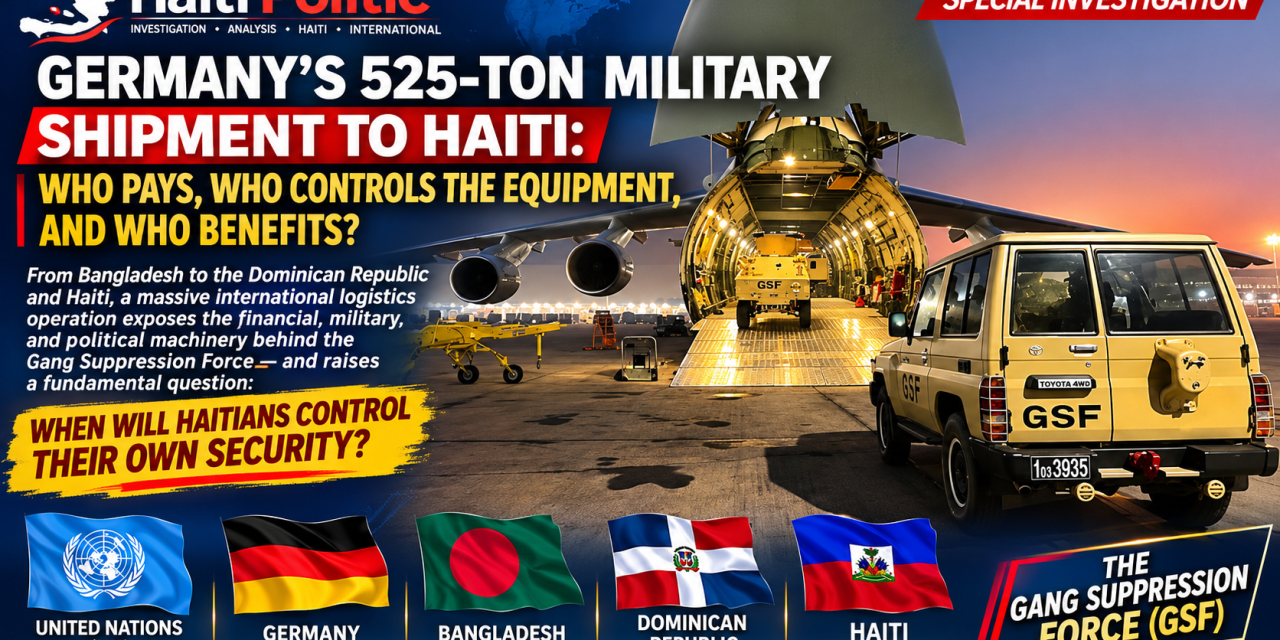
From Bangladesh to the Dominican Republic and Haiti, a massive international logistics operation exposes the financial, military, and political machinery behind the Gang Suppression Force — and raises a fundamental question: When will Haitians control their own security?
HAITI POLITIC | SPECIAL INVESTIGATION
November 7, 2026
By Haiti Politic Investigative Desk
THE SHIPMENT: 525 TONS, MULTIPLE COUNTRIES, ONE DESTINATION
A massive shipment of approximately 525 metric tons of military equipment and operational supplies destined for Haiti’s Gang Suppression Force (GSF) has brought renewed attention to the expanding international security operation in Haiti.
According to reports published in early November 2026, Germany financed the strategic transportation of equipment originating in Bangladesh, while the Dominican Republic facilitated its onward movement toward Haiti.
The United Nations Support Office in Haiti (UNSOH) coordinated logistical arrangements associated with the operation.
The shipment reportedly included armored vehicles, specialized transportation equipment, weapons, and other supplies intended to support Bangladeshi personnel participating in the international security deployment.
But behind the impressive tonnage and the carefully coordinated international operation lies a much larger story.
Germany finances transportation. Bangladesh provides equipment. The Dominican Republic facilitates transit. The United Nations coordinates logistical support. The United States remains a central diplomatic and financial supporter of the international security response.
And Haiti?
Haiti remains the country where these foreign-supported security operations are conducted, where the consequences are felt, and where the population continues to demand protection from armed violence.
The fundamental question is no longer simply whether international partners can deliver military equipment.
It is whether the international security system being constructed around Haiti will ultimately strengthen Haitian sovereignty or prolong the country’s dependence on foreign military assistance.
I. GERMANY’S ROLE: WHO IS PAYING FOR THE OPERATION?
Germany’s involvement represents another example of the international financial arrangements supporting the Gang Suppression Force.
According to the reported German diplomatic announcement, Germany financed strategic air transportation from Bangladesh to the Dominican Republic.
The equipment was subsequently transferred toward Haiti through maritime logistics facilitated by Dominican authorities.
This distinction is important.
Germany’s role in the shipment does not necessarily mean that the German government manufactured, purchased, or owned the equipment.
The reported contribution concerned transportation and logistical support.
Nevertheless, international military logistics can be extraordinarily expensive.
Moving hundreds of tons of equipment across continents requires specialized aircraft, cargo handling, airport coordination, ground transportation, maritime shipping, insurance, security arrangements, and personnel.
The precise cost of this operation has not been established in the publicly available reporting reviewed for this article.
That raises immediate questions.
How much did Germany actually spend?
Which German government budget financed the transportation?
Were private military logistics contractors involved?
Which companies received transportation payments?
Were the contracts competitively awarded?
And what oversight mechanisms exist to ensure that the money was spent appropriately?
These questions matter because international security assistance should be subject to financial accountability, particularly when the intended beneficiaries are people living under extraordinary conditions of insecurity.
A military shipment may be described as international solidarity. But solidarity financed with public money still requires transparency.
II. BANGLADESH: THE COUNTRY BEHIND THE EQUIPMENT
Bangladesh’s involvement reflects the increasingly multinational character of the security operation in Haiti.
Bangladesh has experience contributing personnel to United Nations peacekeeping operations around the world.
Its participation in the current GSF framework represents another international deployment involving Haitian security.
The equipment shipment reportedly supports the Bangladeshi contingent.
That raises an important question about ownership.
Are the armored vehicles and weapons the property of Bangladesh?
Are they temporarily assigned to the GSF?
Will they eventually be transferred to Haitian authorities?
Or will they leave Haiti when the Bangladeshi contingent completes its deployment?
The answers are not merely administrative details.
They determine who controls the equipment, who maintains it, who authorizes its use, and what happens when the international mission ends.
A country can receive hundreds of tons of foreign military equipment without acquiring a single permanent asset for its national security institutions.
That is why the distinction between equipment deployed in Haiti and equipment transferred to Haiti is essential.
Without publicly accessible agreements identifying ownership and disposition, the long-term benefit to Haitian institutions remains uncertain.
III. WHY DID THE EQUIPMENT PASS THROUGH THE DOMINICAN REPUBLIC?
One of the most revealing elements of the shipment is its reported transportation route.
Bangladesh → Dominican Republic → Haiti.
Germany financed the air transportation to the Dominican Republic.
Dominican authorities facilitated the subsequent maritime transfer through the Port of Haina.
UNSOH coordinated logistical arrangements.
The decision highlights the Dominican Republic’s growing importance as a regional logistical partner for international security operations involving Haiti.
But it also raises a question that Haitian authorities should address.
Why was the equipment not delivered directly through Haitian transportation infrastructure?
Haiti possesses several maritime facilities, including those serving Port-au-Prince, Cap-Haïtien, Miragoâne, and other coastal locations.
However, the existence of a port does not automatically mean it has the security conditions, cargo-handling capacity, customs arrangements, or specialized infrastructure required for a particular military shipment.
The available information does not establish why the Dominican route was selected.
It would therefore be premature to conclude that the decision resulted from the failure of Haitian ports or from an effort to bypass Haitian authorities.
Nevertheless, the arrangement deserves examination.
If international partners increasingly depend on Dominican infrastructure to supply security operations in Haiti, what does that mean for Haiti’s own transportation and logistical sovereignty?
Could some of the international funding currently used for foreign transit arrangements also support the rehabilitation and protection of Haitian ports?
And is there a plan to strengthen Haiti’s capacity to receive and manage comparable shipments independently?
These are questions about long-term national capability.
IV. THE UNITED NATIONS: LOGISTICAL SUPPORT OR A PERMANENT SECURITY ARCHITECTURE?
The United Nations plays a central role in coordinating logistical support for the GSF through UNSOH.
The office supports international security operations through transportation coordination, infrastructure, equipment-related services, and operational logistics.
This arrangement must be distinguished from direct military command.
The GSF is not simply a conventional UN peacekeeping mission operating under the same structure as the former United Nations Stabilization Mission in Haiti, known as MINUSTAH.
Nevertheless, the United Nations remains deeply involved in the broader international security framework.
That institutional continuity deserves scrutiny.
For more than two decades, Haiti has experienced successive international interventions, peacekeeping operations, political missions, and security assistance programs.
MINUSTAH operated from 2004 to 2017.
It was followed by the United Nations Mission for Justice Support in Haiti, known as MINUJUSTH, from 2017 to 2019.
The United Nations Integrated Office in Haiti, BINUH, subsequently became a central component of the UN’s political engagement.
The current security framework adds another layer of international coordination.
Each mission has operated under different mandates, and their results cannot be treated as identical.
But together, they raise a persistent question:
After more than twenty years of international security involvement, why does Haiti remain dependent on foreign assistance to restore basic public security?
That question requires an assessment not only of international missions but also of Haitian political leadership, institutional weaknesses, corruption, organized crime, and the failure to develop sustainable national security capabilities.
The responsibility cannot be assigned exclusively to foreign actors.
Nor can foreign institutions be exempted from examining the results of their own interventions.
V. THE UNITED STATES: THE POLITICAL AND FINANCIAL CENTER OF THE SECURITY RESPONSE
Washington has played a prominent role in mobilizing international support for Haiti’s security operations.
The United States has supported the development and expansion of the multinational security framework through diplomacy, funding, equipment assistance, and coordination with international partners.
Its involvement extends beyond the current GSF.
For decades, the United States has supported political development, electoral assistance, governance programs, and institutional reform initiatives in Haiti.
Organizations such as USAID and the Consortium for Elections and Political Process Strengthening (CEPPS), whose partners include the International Republican Institute (IRI), the National Democratic Institute (NDI), and the International Foundation for Electoral Systems (IFES), have participated in democracy-related assistance programs.
These programs are institutionally distinct from the military logistics supporting the GSF.
Their existence does not establish that electoral assistance organizations direct military operations or that a single institution controls Haiti’s political system.
Nevertheless, the broader history creates an important question about foreign policy continuity.
Washington has supported Haitian electoral processes, political transitions, institutional reforms, and security initiatives across multiple administrations.
What measurable institutional independence has Haiti gained from these investments?
And why does each new political crisis appear to generate another international assistance framework?
These questions are especially relevant when examining the relationship between external political assistance and the country’s repeated inability to establish durable democratic institutions.
VI. FROM THE 2010 ELECTION CRISIS TO TODAY’S SECURITY DEPLOYMENT
Haiti’s controversial 2010–2011 presidential election remains an important historical reference when examining foreign influence.
The first round initially placed former First Lady Mirlande Manigat ahead of government-backed candidate Jude Célestin, with Michel Martelly in third place.
Following allegations of electoral irregularities, an Organization of American States expert mission reviewed the results.
Its recommendations supported a revised outcome that placed Martelly ahead of Célestin, allowing Martelly to advance to the runoff against Manigat.
Then-U.S. Secretary of State Hillary Clinton traveled to Haiti in January 2011 during the electoral crisis.
The United States exerted significant diplomatic pressure for the electoral process to move forward in accordance with the disputed revised results.
Martelly ultimately won the runoff and became president.
This episode remains central to debates about the influence of foreign governments and international institutions over Haitian political decisions.
However, the historical record does not establish that Clinton personally selected Martelly as president.
Haitian electoral authorities formally administered the process, while international pressure played a consequential role in the political environment surrounding the disputed results.
The distinction matters.
Foreign diplomatic influence can be substantial without constituting direct legal control of an election.
The 2010 controversy illustrates how international actors can shape political outcomes through diplomatic pressure, institutional recommendations, and recognition decisions.
Today, Haiti faces a different crisis, but some of the same fundamental questions remain.
Who determines the acceptable political transition?
Who defines the conditions for elections?
Who provides the security required for voting?
And how much influence should foreign governments exercise over those decisions?
VII. EL SALVADOR, NAYIB BUKELE, AND THE NEW FOREIGN SECURITY MODEL
The reported deployment of Salvadoran military personnel has introduced another controversial dimension to Haiti’s international security response.
President Nayib Bukele has cultivated an international reputation based on his government’s aggressive campaign against organized gangs in El Salvador.
His security policies have attracted praise for reducing gang violence and criticism concerning mass detention, due process, and human rights.
The application of Salvadoran security experience to Haiti raises serious operational questions.
Haiti’s armed groups operate within a different political, geographical, economic, and institutional environment.
The country’s security crisis involves territorial control, illicit arms trafficking, kidnapping, extortion, political instability, and longstanding institutional weaknesses.
A strategy developed for El Salvador cannot automatically be transferred to Haiti without adaptation.
Furthermore, foreign soldiers operating in unfamiliar territory face significant risks.
Public threats against suspected gang facilities may attract attention, but successful security operations require intelligence, coordination, legal authority, civilian protection, and disciplined operational planning.
The effectiveness of a commander should be measured by results and the protection of personnel and civilians—not by the intensity of public declarations.
The arrival of additional equipment for other international contingents underscores the expanding scale of the operation.
But expansion alone does not establish success.
VIII. DAMIÁN MERLO, MICHEL MARTELLY, AND THE QUESTIONS ABOUT POLITICAL CONNECTIONS
The international security debate has also revived interest in Damián Merlo, a political consultant whose professional relationships and public advocacy concerning Haiti have generated questions about political influence.
Merlo has been associated with political consulting and advocacy involving Haitian political figures, including former President Michel Martelly.
His public commentary supporting international security engagement in Haiti warrants examination as part of the broader debate over foreign intervention.
However, several distinctions are necessary.
A consultant’s professional relationship with a political figure does not establish control over government policy.
Advocacy for international intervention does not establish financial participation in military contracts.
And the existence of overlapping political networks does not prove that the participants coordinated a particular military deployment.
The appropriate investigative questions concern documented relationships, financial arrangements, lobbying disclosures, contracts, and communications.
Did Merlo or any associated firm receive compensation for work related to Haiti’s international security policy?
Were any such services provided to Salvadoran officials, Haitian political actors, or companies seeking security-related contracts?
Did those relationships influence procurement or deployment decisions?
These questions deserve documentary investigation.
They should not be presented as established misconduct without supporting evidence.
The German-financed Bangladesh shipment does not, on the information currently available, establish any direct contractual connection to Merlo or Martelly.
IX. WHO BENEFITS FINANCIALLY FROM THE GSF?
International security operations create extensive economic activity.
Aircraft must be chartered.
Equipment must be transported.
Vehicles require fuel and maintenance.
Personnel require housing, food, medical services, and communications.
Military bases must be constructed or maintained.
Private companies may provide logistics, transportation, technology, infrastructure, and security-related services.
These activities can involve substantial financial commitments.
But the existence of commercial contracts does not automatically indicate corruption or improper enrichment.
The central issue is transparency.
Who receives the contracts?
How are companies selected?
What prices are paid?
Which governments or institutions approve expenditures?
Are contracts independently audited?
And are Haitian authorities able to review the financial arrangements supporting operations conducted on their territory?
For the 525-ton shipment, Haiti Politic has not established the identities of all commercial contractors or the total transportation cost.
Nor has it obtained a complete cargo manifest or the underlying procurement agreements.
Those documents would be essential to determine who received payments and whether the arrangements were competitively priced.
Until such records are available, claims about specific individuals or companies profiting improperly from this shipment would be speculative.
Nevertheless, the financial questions remain legitimate.
An international mission financed with public funds should not operate beyond public financial scrutiny.
X. THE EQUIPMENT QUESTION: WHAT WILL HAITI ACTUALLY OWN?
The arrival of armored vehicles and military supplies may improve the operational capabilities of international contingents.
But there is a difference between strengthening an international deployment and strengthening Haiti’s permanent security institutions.
Suppose foreign personnel use imported armored vehicles for several years and then depart with them.
The equipment may have supported important operations, but Haiti would not necessarily retain the vehicles.
Similarly, foreign troops may receive advanced training, specialized communications equipment, and logistical support without those capabilities being transferred to the Haitian National Police or the Armed Forces of Haiti.
That is why every major international security assistance arrangement should include a clearly defined national capacity-building strategy.
Haiti needs more than temporary operational support.
It needs sustainable security institutions capable of functioning without indefinite foreign assistance.
That requires professional training, institutional oversight, equipment maintenance, intelligence capabilities, judicial accountability, and stable public financing.
Without those foundations, foreign military assistance risks becoming a recurring emergency measure rather than a bridge toward national security independence.
XI. THE UNANSWERED QUESTION: WHAT IS THE EXIT STRATEGY?
The international community has repeatedly described its involvement in Haiti as temporary, supportive, or transitional.
Yet Haiti’s security crisis has persisted through multiple international missions and political administrations.
This history makes the question of an exit strategy particularly important.
What specific conditions must be achieved before foreign military personnel withdraw?
How will those conditions be measured?
Who determines whether the mission has succeeded?
Will Haitian institutions have the equipment and resources necessary to maintain security afterward?
And what happens if the GSF fails to achieve its objectives within the authorized mandate?
A credible international security strategy requires more than deployment schedules and equipment deliveries.
It requires measurable objectives, transparent reporting, civilian protection standards, and a realistic plan for transferring responsibility to Haitian institutions.
Without those elements, the mission risks reproducing the dependency that previous international interventions were intended to overcome.
XII. THE BIGGER PICTURE: FOREIGN ASSISTANCE OR FOREIGN DEPENDENCY?
Germany’s financing of a 525-ton equipment shipment illustrates the remarkable international coordination supporting Haiti’s security response.
Bangladesh contributes equipment and personnel.
Germany finances transportation.
The Dominican Republic facilitates logistics.
The United Nations coordinates support.
The United States and other international partners sustain the broader security framework.
Each participant has its own responsibilities and interests.
The operation may provide meaningful assistance to communities threatened by armed groups.
But Haiti’s long-term interests cannot be measured exclusively by the amount of equipment arriving from abroad.
The more important questions concern the restoration of Haitian state authority, the protection of civilians, and the development of institutions capable of sustaining security independently.
The country needs a functioning justice system.
It needs a properly equipped and accountable national police force.
It needs professional security institutions operating under constitutional authority.
It needs transparent public finances.
And it needs political leadership capable of rebuilding public trust.
Foreign assistance may support those objectives.
It cannot substitute for them indefinitely.
HAITI POLITIC INVESTIGATIVE FINDINGS
The available reporting establishes several important elements of the shipment.
First, Germany financed strategic transportation associated with the reported delivery of approximately 525 tons of equipment and supplies from Bangladesh.
Second, the Dominican Republic played a logistical role in the shipment’s movement toward Haiti.
Third, UNSOH coordinated logistical support associated with the operation.
Fourth, the shipment was intended to support the international security deployment, particularly the Bangladeshi contingent.
Fifth, the publicly available information reviewed does not provide a complete cargo manifest, detailed transportation costs, or the full contractual arrangements governing the shipment.
Sixth, the reporting does not establish that the equipment was purchased by Germany, transferred permanently to Haiti, or intended specifically for Salvadoran personnel.
Seventh, no evidence reviewed for this article establishes that Damián Merlo, Michel Martelly, or other political figures received financial benefits from this particular shipment.
These distinctions are essential to separating documented facts from political interpretation and unanswered investigative questions.
CONCLUSION: 525 TONS OF EQUIPMENT — BUT HOW MUCH SECURITY FOR HAITI?
The arrival of 525 tons of equipment is an impressive logistical achievement.
But military logistics and national security are not the same thing.
The true measure of this operation will not be the number of aircraft involved, the tonnage transported, or the number of countries participating.
It will be whether Haitian families can return to their homes.
Whether children can attend school without fear.
Whether businesses can reopen.
Whether roads become safe.
Whether the Haitian National Police can operate effectively.
And whether Haiti can eventually protect its population without relying on successive foreign military deployments.
Germany’s contribution deserves examination.
Bangladesh’s participation deserves scrutiny.
The United Nations’ logistical arrangements deserve transparency.
The United States’ strategic role deserves public accountability.
And Haiti’s political leadership must be held responsible for developing a credible national security strategy.
The central issue is not whether foreign countries should help Haiti.
It is whether that help is building a stronger Haitian state or financing another international security operation whose long-term results remain uncertain.
After more than two decades of foreign security involvement, Haiti deserves a clear answer.
WHO PAYS? WHO CONTROLS? WHO BENEFITS? AND WHEN WILL HAITI CONTROL ITS OWN SECURITY?
Haiti Politic will continue examining the financial arrangements, institutional relationships, military contracts, and political decisions shaping the international security response in Haiti.
SOURCES AND DOCUMENTARY REFERENCES
United Nations Support Office in Haiti (UNSOH) — Statements and Security Council briefings by Assistant Secretary-General Daniela Kroslak, October 2026.
United Nations Security Council — Resolutions and official documentation concerning the Gang Suppression Force and UNSOH.
German diplomatic reporting — November 2026 announcement concerning transportation of equipment from Bangladesh.
Dominican Today — Reporting on Dominican logistical support and the Port of Haina shipment.
Organization of American States — Documentation concerning Haiti’s 2010–2011 electoral crisis and the OAS electoral verification mission.
U.S. Department of State — Historical diplomatic records concerning Haiti’s 2010–2011 electoral process.
Haiti Politic Research Desk — Analysis of international security assistance, foreign political influence, and institutional accountability.
Editorial note: This article distinguishes documented arrangements from unanswered investigative questions. References to political relationships or financial interests do not constitute allegations of criminal conduct. Additional primary records, including shipping manifests, procurement contracts, and official expenditure reports, are needed to establish the full financial and operational details of the shipment.
© 2026 Haiti Politic | Independent Political Analysis & Investigative Journalism