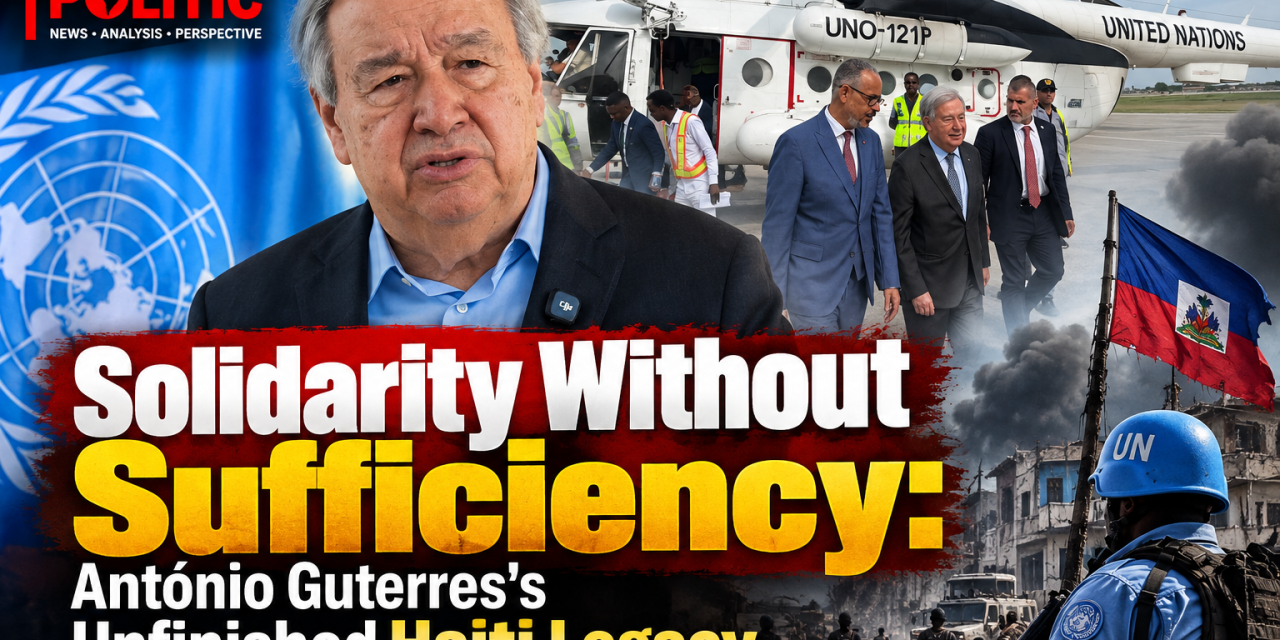
António Guterres marked his own countdown this week: fewer than 100 days left as UN Secretary-General, a tenure he says he’ll carry through “with a spirit of resolve and determination.” It’s worth using that moment to look honestly at one of the longest-running crises of his near-decade in office — Haiti — where the record shows a UN leadership that was consistently thoughtful about the mistakes of the past, but chronically behind the pace of the present.
The Case Against: A Policy That Arrived Late, Every Time
Since Haitian President Jovenel Moïse was assassinated in July 2021 and the country descended into gang-driven collapse, the pattern under Guterres has been strikingly consistent: recommend a modest step, watch it prove insufficient, then recommend a slightly larger one — always a beat behind the deteriorating situation on the ground.
The slow walk to any force at all. Haiti’s government formally requested an international force in October 2022. It took nine months for Kenya to agree to lead one, and by late October 2024 — three months after that mission actually deployed — Kenya had put only 400 of a planned roughly 2,500 troops on the ground. Guterres’s own recommendation that same period was not to escalate to a full UN peacekeeping operation, but to keep the ad hoc, Kenya-led Multinational Security Support mission running with a proposed logistics support office — a modest fix for a mission already acknowledged to be foundering.
A funding gap he named but never closed. By February 2025, Guterres was publicly acknowledging that the MSS mission remained under-resourced — 1,000 personnel deployed against a 2,500 target, with voluntary contributions totaling just $110.8 million against a mission cost estimated at roughly $600 million annually. He kept flagging the shortfall. He never proposed the one structural fix that would have addressed it directly: shifting to UN-assessed (mandatory) funding through a formal peacekeeping mission, which he explicitly declined to recommend even after Human Rights Watch called for exactly that in February 2025.
Admission arrived years too late. It wasn’t until June 17, 2026 — nearly four years after Haiti’s initial request — that Guterres, visiting Port-au-Prince in person, publicly conceded the Kenyan-led mission had “lacked a sufficiently robust mandate to address escalating gang violence.” By then, armed groups controlled an estimated 85% of the capital, more than a thousand schools had closed, and barely a quarter of hospitals remained fully operational. An honest mandate assessment delivered in 2023 might have changed the mission’s trajectory; delivered in 2026, it read more like an epitaph.
Impunity, again. Perhaps the most damning continuity: the UN’s own 2016 report on MINUSTAH-era abuses — the cholera epidemic that killed thousands of Haitians and the sexual exploitation scandals of that mission — was never followed by a functioning reparations mechanism. A decade later, under Guterres’s own watch, the successor mission generated new, UN-confirmed sexual exploitation and abuse cases in 2025 and 2026. The institutional memory of harm was documented. The institutional fix to prevent its recurrence was not.
The Case for Guterres: Caution Born of Real Lessons
To be fair to him, none of this happened in a vacuum, and there’s a genuine argument that his caution reflected hard-won wisdom rather than simple drift.
Guterres’s reluctance to send UN blue helmets back into Haiti wasn’t indecision — it was a direct response to MINUSTAH’s legacy, which many Haitian civil society organizations, including the Institute for Justice and Democracy in Haiti, still cite as a reason to distrust any new UN peacekeeping presence. Rushing back into a formal mission without first resolving accountability for the last one would have been its own kind of failure, and voices within Haiti itself pushed him toward exactly the caution he showed.
The funding structure he worked within also wasn’t fully his to change. A shift to assessed UN contributions requires Security Council approval, and that Council was and remains divided — the US and Panama pushing for a stronger mandate, Russia and China resisting even the transition to the Gang Suppression Force, each citing different grievances about burden-sharing and mission scope. A Secretary-General proposes; a fractured Council disposes.
And he did adapt, incrementally: from a support office, to endorsing the more aggressive Gang Suppression Force mandate authorized in September 2025, to a personal visit and public statement pushing for more. That’s a leader responding to changing facts, even if the response consistently lagged the crisis rather than anticipating it.
The Legacy He Leaves
With under 100 days remaining, Guterres’s Haiti file closes largely unresolved: no elections since 2016, a Gang Suppression Force still in its early deployment months, and a humanitarian emergency that has outpaced every mandate written to address it. Whether history judges that as the record of a Secretary-General constrained by an uncooperative Security Council, or one too cautious to match the moment, likely depends on which failure — institutional overreach or institutional hesitation — a reader considers the graver sin. Both readings are defensible. Neither changes what Haiti still doesn’t have.