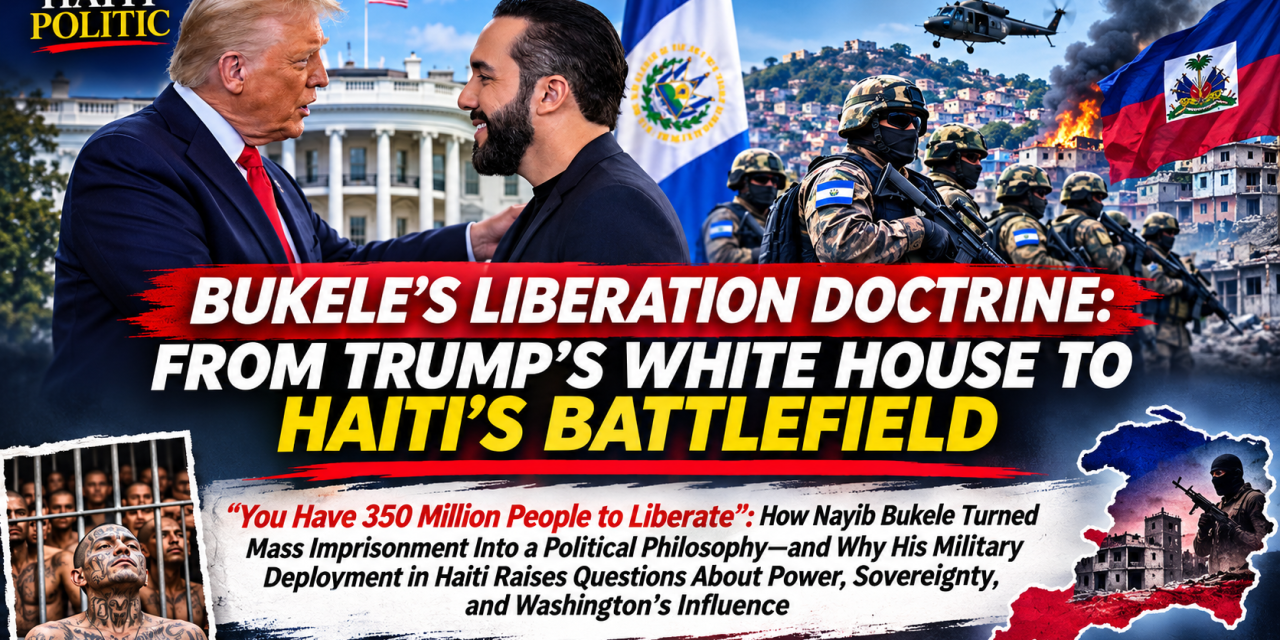
“You Have 350 Million People to Liberate”: How Nayib Bukele Turned Mass Imprisonment Into a Political Philosophy—and Why His Military Deployment in Haiti Raises Questions About Power, Sovereignty, and Washington’s Influence
HAITI POLITIC — SPECIAL INVESTIGATION & POLITICAL ANALYSIS
November 11, 2026
From a remarkable White House conversation about imprisonment and liberation to the deployment of thousands of Salvadoran soldiers in Haiti, President Nayib Bukele is expanding his international security ambitions. But is he exporting a successful crime-fighting strategy, building a new political relationship with Washington, or turning Haiti into a testing ground for his security doctrine?
I. THE WHITE HOUSE CONVERSATION THAT REVEALED BUKELE’S POLITICAL PHILOSOPHY
On April 14, 2025, Salvadoran President Nayib Bukele sat beside U.S. President Donald Trump in the Oval Office.
Their meeting was intended to demonstrate cooperation between two governments that had developed a close relationship over immigration enforcement, criminal detention, and regional security.
But one exchange revealed something more consequential about Bukele’s understanding of government power.
Speaking about his administration’s crackdown on gangs, Bukele declared:
“Sometimes they say that we imprison thousands. I like to say that we actually liberated millions.”
Trump immediately praised the statement and jokingly asked whether he could use it himself.
Bukele then told the American president:
“Mr. President, you have 350 million people to liberate.”
He went on to argue that imprisoning some people was necessary to liberate the broader population.
The exchange was recorded in the official U.S. presidential transcript of the meeting.
At first glance, it sounded like two presidents celebrating their commitment to fighting crime.
But the conversation raises a fundamental question:
What does Nayib Bukele actually mean by liberation?
For most democratic societies, liberation means freedom from oppression, arbitrary government power, political persecution, and violations of fundamental rights.
For Bukele, liberation appears increasingly connected to a different proposition: the state must exercise extraordinary coercive power over some individuals to provide security for everyone else.
That philosophy has become central to his political identity.
It is also the philosophy now being tested beyond El Salvador’s borders.
Source: Official U.S. presidential transcript, April 14, 2025.
II. DOES BUKELE UNDERSTAND THE DIFFERENCE BETWEEN CRIME CONTROL AND JUSTICE?
There is an important distinction between reducing crime and administering justice.
Crime control involves preventing offenses, apprehending suspects, disrupting criminal organizations, and protecting communities.
Justice requires something more.
It requires evidence, independent courts, legal representation, due process, proportionate punishment, and accountability for government officials.
A government can reduce certain forms of crime while simultaneously weakening constitutional protections.
That is precisely the concern raised by human rights organizations examining El Salvador’s security policies.
Since March 2022, Bukele’s administration has operated under an extraordinary security regime that has facilitated mass arrests and prolonged restrictions on constitutional protections.
His government credits the crackdown with dramatically reducing gang violence and homicides.
Those security improvements are politically significant.
Salvadorans who previously lived under threats of extortion, murder, and gang intimidation have legitimate reasons to welcome greater public safety.
However, the human rights record cannot simply be dismissed as the price of success.
In July 2026, Amnesty International published research documenting patterns of arbitrary detention, violations of due process, torture and other ill-treatment, enforced disappearances, and deaths in custody.
The organization also raised concerns about the erosion of judicial independence and the militarization of public security.
These findings challenge Bukele’s suggestion that imprisonment automatically produces liberation.
A person wrongly imprisoned has not been liberated. A family deprived of due process has not received justice. And a society that depends entirely on presidential power has not necessarily developed stronger institutions.
The real test of a security policy is whether it protects citizens while respecting the rule of law.
Security and justice should reinforce one another.
They should not become competing objectives.
Source: Amnesty International, El Salvador: “Security” Without Rights, July 15, 2026.
III. WHY DID BUKELE TELL TRUMP THAT 350 MILLION AMERICANS NEEDED LIBERATION?
Bukele’s statement to Trump deserves closer examination.
The United States has serious problems involving violent crime, organized criminal networks, drug trafficking, and public safety.
But describing the entire American population as people who need liberation creates an unusually expansive definition of the security problem.
It suggests that society itself is trapped and that a powerful executive can become its liberator.
This is politically effective language.
It transforms a president from an elected administrator into a national rescuer.
It also transforms ordinary criminal justice policy into a struggle between freedom and captivity.
Under this framework, critics of extraordinary policing powers risk being portrayed as obstacles to liberation rather than participants in a legitimate democratic debate.
But the United States already possesses established institutions responsible for criminal justice.
Those institutions include local police departments, prosecutors, state courts, federal courts, correctional systems, and constitutional protections.
Their effectiveness can be debated and improved.
Their existence does not mean that 350 million Americans require rescue by a foreign president.
Bukele’s statement was therefore more than an assessment of American crime.
It was a political message designed for Trump.
He was presenting his security model as an international example worth following.
He was also offering his government’s assistance.
The question is whether that offer eventually developed into something larger.
IV. WAS BUKELE OFFERING TRUMP HIS SERVICES AS AN INTERNATIONAL SECURITY CONTRACTOR?
During the same White House meeting, Bukele repeatedly emphasized that El Salvador was willing to help the United States.
He described his country as small but capable of contributing to American security objectives.
This language was diplomatic, but it also had a transactional dimension.
Bukele was effectively telling Trump that El Salvador possessed security expertise that Washington could use.
That does not establish that Bukele was seeking employment or a private security contract.
He remains the elected president of a sovereign country.
Nevertheless, the political relationship increasingly resembles an arrangement in which one government offers security capabilities that another government finds strategically useful.
The distinction matters.
There is nothing inherently improper about security cooperation between sovereign states.
Countries routinely share intelligence, train military personnel, and participate in multinational missions.
The problem arises when the terms of cooperation are unclear, democratic oversight is weak, or military operations are conducted without transparent legal authority.
Those concerns become especially important when the operations take place in a third country.
In this case, that country is Haiti.
V. FROM THE OVAL OFFICE TO HAITI: WHAT CHANGED IN OCTOBER 2026?
Approximately eighteen months after Bukele’s White House meeting, his government dramatically expanded its military presence in Haiti.
The escalation followed an October 2026 attack in which four Salvadoran aviation technicians serving with an internationally supported security mission went missing.
Bukele subsequently deployed a much larger force.
By November, Associated Press reporting described approximately 2,500 Salvadoran troops participating in operations against armed groups in Haiti.
The expanded deployment was politically significant because Salvadoran troops were operating largely outside the command structure of the United Nations-backed Gang Suppression Force.
That raised questions about command authority, coordination, financing, and accountability.
Then came a particularly revealing development.
According to an October 30 Axios investigation, Bukele contacted Trump before expanding the military operation.
The report stated that Bukele wanted to establish whether the American president objected to the escalation.
Sources briefed on the conversation said Trump responded:
“Do what you have to do.”
This reported exchange deserves careful interpretation.
It suggests that Bukele sought political reassurance from Washington before proceeding.
However, it does not establish that Trump formally ordered the deployment, financed it, or possessed the legal authority to approve Salvadoran military operations on Haitian territory.
Those are separate questions requiring documentary evidence.
A presidential expression of support is not a substitute for a valid international agreement.
Nor does Washington’s political approval replace Haiti’s sovereign consent.
Sources: Axios, October 30, 2026; Associated Press, November 11, 2026.
VI. DID TRUMP SEND BUKELE TO HAITI?
This is perhaps the most politically consequential question.
The available reporting establishes that Bukele consulted Trump before expanding his deployment.
It does not establish that Trump originated the plan or instructed Bukele to invade Haiti.
In fact, subsequent reporting suggests disagreement within the American government.
On November 10, Axios reported tensions between Salvadoran officials and the U.S. State Department concerning the military operation.
According to that account, Trump had expressed personal support while American diplomatic officials raised concerns.
Associated Press reporting also indicated that Secretary of State Marco Rubio distinguished Washington’s support for the UN-backed mission from Bukele’s separate offensive.
These developments complicate the argument that El Salvador is simply carrying out a unified American government policy.
A more defensible conclusion is that Bukele received political encouragement from Trump while important questions remained about the position of other American officials and institutions.
Nevertheless, the relationship raises legitimate concerns.
If Washington wishes to avoid deploying American combat troops while another government undertakes dangerous military operations, the arrangement could provide strategic advantages to the United States.
But whether El Salvador is formally acting as an American proxy remains unproven.
To establish that claim, investigators would need evidence concerning financing, operational orders, intelligence-sharing arrangements, military equipment, and the actual chain of command.
Without those records, political suspicion should not be presented as a documented military agreement.
VII. HAITI IS NOT EL SALVADOR
Bukele built his international reputation by confronting criminal organizations inside his own country.
Haiti presents a different challenge.
Haitian armed groups operate within a fragmented political and economic environment shaped by decades of institutional weakness, corruption, illicit weapons trafficking, contested territorial control, and relationships between criminal actors and elements of the political and business establishment.
Some groups exercise influence over transportation routes, commercial corridors, neighborhoods, and access to economic activity.
Others profit from kidnapping, extortion, and illegal taxation.
This is not merely a policing problem.
It is also a crisis of state authority.
A foreign military force may destroy a building, seize equipment, or temporarily dislodge armed men.
But those operations do not automatically restore functioning courts, legitimate local administration, public services, or economic opportunity.
They also do not guarantee that displaced gang members will surrender.
Armed groups can disperse, reorganize, recruit replacements, or move into neighboring communities.
Consequently, the destruction of a gang headquarters should be assessed as one tactical event—not proof that a broader security campaign has succeeded.
The appropriate questions are measurable:
How many hostages have been rescued?
How many gang leaders have been lawfully arrested?
How many communities have returned to functioning civilian administration?
How many displaced families have safely returned home?
How many schools, hospitals, and commercial routes have reopened?
And what mechanisms protect civilians from abuses by every armed actor involved?
Military activity is not the same thing as lasting security.
VIII. WHO AUTHORIZED THE SALVADORAN MILITARY OPERATION?
The deployment also raises serious questions under international law.
Foreign troops may operate within another sovereign state under certain legal arrangements, including valid consent from that state or an applicable United Nations Security Council authorization.
But the existence of an internationally supported mission does not automatically authorize every foreign military operation conducted nearby.
The precise legal basis matters.
If Salvadoran troops are operating under a separate bilateral agreement with Haiti, the public should be able to examine its essential provisions.
Those provisions should identify the mission’s objectives, command arrangements, permitted activities, civilian-protection obligations, accountability mechanisms, and conditions for withdrawal.
Haiti’s government has publicly welcomed Salvadoran military assistance.
Prime Minister Alix Didier Fils-Aimé has thanked Bukele for supporting operations against armed groups.
That political endorsement is relevant.
But the public still deserves to know what the government has authorized and what limits apply.
On November 11, Associated Press reported that Amnesty International had called for publication of the deployment agreement and stronger transparency regarding civilian protection and oversight.
These are not unreasonable demands.
They are basic requirements for democratic accountability.
No foreign president should exercise unlimited military authority in Haiti simply because the country faces a severe security emergency.
IX. LIBERATION OR THE INTERNATIONALIZATION OF BUKELE’S POLITICAL BRAND?
Bukele’s security doctrine has become central to his political appeal.
His government presents its crackdown on gangs as proof that decisive leadership can accomplish what conventional political institutions failed to achieve.
Now that message is being projected internationally.
Videos of Salvadoran soldiers, helicopters, armored vehicles, and attacks on gang positions circulate alongside declarations that Haiti can be liberated.
The imagery serves an obvious communications purpose.
It portrays Bukele as a leader capable of acting where others have hesitated.
But the political benefits may extend beyond Haiti.
El Salvador is approaching a presidential election scheduled for February 2027.
A successful operation could reinforce Bukele’s reputation as a regional security leader.
A prolonged, expensive, or unsuccessful campaign could produce the opposite result.
Associated Press reported on November 11 that political analysts viewed the Haiti operation as a high-stakes gamble with implications for Bukele’s international standing and domestic political support.
This creates a troubling possibility:
Could Haiti’s security crisis become part of another country’s presidential campaign?
That question does not mean Bukele’s government has no genuine interest in fighting armed groups.
Nor does it mean Salvadoran personnel are acting without courage or commitment.
It means that military operations can simultaneously serve security objectives and political interests.
The public deserves to understand both.
X. WHAT DOES WASHINGTON GAIN FROM BUKELE’S HAITI OPERATION?
Washington has longstanding interests in Haiti.
These include regional stability, migration management, countering transnational criminal networks, protecting diplomatic facilities, and limiting the consequences of insecurity near American territory.
A foreign-led operation that weakens Haitian gangs could advance some of those objectives without requiring a major deployment of American combat troops.
That possibility makes Bukele’s role strategically interesting.
However, political convenience is not the same as legal accountability.
If the United States provides financial assistance, intelligence, equipment, training, or operational support to Salvadoran forces in Haiti, the extent and conditions of that assistance should be disclosed through appropriate oversight channels.
Congress has a legitimate interest in understanding how American resources are being used.
Haitians have an equally legitimate interest in understanding who is directing military operations in their country.
And Salvadoran taxpayers deserve to know how much the deployment costs and what their government expects to accomplish.
The central question is not whether foreign assistance is automatically illegitimate.
It is whether that assistance strengthens Haiti’s institutions or creates another security arrangement that Haiti cannot independently sustain.
XI. THE DANGER OF CONFUSING MILITARY POWER WITH NATIONAL LIBERATION
Bukele’s Oval Office remarks reveal the central tension in his political philosophy.
He defines liberation primarily through the restoration of security.
But freedom cannot be measured only by the number of prisoners, the number of soldiers deployed, or the number of buildings destroyed.
A society can be safer from organized crime while becoming more vulnerable to arbitrary government power.
It can experience temporary military success without achieving political stability.
And it can receive foreign security assistance without recovering meaningful control over its own institutions.
Haiti has experienced these contradictions repeatedly.
International missions have arrived with promises of stability.
Foreign governments have announced security initiatives.
Political leaders have presented external assistance as the beginning of national recovery.
Yet Haiti continues to confront the fundamental problems of weak institutions, contested political legitimacy, corruption, and inadequate public accountability.
The lesson is not that Haiti should reject every form of international cooperation.
The lesson is that international cooperation must serve a Haitian-led institutional strategy.
Otherwise, each new deployment risks becoming another temporary intervention without a durable political solution.
XII. TEN QUESTIONS BUKELE, TRUMP, AND HAITI’S GOVERNMENT MUST ANSWER
1. President Bukele: What is the complete legal basis for deploying Salvadoran combat troops outside the UN-backed Gang Suppression Force?
2. President Trump: What exactly did you authorize, encourage, or agree to during your reported October 2026 conversation with Bukele?
3. The U.S. State Department: Does Washington formally support the separate Salvadoran operation, and how does that position relate to the UN-backed mission?
4. Haiti’s prime minister: Will your government publish the agreement governing Salvadoran military operations on Haitian territory?
5. President Bukele: What measurable conditions would constitute success, and when would Salvadoran troops withdraw?
6. El Salvador’s legislature: What oversight has been exercised over the deployment, its financing, and its compatibility with Salvadoran constitutional requirements?
7. Haiti’s government: Who investigates allegations of civilian casualties, unlawful destruction of property, or other abuses involving foreign troops?
8. President Bukele: How will your military strategy address gang financing, illicit weapons trafficking, political protection networks, and the economic structures that sustain armed organizations?
9. President Trump: Is the United States supplying intelligence, military equipment, transportation, financing, or other assistance to the Salvadoran operation?
10. Haiti’s political leadership: What concrete plan will ensure that Haitian institutions—not foreign soldiers—ultimately control national security?
These questions are not arguments in favor of armed gangs.
They are questions in favor of constitutional government, civilian protection, and national sovereignty.
XIII. HAITI POLITIC ANALYSIS: WAS HAITI THE NEXT STEP IN BUKELE’S SECURITY AMBITIONS?
The sequence of events deserves attention.
In April 2025, Bukele visited the White House and presented his security model as a lesson for the United States.
He praised imprisonment as a means of liberating society.
He offered assistance to Trump.
In October 2026, Bukele expanded Salvadoran military operations in Haiti after four Salvadoran personnel went missing.
Before that escalation, according to Axios, he consulted Trump and received political encouragement.
By November, Salvadoran troops were conducting significant operations against Haitian armed groups while questions emerged about coordination with the UN-backed mission.
These events demonstrate an increasingly important relationship between Bukele’s security ambitions and Washington’s regional interests.
But they do not, by themselves, prove that Trump ordered Bukele to invade Haiti or that a secret American military contract exists.
Those claims require evidence.
The more immediate concern is that Haiti has become the setting for an international security experiment whose legal arrangements, operational limits, financial commitments, and exit strategy remain insufficiently transparent.
Bukele may believe he can export the security methods that made him popular in El Salvador.
Trump may see value in a regional ally willing to confront armed organizations.
Haiti’s government may welcome military assistance after years of devastating insecurity.
All three positions can exist simultaneously.
But none eliminates the need for accountability.
Haiti is not a proving ground for foreign presidential ambitions. It is a sovereign country whose people have the right to security, justice, and political self-determination.
CONCLUSION: LIBERATION FOR WHOM, AND UNDER WHOSE AUTHORITY?
When Nayib Bukele told Donald Trump that 350 million Americans needed liberation, he revealed how broadly he understands the political mission of a security-focused president.
His concept of liberation places extraordinary emphasis on executive action, imprisonment, and the use of state power.
Now that philosophy is being applied to an international military operation in Haiti.
The consequences could extend far beyond Bukele’s personal reputation.
They involve Haitian sovereignty, Salvadoran constitutional accountability, American foreign policy, civilian protection, and the future of international security missions.
Haiti desperately needs protection from armed groups.
Its people deserve to live without kidnapping, extortion, displacement, and fear.
But the country also deserves institutions capable of delivering justice without permanently depending on foreign military intervention.
The ultimate measure of success will not be the number of dramatic videos Bukele publishes.
It will be whether Haitian families can safely return home, whether courts can function, whether the state can recover its authority, and whether Haitians can determine their political future without foreign military supervision.
Bukele may be able to destroy a gang headquarters.
But can he build a justice system?
Can he restore Haiti’s constitutional order?
Can he create legitimate Haitian institutions?
And most importantly:
Who gave him the authority to define what liberation means for the Haitian people?
Because liberation is not simply the absence of gangs.
Liberation means security under the law, justice without arbitrary power, and sovereignty without foreign domination.
And those are objectives that no foreign president can deliver on Haiti’s behalf.
Only Haitians, supported by accountable institutions and lawful international cooperation, can build that future.
SOURCES AND DOCUMENTARY REFERENCES
1. Official U.S. Presidential Record — April 14, 2025. Remarks during the White House meeting between Donald Trump and Nayib Bukele. Documents Bukele’s statements about imprisonment, liberation, and the American population.
2. Amnesty International — July 15, 2026. El Salvador: “Security” Without Rights. Investigation into arbitrary detention, due process violations, and institutional changes under El Salvador’s security policies.
3. Axios — October 30, 2026. Trump Blesses El Salvador Strongman’s Troop Surge in Haiti. Reporting on Bukele’s consultation with Trump before expanding the military deployment.
4. Axios — November 10, 2026. El Salvador Blasts U.S. State Department Over Haiti Gang War. Reporting on diplomatic disagreements concerning Salvadoran operations.
5. Associated Press — November 11, 2026. El Salvador’s Bukele Makes a Political Gamble With a Haiti Gang Offensive Ahead of an Election. Analysis of the deployment’s political implications.
6. Associated Press — November 11, 2026. Dominican President Says He Backs Bukele and Salvadoran Troops in Haiti. Reporting on regional support, coordination concerns, and demands for greater transparency.
HAITI POLITIC
Independent Analysis | Investigative Reporting | Public Policy
Editorial note: This article distinguishes documented statements and reported events from political interpretations and unresolved allegations. No evidence presented here establishes that Donald Trump formally ordered El Salvador’s deployment or that Bukele’s military operation has been judicially determined unlawful. The purpose of this analysis is to examine the political and legal questions arising from the available record.