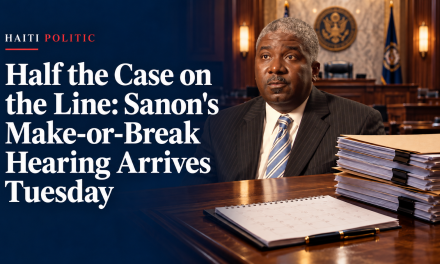
More than five years after Haitian President Jovenel Moïse was gunned down at his private residence, one of the case’s most significant remaining defendants finally has a trial date. U.S. District Judge Jacqueline Becerra has ordered Christian Sanon to stand trial beginning September 28, 2026, in Miami federal court — a case that’s been delayed repeatedly, most recently due to Sanon’s own medical issues.
Who Is Christian Sanon, and Why Does His Trial Matter?
Sanon, a Haitian-American doctor and pastor, is one of the most consequential figures in the U.S. prosecution of the Moïse assassination. Prosecutors allege he wasn’t just a bystander swept into the plot — he’s accused of being one of its architects. According to the criminal complaint, Sanon had his own political ambitions to replace Moïse as president, and in April 2021 he allegedly met with co-defendant James Solages in South Florida to discuss “regime change” in Haiti. From there, prosecutors say Sanon recruited and helped fund roughly 20 Colombian nationals with military training — the same group later accused of storming Moïse’s residence and killing him on July 7, 2021. Sanon himself is charged with smuggling ballistic vests from the U.S. to Haiti for use in the plot, along with related conspiracy charges.
Sanon was originally supposed to stand trial alongside four co-defendants — Arcangel Pretel Ortiz, Antonio Intriago, Walter Veintemilla, and James Solages — but his case was severed for medical reasons just as jury selection began for the others earlier this year. All four of those co-defendants were convicted. Sanon has remained the outstanding piece of the U.S. case ever since — until now.
What the Judge’s Order Actually Says
The order Judge Becerra signed on July 29, 2026, lays out a detailed roadmap for the months leading up to trial:
- Status Conference — August 21, 2026, 10:00 AM: Both sides will appear before Judge Becerra to flag any pretrial issues that still need resolving. Witness and exhibit lists are also due by this date, with government exhibits numbered and defense exhibits lettered.
- Calendar Call — September 15, 2026, 8:30 AM: A final pretrial check-in at the Wilkie D. Ferguson Jr. Courthouse in Miami, the last formal step before trial begins.
- Jury Trial — Specially set for September 28, 2026.
The order also sets a cascade of smaller but important deadlines: proposed jury instructions and a verdict form are due jointly from both sides (with disagreements marked in bold, government-only proposals underlined, and defense-only proposals italicized); voir dire questions are due before the Calendar Call; and the judge signaled she intends to model both jury selection and jury instructions on the trial of Sanon’s four co-defendants — unless the evidence in his case specifically requires something different.
A few procedural details stand out. The order requires the defense to arrange appropriate clothing for Sanon through the Bureau of Prisons at least seven days before trial — a signal that Sanon remains in custody. It also requires any interpreter needs to be flagged immediately, and any transcripts either side wants to use at trial must be exchanged two weeks before the Calendar Call.
What’s Next
With the schedule now locked in, the case moves into its final pretrial phase over the next several weeks. Notably, one docket entry from August 7, 2026 has been sealed until further notice — meaning at least one filing in the case is currently shielded from public view, though it’s unclear what it concerns.
Barring further delay — something this case has seen more than once — jury selection is expected to begin September 28, potentially bringing the U.S. prosecution of Moïse’s assassination to its final chapter, more than five years after the killing shocked Haiti and triggered the political instability the country is still grappling with today.
This article is based on publicly available court filings in United States v. Christian Sanon, Case No. 22-cr-20104 (S.D. Fla.). It is