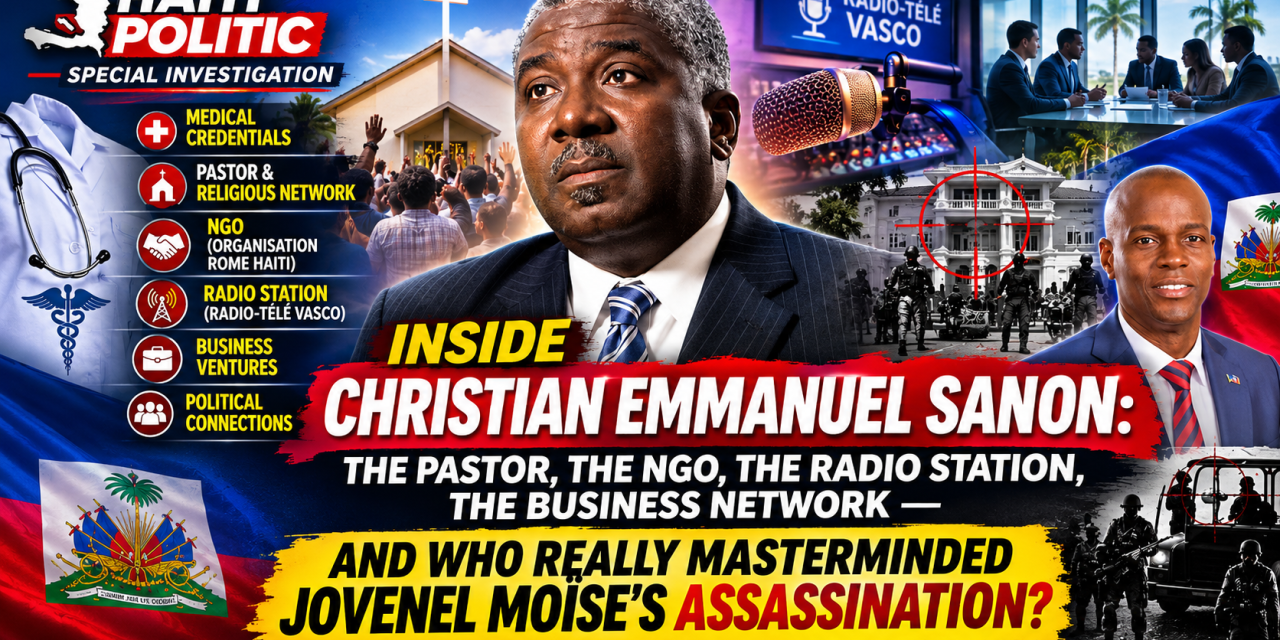
HAITI POLITIC | SPECIAL INVESTIGATION
November 14, 2026
Sanon insists he was not part of the assassination conspiracy. But his testimony raises questions about his medical credentials, religious organizations, business ventures, political relationships, and the American businessmen who financed an operation to remove Haiti’s president. If Sanon was not the ultimate mastermind, who ordered Jovenel Moïse’s assassination—and who expected to benefit?
INTRODUCTION: FIVE YEARS AFTER THE ASSASSINATION, THE CENTRAL QUESTION REMAINS
On July 7, 2021, armed men entered the private residence of Haitian President Jovenel Moïse and assassinated him.
His wife, Martine Moïse, survived the attack.
More than five years later, the federal criminal proceedings in Miami continue to expose a complicated network of Haitian political figures, American businessmen, security contractors, former Colombian soldiers, and individuals who expected to benefit from a change of government.
Among the defendants is Christian Emmanuel Sanon, a Haitian-American religious figure and businessman who once presented himself as a potential leader capable of transforming Haiti.
Sanon has pleaded not guilty.
His defense maintains that he did not knowingly participate in a conspiracy to murder President Moïse.
During his November 12, 2026 testimony in Miami federal court, Sanon described his background, his political activities, his business relationships, and the circumstances under which he became involved with individuals later implicated in the assassination.
His testimony has introduced or revived several questions.
Was Sanon genuinely a medical doctor?
What religious qualifications did he possess?
What happened to his humanitarian organization, Organisation Rome Haiti?
What was the purpose of Radio-Télé Vasco?
Who financed his political ambitions?
What was Frederick Bergmann’s role?
Why did Sanon become involved with a private security company whose personnel later participated in the operation against Moïse?
And why did the conspirators eventually abandon Sanon as their preferred presidential replacement?
Most importantly: If Sanon was not the person who ultimately directed the assassination, who was?
The answer requires following the evidence beyond Sanon’s personal account.
PART I — WHO IS CHRISTIAN EMMANUEL SANON?
1. FROM MARIGOT TO THE UNITED STATES
Christian Emmanuel Sanon was born in Marigot, in Haiti’s Southeast Department.
He later moved to the United States, where he lived in different communities, including Florida.
Over the years, Sanon presented himself through several professional identities:
-
Medical doctor and healthcare entrepreneur.
-
Evangelical pastor and church organizer.
-
Humanitarian and NGO director.
-
Radio and telecommunications businessman.
-
Political reform advocate.
-
Potential presidential candidate.
These identities are central to understanding how he developed contacts in Haiti and the United States.
They also raise questions about the difference between the professional activities he claimed and those independently documented.
During his November 12 testimony, Sanon acknowledged that he had never obtained a license to practice medicine in the United States.
He also acknowledged that he had not completed formal theological seminary training.
He nevertheless maintained that he had studied medicine in the Dominican Republic and established churches within Haitian communities.
These admissions do not establish that Sanon committed a crime.
They do, however, create an important distinction between his claimed professional background and his verified qualifications.
Contemporaneous trial reporting confirms that prosecutors challenged both his medical and religious credentials.
2. THE MEDICAL DOCTOR QUESTION: WHERE ARE SANON’S CREDENTIALS?
Sanon has described himself as a physician.
During his testimony, he said he attended medical school in the Dominican Republic.
He claimed to have completed training that allowed him to practice medicine there and in Haiti.
He also discussed operating a medical diagnostic center and referring patients to healthcare providers in the United States.
However, Florida authorities previously reported finding no record of a Florida medical license issued to him.
During his testimony, Sanon acknowledged that he had not passed the examinations necessary to obtain a U.S. medical license.
This does not automatically invalidate medical qualifications obtained in another country.
But it raises several questions that should be answered through official records.
Which Dominican medical institution did Sanon attend?
What degree did he receive?
In what year did he graduate?
Was he licensed to practice medicine in the Dominican Republic?
Did Haiti’s Ministry of Public Health and Population authorize him to practice?
What medical facilities did he operate?
And what licenses did those facilities possess?
The distinction between a medical diagnostic center and a licensed hospital also matters.
A diagnostic facility does not necessarily possess the authorization, personnel, equipment, or clinical capacity required to operate as a hospital.
Haiti Politic’s finding: Sanon’s lack of a U.S. medical license is documented. His claimed Dominican and Haitian medical qualifications require further documentary verification.
PART II — THE RELIGIOUS AND HUMANITARIAN NETWORK
3. SANON THE PASTOR: RELIGIOUS LEADER OR POLITICAL ORGANIZER?
Sanon has identified himself as an evangelical pastor.
In his 2013 bankruptcy proceedings, he described an association with Tabarre Evangelical Tabernacle, a religious organization in Haiti.
During his November 2026 testimony, Sanon acknowledged that he had not attended a formal theological seminary.
He described himself as someone who established churches.
That distinction does not necessarily disqualify him from religious ministry.
Many evangelical denominations recognize pastors through local congregations or religious organizations rather than university seminaries.
The relevant questions concern institutional recognition and the activities of his organizations.
Who ordained Sanon?
Which churches did he establish?
Where were they located?
Who served on their governing boards?
How were they financed?
And what role did these religious networks play in his subsequent political activities?
Sanon testified that he mobilized members of Haiti’s Christian community because of insecurity, kidnappings, and the country’s political crisis.
He portrayed this activity as civic engagement rather than a conspiracy to overthrow the government.
Prosecutors have presented a different interpretation of his activities.
The issue is not whether Sanon had a religious identity. It is whether his religious and humanitarian networks were used to advance political or financial arrangements connected to the operation against President Moïse.
That question requires financial records, communications, and witness testimony—not assumptions about religious affiliation.
4. ORGANISATION ROME HAITI: THE NGO THAT DESERVES A COMPLETE AUDIT
One of Sanon’s most important institutional connections predates the assassination by nearly two decades.
Organisation Rome Haiti, also described in English-language records as Organization Rome Haiti, appears in Sanon’s earlier financial and humanitarian history.
Sanon identified himself as associated with the organization in his 2013 bankruptcy filings.
Historical reporting also connected the organization to humanitarian assistance following Haiti’s devastating January 2010 earthquake.
Sanon has claimed substantial involvement in medical and humanitarian activities.
According to the account of his testimony discussed during this investigation, he described bringing approximately 300 doctors and nurses to Haiti after the earthquake.
That is a significant claim.
But it requires verification.
The 300 medical professionals
If 300 medical professionals participated in an organized humanitarian operation, there should ordinarily be supporting records.
These might include volunteer rosters, institutional affiliations, travel records, medical licensing information, hospital partnerships, funding records, and activity reports.
Where are those records?
Which hospitals or clinics received the medical teams?
Who coordinated their work?
How long did they remain in Haiti?
Which communities benefited?
And who financed the operation?
At present, the figure of 300 medical professionals should be treated as Sanon’s claim, not an independently established fact.
The July 29, 2002 government recognition
Our earlier investigation also identified a document described as dated July 29, 2002, concerning official recognition of Organisation Rome Haiti.
The document reportedly involved three Haitian ministries headed at the time by:
Paul Duret, Jocelerme Privert, and Joseph Philippe Antonio.
The reported document deserves careful examination.
If authentic and accurately interpreted, it could establish that Organisation Rome Haiti obtained a form of administrative recognition during President Jean-Bertrand Aristide’s administration.
But recognition of an organization is not evidence that the ministers personally directed its activities.
Nor would it establish their involvement in any subsequent criminal conspiracy.
The original document, including its registration number, signatures, legal basis, and scope of authorization, should be independently authenticated.
The land question
Sanon’s humanitarian account also raises questions about an alleged government arrangement involving land between Carrefour and Léogâne.
Who authorized access to the property?
Was it a lease, donation, concession, or informal arrangement?
Was the land public or privately owned?
What project was proposed?
Was the project completed?
And which ministry supervised it?
These questions could clarify the relationship between Organisation Rome Haiti and successive Haitian governments.
The existence of an NGO does not establish wrongdoing. But claims involving public land, humanitarian financing, and government authorization should be supported by records.
5. WHAT HAPPENED TO THE NGO AFTER THE 2010 EARTHQUAKE?
Sanon’s humanitarian history is relevant because the earthquake created enormous demand for medical assistance, international donations, reconstruction projects, and partnerships with government institutions.
Organisation Rome Haiti appears to have operated within that environment.
However, its complete financial and operational history remains unclear.
A meaningful audit would examine the organization’s legal status in Haiti and the United States, its directors, donors, annual expenditures, projects, and government agreements.
It would also establish whether the organization received tax-exempt status in the United States and whether it maintained the registrations required for its activities in Haiti.
The relevant Haitian authorities may include the Ministry of Planning and External Cooperation, which oversees important aspects of NGO recognition and coordination.
An absence from a commercial business registry would not, by itself, prove that an NGO was operating illegally.
The applicable registration requirements depend on the organization’s legal form and activities.
For Haiti Politic, the central question is:
Did Organisation Rome Haiti deliver the humanitarian projects Sanon described, and can its finances and government relationships be independently documented?
PART III — RADIO-TÉLÉ VASCO AND SANON’S BUSINESS INTERESTS
6. RADIO-TÉLÉ VASCO: A MEDIA COMPANY WITH AN UNCLEAR OPERATING HISTORY
Sanon’s 2013 bankruptcy records identify him as president of Radio-Télé Vasco, associated with Tabarre, Haiti.
This is an important finding.
It establishes that Sanon represented himself as having an interest in a Haitian media operation years before the assassination.
However, the available records do not establish whether Radio-Télé Vasco operated continuously as a licensed radio or television station.
Several questions remain unanswered.
Was Radio-Télé Vasco registered as a Haitian company?
Did it obtain authorization from CONATEL, Haiti’s telecommunications regulator?
Did it possess a broadcasting frequency?
Where were its studios located?
Who financed the operation?
Who served as its directors?
Did it broadcast news, religious programming, political commentary, or commercial advertising?
And was the station operating in 2020 or 2021?
Why the radio connection matters
Media organizations can provide access to audiences, advertisers, religious communities, business figures, and political leaders.
But owning or claiming to own a radio station does not establish political influence.
To determine Radio-Télé Vasco’s significance, investigators would need its incorporation documents, broadcasting authorization, ownership records, and operating history.
Haiti Politic’s finding: Sanon’s claimed leadership of Radio-Télé Vasco is documented in reporting about his bankruptcy filings. The station’s licensing, ownership, and operational history remain insufficiently verified.
7. THE BUSINESS PORTFOLIO: MEDICINE, ENERGY, REAL ESTATE AND FAILED VENTURES
Sanon’s business activities extended beyond humanitarian work.
Public reporting identified numerous Florida business registrations associated with him.
The ventures included medical services, diagnostic imaging, energy, real estate, and other commercial activities.
Many became inactive.
Sanon also discussed efforts to develop medical laboratories and healthcare facilities in Haiti.
During his November 2026 testimony, he acknowledged that some proposed ventures never became operational.
One involved entering Haiti’s fuel business.
He said his group had been unable to obtain the financing necessary to supply fuel.
That admission raises an important distinction.
A proposed business project is not the same as an operating enterprise.
A person may negotiate contracts, form companies, and seek investors without ever generating commercial revenue.
This distinction matters when examining Sanon’s financial capacity and political ambitions.
If Sanon intended to become Haiti’s president, what financial resources supported his activities?
Were his political projects funded by successful businesses?
Were they financed through loans?
Did outside investors expect government contracts in return?
And what obligations would Sanon have assumed if he had entered office?
These questions became particularly important when Sanon developed relationships with American security contractors and financiers.
8. THE 2013 BANKRUPTCY: FINANCIAL TROUBLE BEFORE THE PRESIDENTIAL PROJECT
Sanon filed for bankruptcy in Florida in 2013.
Court records reviewed by journalists identified financial difficulties involving his household and business interests.
The proceedings also raised questions concerning property interests in Haiti.
A bankruptcy trustee reportedly determined that Sanon and his wife had failed to disclose ownership of approximately 35 acres of Haitian land.
That finding warrants examination of the underlying court records and any subsequent orders.
Bankruptcy does not automatically establish fraud or criminal misconduct.
But it can provide important information about assets, liabilities, business ownership, and financial representations.
The central investigative question is whether Sanon’s later political ambitions were supported by independently verifiable resources.
How did a businessman whose earlier ventures experienced financial difficulties become involved in an operation requiring substantial expenditures on security personnel, transportation, accommodations, and equipment?
The answer leads directly to Frederick Bergmann and the South Florida companies involved in the conspiracy.
PART IV — FREDERICK BERGMANN AND THE MONEY BEHIND THE OPERATION
9. FREDERICK BERGMANN: FRIEND, INVESTOR AND FEDERAL DEFENDANT
Frederick Bergmann, a Tampa businessman, was a longtime associate of Christian Emmanuel Sanon.
According to testimony reported during the Miami trial, the two men had known each other for approximately 17 years.
Bergmann became involved in financing aspects of Sanon’s activities in Haiti.
Federal prosecutors alleged that Bergmann helped pay for accommodations for Colombian security personnel.
He also participated in shipping ballistic vests from the United States to Haiti.
The U.S. Department of Justice alleged that Bergmann and Sanon arranged for 20 CTU-branded ballistic vests to be shipped using false export documentation.
Bergmann subsequently pleaded guilty to offenses related to the illegal shipment and received a nine-year prison sentence.
His role is particularly important because he had a longstanding relationship with Sanon and possessed firsthand knowledge of aspects of the financing and logistics.
Bergmann’s testimony
During the November 2026 trial, Bergmann testified about conversations with Sanon before and after the assassination.
According to courtroom reporting, Bergmann described Sanon as having expressed hostility toward Moïse after the killing.
Sanon challenged Bergmann’s credibility during his own testimony.
He portrayed his former associate as financially motivated and questioned his reliability.
Those competing accounts are central to the jury’s assessment.
Bergmann’s testimony is evidence presented in court, but its credibility and interpretation remain matters for the jury.
The fact that Bergmann pleaded guilty to his own offenses does not automatically establish every allegation he made against Sanon.
10. THE COVID-19 MASK BUSINESS: A GOVERNMENT CONNECTION OR AN ABANDONED PROPOSAL?
Another issue raised in our review of Sanon’s testimony concerns a possible business opportunity involving protective masks during the COVID-19 pandemic.
According to the account of Sanon’s testimony discussed in this investigation, he said he introduced a member of a politically connected Haitian family to Frederick Bergmann to explore selling masks in Haiti.
The reference has also been associated with Kiko, whom the user identified as having worked at Haiti’s National Palace.
However, the precise identity of the individual, the family relationship, and the wording of Sanon’s testimony have not been independently established from the official court transcript.
This distinction is essential.
A business introduction is not evidence of corruption.
Nor does a proposed sale establish that the Haitian government purchased the products.
Questions requiring verification
Who was the family member?
What was that person’s official position, if any?
Did Bergmann own or represent a company selling protective equipment?
Was a written proposal submitted?
Did the Haitian government award a contract?
Was the contract competitively procured?
Were any masks delivered?
How much money changed hands?
Did any public official receive a commission?
And was the transaction ever examined by the ULCC or another oversight institution?
At present, the available evidence does not establish that the alleged introduction resulted in a government contract or a COVID-19 procurement scandal.
The relevant procurement documents would be necessary before making such an allegation.
PART V — POLITICAL CONNECTIONS AND THE PLAN TO REMOVE MOÏSE
11. FROM HUMANITARIAN ACTIVIST TO PRESIDENTIAL ASPIRANT
Sanon’s political activities became more visible after the 2010 earthquake.
He publicly criticized corruption and the failures of Haitian leadership.
He presented proposals for reconstruction, economic development, and institutional reform.
During his November 2026 testimony, Sanon said he had communicated with international actors, including representatives of the United States and the European Union.
He also described meetings with individuals who claimed to possess significant military or governmental connections.
These claims require careful examination.
Contacting a foreign government does not mean that government endorsed a political project.
Likewise, a private individual claiming to represent an American agency does not establish official authorization.
Sanon testified that he became involved with people who presented themselves as influential security professionals.
He described meeting individuals associated with Counter Terrorist Unit, commonly known as CTU.
According to his testimony, some participants used military titles and claimed connections to American institutions.
He said he was initially skeptical.
The prosecution, however, argues that Sanon knowingly participated in an unlawful effort to remove Moïse.
12. JAMES SOLAGES: THE INTRODUCTION THAT CHANGED EVERYTHING
James Solages was an important intermediary between Sanon and the South Florida security network.
According to Sanon’s November testimony, he first became acquainted with Solages by telephone in 2020.
He later met individuals Solages introduced as influential figures capable of assisting his political project.
The meetings eventually connected Sanon to CTU and its principals.
Prosecutors allege that the participants discussed replacing President Moïse with Sanon.
Sanon’s defense disputes that he knowingly agreed to a murder conspiracy.
The distinction matters.
There is a difference between discussing political change, agreeing to an unlawful seizure of power, and knowingly joining a conspiracy to assassinate a president.
The prosecution must prove the elements of the charged offenses beyond a reasonable doubt.
13. CTU, ANTONIO INTRIAGO AND ARCÁNGEL PRETEL ORTIZ
The South Florida security companies were central to the federal prosecution.
Antonio Intriago and Arcángel Pretel Ortiz were principals associated with CTU.
Federal prosecutors alleged that the companies participated in planning and coordinating the operation against Moïse.
The initial arrangement reportedly contemplated removing the president and installing Sanon.
In exchange, the companies expected lucrative contracts involving security, infrastructure, and military equipment.
This alleged arrangement is important because it provides a possible financial motive.
The participants were not simply discussing political ideology.
According to prosecutors, they were negotiating future government business.
The question of political legitimacy
Sanon did not possess a constitutional mechanism allowing him to assume the presidency merely because a private security company supported him.
Nor could private contractors legally determine Haiti’s presidential succession.
The alleged plan therefore raises a fundamental question:
Who believed they possessed the authority to remove Haiti’s president and select his replacement?
That question extends beyond Sanon.
It concerns the political and financial expectations of the entire network.
14. WALTER VEINTEMILLA AND THE FINANCING OF REGIME CHANGE
Walter Veintemilla, associated with Worldwide Capital Lending Group, was another important figure.
Federal prosecutors alleged that his company provided a $175,000 line of credit to support the operation.
The government also alleged that funds were used for ammunition and other expenses.
Veintemilla and other participants expected financial benefits if the proposed change of government succeeded.
This provides an important perspective on the conspiracy.
The operation was not merely a political dispute.
According to the prosecution’s evidence, it involved commercial interests seeking future contracts.
The financial arrangements raise questions about who ultimately supplied the money, who controlled expenditures, and who expected to receive government contracts.
Following the money is essential to identifying the organizers and beneficiaries of the conspiracy.
PART VI — THE MOST IMPORTANT TURNING POINT
15. WHY DID THE CONSPIRATORS ABANDON SANON?
One of the most significant facts in the federal prosecution is that Sanon was not the only proposed replacement for President Moïse.
According to the Justice Department, by June 2021, several participants had concluded that Sanon lacked the constitutional qualifications and political support necessary to become president.
Their support shifted to a former Haitian Supreme Court judge.
That judge allegedly signed documents connected to the proposed arrest and detention of Moïse.
The documents reportedly included representations concerning immunity for participants.
This development changes the analysis of the conspiracy.
If Sanon had been the sole mastermind controlling the entire operation, why would other participants have been able to replace him as their preferred political beneficiary?
The shift suggests that the operation involved individuals with influence over the selection of a replacement leader.
It does not establish that Sanon was innocent.
A person can participate in an earlier phase of a conspiracy and remain legally responsible even if others later assume control.
But it raises a legitimate question about the operation’s hierarchy.
Who had the authority to remove Sanon from the political plan and select another candidate?
The answer may help identify the people exercising the greatest control over the conspiracy.
16. FROM ARREST TO ASSASSINATION: WHO MADE THE FINAL DECISION?
Federal prosecutors described an evolution in the operation.
The original plan allegedly involved removing Moïse from office.
Later discussions involved arresting him, detaining him, and transporting him outside Haiti.
By the beginning of July 2021, the operation had evolved into a plan to kill him.
According to the Justice Department, participants gathered on July 6, 2021, near the president’s residence.
Weapons and equipment were distributed.
The mission was described to participants as an operation to kill Moïse.
The following morning, armed men entered his residence and assassinated him.
The critical question is not simply who wanted Moïse removed.
It is:
Who authorized the change from political removal or detention to assassination?
Who communicated the order?
Who approved the operational plan?
Who provided the weapons?
Who directed the armed personnel?
And who expected to assume political control afterward?
Those questions are central to identifying the people who masterminded the killing.
PART VII — GEORGE DAGHER AND THE PASSPORT ALLEGATIONS
17. SANON’S REPORTED TESTIMONY ABOUT A RELIGIOUS INSTITUTION IN NORTHEAST HAITI
Another allegation discussed in connection with Sanon’s testimony concerns a man identified as George Dagher.
According to the French-language account of testimony provided during this investigation, Sanon referred to a person allegedly connected to a Muslim religious institution in Haiti’s Northeast Department.
The account alleges that fraudulent Haitian passport transactions occurred through that institution and that the passports were intended to facilitate entry into the United States by individuals described as terrorists.
These are extremely serious allegations.
However, Haiti Politic has not obtained an official court transcript independently confirming the precise wording, identities, or evidentiary basis of these claims.
Nor has independent evidence been established linking George Dagher to passport fraud, terrorism, or the assassination conspiracy.
What must be verified?
Is the name George Dagher correctly transcribed?
Which religious institution was allegedly involved?
Where was it located?
Did Sanon claim firsthand knowledge?
Was he repeating information received from someone else?
Did he identify any actual fraudulent passports?
Were any of the alleged documents examined by U.S. authorities?
Did investigators identify a trafficking network?
And was the allegation connected to the assassination case, or was it an unrelated claim introduced during testimony?
A Haitian passport alone does not authorize entry into the United States.
Additional immigration authorization is generally required.
The allegation must not be presented as an established fact or used to implicate an entire religious community.
The George Dagher identity question
Earlier research identified social media references to a person named George Dagher, including a charitable sponsorship acknowledgment and a Facebook profile associated with Tampa, Florida.
Those references do not establish that the individuals are the same person described in Sanon’s reported testimony.
They also do not establish involvement in any illegal activity.
Haiti Politic should not publish an allegation connecting a particular private individual to terrorism without reliable identity verification and substantial corroborating evidence.
PART VIII — WHO REALLY MASTERMINDED THE ASSASSINATION?
18. SANON MAY NOT HAVE BEEN THE ONLY ORGANIZER
The evidence presented by federal prosecutors points to a conspiracy involving several layers of responsibility.
There were individuals who sought political power.
There were businessmen who expected financial benefits.
There were people who recruited and coordinated armed personnel.
There were individuals who supplied equipment, financing, transportation, and logistical support.
And there were participants who carried out the assault.
These roles should not be confused.
A political beneficiary is not necessarily the operational commander.
A financier is not necessarily the person who ordered the killing.
A security contractor is not necessarily the person who conceived the political conspiracy.
And a person who initially supported removing a president may not necessarily have agreed to murder him.
The evidence must establish each participant’s knowledge, intentions, and actions.
19. THE FOUR LEVELS OF RESPONSIBILITY
A comprehensive investigation should distinguish four levels.
Level One: Political beneficiaries
Who expected to assume power after Moïse’s removal?
Sanon was initially discussed as a possible replacement.
A former Supreme Court judge later emerged as another proposed candidate.
Investigators should examine the political arrangements, documents, and promises associated with both proposed successors.
Level Two: Financial organizers
Who supplied the money?
Who extended credit?
Who paid the security personnel?
Who financed travel, accommodations, equipment, and ammunition?
What contracts were promised in return?
The roles of CTU, Worldwide Capital Lending Group, and individual investors are central to this inquiry.
Level Three: Operational planners
Who recruited the Colombian personnel?
Who directed their deployment?
Who established the command structure?
Who selected the date and location?
Who communicated the final mission?
The prosecution’s evidence identifies several individuals associated with these operational decisions.
Level Four: The decision to kill
This is the most consequential level.
Who specifically authorized the assassination?
Was the decision made by one individual or several?
When was it made?
Who communicated it to the armed personnel?
And did the people who ordered the killing differ from those who initially organized the proposed removal of Moïse?
The ultimate mastermind question cannot be answered simply by identifying the person who was initially expected to become president.
20. JOSEPH FÉLIX BADIO AND THE HAITIAN CONNECTION
Joseph Félix Badio remains an important figure in the wider assassination investigation.
He previously worked for Haiti’s Ministry of Justice and the ULCC.
He was dismissed from the ULCC in May 2021, shortly before the assassination.
He subsequently became a suspect in the case.
The September 2021 controversy surrounding reported communications between Badio and Prime Minister Ariel Henry created a major political crisis.
Henry denied involvement in the assassination.
The allegations concerning those communications should not be treated as proof that Henry ordered or participated in the killing.
Nevertheless, Badio’s role deserves continued examination.
What was his relationship with the operational planners?
Who financed his activities?
What communications did he exchange before July 7?
What instructions did he give or receive?
And what do the original telephone records establish?
The expanded federal proceedings announced in September 2026 include Badio among defendants facing charges connected to the assassination conspiracy.
The charges are allegations, not findings of guilt.
21. THE PRESIDENTIAL SECURITY FAILURE
Another major question concerns the security apparatus assigned to protect President Moïse.
The assassination occurred at a heavily guarded presidential residence.
Yet the president was killed inside his home.
This raises questions that cannot be answered solely through the prosecution of foreign contractors.
Who commanded the presidential security units?
What instructions were issued before the attack?
Were security personnel properly deployed?
Did anyone receive advance warnings?
Why was the response ineffective?
And were there failures of command, negligence, or deliberate assistance?
The available evidence does not justify accusing every member of the presidential security apparatus of complicity.
But the security failure remains an essential part of understanding how the assassination became possible.
PART IX — WHAT SANON’S TESTIMONY DOES AND DOES NOT ESTABLISH
22. SANON’S DEFENSE: POLITICAL AMBITION IS NOT MURDER
Sanon’s defense rests on a distinction between political ambition and criminal intent.
He acknowledges having engaged in political activities.
He acknowledges relationships with individuals subsequently implicated in the operation.
He acknowledges involvement in discussions concerning Haiti’s political future.
But he disputes knowingly participating in the assassination conspiracy.
That distinction is legally significant.
A person cannot be convicted merely because he disliked a president or wanted political change.
The prosecution must establish the charged criminal conduct and the required state of mind.
However, Sanon’s denial does not automatically resolve the evidence concerning his contacts, contracts, financing arrangements, or involvement with the security personnel.
The jury must evaluate his testimony against the documents and other witnesses.
The contradictions that matter
Sanon testified that he had not originally aspired to become president, while also acknowledging that he had worked toward that objective.
He described business and humanitarian activities whose documented scale remains uncertain.
He challenged Bergmann’s credibility, while Bergmann provided testimony about their relationship and communications.
And he described encounters with security contractors whose activities ultimately became central to the assassination.
These issues do not independently establish guilt.
But they provide important subjects for cross-examination.
23. THE PROSECUTION’S CASE: CONTRACTS, COMMUNICATIONS AND FINANCIAL EXPECTATIONS
Federal prosecutors have relied on more than Sanon’s political ambitions.
The evidence described in trial reporting includes communications, contracts, financial arrangements, shipping records, and testimony from cooperating witnesses.
The prosecution argues that Sanon participated in an operation intended to remove Moïse and place him in power.
The defense argues that Sanon was misled and ultimately sidelined by individuals who pursued their own objectives.
The shift to another proposed presidential replacement is particularly important.
But being sidelined does not necessarily establish innocence of earlier conduct.
Likewise, participating in an earlier unlawful plan would not automatically establish knowledge of the subsequent decision to kill.
The decisive issue is what Sanon knew, when he knew it, and what he intentionally agreed to do.
PART X — THE UNANSWERED QUESTIONS
24. TWENTY QUESTIONS HAITI POLITIC BELIEVES THE INVESTIGATION MUST ANSWER
1. What are Christian Emmanuel Sanon’s verified medical qualifications?
Which institutions issued his degrees and licenses?
2. What religious organizations formally recognized him as a pastor?
What documentation establishes his ministerial activities?
3. What was the complete financial history of Organisation Rome Haiti?
Who financed it, and what projects did it complete?
4. What did the July 29, 2002 government recognition authorize?
Which ministries approved the organization, and under what legal framework?
5. Did Organisation Rome Haiti receive access to public land after the 2010 earthquake?
Who authorized the arrangement?
6. Can Sanon document his claim concerning approximately 300 medical professionals?
Where are the rosters and activity reports?
7. Was Radio-Télé Vasco a licensed and operational broadcaster?
Who owned it, and who financed it?
8. What happened to Sanon’s medical, energy, and real estate ventures?
Which projects became operational?
9. What assets and liabilities did Sanon disclose in his bankruptcy proceedings?
What did the court ultimately determine?
10. What was the complete financial relationship between Sanon and Frederick Bergmann?
How much money changed hands?
11. Did Bergmann pursue COVID-19 mask contracts involving Haitian government officials?
Were any contracts awarded or payments made?
12. Who introduced Sanon to James Solages and the CTU network?
What did the participants represent about their authority?
13. Did Sanon knowingly agree to an unlawful operation to remove President Moïse?
What communications support or contradict that allegation?
14. Who negotiated the proposed government contracts with CTU and Worldwide Capital Lending Group?
Who expected to benefit financially?
15. Who decided to replace Sanon with another proposed presidential successor?
What authority did that person or group exercise?
16. Who authorized the change from arresting or removing Moïse to killing him?
What evidence identifies the decision-makers?
17. What was Joseph Félix Badio’s precise role?
What do the communications and financial records establish?
18. What happened inside the presidential security apparatus before and during the attack?
Were failures of command investigated?
19. What exactly did Sanon testify about George Dagher and alleged passport trafficking?
Was the testimony supported by independently verifiable evidence?
20. Who ultimately financed, directed, and expected to benefit from the assassination?
Can investigators distinguish the political organizers, financial beneficiaries, operational commanders, and people who ordered the killing?
CONCLUSION — IF SANON WAS NOT THE MASTERMIND, WHO WAS?
Christian Emmanuel Sanon’s testimony presents a complicated portrait.
He describes himself as a religious leader, medical professional, humanitarian organizer, businessman, and political reformer.
He says he wanted to improve Haiti.
He disputes knowingly participating in the assassination conspiracy.
But the documentary record raises serious questions about his professional credentials, business activities, financial relationships, and involvement with individuals who organized an unlawful operation against President Moïse.
The evidence also demonstrates that the conspiracy extended beyond Sanon.
American security contractors participated in planning and coordination.
Financiers expected commercial benefits.
Armed personnel were recruited and deployed.
A proposed presidential successor was selected.
That proposed successor was later replaced.
And an operation initially described in terms of political removal or detention evolved into an assassination.
Those developments make it difficult to explain the entire conspiracy through the ambitions of one man alone.
Yet they do not establish that Sanon was innocent.
The federal jury must decide his criminal responsibility based on the evidence and the law.
For Haiti, the broader historical question remains.
Who possessed the political influence to select a replacement president?
Who controlled the financing?
Who commanded the armed operation?
Who authorized the final decision to kill?
And who expected to control Haiti’s government after Moïse was gone?
The available record identifies important participants in the conspiracy, including individuals convicted or accused of financing, organizing, and carrying out the operation.
It does not yet provide a single, conclusively established answer identifying one person as the ultimate mastermind behind every stage of the assassination.
The strongest evidence points toward a network of political and financial interests whose roles changed as the operation developed.
That network must be examined through contracts, communications, financial transactions, witness testimony, and judicial findings.
Sanon’s testimony may clarify some of those relationships.
It may also expose contradictions.
But the central question cannot be settled by his denial alone—or by the prosecution’s characterization of him as a mastermind.
If Sanon was not the person who ultimately ordered the assassination, the investigation must identify who made that decision and who helped execute it.
Until those questions are fully answered, the historical accounting of President Jovenel Moïse’s assassination remains incomplete.
HAITI POLITIC — SPECIAL INVESTIGATION
November 14, 2026
Editorial disclosure: Christian Emmanuel Sanon has pleaded not guilty and is presumed innocent unless proven guilty. Allegations involving other defendants are distinguished from convictions and guilty pleas. References to Organisation Rome Haiti, Radio-Télé Vasco, the alleged COVID-19 mask opportunity, and George Dagher are presented according to the available documentary record and the stated limits of verification. No finding of involvement in passport trafficking or terrorism is made against George Dagher or any religious institution. The original transcript of Sanon’s November 2026 testimony has not been independently reviewed for every statement discussed here.