Haiti Politic — September 20, 2026
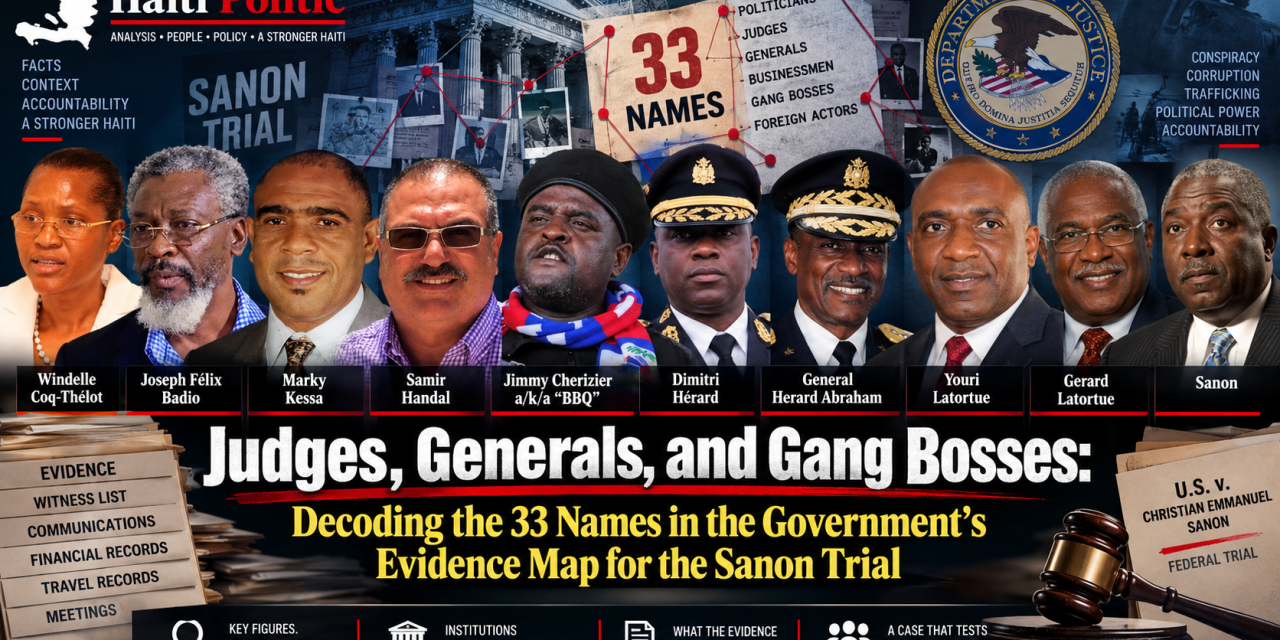
On August 20, 2026, federal prosecutors filed a 56-page exhibit list (ECF No. 1833) in United States v. Christian Sanon, Case No. 22-20104-CR-BECERRA, ahead of a trial scheduled to begin September 28, 2026, in the Southern District of Florida. The list is, in effect, an evidentiary map of everyone the government considers relevant to explaining how President Jovenel Moïse was assassinated on the night of July 6–7, 2021 — and it names dozens of people well beyond Sanon himself.
Before going further, an important legal clarification: appearing on this exhibit list does not mean a person is charged, or a defendant, in this case. Christian Sanon is the sole defendant in this particular indictment. Many of the names below appear because the government intends to introduce photographs for witness identification, records establishing (or disproving) their identity and affiliations, or documentation tied to guilty pleas they’ve already entered in separate case numbers. Some are victims of the plot’s aftermath; some are officials whose conduct is contextual rather than criminal; at least one is dead — or reportedly dead, which is itself part of the story. With that caveat established, here is what the exhibit list — cross-referenced against years of public reporting — reveals about each name.
The alleged inside coordinators
Joseph Félix Badio (Exhibits 34A–C): A former official at Haiti’s anti-corruption unit, dismissed from his post months before the assassination. His exhibit package includes a New York driver’s license record and, notably, his “Haitian Law Enforcement Termination Record” — official documentation of his firing. Badio has long been described by investigators as one of the plot’s central on-the-ground coordinators. He was extradited from Haiti to Florida on September 20, 2026, the same week this exhibit list became newly relevant.
Windelle Coq-Thélot (Exhibits 35A–B): A former judge of Haiti’s Supreme Court (Cour de Cassation), ousted from the bench in February 2021 after Moïse himself alleged a coup was being organized against him. Haitian police issued an arrest warrant for her within weeks of the assassination, after Colombian mercenaries and Haitian-American suspects told investigators they had met with her and signed documents at her home beforehand — details consistent with the long-standing theory that plotters intended to install her as a constitutional successor to Moïse. Her exhibit package includes her “Haitian Supreme Court Termination Record.” In a bizarre twist that has complicated her role in this case for years: her death was reported in January 2025, yet in June 2026 a Haitian investigating judge issued a fresh wanted notice and arrest warrant for her, and Moïse’s widow, Martine Moïse, has since formally demanded a forensic autopsy of the body attributed to her, citing suspicions about the circumstances of a death that came after more than three years spent as a fugitive in hiding.
The security failure at the center of the case
Dimitri Hérard (Exhibit 39, photo only): The head of the Presidential Palace’s security unit (USGPN) at the time of the assassination. Hérard was arrested and detained by Haitian authorities in the aftermath on suspicion of negligence or complicity — investigators have never fully explained how a squad of gunmen was able to reach and kill a sitting president inside his own residence without his security detail firing a shot to stop them.
Figures tied to the chaotic political aftermath
Gerard Latortue (Exhibit 44) and Youri Latortue (Exhibit 45), photos only: Gerard Latortue, Haiti’s interim prime minister from 2004–2006, and his nephew Youri Latortue, a longtime and controversial Haitian senator previously flagged in U.S. diplomatic cables over organized-crime allegations, both appear by photograph alone — consistent with their names surfacing in reporting about the scramble for power among Haitian political figures in the days immediately following the killing, rather than direct operational involvement in the murder itself.
General Herard Abraham (Exhibit 46, photo only): The former commander-in-chief of Haiti’s armed forces, remembered historically for peacefully ceding power during Haiti’s 1990 transition away from military rule. His inclusion, limited to a photo, is consistent with reports that his name was floated as a potential member of a transitional governing council proposed in the immediate, lawless aftermath of Moïse’s death.
The gang-world names
Jimmy Cherizier, a/k/a “BBQ” (Exhibit 41) and Vitel’Homme Innocent (Exhibit 42), photos only: Cherizier, a former police officer and now the country’s most prominent gang federation leader (head of the “Viv Ansanm” coalition), and Vitel’Homme Innocent, leader of the Kraze Barye gang and the subject of a standing FBI reward for his role in a separate 2021 kidnapping of American and Canadian missionaries, both appear with photo exhibits only — suggesting their relevance here concerns the broader security vacuum and armed-group landscape surrounding the case rather than direct operational roles in the assassination itself.
The property and logistics network
Samir Handal (Exhibits 56A–F): The Jordanian-Haitian businessman who rented the Pèlerin 5 property where Moïse was killed to Christian Sanon. His exhibit package is unusual in scope — a photo, Florida ID records, and four separate certified confirmations that he never held employment with the State Department, FBI, DOD, or DEA — signaling prosecutors are prepared to rebut any suggestion, from any source, that he held genuine federal credentials.
Marky Kessa (Exhibit 55A, photo only): The former mayor of Jacmel, named in connection with the case for years. Notably, when 18 suspects were extradited from Haiti to Florida on September 20, 2026, Kessa was reportedly not among them — he remains detained in Haiti, meaning his legal status continues to run on a separate, domestic track.
The cooperating witnesses
A handful of names on this list come attached not to “lack of employment” records but to certified plea agreements, factual proffers, and judgments — meaning these individuals have already pleaded guilty in related federal cases and are likely being called, or referenced, as cooperating witnesses:
- Jacob Israel (Exhibits 60A–B4): Alongside his Florida ID and a Florida corporate record tied to an entity called Charis Equity Partners LLC, his exhibits include a certified plea agreement and factual proffer from a separate case, No. 26-20053-CR-KMW — indicating a guilty plea entered earlier in 2026 in a related prosecution.
This pattern — a named individual with a corporate entity and a certified guilty plea from a different case number — mirrors how earlier, publicly reported defendants in this sprawling prosecution (such as Rodolphe Jaar, Mario Palacios, and John Joël Joseph) were first documented before their pleas became widely known.
The broader U.S.-based network — and the two exceptions worth noticing
The largest single bloc of names on this list — Jean Wesley Lucien, Roland Jean Pierre, Robert Balthazar, Willy Louis, Gordon Phenil Desir, Gashner Fevilien, Junior Alexis, Bony Gregoire, Dumel Joseph, Byron Rainer, Richard Weiner, Paul Richardson, Robert Jean Marie, David Alexis, and Parnell Duverger — share a strikingly consistent exhibit pattern: a photograph, a state driver’s license record (mostly Florida, some Maryland, Texas, and Virginia), and certified confirmations that they have no employment record with the State Department, FBI, DOD, or DEA. This is the same evidentiary structure applied to Samir Handal, and it points to a broader prosecutorial strategy: systematically foreclosing any claim — whether raised by defense counsel, a witness, or circulating rumor — that anyone in this extended network held genuine U.S. federal government credentials or authorization. Public reporting has not detailed the specific role of every name in this bloc, and this article does not claim more precision than the record supports; what the exhibit list does establish is that prosecutors treated each of them as significant enough to build individualized evidentiary packages disproving federal ties.
Two names break that pattern in a way worth flagging directly: Jean Wesley Lucien (Exhibit 48C) and Jimmy Glenn Thompson Jr. (Exhibit 65D) are each listed with a genuine, certified U.S. Department of Defense/War employment record — not a “lack of” record like everyone else in this bloc. That distinction suggests both men actually did have real U.S. military-related employment histories, setting them apart from others whose claims of federal affiliation the government intends to rebut. Robert Jean Marie’s exhibits additionally include certified T-Mobile toll and subscriber records for a specific phone number, indicating his communications — not just his identity — are part of the evidentiary record.
Francis Cineus Alexis, Reynaldo Corvington, Dominick Cauvin, Gilbert Dragon, Ezechiel Alexandre, and Ashkard Pierre appear in the exhibit list with photographs only and no further documentary exhibits, limiting what can be said about their specific roles from this filing alone; available public reporting on these individual figures is limited.
Why this matters
Taken together, the exhibit list tells a story the individual news cycles around this case have never fully connected: a plot that investigators have always described as sprawling — spanning Haitian security officials, a displaced Supreme Court judge, political figures jockeying for post-assassination power, a Miami-based private security training company, and a network of financiers and intermediaries whose claimed government ties prosecutors are working to systematically dismantle — is about to be laid out, name by name, document by document, in front of a Miami jury. Whether all 33 names end up mattering equally to the verdict against Christian Sanon specifically is a separate question from why the government considered each one necessary to the full picture it plans to present starting September 28.